5 Industries Relying on Fuel Generators
When the power grid fails or isn’t available, fuel generators become essential for many industries. These machines convert fuel like diesel, gasoline, or propane into electricity, ensuring operations continue without interruption. From life-saving equipment in hospitals to powering remote construction sites, generators fill critical power gaps. Here's a quick look at five sectors heavily dependent on fuel-powered generators:
- Healthcare: Keeps life-support systems, medical devices, and refrigeration for medicines running during outages.
- Construction: Supplies off-grid power for heavy machinery, lighting, and temporary site offices.
- Agriculture: Powers irrigation, grain dryers, and livestock systems, especially in remote or weather-affected areas.
- Food Industry: Maintains refrigeration, cooking, and payment systems in restaurants, supermarkets, and food trucks.
- Telecommunications: Ensures cell towers, data centers, and communication networks stay operational.
Fuel generators are indispensable for these industries, providing reliable power when the grid fails or isn’t accessible.
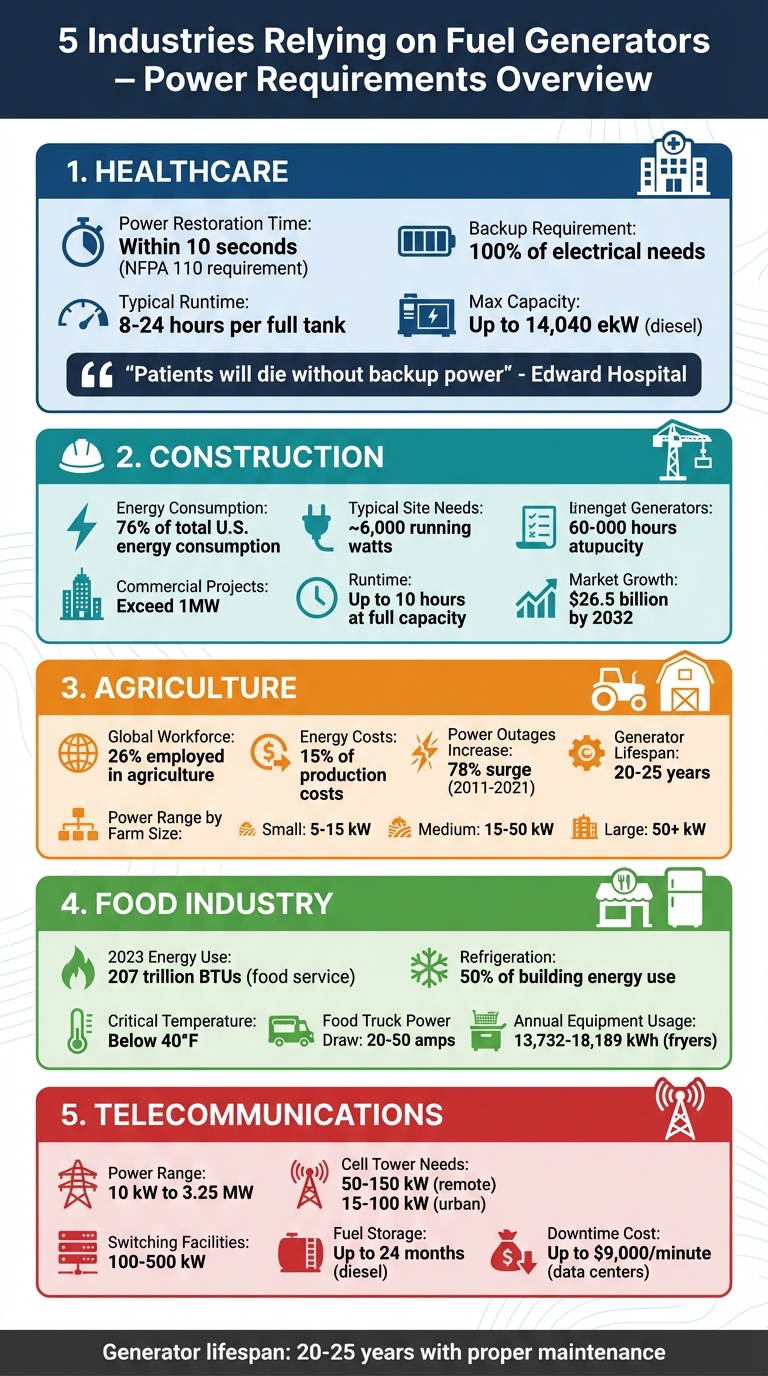
Power Requirements and Generator Capacities Across 5 Key Industries
Diesel Generators Explained
sbb-itb-501186b
1. Healthcare
In healthcare, where even a brief power loss can have life-threatening consequences, fuel generators play a critical role by delivering reliable, immediate power when it's needed most.
Power Reliability During Outages
Hospitals cannot afford delays during power outages. Automatic transfer switches (ATS) are designed to detect power loss and activate backup generators within seconds, ensuring compliance with regulations set by the NFPA and The Joint Commission. These standards, such as NFPA 110, require Level 1 systems to restore power to life-saving equipment within 10 seconds of an outage.
"Patients will die if we don't have the backup power available to them." - Patti Ludwig-Beymer, Vice President and Chief Nursing Officer, Edward Hospital
Edward Hospital & Health Services exemplifies this commitment to patient safety. Across its 28 locations, the facility supports over 1,000 physicians and a staff of 4,700 using a robust standby power system. This system includes Cat uninterruptible power supply (UPS) units and transfer switches, ensuring that critical medical systems remain operational during any power disruption.
Critical Equipment Dependency
Generators are essential for keeping vital medical equipment running at all times. Devices like ventilators, dialysis machines, cardiac monitors, operating room lighting, and anesthesia equipment rely on continuous electricity. Backup power also safeguards refrigeration systems that store temperature-sensitive medicines, vaccines, and blood supplies. To meet these demands, the National Electrical Code requires hospitals to have enough backup power to cover 100% of their electrical needs during outages. This level of reliability has made diesel systems the go-to choice for healthcare facilities.
Industry-Specific Energy Needs
Diesel generators are particularly well-suited for healthcare due to their ability to handle large electrical loads and start quickly, even in extreme conditions. Unlike gas systems, they don't rely on external utility pipelines, which can fail during natural disasters. Diesel units can support loads up to 14,040 ekW, whereas gas units typically max out at 9,700 ekW. Hospitals often store enough fuel to operate for 96 hours, though a full diesel tank generally powers facilities for 8–24 hours, depending on usage. This robust capacity makes diesel systems a reliable backbone for healthcare power needs.
2. Construction
Construction sites often operate in locations without access to the power grid, making fuel generators indispensable. Whether it's building highways through remote areas or constructing facilities in undeveloped regions, these generators provide the energy needed to keep operations running smoothly.
Support for Off-Grid Operations
Most construction projects are far from permanent electrical infrastructure. Roads, bridges, and large-scale developments often take shape miles away from the nearest power source. Generators eliminate the delays and expenses tied to setting up temporary utility connections - a process that can stall progress for weeks.
"Construction can take place anywhere, including places without reliable access to grid power." – GenTech USA
The construction sector accounts for about 76% of total energy consumption in the United States, with generators powering everything from heavy machinery to temporary site offices. A typical site requires around 6,000 running watts, while larger commercial projects often demand generators exceeding 1MW. Industrial-grade units can operate for up to 10 hours at full capacity on a single tank of fuel, making them a practical choice for day-long operations. This reliable off-grid power is critical, ensuring that machinery functions properly and site safety remains intact.
Critical Equipment Dependency
Beyond supporting off-grid operations, generators play a crucial role in keeping construction machinery and safety systems running without interruption. Cranes, excavators, concrete mixers, and welding equipment all rely on consistent power. Additionally, generators support essential safety measures, such as floodlights, surveillance cameras, and emergency warning systems. Poor lighting alone increases the risk of accidents by 20%, highlighting the importance of proper illumination.
"Industrial generators should be considered workplace safety equipment." – GenTech
When planning power requirements, it's important to account for surge wattage - the temporary spike in power demand when motors start, which can be up to three times the rated wattage of the equipment. Adding a 20% buffer to the total calculated load helps accommodate these surges and allows for future equipment needs. The global diesel generator market is expected to reach $26.5 billion by 2032, largely driven by demand from the construction industry.
3. Agriculture
Agriculture, much like healthcare and construction, encounters specific energy challenges that highlight the importance of fuel generators in ensuring uninterrupted operations. With agriculture employing an estimated 26% of the global workforce, modern farming has become increasingly reliant on electricity to maintain efficiency. In the U.S., energy expenses now make up about 15% of total agricultural production costs.
Power Reliability During Outages
Between 2011 and 2021, weather-related power outages surged by 78% compared to the prior decade, leaving farms particularly vulnerable. Standby generators equipped with automatic transfer switches (ATS) can restore power in seconds, safeguarding critical systems like ventilation, heating, and refrigeration that are essential for animal welfare and preserving produce. Power loss is more than just an inconvenience - it can disrupt time-sensitive tasks like milking, grain drying, and irrigation, especially during peak seasons.
Support for Off-Grid Operations
In remote areas, where grid access is either unavailable or too costly, generators are indispensable for powering wells, crop fields, and livestock pastures. As of 2004, U.S. farms consumed approximately 41 billion kilowatt-hours of electricity - a number that has likely grown with advances in automation.
Diesel generators are particularly suited to agricultural needs due to their efficiency and durability, often lasting 20 to 25 years with proper maintenance. Farmers can store diesel in bulk on-site, ensuring a steady fuel supply even during tough conditions. Diesel also has a longer shelf life and is safer to store than gasoline. For added flexibility, tractor PTO generators - portable units powered by a tractor’s engine - are available at prices ranging from $1,500 to $7,500, depending on capacity (8 kW to 50 kW). These units allow farmers to make the most of their existing machinery. This level of reliability mirrors the demands seen in other essential industries.
Critical Equipment Dependency
Farming equipment requires consistent and substantial power. For example, a 100 HP irrigation pump consumes roughly 75 kW, while a dairy farm typically needs around 200 kW to run milking systems, cooling tanks, and ventilation simultaneously. Grain dryers, on the other hand, may require up to 500 kW.
Here’s a breakdown of power needs based on farm size:
| Farm Type | Recommended Generator Capacity | Typical Equipment Powered |
|---|---|---|
| Small Farm | 5–15 kW | Lighting, small pumps, basic machinery |
| Medium Farm | 15–50 kW | Irrigation systems, grain dryers, moderate equipment |
| Large Farm | 50+ kW | Heavy machinery, large cooling systems, automated setups |
To choose the right generator size, farmers should calculate the total wattage of essential equipment and multiply by 1.4 to account for startup surges and potential future needs. This approach helps prevent costly disruptions. Additionally, smart generators equipped with remote monitoring and automatic load management can cut fuel costs by up to 15% and reduce unnecessary runtime by 30%.
These reliable energy solutions highlight how critical fuel generators are to the agricultural industry’s operations and productivity.
4. Food Industry
The food industry has specific power requirements that make fuel generators essential. In 2023, the U.S. food service sector used 207 trillion British thermal units (BTUs) of electricity, while grocery stores and supermarkets consumed 183 trillion BTUs. Any interruption in this power supply can lead to immediate financial losses and significant health risks.
Power Reliability During Outages
Maintaining proper temperatures is critical in food storage and preparation. For example, raw chicken must be kept at or below 40°F, as food stored above this temperature for more than two hours can become a health hazard. With commercial refrigerators and freezers accounting for up to 50% of a food service building's energy use, backup power is crucial to ensure compliance with FDA and USDA safety standards.
"A loss of power causes these temperatures to fall off-balance, leading to increased bacteria production, spoilage and wastage of hundreds if not thousands of dollars' worth of food." - Power Plus
Beyond refrigeration, generators are essential for keeping electronic systems like payment terminals, digital menu boards, and cloud-based inventory tools operational during outages. Inverter generators are particularly favored for their ability to deliver clean power with minimal harmonic distortion, protecting sensitive systems like POS devices and digital signage.
Support for Off-Grid Operations
Food trucks and mobile catering businesses rely entirely on generators when shore power isn’t available. These portable kitchens need electricity for high-demand appliances, ventilation systems, and payment terminals. Commercial cooking equipment alone can draw between 20 and 50 amps, with startup surges requiring 3–5 times the running wattage.
"Generator systems represent the lifeblood of these mobile kitchens, providing critical power when shore connections aren't available." - EcoFlow
Propane generators are a popular choice for mobile kitchens because they work well with existing cooking systems and produce fewer emissions compared to gasoline. Generators also power ventilation systems, which use 400–800 watts, to prevent dangerous carbon monoxide buildup from cooking appliances. This level of reliability allows multiple high-energy systems to run simultaneously without interruptions.
Critical Equipment Dependency
Food service operations rely on a variety of high-energy equipment. For example, electric deep-fat fryers consume 13,732 to 18,189 kilowatt-hours annually, while commercial dishwashers use 9,407 to 17,176 kWh per year. Walk-in freezers, convection ovens, and ice makers also require consistent power to maintain schedules and meet safety regulations.
To ensure smooth operation, it’s important to calculate total running wattage and add 30–50% for startup surges. Facilities that switch between grid and generator power should use automatic transfer switches to avoid dangerous back-feeding and ensure seamless transitions. Regular maintenance is also key to preventing vibration-related issues that could impact generator performance.
5. Telecommunications
Just like healthcare, construction, agriculture, and food industries, telecommunications depend heavily on reliable generator support. Fuel-powered generators are essential for keeping telecom cell towers, data centers, switching stations, and broadcast facilities operational. The power needs in this sector vary significantly - from smaller 10 kW units for individual cell towers to massive 3.25 MW systems for large-scale data centers. In remote or mountainous regions without access to the grid, generators often serve as the primary power source rather than just a backup option.
Power Reliability During Outages
Telecom networks rely on a layered backup system to handle power outages. First, battery power kicks in immediately, followed by an Automatic Transfer Switch (ATS) that activates the generator until utility power is restored. This smooth transition ensures critical equipment like diplexers, tower-mounted amplifiers, remote radio heads, and microwave dishes remain operational.
"Telecommunications networks are the backbone of modern communication, and maintaining uninterrupted service is critical." - Generac Industrial Power
Generators also support vital systems such as UPS units, rectifiers, and HVAC systems, which prevent overheating in data centers. Regular maintenance, including load testing, monthly test runs, and quarterly fuel quality checks, ensures generators are ready to meet power demands during outages.
Support for Off-Grid Operations
In remote areas, cell towers depend on diesel generators for independent power due to their ability to store fuel safely for up to 24 months, making them ideal for locations with infrequent fuel deliveries. In urban areas, natural gas generators are becoming a preferred choice thanks to their extended service intervals of up to 8,600 hours and their ability to operate in temperatures ranging from 14°F to 126°F.
Bi-fuel systems, which start on diesel and transition to natural gas under load, provide even longer runtimes. For facilities with high energy demands, paralleled generator systems can scale to handle loads as large as 100 MW. Additionally, modern generators often include remote monitoring capabilities, allowing operators to track key metrics and plan maintenance without needing on-site visits. This level of reliability ensures telecom operations continue seamlessly, even when grid power is unavailable.
Critical Equipment Dependency
Power needs vary depending on the type of telecom site. Remote cell towers typically require 50 kW to 150 kW to operate antennas and microwave dishes, while urban cell sites need 15 kW to 100 kW for rectifiers and smaller HVAC systems. Switching facilities demand higher power - between 100 kW and 500 kW - to support switching gear and cooling systems. In residential areas, sound-attenuated enclosures are often used to comply with local noise regulations.
To maintain generator performance over their 20–25-year lifespan, routine maintenance is key. This includes weekly inspections, monthly tests, and annual servicing. Redundant generator setups offer an added layer of protection - if one unit fails during an emergency, backup units ensure continuous service. This emphasis on reliable and redundant power highlights the critical role generators play in keeping telecommunications running smoothly, no matter the circumstances.
Conclusion
Fuel-powered generators play a critical role in industries like healthcare, construction, agriculture, food production, and telecommunications. These sectors rely on steady power to keep essential operations running during outages or in areas where the electrical grid is inaccessible. Whether it’s powering life-saving equipment in hospitals or ensuring cell towers remain functional in remote locations, generators fill the gap between power demands and availability.
The costs of power outages can be staggering - data centers alone can lose up to $9,000 per minute during downtime, while refrigeration-dependent businesses face significant risks to their operations. These figures highlight why backup power solutions are not just useful but necessary for businesses where interruptions could compromise safety, productivity, or profitability.
"A reliance on an external energy source can typically work well... In areas where supplied energy is unreliable, however, energy independence can be vital." – CSL Power Systems
The rise of hybrid systems that integrate diesel generators with renewable energy sources reflects a shift toward more sustainable and efficient power solutions. Modern generators now come equipped with remote monitoring features, enabling operators to oversee performance and manage maintenance tasks from a distance. With a lifespan of 20 to 25 years for diesel units, these generators are a long-term investment in reliability and operational stability.
From serving as a primary power source in remote settings to acting as a safety net for urban infrastructure, fuel-powered generators ensure that critical systems remain functional. They provide the energy independence needed to protect lives, safeguard assets, and maintain connectivity, even when the grid goes offline.
FAQs
How do I choose the right generator size for my industry?
To pick the right generator size, you’ll need to calculate the total electrical load your equipment requires to run at the same time. This can be measured in wattage or kVA. Think about the specific needs of your industry - whether it’s dependable backup power for healthcare facilities or rugged performance for construction sites. Make sure the generator can handle peak loads and leave room for future expansion. For added confidence, consult a specialist to ensure it aligns with your operational and safety standards.
Which fuel type is best for my application (diesel, gasoline, propane, or natural gas)?
When choosing the best fuel type, it all comes down to your specific needs and surroundings. Diesel stands out for heavy-duty tasks, off-grid setups, or continuous use because it’s dependable and fuel-efficient. Gasoline works well for smaller, portable uses, such as powering equipment at outdoor events. If you’re after cleaner and quieter energy, propane and natural gas are excellent choices, often preferred for homes or facilities with existing connections. Be sure to weigh factors like your power requirements, fuel availability, and overall cost before making a decision.
How much fuel should I store to stay powered during long outages?
To get ready for extended power outages, make sure you have enough fuel to keep your generator running for at least 8 hours. Depending on how your facility operates, you might want to store larger amounts to meet your needs. Be sure to handle and store fuel properly to ensure both safety and the quality of the fuel.