Fire-Resistant Enclosures: 7 Design Factors
If you mix up a fire rating with a NEMA rating, you can spec the wrong enclosure. I’d keep one point front and center: a NEMA 4X mark tells me about water and corrosion resistance, not how the enclosure holds up in a fire.
Here’s the short version: when I review a fire-resistant enclosure, I look at 7 things that can make or break the assembly during a fire:
- Material choice: steel, stainless steel, aluminum, or polymer all behave differently under heat
- Heat limits: electronics often top out around 104°F to 140°F
- Cable entries: penetrations need listed firestopping
- Door seals and windows: weak gaps can fail before the main shell
- Compartmentation: internal barriers can keep a fault from spreading
- Airflow and pressure relief: vents must control heat without becoming fire paths
- Code and listing alignment: the full assembly has to match the tested rating basis
A few numbers stand out. The article notes that aluminum loses much of its strength around 392°F and melts near 1,220°F. It also notes that fires that spread beyond the room of origin account for 21% of fires but 58% of civilian deaths. That’s why small details like seals, penetrations, and vents matter so much.
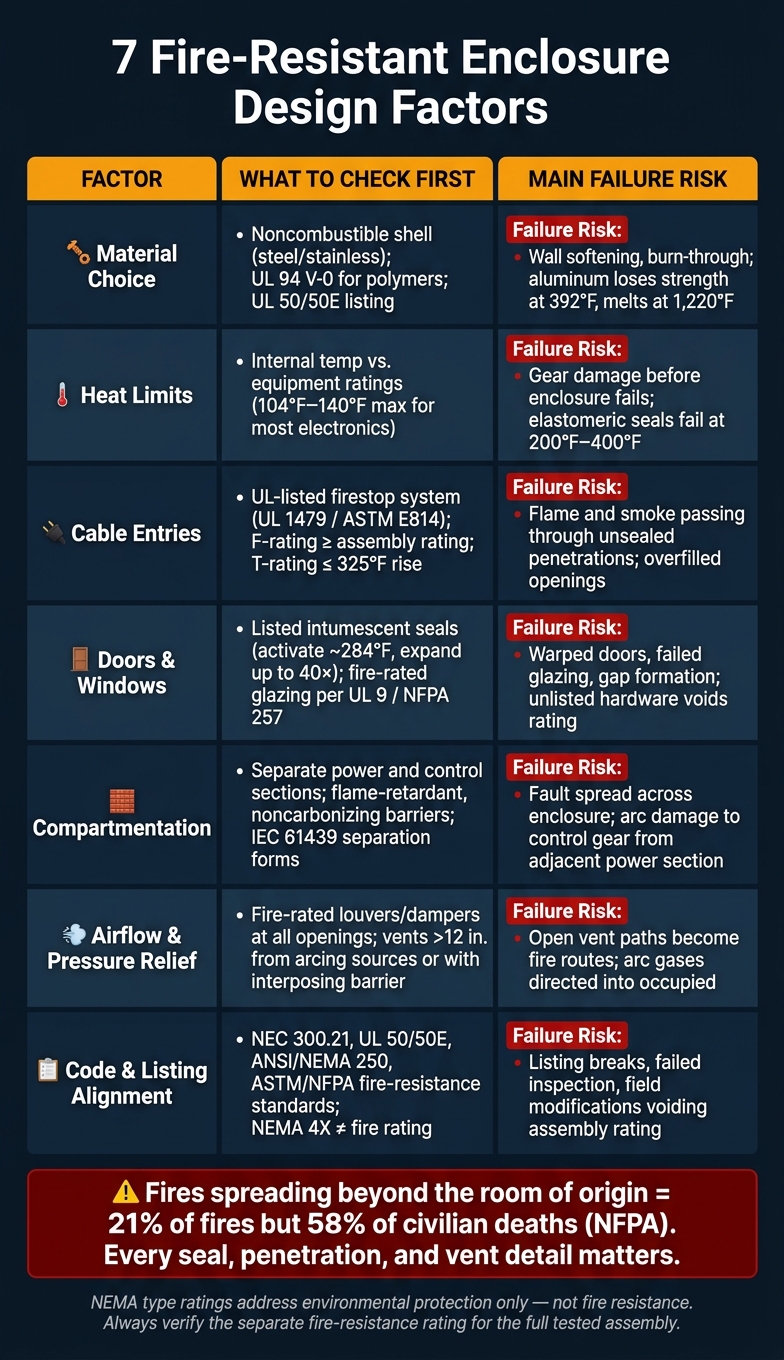
7 Fire-Resistant Enclosure Design Factors: Key Checks & Failure Risks
Quick Comparison
| Factor | What I check first | Main failure risk |
|---|---|---|
| Material | Noncombustible shell, listed construction | Wall softening, burn-through, loss of strength |
| Heat limits | Internal temp vs. equipment ratings | Gear damage before the enclosure fails |
| Cable entries | UL-listed firestop system, fill limits | Flame and smoke passing through openings |
| Doors/windows | Listed seals, glazing, hardware | Gaps, warped doors, failed glazing |
| Compartmentation | Separation of power and control sections | Fault spread across the enclosure |
| Airflow/relief | Fire-rated vents, dampers, gas routing | Open vent paths, blown seals, unsafe exhaust |
| Code fit | NEC, UL, NEMA, ASTM/NFPA path | Listing breaks, failed inspection, bad substitutions |
My takeaway is simple: a fire-resistant enclosure is not just a box with thick metal. It’s a tested assembly where the shell, openings, seals, barriers, and accessories all have to work together and stay within the listing.
sbb-itb-501186b
Why Enclosure Design Matters During a Fire
Electrical faults inside an enclosure - like arc faults, overloaded connections, and worn insulation - can create intense heat, arc pressure, and molten metal. That mix can punch through panels, seams, or weak spots. A fire outside the enclosure can be just as dangerous. Heat and hot gases from a building fire can wear down both the enclosure and the gear inside it. In either case, the assembly can fail and let the fire spread past the point where it started.
Arcing faults add another risk. They can ignite cables in nearby trays and damage components in the surrounding lineup. That’s why enclosure material, sealing, and ventilation aren’t small details. They shape how well the enclosure holds up when things go wrong.
Fire-resistant enclosures need to handle two jobs at once: keep flames, smoke, and hot gases contained inside the enclosure, and keep the equipment running long enough for a safe shutdown.
If the enclosure fails, the damage doesn’t stop at the fire itself. Smoke and soot can leave corrosive residue on breaker contacts and relay parts. Heat-damaged protective devices may also clear faults too slowly, which can increase incident energy and equipment damage.
Those fire paths set up the seven design factors below, starting with material choice.
1. Material Choice
The enclosure shell is your first line of defense. The material affects how well the enclosure holds back fire, how much heat it can take, and how long the gear inside stays protected.
Fire Spread Containment
Steel and stainless steel are noncombustible. That means they don't add fuel to a fire, and they help keep an internal ignition event contained. Metal walls can also slow heat moving in from an outside fire.
Polymeric enclosures can still be used, but only when they're made and listed for that job. Check for flammability ratings like UL 94 V-0, which means the material self-extinguishes within 10 seconds and does not drip flaming particles. For electrical enclosures, make sure the product is listed under UL 50/50E and, when it applies, UL 508A.
Equipment Survival Under Heat
Temperature limits matter more than many buyers expect. Stainless steel holds its strength longer than aluminum during fire exposure, so it's a better fit when the enclosure itself needs to serve as a fire barrier. That extra strength can delay enclosure failure.
Aluminum behaves differently. It starts to lose a lot of strength at around 200°C (392°F) and melts at about 660°C (1,220°F). Aluminum enclosures can still work well in many settings, but if the enclosure must serve as the main fire barrier, aluminum usually isn't the first pick.
Barrier Integrity at Openings
The wall material also affects how well firestopping performs at cable entries, doors, and access panels. Metallic walls give firestop systems a stable, noncombustible surface to bond to and expand against during a fire. Polymeric walls may soften or deform under heat, and that can weaken the seal.
So the shell is only one part of the fire barrier. The next weak spot is often the cable entry.
U.S. Code and Listing Alignment
Use a UL-listed enclosure, and check that the data sheet shows the material grade, gauge, and the test standard that applies.
Even a strong shell can fall short if the cable entries aren't sealed well. The next factor looks at that.
2. Temperature and Heat Limits
Heat limits decide whether an enclosure can hold back fire long enough for a safe shutdown. After shell material, the next issue is simple: how long can the enclosure protect the equipment before heat pushes it past failure?
Fire Spread Containment
Keep conductor and component temperatures within their listed limits to lower the risk of insulation breakdown and arcing. Less internal heat means less stress on insulation, and that makes sustained arcing less likely.
Equipment Survival Under Heat
Most PLCs, protective relays, and control electronics are rated for continuous operation at 104°F to 140°F (40°C to 60°C). Go past that range, and the chance of permanent damage goes up, even if the enclosure itself is still standing.
That’s why it helps to compare the enclosure’s expected internal temperature profile under both normal load and fire conditions against the equipment ratings. If the numbers get too close for comfort, add thermal barriers or compartmentation where needed. A box can stay intact and still cook what’s inside.
Barrier Integrity at Openings
Openings usually fail before solid walls. Heat builds up at seals and penetrations, and that weak spot can turn into the first point of failure.
Heat can weaken seals and firestops at every opening. Many elastomeric gaskets and door seals can soften or break down at about 200°F to 400°F (93°C to 204°C), so fire-resistant enclosures often use higher-temperature materials or intumescent seals.
At cable entry points, intumescent firestop materials are made to expand when exposed to heat. That expansion helps close gaps as cable jackets soften or burn away. The key number here is the T-rating. It measures how long a firestop system keeps the temperature rise on the unexposed side below 325°F (163°C) above ambient.
If a seal is picked without checking its T-rating against the enclosure’s fire-resistance requirement, that opening can become the weak link, even when the rest of the enclosure is solid.
U.S. Code and Listing Fit
UL listings for enclosures may include maximum ambient temperature ratings and, when needed, fire-resistance or flammability classifications. UL 508A and UL 891 address temperature-rise limits for industrial control panels and switchboards at given load levels.
For plan review and inspection, document these items in drawings, schedules, and UL field evaluation reports:
- Ambient temperature
- Maximum internal temperature
- Conductor insulation class
- Required fire-resistance rating
That gives AHJs a clear way to verify compliance.
Even with the right temperature limits, unsealed cable entries can still defeat the enclosure.
3. Cable Entry Points and Firestopping
Once heat starts to weaken seals, cable entries usually become the next place things go wrong. In many cases, they’re the first weak spot in a fire event. Any unsealed penetration can let flame, smoke, and hot gases move through the barrier. So cable routing and sealing aren’t side issues. They’re part of the fire barrier itself.
Fire Spread Containment and Barrier Integrity
NEC Section 300.21 requires firestopping at penetrations through fire-resistance-rated assemblies so the assembly keeps its rating. In plain terms, if a cable passes through a rated wall or floor, that opening has to be sealed with a firestop method that matches the assembly.
Cable routing should keep penetrations to a minimum and place them where listed firestop methods can be installed and checked. Fewer penetrations, placed in the right spots, help with fire containment and make later service work easier.
At cable entries, firestopping usually means using a UL-listed through-penetration system tested to ASTM E814 or UL 1479, with an F-rating that is not less than the assembly rating and, where needed, a T-rating. These systems often use mineral wool packed to the required depth along with intumescent sealant or putty. They also come with cable fill limits. That part matters. If an opening is overfilled, system performance can drop.
If more cables need to be added later, the safer move is to install a new penetration and firestop it the right way instead of stuffing more cables into an existing opening.
U.S. Code and Listing Fit
Picking the right UL system means matching it to the assembly type, rating, penetrant, opening size, and annular space. If even one of those pieces is off, the installed system may not match the listing.
Specification language should call out the exact UL system number and confirm compliance with UL 1479 or ASTM E814. That gives the AHJ a clear path from the drawing set to the installed product. It also helps stop a common field problem: crews swapping in unlisted caulk or foam that isn’t listed for that use.
4. Door Seals, Windows, and Opening Protectives
After cable entries, doors and glazing are the next common places where fire gets through. In many fire-rated enclosures, these openings are the weak spots. Small gaps, unlisted hardware, and worn or failed seals can let flames and smoke get past the cabinet body. Opening protectives carry a fire-protection rating, while the wall, floor, or ceiling around them carries a fire-resistance rating.
Fire Spread Containment and Barrier Integrity at Openings
During a fire, the door can warp, hinges can deform, and seals can compress unevenly. That can create leak paths earlier than expected. The main line of defense is the intumescent door seal. Some intumescent seals activate at about 284°F (140°C) and expand up to 40 times, closing the gap around the door perimeter.
Smoke gaskets and intumescent seals do different jobs. Smoke gaskets help limit leakage at lower temperatures. As heat builds, intumescent seals expand and take over. In some assemblies, both are required.
That same weak point shows up in viewing windows too. If the window fails, the opening can lose integrity even if the rest of the enclosure still looks sound.
Windows and Viewing Panels
A viewing window helps technicians check equipment without opening the enclosure, which is useful. But glazing can soften, crack, or lose its seal faster than the door panel itself. That’s why fire-rated glazing has to be tested as part of the full assembly, including the frame, seal, and attachment method. It can’t be judged as a standalone product.
In U.S. applications, fire windows are usually tested to UL 9 or NFPA 257, while fire-resistance-rated glazing used in vision lites and sidelites is tested to ASTM E119 or UL 263. If the glazing does not match the tested assembly, the listing is broken and the rating can end early.
Equipment Survival and U.S. Code Fit
When an opening loses integrity, heat builds faster inside the enclosure and smoke gets in sooner. That can damage drives, relays, and PLCs before direct flame ever touches them. A well-sealed door slows heat and smoke long enough to help protect controls during shutdown.
Under NFPA 80, fire doors and their hardware must be installed and maintained exactly as tested and listed. That applies to the full setup:
- Door
- Frame
- Seals
- Glazing
- Latches
If you swap in an aftermarket latch or replace glazing with an unlisted product, you can void the assembly’s rating, even if the change seems small. Check the label, listing, and installation instructions before replacing any part.
Once the opening protectives are controlled, the next question is how the interior is divided.
5. Internal Panel Layout and Compartmentation
A sealed door helps, but it doesn't solve the whole problem. If the inside of the panel is laid out poorly, heat and flame can still move from one section to another. Internal separation decides whether a fault stays put in one bay or runs through the lineup. That's why layout is the next layer of containment after doors and seals.
Fire Spread Containment
Fire inside a panel can move through the cabinet structure, cable paths, and open shared spaces. One of the best ways to slow that down is to separate busbars, functional units, and terminals into sealed metal compartments with isolation barriers. That kind of split limits how far a fault can travel.
IEC 61439 forms of internal separation are meant to restrict the movement of flame, heat, and hot gases. Higher separation forms do a better job of containing the event. Put simply, when faulted power sections are kept apart from control sections, a small incident is less likely to become a panel-wide failure.
Equipment Survival Under Heat
Form 4 compartmentation is often used when control gear needs a better chance of surviving a fault below it. In this setup, control terminals and instrumentation are placed in upper compartments and kept physically separate from high-current conductors below. If an arc starts in a lower power compartment, the control section above is far more likely to remain intact.
Arc-resistant switchgear follows the same basic idea. Isolated compartments help protect nearby sections from arcing effects and send incident energy toward planned relief paths instead of pushing it out through doors.
Barriers matter too. They need to be flame-retardant and noncarbonizing. If a barrier ignites or creates conductive carbon tracks under heat, it can open up new fault paths.
U.S. Code and Listing Fit
Internal barriers can't ignore enclosure rules. UL 508/508A and UL 50 set construction limits those barriers have to follow. The NEC also requires layouts that do not increase fire spread or combustion.
A few layout mistakes show up again and again:
- Putting PLCs, relays, and terminals right next to high-current conductors
- Leaving shared cable compartments open, with no partitions
When controls and power share the same space, a local fault can take down the whole system.
Internal layout also shapes airflow and pressure relief, which leads directly to the next design factor.
6. Airflow Control, Vents, and Pressure Relief
Vents, fans, and relief ports can help manage heat. But if they aren't protected, they can also become direct paths for fire, heat, and smoke. That's the catch: a panel may be well divided inside, yet still fail if its openings let hot gases move straight through.
Fire Spread Containment
Use listed fire-rated louvers, intumescent closures, or dampers at each airflow opening that crosses a fire-rated barrier. If ducts or transfer openings pass through a rated barrier, listed firestopping and dampers are required to keep that rating in place.
Heat control matters too. But it only helps if the barrier still does its job.
Equipment Survival Under Heat
The aim is controlled airflow, not the most ventilation possible. Under normal operation, airflow can manage equipment temperature. During a fire, that same path should close automatically or shut off through thermal response.
UL 508A also calls out vent location near arcing sources. If ventilation openings are within 12 inches of a potential arcing source, an interposing barrier is required to limit the spread of arc products.
A vent in the wrong spot can turn a small internal event into a much bigger one.
Barrier Integrity at Openings
Pressure relief creates another fire-risk path. Arc faults and internal fires can produce enough expanding gas to deform panels, blow out seals, or damage hardware. Arc-resistant switchgear tested to IEEE C37.20.7 uses engineered pressure-relief channels and exhaust plenums to direct gases and burning particles away from operators. Route arc gases away from occupied spaces, not into them.
That sounds simple, but it matters a lot in practice. A relief path has to send heat and debris somewhere safe, not into a hallway, work area, or control room.
Those relief paths only work when they match the enclosure's listing and installation limits.
U.S. Code and Listing Fit
Follow NEC ventilation rules, and keep openings within the enclosure's UL and NEMA listing limits.
Field-cut vents can void the listing and reduce fire containment.
The last design check is simple: make sure the enclosure matches the exact code and rating basis.
7. Code, Standard, and Rating Alignment
After material, sealing, compartmentation, and airflow, the last check is simple but easy to miss: is the enclosure matched to the right fire standard? A box can be well made and still fail inspection if the spec missed the code path from day one.
In the U.S., that usually means checking NEC (NFPA 70), UL 50/50E, ANSI/NEMA 250, and the ASTM and NFPA fire-resistance standards that apply to the job. That alignment affects three things fast: fire containment, heat survival, and what installers can do in the field without breaking the listing.
Fire Spread Containment
The NEC sets the base rules for rooms and vaults that hold electrical equipment, often calling for 1- to 3-hour fire-rated construction. That rating can fall apart at the first cable or conduit opening if the penetration is handled the wrong way.
NEC Section 300.21 says openings through fire-rated barriers must be sealed with approved methods so they do not turn into routes for fire or smoke. In practice, that usually means using firestop systems tested and listed to ASTM E814 or UL 1479.
Equipment Survival Under Heat
Heat performance matters too, especially with nonmetallic parts. For polymer housings, specify UL 94 V-0 or 5VA where those materials are allowed.
That doesn't mean the whole enclosure suddenly becomes fire-rated. It means the plastic parts meet a known flammability test level, which is an important distinction when you're reviewing submittals.
Barrier Integrity at Openings
Openings are often the first place where fire resistance starts to fail. Unused openings should be closed with materials that match the enclosure wall, and any field change has to stay within what the enclosure's UL listing and NEMA type rating allow.
That includes the kind of small change people sometimes treat as harmless, like adding a knockout, swapping a closure piece, or changing a gland location. If the listing doesn't allow it, the rating path can come apart fast.
U.S. Code and Listing Fit
A common mistake is treating a NEMA or UL type rating like a fire-resistance rating. They're not the same thing.
ANSI/NEMA 250 does not address thermal damage or gas vapor ignition. So yes, a NEMA 4X enclosure may be the right pick for wet or corrosive service, but that does not tell you how it performs in a fire. Fire resistance comes from tested assemblies, not from the environmental type mark.
A good way to think about it: NEMA tells you what the environment may do to the enclosure. Fire testing tells you what the enclosure may do during a fire event. Both matter, but they answer different questions.
So the process is straightforward:
- Pick a UL-listed, NEMA-rated enclosure that fits the site conditions
- Then verify the separate fire-resistance rating
- Make sure material, seals, penetrations, vents, and internal layout all stay within the tested UL assembly and rating basis
When several products meet the same rating basis, comparison tables can make the choice easier by checking the listing, material, and temperature limits side by side.
Where Comparison Tables Help
Once you've narrowed down the main design factors, tables make it much easier to compare the shortlist fast. Instead of scanning blocks of text, you can spot tradeoffs at a glance.
Three compact tables tend to do the job best:
- For cable entries, compare sealing methods by rating range, re-entry ease, maintenance burden, and common failure modes.
- For door seals, compare gasket types by smoke control, fire rating, compression set, and heat tolerance.
- For internal layout, compare open and segregated layouts by fault containment, heat dissipation, and maintenance access.
Keep the tables tight. Use simple rating scales, and add a short "Best for…" column so decisions come faster. For U.S. projects, show temperatures in °F and dimensions in inches.
Use these tables during submittal review and specification comparison.
Common U.S. Compliance and Specification Mistakes
Most spec mistakes happen when people treat unrelated listings as if they mean the same thing. They don’t.
A NEMA type rating deals with the enclosure’s environmental protection. It does not tell you anything about fire resistance. So a NEMA 4X enclosure may be fine for wet or corrosive areas and still have no fire-resistance rating at all.
The same kind of mix-up shows up at penetrations. One common miss is leaving the annular space unsealed. Another is using materials that aren’t listed for that exact assembly. The fix is simple on paper, but it has to be exact in the field: specify a listed through-penetration firestop system tested to UL 1479 or ASTM E814 and matched to the assembly rating.
Door openings are another weak spot. The door, latch, hinge, and gasket need to match a tested, listed configuration. If one piece falls outside that setup, the whole assembly can be at risk.
Enclosure fire performance also needs to line up with the room’s rated construction. That means coordinating enclosure openings and firestops with the room’s rated separations, so one part of the build doesn’t undercut the other.
The last trap is thinking accessories don’t matter. They do. Adding vents, windows, or glands outside the tested configuration can void the fire rating. Treat every added vent, window, or gland as part of the tested assembly, not as a separate add-on.
Conclusion
A fire-resistant enclosure is only as strong as its weakest detail. The material matters. So do heat limits, penetrations, seals, layout, airflow, and code fit. If any one of those pieces falls short, the enclosure may fail to contain a fire or protect the equipment inside.
In the field, none of these factors work on their own. The full assembly has to perform as one system. NFPA research puts that in stark terms: fires that spread beyond the room where they start but stay inside the building make up 21% of fires yet 58% of civilian deaths. That’s a strong reminder that compartmentation and barrier integrity are not optional.
Code and listing alignment holds the whole thing together. NFPA 70, UL listings, and the right NEMA ratings need to match the installation from day one, not be patched together later.
When you review enclosure performance during a fault, arc-flash event, or fire in an adjacent room, look at the full assembly - not just the individual parts. Use the seven factors as a checklist so enclosure design stays repeatable and defensible.
FAQs
How do I verify a fire rating?
Verify the fire rating by making sure the entire assembly matches the manufacturer’s UL listing. That means the enclosures, raceways, supports, and fittings all need to line up with the listed system. Single parts, by themselves, aren’t enough. The rating applies to the complete setup.
Also confirm that fire-rated cables meet UL 2196. Check that penetrations were tested to ASTM E814 (UL 1479), and make sure your installation matches the manufacturer’s UL FHIT documentation. For code compliance, confirm details with your local AHJ.
Can I modify a rated enclosure in the field?
Generally, no. Field changes can void an enclosure’s certification and fire-resistance rating. Even small edits to conduit entries, seals, or panel layout can weaken the system and move it away from the way it was tested.
If a change has to be made, the work needs to follow the enclosure’s original listed installation method, meet local code rules, and have written engineering approval, along with review by the local Authority Having Jurisdiction.
When is aluminum a poor enclosure choice?
Aluminum isn't a good fit for high-heat settings. It starts to lose structural strength at 200°C (392°F) and melts at about 660°C (1,220°F).
That limit matters. If a project needs strong fire resistance or has to handle very high temperatures, aluminum usually isn't the right pick. In those cases, stainless steel or other specialized non-combustible housings are usually preferred.