Expansion-Deflection Fittings: Selection Guide
Pick the fitting by movement, not by name. If your conduit run can move straight, sideways, or at an angle, I’d check the fitting’s listed axial, lateral, and angular ratings before anything else.
Here’s the short version:
- Standard couplings do not allow movement
- Expansion-only fittings handle straight-line movement
- Expansion-deflection fittings handle axial, angular, and lateral movement
- NEC 300.7(B) requires the right fitting where thermal growth, contraction, or structure movement can stress the raceway
-
PVC moves much more than steel
- A 100 ft PVC run over a 100°F swing can move about 3.6 in.
- A 100 ft steel run over that same swing moves about 0.78 in.
- For PVC, an expansion fitting is required when expected movement between fixed points reaches 0.25 in. or more
- I’d also verify:
- listed conduit type and trade size
- bonding path
- wet-location rating
- temperature limits
- support layout, fixed points, and fitting orientation
If you’re buying for a joint, bridge, rooftop run, or long outdoor raceway, the main check is simple: match the fitting’s listed movement capacity to the run’s actual movement and site conditions.
| Item | What I’d confirm |
|---|---|
| Raceway match | RMC, IMC, EMT, or PVC listing |
| Movement type | Axial only, or axial + angular + lateral |
| Movement amount | Calculated thermal movement and joint movement |
| Location | Indoor, outdoor, washdown, coastal, rooftop |
| Material | Coated steel, galvanized, aluminum, or 316 stainless steel |
| Installation | Fixed support, sliding side, spacing, neutral position |
That’s the core of the article: calculate movement, match the listing, and make sure the conduit has room to move without shifting stress into boxes, supports, or conductors.
Thomas & Betts Non Metallic Expansion Deflection Coupling
sbb-itb-501186b
Step-by-Step Selection Factors
Expansion vs. Deflection Fittings: Movement Ratings & Material Guide
With the fitting type sorted out, the next job is matching the listed movement capacity to the actual conduit run.
Match the Fitting to Raceway Type and Conduit Size
Start with the raceway material and trade size. Most expansion-deflection fittings are listed for one material type - like RMC, IMC, EMT, or rigid PVC - and one trade size in inches. So a fitting listed for 2 in. RMC is not automatically okay for 2 in. PVC, even if the parts seem to fit together.
PVC moves a lot more than steel, so the fitting needs to be sized for the section with more movement. If a run mixes PVC and metal - for example, PVC above grade that transitions to RMC underground - base the selection on the section that moves more. On mixed runs, use PVC-rated fittings on the plastic section and listed transition couplings where the materials meet. One fitting does not automatically cover both.
After that, turn the material choice and run length into a movement number you can use.
Calculate Axial, Angular, and Lateral Movement
Once you know the raceway type, estimate the movement you should expect. The standard formula for thermal expansion is:
ΔL = α × L × ΔT
Where α is the expansion coefficient, L is run length in inches, and ΔT is the temperature change in °F.
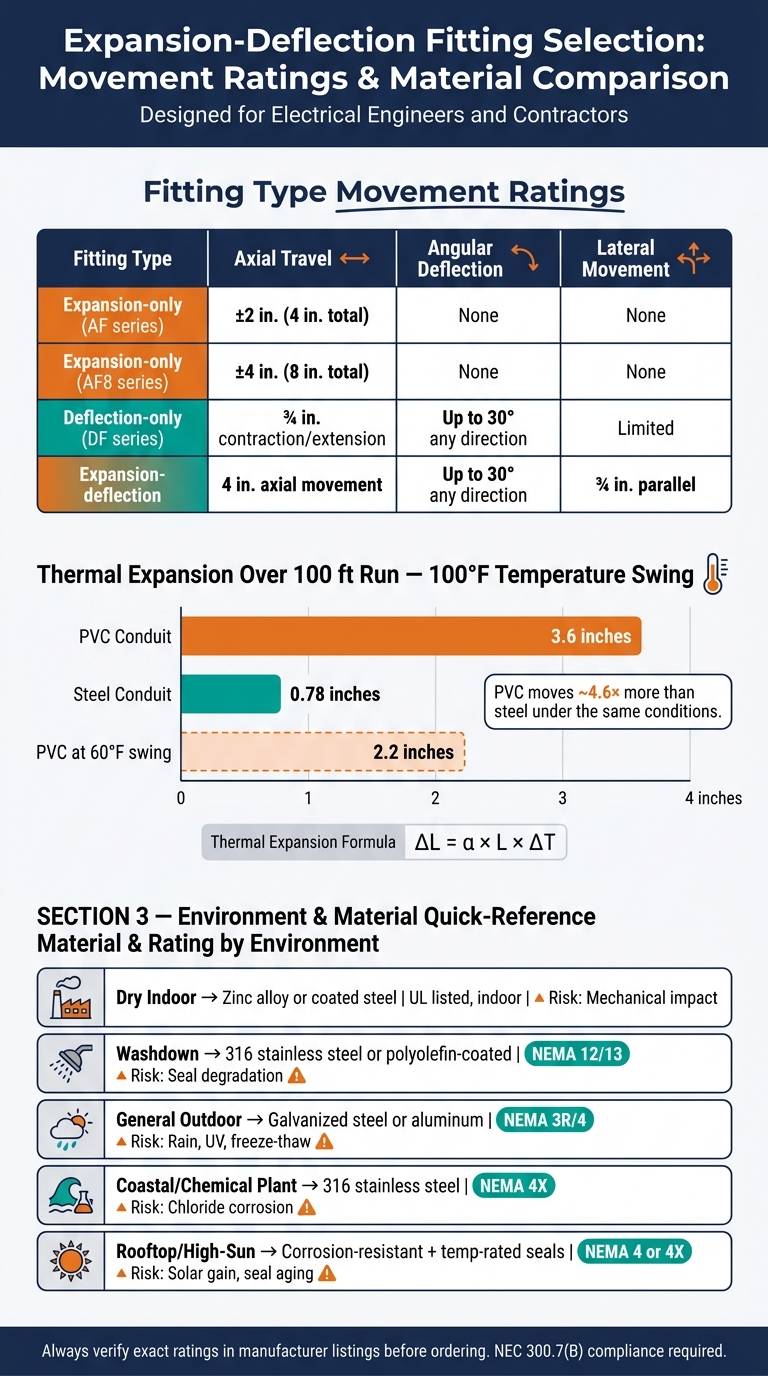
Here’s what that looks like in practice: a 100 ft run of rigid PVC conduit exposed to a 100°F temperature swing will expand or contract by about 3.6 in. A 100 ft run of steel conduit under that same swing changes by only about 0.78 in. Even with a milder swing - say, 60°F - that PVC run still moves about 2.2 in., which is enough to put stress on conductors, supports, and fittings.
For angular and lateral movement, pull that information from the structural drawings at joints, bridges, and equipment pads.
Then compare the required movement to the fitting ratings - not the product name. This is where people get tripped up. A label can sound right, but the listed movement range is what matters.
| Fitting Type | Axial Travel | Angular Deflection | Lateral Movement |
|---|---|---|---|
| Expansion-only (AF series) | ±2 in. (4 in. total) | None | None |
| Expansion-only (AF8 series) | ±4 in. (8 in. total) | None | None |
| Deflection-only (DF series) | ¾ in. contraction/extension | Up to 30° in any direction | Limited |
| Expansion-deflection | 4 in. axial movement | Up to 30° in any direction | ¾ in. parallel movement |
Always confirm the exact rating in the manufacturer’s listing. If your design needs 1¼ in. of axial movement and 10° of angular deflection on a 2 in. PVC run, pick a fitting rated for at least 2 in. of axial travel and 15° of angular deflection so you have some margin.
Verify Listings, Markings, and Ratings
Before you order anything, check the product label and spec sheet line by line. A fitting marked expansion-only will not handle angular or lateral movement. If you use one at a structural joint where both types of movement are expected, the install won’t be code-compliant. The label or spec sheet should clearly say whether the unit is expansion-only, deflection-only, or expansion-deflection.
Focus on these four specs in the listing:
- Movement range: Axial travel, angular deflection, and lateral offset for that trade size.
- Bonding path: Whether the fitting keeps an internal grounding path or needs external bonding jumpers.
- Wet-location rating: NEMA Type 3, 3R, 4, or 4X for outdoor, wet, or underground use.
- Temperature and environment rating: Marked use conditions that show where the fitting is approved, often up to 302°F (150°C) under UL 514B.
Use listing filters to sort these specs fast. On Electrical Trader, you can compare them side by side before narrowing the fit.
Use Cases, Mounting Points, and Support Layout
Placement matters just as much as fitting type. The raceway needs room to move, and the supports need to let that happen. Use the movement total from the previous section to decide where the fitting goes and how far apart to place supports.
Building Joints, Bridges, and Long Outdoor Runs
For structural expansion joints, place the fitting close to the joint, usually within 12–24 in. on a straight run. Size the fitting for the full structural and thermal movement, with some margin.
Bridge and parking structure crossings bring vibration into the mix along with structural movement. In those spots, heavy-duty fittings are usually the better pick. Go with corrosion-resistant materials like galvanized or stainless steel and, when called for, elastomer parts rated for UV exposure and de-icing chemicals. Support spacing is often tightened to about 5–8 ft so the raceway doesn't sag and the fitting doesn't end up acting like a flex point.
For long rooftop or outdoor runs, place the fitting at structural breaks, roof steps, or between buildings.
Fixed Points, Free-Moving Sections, and Fitting Orientation
Every run needs at least one fixed point. That's the rigid anchor at a column, wall penetration, or equipment termination where the raceway can't move axially. Put the fitting between that fixed anchor and a section that can slide. If both sides are locked down, the fitting can't move, and the stress shifts into couplings or equipment enclosures.
On the moving side, use supports that allow travel, such as:
- Slotted hangers
- Sliding clamps
- Roller supports
Place fixed supports within 2–4 ft of the fitting body on the anchor side.
Orientation details matter more than many buyers think. A lot of fittings have a marked fixed end and a moving end. Some also need a minimum straight length on each side before a bend. Check that the fitting is set at its neutral position and follow the manufacturer's orientation marks. It's a lot easier to review the installation sheet before ordering than after the material shows up on site.
Application-to-Fitting Comparison Table
| Application | Fitting Type | Movement to Plan For | Mounting Notes | Support Considerations |
|---|---|---|---|---|
| Building expansion joint | Expansion-deflection | ±1–2 in. axial plus some angular movement | Within 12–24 in. of the joint | Fixed support within 2–4 ft on anchor side; sliding supports on free side |
| Bridge or parking structure | Heavy-duty expansion-deflection | Axial movement plus up to 30° angular misalignment | Place on the bridge side of the abutment or in the expansion joint region | Hanger spacing about 5–8 ft; avoid rigid supports directly on the fitting body |
| Long rooftop run | Expansion-deflection | Multiple inches of thermal movement over long straight segments | At roof breaks or where the run crosses between buildings | Slotted or roller supports on the free side; rigid anchors at fixed points |
| Long outdoor metallic run | Expansion-deflection | Smaller than PVC, but still must be calculated over long runs | Fix one end and let the run float toward the fitting | Oversized clamps or sleeves allow the raceway to slide through supports |
After placement is set, match the listing to the indoor, outdoor, or corrosive environment.
Indoor, Outdoor, and Corrosive Environment Requirements
After placement is set, the next step is matching the fitting's material, seals, and bonding parts to the actual site. That part matters more than it might seem. If corrosion makes the fitting stiff, it may stop deflecting the way it was meant to.
Indoor Industrial Conditions
Once the location is fixed, material choice decides whether the fitting keeps moving or locks up over time.
In dry industrial spaces, zinc alloy or coated steel is usually enough. In NEMA 12/13 areas with oils, coolants, and harsh cleaners, 316 stainless steel is the safer pick because standard coatings and seals tend to wear out faster there. In metalworking areas, polyolefin-coated fittings help fight oil mist and splash.
Near vibrating equipment, use stainless bands and braided grounding straps to keep continuity in place. The fitting still needs to slide and deflect without binding.
Outdoor Exposure, Corrosion, and Temperature Range
Indoor contamination affects material choice. Outdoors, you also have to deal with weather, UV exposure, and corrosion.
For outdoor runs, make sure seal materials stay flexible across the full expected temperature range, including lows of –20°F or lower in colder parts of the country. A seal rated only to 180°F for continuous service can age faster on rooftops with heavy sun exposure.
On coastal sites or near chemical plants, use NEMA 4X where corrosion exposure is severe. In those settings, 316 stainless steel is the preferred choice. Galvanized steel or aluminum may still work in less severe inland exposure. Freeze-thaw cycles can crack seals, let water in, and break continuity. Before ordering, check that the seal material's lower temperature limit matches actual winter conditions.
| Environment | Recommended Material | Minimum Rating | Key Concern |
|---|---|---|---|
| Dry indoor | Zinc alloy or coated steel | UL listed, indoor | Mechanical impact |
| Washdown | 316 stainless steel or polyolefin-coated | NEMA 12 / NEMA 13 | Seal and coating degradation |
| General outdoor | Galvanized steel or aluminum | NEMA 3R / NEMA 4 | Rain, UV, freeze-thaw |
| Coastal or chemical plant | 316 stainless steel | NEMA 4X | Chloride and chemical corrosion |
| Rooftop/high-sun | Corrosion-resistant material with temperature-rated seals | NEMA 4 or 4X | Solar gain and seal aging |
Use the table to narrow down the material and rating before you compare the exact listing.
Specification Checklist for Comparing Listings
Before you order, put the actual listings next to each other and check them line by line. This turns movement and site needs into a simple buy/no-buy screen. The goal is to rule out look-alike fittings that miss the mark on rating, material, or install limits.
Key Specs to Compare Side by Side
Compare these listing fields side by side before ordering.
| Spec Field | What to Check | Why It Matters |
|---|---|---|
| Raceway type | Listed conduit family | Fittings are listed for specific conduit families; mixing types can violate listings and create inspection problems |
| Trade size (in.) | Exact match to installed conduit | Mismatches can reduce movement capacity and stress seals or threads |
| Axial travel (in.) | Rated value at or above calculated expansion/contraction | Under-rated fittings can bind, damage conduit, or transfer stress to boxes and supports |
| Angular deflection (°) | Rated value at or above expected joint rotation | Exceeding the rating can crack conduit or pull it from the fitting |
| Lateral movement (in.) | Rated value at or above expected sideways shift | Critical on bridge and catwalk runs where deck movement is significant |
| Material/finish | Match the site exposure | Drives corrosion performance and long-term movement reliability |
| Use environment | Dry, damp, wet, or corrosive | Helps avoid premature failure and installation issues |
| Bonding/grounding path | Integral path or external jumper required | Maintains bonding continuity across the fitting |
| Listing/markings | Certifying body, standard, and use limits | Supports submittals and AHJ review |
| Installation limits | Support spacing, orientation, and temperature range | Field conditions must match the tested installation to achieve rated movement |
Do not add axial, angular, and lateral ratings together. Use the axial rating only for pure axial movement.
Once you cut the list down, compare the remaining product listings in one place. That makes it much easier to spot small differences that can turn into field problems later.
Using Electrical Trader to Review Product Listings

On Electrical Trader, filter by conduit type, trade size, material, and application. Then compare axial, angular, and lateral ratings side by side before saving listings for submittals.
Conclusion: What to Confirm Before You Buy
After you narrow the listings, check the final pick against the project drawings and the installation instructions. A fitting may look right on paper and still fail once you match it to the jobsite conditions.
Before ordering, confirm raceway type and size, movement ratings, material and environment, installation limits, and bonding/listing details. Also check lead times and availability so the selected fitting can arrive within the project schedule. Add the checklist to the procurement package to cut rework and help inspection review move faster.
FAQs
How do I calculate conduit movement?
Use the linear thermal expansion formula: ΔL = αL₀ΔT.
Here, ΔL is the total change in length, α is the coefficient of linear thermal expansion for the conduit material, L₀ is the original conduit length, and ΔT is the total expected temperature change.
For ΔT, use the full temperature range the equipment may see during operation or storage.
When do I need expansion-deflection instead of expansion-only?
Choose an expansion-deflection fitting when your raceway system needs to handle movement in more than one direction.
Unlike an expansion-only fitting, it can deal with axial movement from thermal expansion and contraction plus angular misalignment, vibration, and lateral shift.
That matters most in industrial settings where mechanical stress is high, seismic activity is a factor, or raceways connect to equipment that may move out of alignment during thermal cycles.
What should I verify before ordering a fitting?
Before you order an expansion-deflection fitting, check the movement range it needs to handle in your raceway system. That way, the fitting can accommodate the thermal expansion and contraction you expect.
You’ll also want to make sure it’s rated for the space where it will be installed, whether indoor or outdoor. Then review the manufacturer’s specs for load requirements and NEC standards. Electrical Trader makes it easier to compare product details so you can pick the right fitting.