EPA Standards for Natural Gas Power Plants
If you classify a gas power project wrong at the start, you can end up with the wrong turbine, the wrong controls, and a permit problem before startup.
I’d boil this article down to one point: you need to sort the unit by date, status, size, load profile, and site emissions before you buy anything. A plant can fall under turbine NSPS rules, CO₂ rules for EGUs, and HAP rules at the same time. And for projects that started after December 13, 2024, the turbine NSPS path changes.
Before sourcing equipment, I’d check these items first:
- Project date: after 12/13/2024 can shift a turbine from Subpart KKKK to Subpart KKKKa
- Unit status: new, modified, or reconstructed can change the rule path
- Turbine size: heat input affects the NOx limit
- Use pattern: low-load, intermediate-load, or base-load changes the CO₂ metric
- Fuel plan: backup fuel can affect SO₂ and NOx
- Site HAP totals: major HAP source status can trigger Subpart YYYY and a formaldehyde limit
Here’s the short version of what matters:
- NOx: can range from 42 ppm down to 5 ppm at 15% O₂, depending on turbine class and use
- SO₂: often stays at 0.060 lb/MMBtu, but backup fuel can make it a bigger issue
- CO₂: standards shift by capacity factor, with output-based limits for many non-peaking EGUs
- Formaldehyde: major HAP-source turbines may need to meet 91 ppbvd at 15% O₂
RFF Live | Reducing Power Plant Pollution: An Overview of EPA’s Recent Emissions Rules

sbb-itb-501186b
Quick comparison
| Rule area | What I’d check first | Main trigger |
|---|---|---|
| Turbine NSPS | Construction/modification date, heat input, turbine class | KKKK vs. KKKKa |
| CO₂ for EGUs | Annual capacity factor, unit type | Low-, intermediate-, or base-load status |
| HAP rule | Site-wide HAP emissions | Major HAP source threshold |
Bottom line: I’d match the project to the right EPA rule set first, then compare vendor guarantees, controls, and monitoring setup against that rule before issuing purchase orders.
Which EPA rules apply to natural gas power plants
Three separate EPA rule sets can hit a natural gas power plant at the same time. Each one deals with a different slice of emissions, so this isn't a one-rule problem.
NSPS coverage for new, modified, and reconstructed turbines
One of the main NSPS rules for stationary combustion turbines is 40 CFR Part 60, Subpart KKKK. It applies to turbines with a heat input at peak load of 10 MMBtu/h or more that began construction, modification, or reconstruction after February 18, 2005.
Subpart KKKK sets limits for NOx and SO₂. The exact limit depends on turbine size and whether the unit is used for electric generation or mechanical drive. For instance, a natural gas-fired electric-generating turbine rated at 50 MMBtu/h or less must meet 42 ppm NOx at 15% O₂, while a mechanical-drive unit at the same size can emit up to 100 ppm at 15% O₂.
For turbines that begin construction, modification, or reconstruction after December 13, 2024, a newer rule steps in: Subpart KKKKa. It covers turbines with a heat input at peak load greater than 10 MMBtu/h. Unlike KKKK, it does not split electric-generating and mechanical-drive units into separate subcategories. Instead, both fall under one limit structure based on turbine class.
So the cutoff date matters. If a project starts after Dec. 13, 2024, Subpart KKKKa replaces KKKK for covered turbines and uses that single limit structure by turbine class.
Greenhouse gas rules for gas-fired electric generating units
NSPS handles turbine emissions, but CO₂ rules add another layer for the generating unit itself. CO₂ standards for gas-fired electric generating units, or EGUs, sit under Clean Air Act Section 111.
These rules sort EGUs into low-load, intermediate-load, and base-load units based on annual capacity factor. That classification isn't just paperwork. It changes the compliance metric.
Base-load and intermediate-load units are generally subject to output-based standards in lb CO₂/MWh-gross. Low-load peaking units, by contrast, use an input-based standard in lb CO₂/MMBtu because their output swings too much for an output-based measure to work as well.
A new base-load gas turbine is subject to an output-based standard, and larger units are later tied to 90% CO₂ capture by Jan. 1, 2032. That means getting the capacity factor category right early can shape the whole project, from the rule that applies to the control setup you may need.
Hazardous air pollutant standards at major HAP sources
Bigger sites can also run into hazardous air pollutant rules. 40 CFR Part 63, Subpart YYYY applies to stationary combustion turbines at major HAP sources. That means contiguous sites under common control that emit 10 tons/year or more of any single hazardous air pollutant, or 25 tons/year or more of any mix of HAPs.
Under this rule, formaldehyde is the main HAP to watch. New and reconstructed lean-premix and diffusion-flame gas turbines at major HAP sources must limit formaldehyde to 91 ppbvd at 15% O₂, except during startup.
If a plant is close to the major-source threshold, it's smart to check Subpart YYYY before locking in turbine and control decisions.
Key pollutant limits and the plant categories that change them
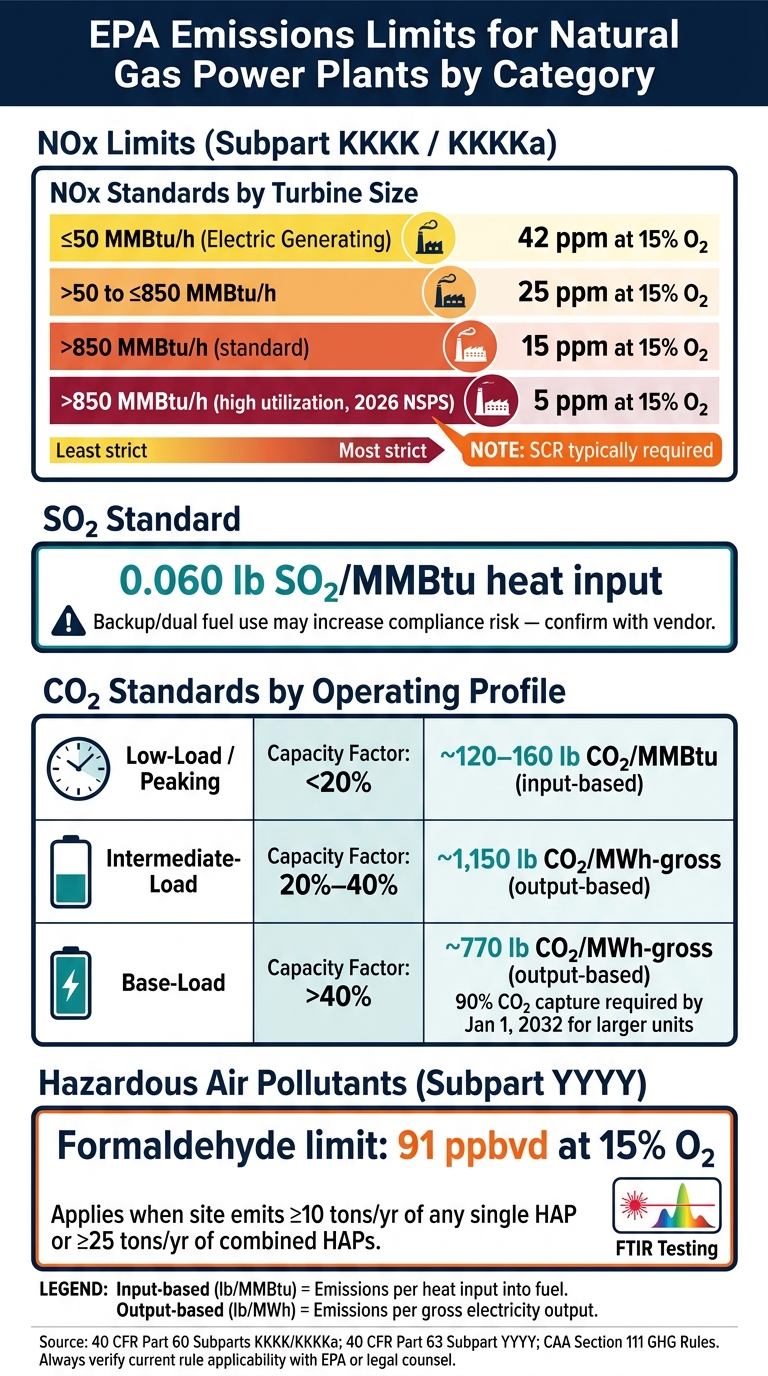
EPA Emissions Limits for Natural Gas Power Plants: NOx, SO₂, CO₂ & HAPs by Plant Category
Once you know which rule applies, the next step is simple: match the turbine's size and operating profile to the right emissions limit. That's where the numbers start to shift.
NOx and SO2 standards for stationary combustion turbines
Under Subpart KKKK, a new electric-generating turbine firing natural gas at ≤50 MMBtu/h must meet 42 ppm NOx at 15% O₂. If the unit falls in the >50 to ≤850 MMBtu/h range, the limit drops to 25 ppm. For units above 850 MMBtu/h, the standard tightens again to 15 ppm at 15% O₂.
The 2026 NSPS pushes large covered turbines even lower in some cases. For units above 850 MMBtu/h with higher utilization, the NOx limit can fall to 5 ppm, which will usually mean adding selective catalytic reduction (SCR).
SO2 works a bit differently. In many gas projects, pipeline-quality natural gas keeps SO2 low enough that the standard has not changed. The current limit remains 0.060 lb SO₂/MMBtu heat input.
SO2 starts to matter more when a project plans to use backup fuel with higher sulfur content. In that case, it makes sense to confirm two things with the turbine vendor:
- SO2 performance on the backup fuel
- Dual-fuel NOx performance under the same setup
CO2 performance standards by operating profile
CO2 does not follow the same setup as NOx and SO2. Here, the plant's operating profile matters just as much as the machine itself. EPA's GHG standards sort gas-fired electric generating units into low-load, intermediate-load, and base-load categories, and each category comes with its own target and measurement basis.
| Plant Category | Capacity Factor | CO2 Standard (approximate) |
|---|---|---|
| Low-load / Peaking | < 20% | Input-based: ~120–160 lb CO₂/MMBtu, depending on fuel type |
| Intermediate-load | 20%–40% | Output-based: ~1,150 lb CO₂/MWh-gross |
| Base-load | > 40% | Output-based: ~770 lb CO₂/MWh-gross for larger base-load units |
For new base-load gas plants, EPA has identified 90% CO₂ capture as the long-term best system of emission reduction. There is also an interim path: co-firing 30% low-GHG hydrogen, aimed at about 680 lb CO₂/MWh-gross by 2032.
HAPs and when they apply at larger sites
These limits should be checked against vendor data before any equipment order is placed. For new lean-premix and diffusion-flame turbines at major sources of HAPs, the current limit is 91 ppbvd at 15% O₂. Compliance is verified through initial and annual performance testing using FTIR testing.
Use these numbers early to screen turbine options and control packages before procurement.
What to check before sourcing equipment
Once you’ve identified the right EPA rule and the emissions limit that applies, do a few checks before you place any equipment order. This helps you avoid a common problem: buying gear first and finding out later that it doesn’t fit the rule.
Match the unit category to the correct EPA standard first
Before you talk to vendors, put together a short EPA applicability sheet. Include the unit configuration, heat input at peak load, expected annual capacity factor, gross and net output, construction date, and whether the unit is new, modified, or reconstructed.
Configuration matters because it can change which GHG category applies. Then record the heat input rating at peak load in MMBtu/h (HHV).
For stationary combustion turbines, the revised NSPS Subpart KKKKa applies to sources that commence construction, modification, or reconstruction after December 13, 2024. Make sure the project status is clearly documented as new, modified, or reconstructed.
Once you’ve matched the project to the rule, check whether the vendor’s performance data lines up with that category.
Review vendor emissions data and monitoring compatibility
Ask vendors for guaranteed NOx in ppm at 15% O₂, based on a 1-hour average, at 100%, 75%, and 50% load on natural gas. If the turbine falls under tighter limits, ask for a design guarantee that matches the standard that applies. Vendors should also spell out how the turbine package will meet that level, including whether combustion controls and SCR are built into the design.
Don’t stop at full-load numbers. Ask for startup and shutdown NOx data too.
You’ll also want to confirm that the stack can support certified NOx and O₂ CEMS and the required RATAs. Add Part 75 CO₂, NOx, and SO₂ monitoring where it applies.
Using Electrical Trader to support compliant sourcing

On the electrical side, sourcing still plays a part. Electrical Trader offers new and used electrical components, including breakers, transformers, and low- and high-voltage equipment. It can help with early sourcing, but engineering review and EPA compliance checks should happen first.
Conclusion: A compliance checklist for 2026 projects
After you identify the NSPS, GHG, and HAP rules that apply, lock in the unit category before procurement.
Key points to carry into procurement and design reviews
Begin with the unit category. New, modified, reconstructed, and high-utilization gas turbines can face different EPA limits. Get that classification wrong, and you can change the equipment package, control setup, and total cost. In plain terms, that call shapes every compliance check that follows.
Once the category is set, compare EPA limits directly with vendor guarantees using the same units required by the rule: ppm at 15% O₂, lb/MWh, or lb/MMBtu. Check those numbers at the loads the turbine is expected to run at, not only at full load. Then confirm that the proposed control package works with required CEMS, RATA testing, and Part 75 reporting before any purchase orders are issued.
Before procurement, confirm these four items:
- Applicability - unit status (new, modified, or reconstructed), size class, and capacity factor decide which NSPS subpart and GHG subcategory apply
- Vendor guarantees - NOx ppm and CO₂ intensity must meet the applicable standard under expected operating conditions
- Monitoring and reporting - CEMS, RATA, and Part 75 compatibility must be confirmed before equipment is specified
- HAP threshold - check whether the site qualifies as a major HAP source and whether Subpart YYYY applies
Build these checks into feasibility and design review before equipment is specified.
FAQs
How do I know if my turbine falls under KKKK or KKKKa?
Check your turbine’s documentation and your local air quality district. Whether a rule applies usually comes down to a few basic details: the unit’s size, its rated horsepower, and whether it’s used for power generation or as backup power in oil and gas operations.
It’s also smart to verify the permanent Emission Control Information label for stationary engines and confirm the rules with your local Authority Having Jurisdiction (AHJ).
What makes a gas plant low-load, intermediate-load, or base-load?
Base-load units run all the time to cover the steady minimum level of electricity demand. Intermediate-load plants change their output to fill the gap between base-load demand and peak demand.
Low-load operation means a generator is running at a reduced output, often far below its maximum rated capacity.
When does Subpart YYYY apply to a gas power project?
Subpart YYYY of the EPA’s NSPS applies to stationary combustion turbines used for power generation, including spark-ignition engines that run on natural gas or propane.
The exact rules can change based on the setup. A large natural gas turbine may face different requirements than a smaller backup microturbine. Because of that, plant teams should check with local air quality districts to confirm what their project triggers.