40 CFR Part 75: Emission Monitoring Explained
40 CFR Part 75 is a federal regulation from the EPA that requires facilities to monitor and report air pollutants like SO₂, NOₓ, and CO₂ using Continuous Emission Monitoring Systems (CEMS). It ensures compliance with the Clean Air Act and supports programs like the Acid Rain Program. Key takeaways:
- Who Must Comply: Facilities under the Acid Rain Program, NOₓ reduction programs, or those opting in under 40 CFR Part 74. Exemptions exist for smaller units or low-sulfur fuel users.
- What’s Required: Installation and certification of CEMS, regular QA/QC tests (e.g., calibration, RATAs), and quarterly emissions reporting to the EPA.
- Challenges: Facilities face technical issues, tight deadlines, and costs. Solutions include alternate protocols, conditional data validation, and hiring qualified testing bodies.
Compliance ensures accurate emissions tracking, reduces air pollution, and avoids penalties. Facilities should prioritize proper setup, testing, and reporting to meet these standards.
Main Requirements of 40 CFR Part 75
Continuous Emission Monitoring Systems (CEMS)
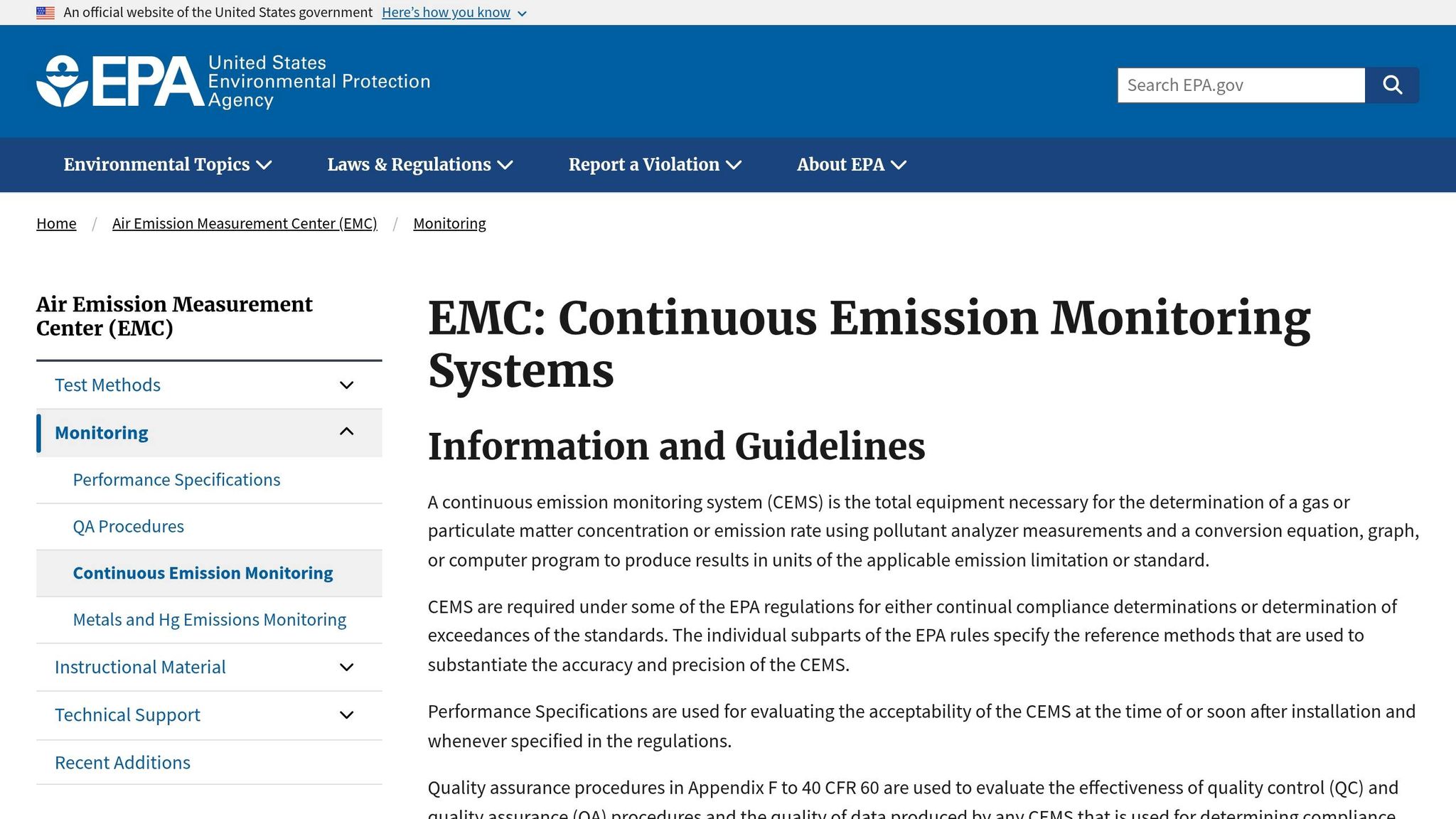
CEMS are designed to track emissions directly from stacks in real time. These systems measure pollutant concentrations and exhaust volumes continuously, providing the data needed to calculate total emissions. Under the regulation, facilities are required to monitor three main pollutants: sulfur dioxide (SO₂), nitrogen oxides (NOₓ), and carbon dioxide (CO₂).
A typical CEMS includes several essential components: pollutant concentration monitors, a stack gas volumetric flow rate monitor, and an opacity monitor. The system also needs to record data, convert measurements into the required units, and provide substitute data when the primary monitor is unavailable. For specific facilities, such as gas-fired or oil-fired peaking units, alternative estimation protocols outlined in Appendices D and E may replace the need for a full CEMS installation. To ensure accuracy, strict quality assurance and control (QA/QC) measures are mandatory.
Quality Assurance and Quality Control (QA/QC) Procedures
Part 75 mandates strict QA/QC protocols to maintain the accuracy and reliability of CEMS data. Facilities are required to conduct a daily calibration error test using two reference points - zero and high-level gas - every 24 hours to confirm analyzer accuracy. For stack volumetric flow monitors, a daily flow interference check ensures the proper functioning of sensors.
Facilities must also perform quarterly linearity checks, which involve testing analyzers with low, mid, and high-level calibration gases to confirm accurate operation across the entire range. One of the most critical tests is the Relative Accuracy Test Audit (RATA), conducted semiannually or annually by an accredited Air Emission Testing Body (AETB). During a RATA, at least nine paired runs compare CEMS data to independent EPA Reference Method measurements. If results show the system under-reports emissions, a Bias Adjustment Factor (BAF) must be applied to future data.
Data Reporting and Recordkeeping
Accurate emissions monitoring and validated QA/QC testing form the foundation of reliable reporting. Facilities must maintain a detailed monitoring plan that outlines unit configurations, the systems in use, and the pollutants being tracked (§ 75.53). Quarterly electronic reports for SO₂, NOₓ, CO₂, and heat input must be submitted within 30 days after the end of each quarter. Additionally, facilities are required to retain all relevant data and QA/QC records for at least three years (§ 75.57, § 75.64). This includes daily calibrations, RATAs, and other certifications and tests (§ 75.59). If a CEMS is unavailable or fails a QA test, facilities must follow the missing data substitution procedures in Subpart D to ensure emissions are accurately reported.
sbb-itb-501186b
What is a Continuous Emissions Monitoring System (CEMS)?
How to Comply with 40 CFR Part 75
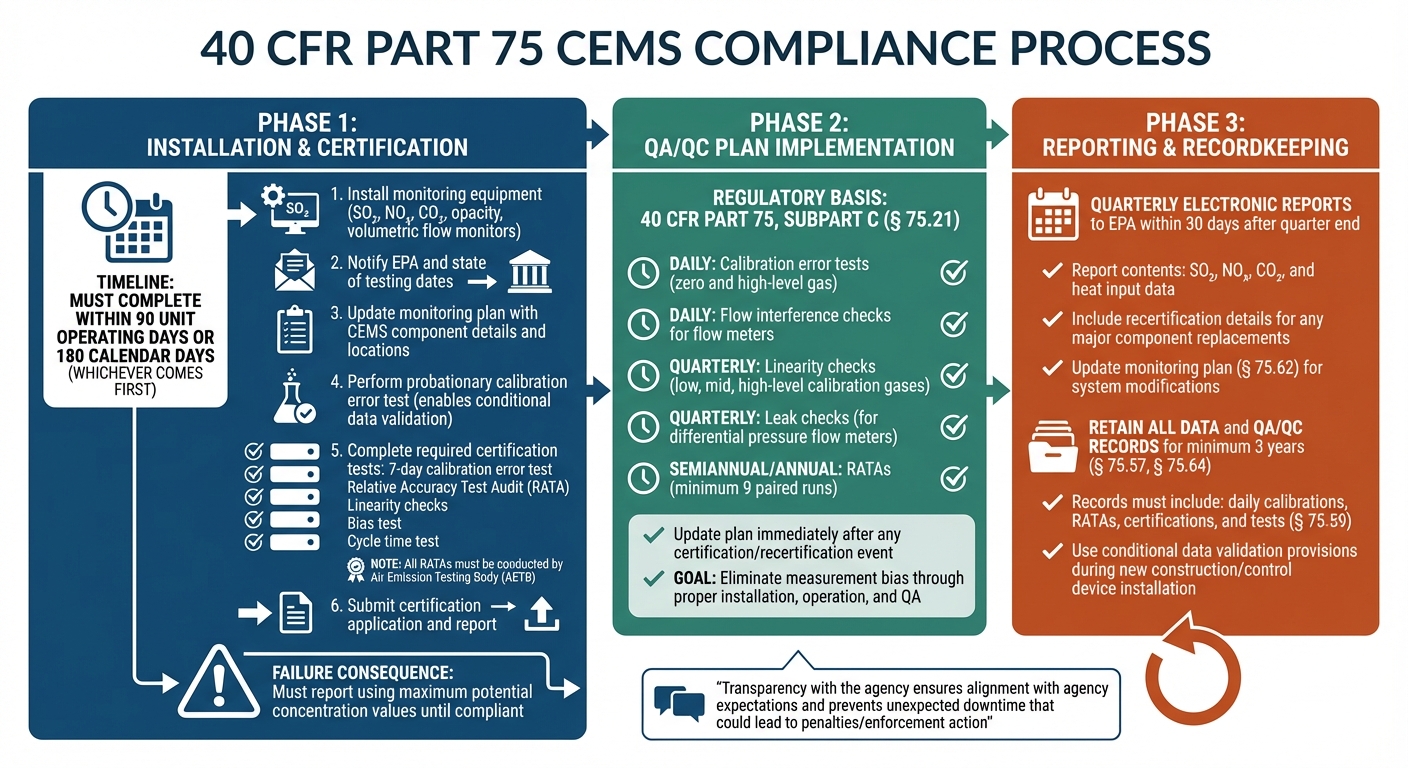
40 CFR Part 75 CEMS Compliance Process and Timeline
Installing and Certifying CEMS
To start the certification process, you’ll need to install the right monitoring equipment based on your facility’s requirements. This includes monitors for SO₂, NOₓ, CO₂, opacity, and volumetric flow. The setup should cover the entire measurement chain needed for your unit.
Before diving into the certification tests, notify both the EPA and your state agency about the planned testing dates. At the same time, update your monitoring plan to include details about the CEMS components, their locations, and how the data will be collected.
Timing is crucial here. Certification must be completed within 90 unit operating days or 180 calendar days, whichever comes first, after your unit begins commercial operation or after new emission controls are installed. For units in long-term cold storage, the clock starts ticking once operations resume.
The certification process includes a specific sequence of tests. First, perform a probationary calibration error test, which allows for conditional data validation. This means you can treat the data as valid while completing the formal testing. The required tests include:
- 7-day calibration error test
- Relative Accuracy Test Audit (RATA)
- Linearity checks
- Bias test
- Cycle time test
"Transparency with the agency ensures alignment with agency expectations and prevents unexpected downtime that could lead to penalties/enforcement action." - Ben Johnson, Author, ALL4
All RATAs and stack tests must be conducted by an Air Emission Testing Body (AETB). Once the testing is successfully completed, submit your certification application and report to finalize the process. If the tests don’t meet standards, you’ll need to report emissions using maximum potential concentration values until compliance is achieved.
After certification, maintaining data accuracy is key - this is where a solid QA/QC plan comes into play.
Creating a QA/QC Plan
Once your CEMS is certified, a detailed QA/QC plan is essential to ensure ongoing accuracy. This plan is your guide to maintaining reliable measurements and must comply with 40 CFR Part 75, Subpart C (§ 75.21). Technical procedures for these assessments are outlined in Appendix B. Key components of the plan include:
- Daily calibration error tests
- Daily flow interference checks for flow meters
- Quarterly linearity checks
- Semiannual or annual RATAs
Make updates immediately after any certification or recertification event. The plan should clearly specify when valid data collection resumes - usually after passing a probationary calibration error test.
If you’re using differential pressure flow meters, your plan must include the required quarterly leak check. The ultimate goal is to eliminate bias in measurements through proper installation, operation, and quality assurance. With around 1,500 CEMS operating on fossil fuel-fired boilers and stationary gas turbines across the U.S., compliance costs are largely tied to equipment and ongoing QA/QC efforts.
Submitting Emissions Reports to the EPA
After certification and QA/QC measures are in place, the next step is accurate reporting. You’re required to submit quarterly electronic reports to the EPA within 30 days of the quarter’s end. Before sending these reports, carefully review your EDR files for any formatting errors or questionable data, as mistakes can label your facility as "poor performance" in EPA records.
If you replace major CEMS components, include recertification details in your next quarterly report. This includes documenting the recertification event and noting the exact time when certified data collection resumed. Update your monitoring plan (§ 75.62) to reflect any system modifications, and file certification applications (§ 75.63) after completing successful testing.
During new construction or the installation of control devices, take advantage of conditional data validation provisions to report data while certification tests are still underway. If you’re unsure about reporting requirements for your facility, reach out to the EPA’s Emission Monitoring Contact or your local state agency for clarification. The EPA also uses a "Control Chart Methodology" to spot potential leaks or under-reported data, so accuracy is non-negotiable.
Common Compliance Challenges and Solutions
Understanding these challenges is essential for successfully implementing the compliance strategies outlined earlier. Facilities often encounter technical, regulatory, and financial obstacles when striving to meet the requirements of 40 CFR Part 75.
Technical Problems with CEMS
Continuous Emissions Monitoring Systems (CEMS) can experience issues like equipment failures, measurement inaccuracies, and bias. To prevent under- or over-reporting, facilities must follow strict installation, operation, and quality assurance (QA) procedures. For example, leaks in sampling or delivery lines can compromise data accuracy.
If a CEMS fails a QA test - whether it’s a daily calibration or a Relative Accuracy Test Audit (RATA) - it enters a non-compliance period. During this time, the data cannot be reported as quality-assured until the missing data substitution procedures in Subpart D (Sections 75.31 through 75.37) are applied.
RATA failures are often linked to unqualified testing bodies. Part 75 mandates that RATAs and stack tests be conducted by an Air Emission Testing Body (AETB). If a CEMS shows a low bias during a RATA, a bias adjustment factor must be applied to future data to ensure emissions are not under-reported. A practical tip to avoid this is performing "double calibrations" - a second calibration within two hours - to detect analyzers that might fail formal tests due to significant drift.
In addition to technical challenges, facilities must navigate tight regulatory deadlines.
Meeting Regulatory Requirements
Certification deadlines can be stressful, especially after events like forced outages or the construction of new stacks. Missing these deadlines can lead to compliance gaps and potential penalties.
For facilities installing new control devices, such as flue gas desulfurization systems, there’s a provision to report data from a certified high-scale monitor as quality-assured for up to 60 operating days. This allows time to certify a low-scale monitor.
To avoid enforcement actions, facilities can submit notifications to regulatory agencies, even when not explicitly required. This proactive communication ensures alignment with agency expectations and reduces the risk of surprises.
These regulatory demands often come with significant financial considerations.
Managing Costs and Budgets
Compliance costs generally fall into three categories: equipment expenses, costs from inaccurate data, and QA/QC activities. However, there are ways to manage these costs effectively while meeting 40 CFR Part 75 standards.
- Explore alternative monitoring protocols: Gas- or oil-fired units may qualify for protocols in Appendices D, E, and G, which can replace the need for full CEMS. Facilities meeting Low Mass Emissions (LME) criteria under § 75.19 can use simplified calculations for SO₂, NOₓ, and CO₂, significantly reducing costs.
- Use conditional data validation: During certification or recertification, facilities can use provisions under § 75.20(b) to avoid reporting "maximum potential" emission values, which can be costly.
- Petition for alternative procedures: If standard requirements are too challenging, facilities can request alternative monitoring or reporting methods from the EPA Administrator under § 75.66.
- Ensure AETB competence: Hiring a capable AETB minimizes the risk of re-testing, saving both time and money.
Conclusion
Let’s pull together the key points and outline actionable steps to help facilities meet the requirements of 40 CFR Part 75.
Summary of 40 CFR Part 75 Requirements
40 CFR Part 75 lays out the rules for monitoring, recording, and reporting emissions from affected units. Facilities must track pollutants like SO₂, NOₓ, CO₂, flow, and opacity using Continuous Emissions Monitoring Systems (CEMS) or approved alternatives . To ensure accuracy, strict Quality Assurance and Quality Control (QA/QC) protocols, outlined in Appendices A and B, must be followed. Facilities are also required to submit quarterly electronic reports to the EPA, demonstrating compliance with the Acid Rain Program and NOₓ reduction programs.
Benefits of Compliance
Meeting these regulations isn’t just about avoiding penalties - it has tangible advantages. Accurate emissions data helps protect air quality by ensuring pollutants are properly tracked and controlled. The QA/QC protocols also enhance operational reliability by providing dependable data for better decision-making. Proper installation and operation prevent biased results, ensuring the data reflects actual conditions, which strengthens trust with regulators and the public.
These benefits can lead to noticeable improvements in both environmental outcomes and facility operations.
Next Steps for Facilities
To stay on track, evaluate your monitoring systems for any gaps in certification, QA/QC, or reporting. Address these gaps using the strategies discussed earlier. For new units, complete all certification tests within 180 calendar days of starting commercial operation. Units with new stacks or emission controls have a shorter window - 90 operating days or 180 calendar days. The EPA's "Plain English Guide to the Part 75 Rule" is a great resource for navigating these requirements.
Also, ensure that Relative Accuracy Test Audits (RATAs) are conducted by qualified Air Emission Testing Bodies (AETB) to avoid unnecessary re-tests. For reliable electrical components and power distribution equipment that support your monitoring systems, check out Electrical Trader at https://electricaltrader.com.
FAQs
Does my unit qualify for an alternative to full CEMS?
Units could be eligible for an alternative to full CEMS under specific provisions outlined in 40 CFR Part 75. To qualify, you must use approved alternative monitoring methods that include proper safeguards and meet the required performance specifications. However, these alternatives require approval from the relevant regulatory agency. Make sure all criteria are met before considering this option.
What triggers a CEMS recertification under Part 75?
CEMS recertification under Part 75 is necessary when the system goes through its initial certification or when periodic recertification is required by the regulations. These steps are in place to ensure that the system adheres to established monitoring and reporting standards.
What happens if my CEMS fails a QA test or goes down?
If your CEMS fails a QA test or stops working, you'll need to conduct a performance test or recertify the system. If it still doesn't meet the required standards, repairs or even a replacement might be necessary to remain compliant. Missing QA tests can affect your ability to meet the monitoring and reporting requirements outlined in 40 CFR Part 75.