How to Become a Certified Calibration Technician
Becoming a Certified Calibration Technician (CCT) can elevate your career in industries like aerospace, pharmaceuticals, and automotive. This certification proves your expertise in maintaining and calibrating instruments, ensuring precise measurements. Here's what you need to know:
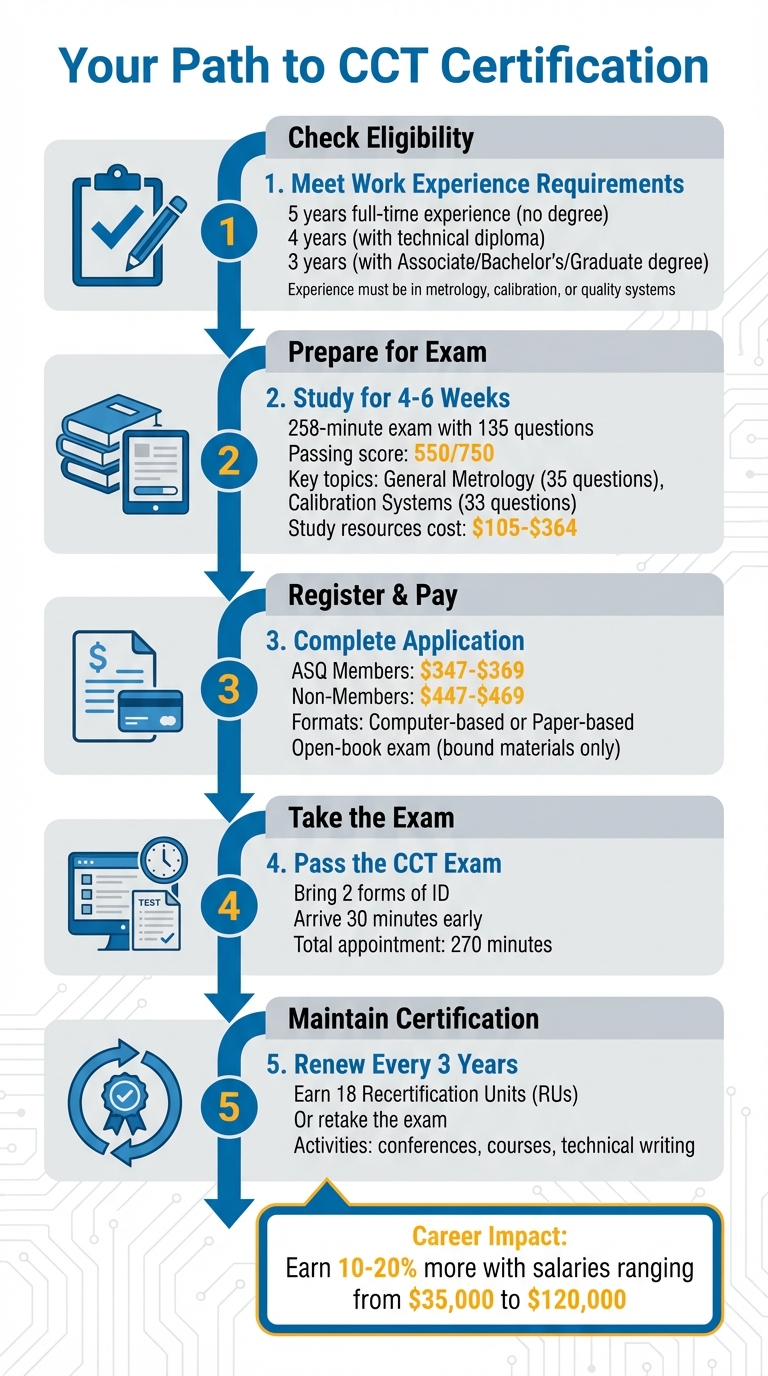
- Eligibility: At least 5 years of relevant work experience or reduced experience with a technical degree.
- Exam Details: A 258-minute test with 135 questions. Passing score: 550/750.
- Preparation: Use ASQ resources like the Metrology Handbook and practice exams. Dedicate 4–6 weeks of study.
- Costs: Exam fees range from $347 (members) to $469 (non-members). Study materials are additional.
- Salary Impact: Certified technicians earn 10–20% more, with salaries ranging from $35,000 to $120,000 depending on experience.
Once certified, maintain your credential every three years by earning recertification units through professional activities or retaking the exam. This certification boosts your credibility and opens doors to higher-paying roles.
Steps to Become a Certified Calibration Technician (CCT)
How do I become a Certified Calibration Technician (ASQ CCT)?
sbb-itb-501186b
Eligibility Requirements for CCT Certification
To qualify for the CCT exam, candidates must meet specific criteria outlined by ASQ.
Required Work Experience
At a minimum, candidates need five years of full-time, paid work experience in at least one area covered by the CCT Body of Knowledge. This experience must involve hands-on work in fields such as General Metrology, Measurement Systems, Calibration Systems, Measurement Uncertainty and Applied Math, or Quality Systems and Standards.
Make sure your work history includes roles focused on calibration, measurement, or quality. Keep detailed records of your job titles, employment dates, and specific calibration responsibilities, as ASQ will require this documentation during the application process.
Education Substitutions for Work Experience
Candidates with a degree or diploma in a scientific or technical field from an accredited institution can reduce the required work experience. This substitution acknowledges the role of formal education in building foundational knowledge for certification.
| Education Level | Required Work Experience | Experience Waived |
|---|---|---|
| High School Diploma or GED | 5 Years | 0 Years |
| Technical or Trade School Diploma | 4 Years | 1 Year |
| Associate, Bachelor's, or Graduate Degree | 3 Years | 2 Years |
For instance, if you have a Bachelor's degree in Electrical Engineering, you’ll only need three years of hands-on calibration experience instead of the standard five. To apply for this waiver, include official transcripts with your application.
Once these requirements are satisfied, candidates can move forward with preparing for the exam.
How to Prepare for the CCT Exam
To tackle the 258-minute Certified Calibration Technician (CCT) exam, you'll need a strategic approach. The test consists of 135 multiple-choice questions (125 scored, 10 unscored) and requires a minimum score of 550 out of 750 points to pass.
Exam Content and Topics
The exam covers five key domains, each with a specific focus and weight. Here’s a breakdown:
- General Metrology: The largest section, with around 35 questions. Topics include SI units, traceability hierarchy, measurement standards, and fundamental constants.
- Calibration Systems: Approximately 33 questions on calibration procedures, environmental controls, validation processes, and recordkeeping.
- Measurement Uncertainty and Applied Mathematics: About 20 questions, focusing on uncertainty calculations and mathematical applications.
- Quality Systems and Standards: Roughly 15 questions, covering quality management principles and standards.
- Measurement Systems: The remaining questions address various measurement system principles.
Since General Metrology and Calibration Systems make up nearly half the exam, allocate extra study time to these areas.
Study Materials and Preparation Resources
ASQ offers several tools to help you prepare effectively:
- CCT Certification Preparation Course: A self-paced, web-based program requiring 10–20 hours to complete. It includes hundreds of practice questions and costs $324 for ASQ members and $364 for non-members.
- ASQ Metrology Handbook (3rd Edition): The primary reference book for the exam, priced at $105 for members and $150 for non-members.
- CCT Question Bank: This resource mimics the test structure and provides visual reports to highlight weak areas. It’s available for $109 (members) and $119 (non-members).
Since the exam is open-book, organize your reference materials with tabs or markers for quick access to critical formulas and SI conversions. Keep in mind that loose-leaf papers aren’t allowed in the testing center.
For optimal preparation, dedicate 1–2 hours daily over 4–6 weeks. In the final two weeks, aim to complete 3–5 full-length mock exams to build stamina and familiarity with the test format. Up next: learn the application process and what to expect on exam day.
How to Apply and Take the CCT Exam
Application Steps and Registration
To apply for the CCT exam, head to the ASQ website and complete the online application. Make sure you meet ASQ's eligibility requirements, which typically involve 3–5 years of work experience, though this can vary depending on your educational background.
Once your application is approved, you'll receive instructions via email to schedule your exam at an authorized testing center. Be sure to arrive at the center at least 30 minutes before your scheduled time. Bring two valid forms of identification, such as a driver's license and a passport. The entire appointment lasts 270 minutes, which includes time for administrative processes and the 258-minute exam.
Before scheduling, review the exam formats and fees so you can prepare accordingly.
Exam Formats and Costs
The CCT exam is offered in two formats: computer-based testing (CBT) and paper-based testing (PBT). The CBT version includes 135 multiple-choice questions (125 scored and 10 unscored) and allows 258 minutes for testing. The PBT format, on the other hand, consists of 125 questions and provides four hours to complete the exam. Both formats are open-book, but only bound reference materials are permitted during the test.
Cost Breakdown:
- ASQ Members: $347–$369
- Non-Members: $447–$469
- Retake Fee: $247–$269
If you're not a member, consider joining ASQ before registering. Membership offers a discount of around $100 on the exam fee and provides access to reduced prices on study materials.
Speaking of preparation, remember to budget for additional resources. The ASQ Metrology Handbook costs between $105 and $150, and the CCT Question Bank ranges from $109 to $119, depending on your membership status. These tools are highly recommended to ensure you're fully prepared for the exam.
How to Maintain Your CCT Certification
Keeping your CCT certification active is essential for maintaining professional credibility. Once certified, your credential is valid for three years from the date you pass the exam. To renew it, you’ll need to earn 18 recertification units (RUs) within each three-year cycle. If you don’t meet this requirement, your certification will lapse, and you’ll lose the right to use the CCT designation.
ASQ offers a helpful tool called the Recertification Journal, which is designed to guide you through an 18-point program to maintain your certification without retaking the exam. Jeff Frost from the Elsmar Quality Forum explains:
With your CCT you should have also received from ASQ a Recertification Journal which is an 18 point program for maintaining your certification without taking the exam again.
You can accumulate RUs by participating in various professional activities, including working in calibration or metrology, attending industry conferences like MSC or NCSLI, completing professional courses (such as the ASQ CCT Certification Preparation course, which earns 1 RU), or engaging in technical writing and training. As Metrologist-Auditor Hershal points out:
Just working in the field is a substantial portion of the required points. Attending NCSLI and MSC events, writing technical articles, and conducting training sessions all contribute valuable RUs.
To meet the 18-unit requirement, it’s crucial to diversify your activities rather than relying on just one type. For example, a 20-hour course might only earn you 1 RU, so combining multiple professional development opportunities is key. This approach not only simplifies the recertification process but also ensures a well-rounded professional growth.
If you prefer, you can also renew your certification by retaking the exam before it expires. However, most technicians find that earning RUs through ongoing professional activities is both more practical and cost-effective. Plus, staying engaged in these activities boosts your skills and strengthens your reputation in the industry.
Conclusion
Becoming a Certified Calibration Technician (CCT) is a clear and achievable goal when you follow the right steps. Start by ensuring you meet the eligibility criteria, which can be fulfilled through relevant work experience or academic qualifications. The certification process offers flexibility, allowing candidates from various backgrounds to participate.
Once eligible, focus on preparing for the exam with resources provided by ASQ. This exam evaluates your skills in testing, maintaining, and repairing instruments across electrical, mechanical, and electronic systems. Successfully passing the exam demonstrates your technical abilities and boosts your professional credibility. It can also give you an edge in competitive fields like aerospace, medical devices, and pharmaceuticals. This certification not only verifies your expertise but also opens the door to ongoing professional growth.
After earning your certification, it’s important to stay engaged in professional development. Maintaining your CCT credential involves periodic renewal through activities that keep you up-to-date with advancements in technology and regulatory standards, such as ISO 17025. As InterviewGuy aptly says:
The more you know, the more valuable you are to your employer.
Certification strengthens your career prospects and establishes your reputation in key industries. By following these steps, you can position yourself for long-term success and recognition in your field.
FAQs
What jobs count toward the CCT work-experience requirement?
To meet the CCT work-experience requirement, jobs need to involve tasks like calibrating, testing, maintaining, and repairing electrical, mechanical, electromechanical, analytical, or electronic instruments and equipment. The goal in these roles is to ensure that the tools and devices align with established standards. Gaining relevant experience in these areas is necessary to satisfy the five-year certification requirement.
What should I bring to the open-book CCT exam?
When preparing for the open-book CCT exam, it's crucial to stick to the materials listed in the official exam guidelines. These may include writing tools - such as pencils or pens - if permitted, along with any approved reference materials. The exam consists of 125 multiple-choice questions, spans four hours, and requires careful preparation. Make sure to thoroughly review the official instructions to avoid any surprises on test day.
Which recertification activities earn the most RUs fastest?
Activities such as industry-recognized training, advanced courses, workshops, or certification exams tied to calibration standards are some of the most efficient ways to earn Renewal Units (RUs). These options often provide a higher number of RUs in a shorter amount of time compared to more routine activities. For tailored strategies, it’s best to review the specific guidelines provided by your certifying organization.