




Electrification Programs Boosting Rural Equipment Needs
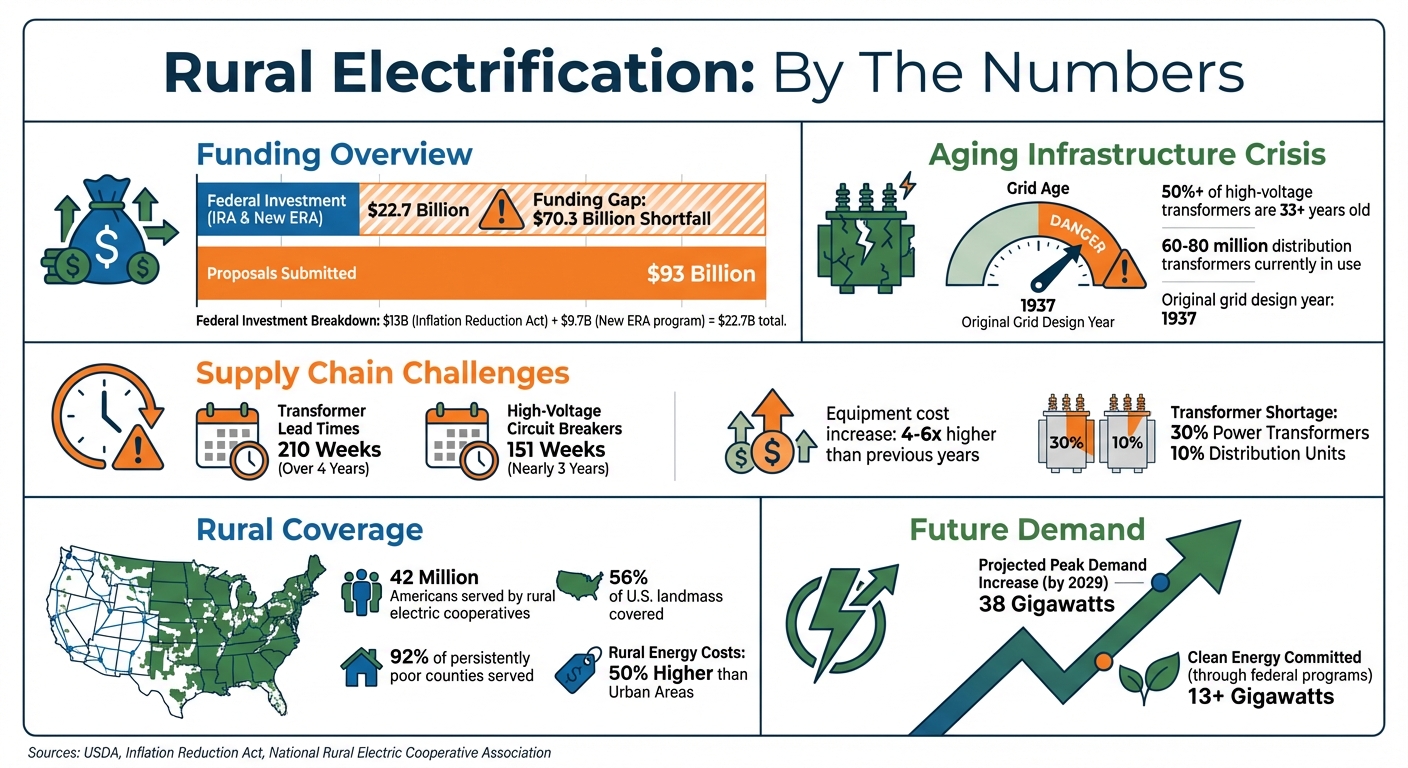
Rural America faces aging electrical systems that were built decades ago, leaving them unprepared for modern energy demands like EV charging, heat pumps, and data centers. Federal initiatives, including $13 billion from the Inflation Reduction Act and $9.7 billion from the New ERA program, are helping upgrade this infrastructure. However, the funding falls short of the $93 billion in proposals submitted, highlighting a major gap.
Key challenges include:
- Aging power grids: Over half of high-voltage transformers are 33+ years old.
- High costs and limited funding: Equipment prices have surged, and rural electric cooperatives operate on tight budgets.
- Unreliable power supply: Long transmission distances and severe weather cause frequent outages.
Solutions focus on federal funding, renewable energy projects, smart grid upgrades, and improved equipment sourcing. Platforms like Electrical Trader help utilities access critical components amid supply chain delays, ensuring rural communities can modernize their grids and meet growing energy demands.
Rural Electrification Funding and Infrastructure Challenges in America
Challenges in Rural Electrification
Aging and Overloaded Power Grids
Rural electrical systems, many of which date back to 1937, were originally designed to handle basic lighting and a few appliances. Fast forward to today, and these grids are being pushed far beyond their intended capacity. Modern demands like EV charging stations, heat pumps, and automated agricultural machinery have exposed the limits of these aging systems. Here's a startling fact: over half of the 60 to 80 million high-voltage distribution transformers in use today are more than 33 years old - essentially at or past their expected lifespans.
The strain on these grids is growing. For instance, an electric school bus can draw as much power as several homes, while an electrified truck stop can require the energy supply of a small town. Add to that the increasing energy needs of AI-powered data centers and the electrification of medium- and heavy-duty vehicles, and it's clear that rural substations are struggling to keep up.
"The challenge is straightforward: these vehicles require large amounts of power, often in locations for which rural grids were not originally designed." – Dakoury Godo-Solo, Environmental Defense Fund Project Manager
These technical limitations also bring significant financial and logistical hurdles.
High Costs and Limited Funding
Economic challenges add another layer of difficulty to rural electrification. Rural electric cooperatives, which serve 92% of U.S. counties identified as persistently poor, often operate on razor-thin margins. Upgrading infrastructure like poles, wires, and transformers is expensive, especially when these investments serve fewer households compared to urban areas. To make matters worse, equipment costs have soared - distribution transformers, for example, now cost four to six times more than they did just a few years ago.
The funding shortfall is glaring. In 2023, over 150 cooperatives applied for $20 billion in funding through the New ERA program, but only $9.7 billion was available. Compounding the issue, many cooperatives are still weighed down by debt from earlier investments in coal plants, leaving little room to finance renewable energy projects or storage solutions.
"Cooperatives were struggling under massive debts brought about by years of doubling down investments on the same coal plants, they had no access to the capital required to build new renewables and storage." – Jeremy Fisher, Principal Advisor, Sierra Club
Unreliable Power Supply in Remote Areas
For rural areas, reliability is another major concern. Long transmission distances combined with severe weather often lead to downed poles and extended outages. Replacing critical infrastructure like power transformers is no small feat - these massive units, weighing between 100 and 400 tons, require specialized railcars. The problem? There are only about 10 of these railcars in the entire U.S., which means replacement timelines can stretch into months.
Supply chain issues are making things worse. Lead times for transformers have ballooned to as much as 210 weeks, while high-voltage circuit breakers now take about 151 weeks - roughly double the time it took before the pandemic. Maintenance crews, often covering vast and sparsely populated areas, face significant delays, especially during severe weather events when access routes may be cut off.
"Electric co-ops are finding that these firms cannot respond to requests, they're charging price premiums, or that planning for projects four years out is already 'too late.'" – Stephanie Crawford, Regulatory Affairs Director, National Rural Electric Cooperative Association
sbb-itb-501186b
Solutions to Address Rural Electrification Needs
Government Programs and Funding
Federal initiatives are reshaping the landscape of rural electrification. The Empowering Rural America (New ERA) program has committed $9.7 billion to help electric cooperatives transition to clean energy, with most of the funding expected to be allocated by January 2025. Similarly, the Powering Affordable Clean Energy (PACE) program introduced $1.6 billion in forgivable loans to support renewable energy developers.
In January 2025, Great River Energy secured $794 million through New ERA to acquire 1,275 megawatts of renewable energy for Minnesota and North Dakota. This project is set to create over 1,600 jobs and reduce member costs by $40 million annually. Around the same time, the Navajo Tribal Utility Authority received $100 million via PACE to develop 30.75 megawatts of solar power and battery storage, bringing electricity to nearly 13,000 rural homes in Arizona and New Mexico.
The Rural Energy for America Program (REAP) also supports renewable energy efforts, offering grants up to $1 million and guaranteed loans for agricultural producers and small businesses. Funding for REAP is expected to exceed $600 million between fiscal years 2025 and 2027. Meanwhile, the National Electric Vehicle Infrastructure (NEVI) Formula Program provides $5 billion over five years (2022–2026) to build EV charging stations along designated corridors, covering up to 80% of project costs.
"In just two years, the New ERA and PACE programs have created dozens of new partnerships with rural electric cooperatives and communities that will reduce pollution, create jobs and make clean energy more affordable for millions of rural Americans." – Tom Vilsack, Agriculture Secretary, USDA
While funding is essential, modernizing grid infrastructure with renewable energy solutions is equally critical.
Renewables Integration and Grid Modernization
Distributed renewable energy systems are gradually replacing aging coal plants, reducing the risk of widespread power outages. As of January 2025, rural cooperatives have committed to developing or purchasing over 13 gigawatts of clean energy through federal programs. These projects often incorporate battery energy storage systems (BESS) to stabilize power during fluctuations in solar and wind generation.
For instance, Seven States Power Corporation received $439 million in January 2025 to construct a 250-megawatt solar facility serving regions in Alabama, Georgia, Kentucky, Mississippi, North Carolina, Tennessee, and Virginia. This project will power 113,000 homes annually and cut climate pollution by nearly 291,000 tons per year. In Hoonah, Alaska, the Inside Passage Electric Cooperative leveraged a $7.4 million investment to build a 0.35-megawatt run-of-river hydropower facility, delivering clean energy to 543 homes without the need for a dam.
Upgrades to smart grids are often integrated with renewable energy projects to enhance reliability and security. The USDA allocated $613 million in one funding round for smart grid technologies, including advanced sensors, automated controls, and telecommunications systems. In March 2021, the Navajo Tribal Utility Authority used a $235 million loan to construct 636 miles of power lines, with $29.4 million dedicated to smart grid technologies such as 304 miles of backbone fiber and 27 miles of customer connections. These upgrades improved both electrical reliability and telecommunications.
"This funding will help rural cooperatives and utilities invest in changes that make our energy more efficient, more reliable, and more affordable." – Tom Vilsack, Agriculture Secretary, USDA
Expanding the grid's capacity to meet the growing demands of digital infrastructure and electric mobility is another critical step.
Expanding EV and Data Center Infrastructure
With stronger funding and modernized grids, the focus shifts to expanding infrastructure for EV charging and data centers - both of which drive demand for upgraded transformers, substations, and three-phase power in rural areas. This modern infrastructure not only supports emerging technologies but also attracts businesses, creating jobs and boosting local economies. However, rural grids often face limitations, prompting solutions like battery-buffered chargers and solar-plus-storage systems to provide reliable power without requiring massive grid overhauls.
Rural electric cooperatives serve 42 million Americans across 56% of the U.S. landmass, including 92% of counties with persistent poverty. Federal programs play a vital role in addressing these challenges. The Charging and Fueling Infrastructure (CFI) Discretionary Grant Program prioritizes at least 50% of its funding for rural and underserved areas, with grants ranging from $500,000 to $15 million.
To ensure successful implementation, developers are encouraged to engage rural utilities early in the planning process to assess feasibility for high-power needs like DC fast chargers. Utility-sponsored "make-ready" programs can help offset the costs of electrical upgrades required for EV charging stations. Placing charging stations near amenities like diners, motels, or grocery stores can also improve usage rates and profitability.
"These investments will build modern infrastructure that will attract employers to the nation's smallest towns and most remote communities, creating jobs, vibrant Main Streets, and lasting economic growth for the people who live there." – Tom Vilsack, Secretary, U.S. Department of Agriculture
The Macro Grid Initiative: Can America still build big, beautiful things?
Sourcing Power Distribution Equipment via Electrical Trader

Rural electrification projects come with unique challenges, especially when it comes to upgrading outdated infrastructure and incorporating renewable energy. To tackle these hurdles, adopting new procurement strategies is key. For instance, pole-mounted transformers, essential for regulating voltage on remote distribution lines, are available through Electrical Trader in various capacities. Options include 50 KVA units priced at $10,000 and 167 KVA units at $23,000. For larger installations, refurbished 300 KVA units are a cost-saving alternative at approximately $18,500.
Reliable backup power is another crucial component, particularly in areas prone to frequent outages. Electrical Trader offers a range of diesel generators, from compact 25 KVA Tier 4 models priced around $10,999 to 250 kW trailer-mounted systems for about $17,999. Additionally, the marketplace provides essential protective gear like 1,200-amp ABB power circuit breakers ($3,125) and General Electric contact switches ($1,062.50), ensuring the safety and efficiency of distribution networks.
One standout feature of Electrical Trader is its filtering system, which allows project managers to quickly find equipment tailored to specific voltage, capacity, or phase requirements. This is especially important given the current supply constraints in the U.S., where there’s a 30% shortage in power transformers and a 10% deficit in distribution units. These shortages make sourcing equipment through a streamlined platform like Electrical Trader even more valuable.
Benefits of Using Electrical Trader
Electrical Trader addresses supply chain challenges head-on by offering a marketplace for new, used, and surplus equipment. With transformer prices rising by 45–95% and the U.S. transformer market expected to hit $12.2 billion in 2024 - with an annual growth rate of 7.7% through 2034 - this platform provides a practical solution. It eliminates the typical 12–24 month wait for new production by offering immediate access to a wide inventory.
This approach not only helps alleviate supply bottlenecks but also aligns with federal initiatives aimed at modernizing rural grids and integrating renewable energy technologies.
Conclusion
Rural electrification is at a pivotal moment. The USDA is channeling $6.3 billion across 44 states, and the Inflation Reduction Act has allocated an additional $10.7 billion. Yet, challenges like aging infrastructure, long transformer lead times, and soaring equipment costs persist.
Modernizing the grid is critical to keeping up with growing energy demands from data centers, electric vehicles (EVs), and electrified farm machinery. However, as Stephanie Crawford points out, "The domestic supply chain hasn't caught up with demand, and the industry is going through a learning curve".
Addressing these issues requires more than just funding - it demands reliable and readily available equipment. Utilities are preparing for a projected 38-gigawatt peak demand increase by 2029, while data centers continue to consume significantly more energy per square foot than conventional buildings. Online platforms like Electrical Trader help bridge the gap by offering advanced search tools for voltage, capacity, and phase requirements, making it easier for project managers to source critical components despite supply chain difficulties.
The future of rural electrification depends on collaboration between federal programs, utilities, and equipment suppliers. With rural households experiencing energy costs nearly 50% higher than urban ones, the infrastructure built today will shape whether these communities can attract businesses, embrace clean energy, and drive long-term economic growth.
FAQs
Why are rural grids struggling with EV chargers and heat pumps?
Rural electrical grids encounter significant hurdles when it comes to supporting EV chargers and heat pumps, primarily due to their limited infrastructure and capacity. These networks often aren't built to handle the surge in power demand, which can result in problems like voltage fluctuations and unbalanced loads.
On top of that, the economics don’t always add up. In rural areas, charger utilization rates tend to be lower, while the costs of upgrading infrastructure are notably higher. This combination creates financial obstacles, making investments in electrification technologies less appealing and slowing down their adoption in these regions.
How can rural co-ops fund upgrades when equipment costs keep rising?
Rural electric cooperatives have several opportunities to secure funding for upgrades, even as costs continue to climb. Programs like the Rural Utilities Service (RUS) electric loan program and the USDA’s Energy Resource Assessment (ERA) initiative provide low-interest loans and grants. These funds can be used for infrastructure improvements, clean energy projects, and modernizing the grid.
On top of that, federal initiatives like the DOE Grid Resilience and Innovation Partnerships (GRIP) program offer additional financial support. These programs aim to ease the financial strain and assist with essential upgrades to equipment and systems.
How can utilities get transformers faster despite long lead times?
Utilities facing transformer delays have several strategies to consider. One option is to invest in domestic manufacturing and reshoring initiatives, which can help reduce reliance on overseas suppliers. Building stronger relationships with suppliers, streamlining procurement processes, and staying updated on industry trends are also effective ways to navigate these challenges. Platforms like Electrical Trader, which focus on electrical components, can offer access to available stock and alternative solutions, potentially cutting down wait times. Additionally, increased investment in new manufacturing facilities is playing a role in addressing delays and managing costs.





