Electrical Load Testing: Key Standards by Brand
Electrical load testing ensures power systems like generators and transformers can handle real-world demands. Skipping these tests risks undetected issues, such as wet stacking in diesel generators or failing components under stress. Key takeaways:
- Why It Matters: Regular testing prevents costly failures, ensures compliance (e.g., NFPA 110), and maintains warranty coverage.
- Brand-Specific Standards: Major manufacturers like Schneider Electric, Siemens, Caterpillar, and Cummins follow strict protocols tailored to their equipment.
- Testing Basics: Monthly tests often run at 30% load for 30 minutes, while annual tests include higher loads (up to 75%) for extended periods.
- Compliance: Standards like NFPA 110 and ISO 8528-5 guide testing for healthcare and industrial settings, ensuring safety and reliability.
For effective testing, follow manufacturer guidelines, use proper tools, and document results. Skipping these steps risks equipment failure and voided warranties.
Battery Maintenance Load Testing - Standards Requirements & Recommended Practices
sbb-itb-501186b
Load Testing Standards by Major Brands
Major brands design their load testing protocols to align with product limits and meet regulatory standards. Here's a closer look at how some major companies approach these tests.
Schneider Electric Standards

Schneider Electric follows IEEE 450 for vented lead-acid battery systems. This standard requires monthly inspections and annual capacity tests when battery degradation exceeds 10% or total capacity drops below 90%. For generator sets, Schneider adheres to NFPA 110, conducting monthly 30-minute runs at 30% load. This helps prevent wet stacking in diesel engines while ensuring proper fuel delivery, cooling, and voltage regulation under thermal stress. Schneider recommends replacing battery systems once their capacity falls below 80% of the rated level.
Eaton Testing Protocols
Eaton relies on IEEE 1188 for valve-regulated lead-acid (VRLA) batteries, commonly used in UPS systems and other critical applications. These sealed batteries undergo capacity testing when degradation reaches 10%. Eaton advises replacing batteries when their capacity drops below 80%.
Siemens Load Testing Guidelines
Siemens incorporates IEC 62619 to test lithium-ion battery systems, reflecting the increasing use of this technology in energy storage and backup power. For emergency power systems, Siemens follows NFPA 110, conducting an annual load bank test with a stepped protocol: 30% load for 30 minutes, 50% load for another 30 minutes, and 100% load for the final hour. This method allows technicians to monitor system performance at each stage of the test.
ABB's Reliability Standards

ABB uses IEEE 485 to guide battery sizing and load testing across various applications, including telecommunications and industrial power distribution. This standard helps calculate the correct battery size based on load profiles and discharge rates. ABB verifies installed capacity through controlled discharge tests, using electronic load banks equipped with automatic cell voltage monitoring and precise constant current capabilities.
GE Testing Practices

GE applies IEEE 1106 for vented nickel-cadmium (Ni-Cd) battery systems, which are widely used in aviation, rail, and heavy industrial sectors. This standard outlines installation, maintenance, and performance tests to determine when batteries should be replaced. For load bank testing, GE uses both resistive tests, which simulate heaters and lighting, and reactive tests, which mimic the magnetic fields generated by motors and transformers. Voltage and frequency are documented at every load step to detect performance issues and signs of early degradation.
Generator Load Testing Standards by Brand
Generator load testing is a specialized process designed to evaluate engine performance, transient response, and extended runtime capabilities. These tests go beyond standard equipment evaluations, focusing on the unique demands of generator operation. Below, we explore how leading manufacturers like Caterpillar and Cummins approach their load testing protocols.
Caterpillar Load Testing Standards
Caterpillar adheres to ISO 8528-5, a standard that categorizes generator performance into four classes: G1, G2, G3, and G4. These classes reflect how sensitive loads are to changes in voltage and frequency. Most Caterpillar diesel generators in the 750–4,000 ekW range meet the G3 performance class, which ensures strong load acceptance and steady-state performance. According to ISO 8528-5, generators typically achieve full load in three to six steps, depending on the engine's Brake Mean Effective Pressure (BMEP).
Caterpillar's testing procedure involves several critical steps: a basic inspection, alarm simulation, long-term load and heat testing, and evaluations of both steady-state and transient responses. During their 4-hour full-load test, technicians collect engine data every 15 minutes at the start and then hourly. For load steps ranging from 0% to 100%, transient voltage recovery time must stay under six seconds.
Cummins Load Testing Practices
Cummins has developed its own efficient protocols, emphasizing compliance and operational readiness. Following NFPA 110 guidelines, Cummins conducts monthly tests at 30% load for 30 minutes to avoid wet stacking. The annual testing regimen includes running the generator at 50% load for 30 minutes, followed by 75% load for one hour. A cold start is also performed to confirm engine readiness.
For healthcare facilities using Type 10 systems, Cummins ensures that power is restored within 10 seconds of a utility failure, meeting strict performance requirements.
Brand Standards Comparison
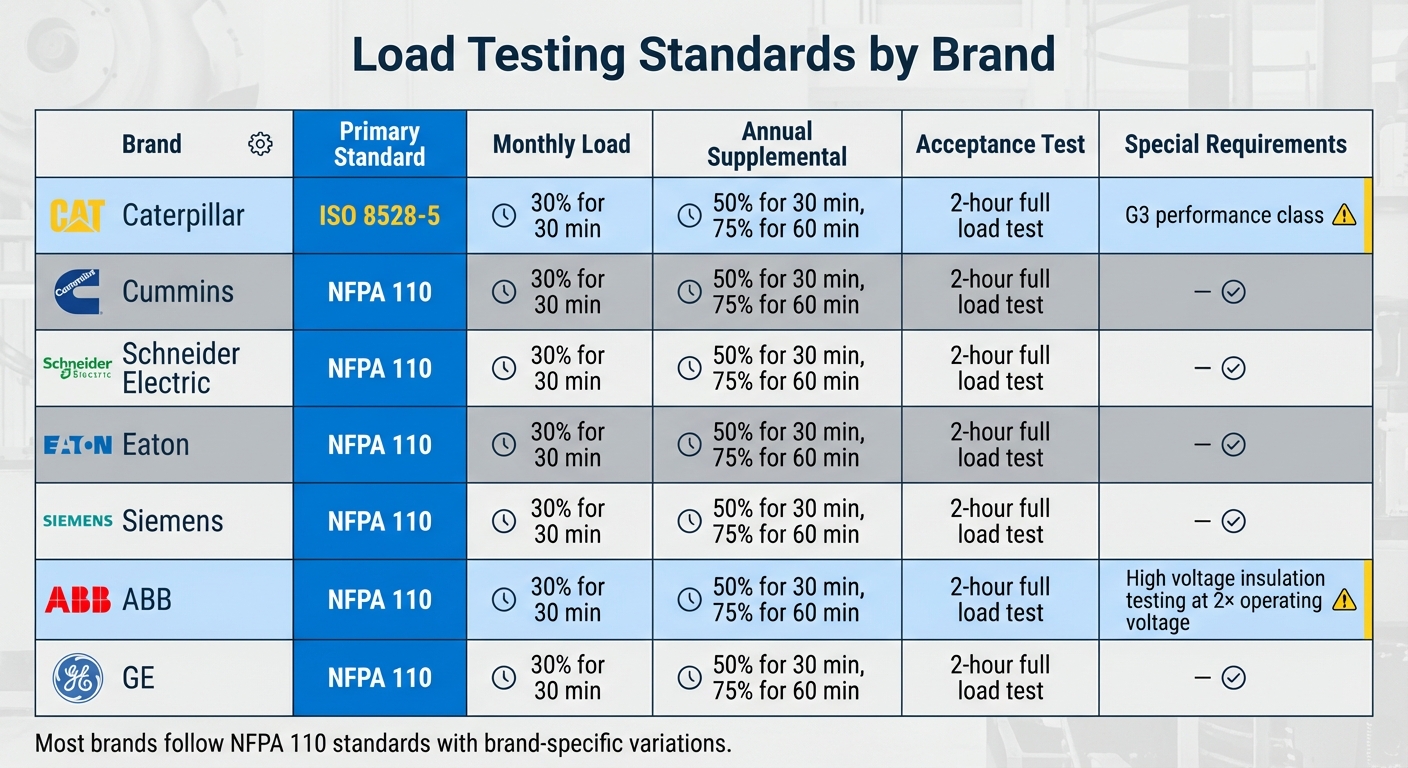
Electrical Load Testing Standards Comparison by Major Brands
Looking at the detailed protocols across brands, it's clear there are both similarities and differences in how manufacturers approach testing and compliance. While Caterpillar and Cummins have distinct methods, most electrical equipment manufacturers adhere to NFPA 110 standards to ensure their systems meet compliance requirements and maintain reliability.
The core testing protocols, both monthly and annual, are largely consistent across brands. For example, the 2025 edition of NFPA 110 has streamlined the annual testing process: it now mandates a 50% load for 30 minutes, followed by a 75% load for 1 hour (a total of 1.5 hours). Additionally, when monthly load testing falls short, an annual supplemental test is required. For new installations, a 2-hour full load test is necessary, incrementally increasing from 30% to 50% and then to 100% of the system’s nameplate rating.
When it comes to critical life-safety systems, the requirements are even stricter. For instance, healthcare facilities using Type 10 systems must restore power within 10 seconds of a utility failure. They are also required to perform 12 tests per year, spaced 20 to 40 days apart, as outlined in NFPA 99.
Testing Standards Comparison Table
The table below highlights the key testing protocols across major brands:
| Brand | Primary Standard | Monthly Load | Annual Supplemental | Acceptance Test | Special Requirements |
|---|---|---|---|---|---|
| Caterpillar | ISO 8528-5 | 30% for 30 min | 50% for 30 min, 75% for 60 min | 2‑hour full load test | G3 performance class |
| Cummins | NFPA 110 | 30% for 30 min | 50% for 30 min, 75% for 60 min | 2‑hour full load test | |
| Schneider Electric | NFPA 110 | 30% for 30 min | 50% for 30 min, 75% for 60 min | 2‑hour full load test | |
| Eaton | NFPA 110 | 30% for 30 min | 50% for 30 min, 75% for 60 min | 2‑hour full load test | |
| Siemens | NFPA 110 | 30% for 30 min | 50% for 30 min, 75% for 60 min | 2‑hour full load test | |
| ABB | NFPA 110 | 30% for 30 min | 50% for 30 min, 75% for 60 min | 2‑hour full load test | High voltage insulation testing at 2× operating voltage |
| GE | NFPA 110 | 30% for 30 min | 50% for 30 min, 75% for 60 min | 2‑hour full load test |
This comparison highlights shared regulatory frameworks while also pointing out brand-specific details. For instance, Caterpillar stands out by categorizing its generators into performance classes based on ISO 8528-5, which allows for more precise adjustments to load sensitivity and performance under varying voltage and frequency conditions. Similarly, ABB includes high voltage insulation testing, doubling the operating voltage to ensure reliability in high-demand scenarios.
How to Implement Load Testing Standards
To carry out load testing effectively, start by selecting the right type of load bank for your equipment. Use resistive load banks for generators, UPS systems, and power networks; reactive load banks for motors, transformers, or power factor correction equipment; and combined load banks for power plants and substations.
Before starting, confirm that pre-test conditions are met. Check fuel, oil, and coolant levels, and ensure cooling vents are open and unobstructed. Match the load bank's voltage to the generator's output, and use cables specified by the manufacturer's technical guidelines. Additionally, ensure the load bank complies with UL (Underwriters Laboratories) or CE (Conformité Européenne) standards to meet regulatory requirements.
Once pre-start checks are complete, proceed with a controlled, step-by-step loading process. Typically, this involves testing at 25%, 50%, 75%, and 100% of the rated load, allowing time at each step for thermal stability. During testing, technicians should document key metrics, including voltage, frequency, kW, kVAR, oil pressure, and exhaust or coolant temperatures. For compliance, NFPA 110 requires a 30-minute test at 30% load monthly and a four-hour test for critical systems annually.
Accurate data collection and adherence to testing parameters are critical for protecting both equipment and personnel. Regular load testing helps prevent issues like "wet stacking" in diesel engines - a condition where unburned fuel accumulates and clogs injectors, leading to increased emissions. It also identifies potential problems with cooling systems, fuel lines, or engine wear that may not appear during light-load operations. In industries like healthcare, meeting these standards is vital to avoid fines and ensure life-support systems remain operational. Moreover, following manufacturer guidelines is essential to maintain warranty coverage, as consistently running equipment below 30% load can void warranties.
After testing at peak load, gradually reduce the load in steps to allow for proper cooldown. Keep detailed logs of load steps, dwell times, and any anomalies for future reference and audits. To simplify reporting and ensure precision, opt for load banks with digital displays and data logging features, which are invaluable for meeting compliance requirements.
Conclusion
Brand-specific load testing standards play a key role in maintaining reliable electrical systems. As MGI advises, "Build your maintenance schedule from the manufacturer's recommendations first. The NFPA 110 annex figures are fallback guidelines, not master protocols". Sticking to these guidelines helps prevent equipment failures and keeps warranty protections intact. For instance, running diesel generators below the loads specified by manufacturers can void warranties and lead to costly repairs.
Using the right tools is just as important. Certified equipment rated for Measurement Category III or IV is a must. Fluke explains, "If the meter isn't properly rated and certified, there is no way to tell if the meter offers necessary protection against electrical transients that may lead to insulation breakdown or arc explosion". Non-certified or undersized tools not only put technicians at risk but can also cause damage to critical power systems. Proper tools are essential for protecting both people and equipment during high-energy testing.
Manufacturer protocols also address specific equipment challenges. For diesel generators, maintaining proper exhaust gas temperatures and kW outputs is critical to avoid wet stacking - an issue where unburned fuel accumulates, clogs injectors, and accelerates engine wear. Similarly, distinguishing between resistive and reactive loads ensures alternators and voltage regulators are tested under conditions that reflect actual usage.
For those looking to source compliant load banks, testing tools, and replacement parts, Electrical Trader is a reliable resource. They offer resistive and reactive load banks, high-voltage testing tools, and components from leading brands. This makes it easier for facilities to meet both brand-specific standards and regulatory requirements like NFPA 110 and NETA ATS.
Regular, manufacturer-recommended testing is crucial for safeguarding critical infrastructure. This is especially true in healthcare and public safety, where Type 10 emergency systems must restore power within 10 seconds of a utility failure. By following brand-specific protocols and using properly rated equipment, maintenance teams can ensure their systems operate reliably when it matters most.
FAQs
How do I know which load-testing standard applies to my equipment?
To choose the appropriate load-testing standard for your equipment, start by examining the regulatory and safety requirements tied to its specific use. For instance, NFPA 110 provides detailed testing protocols for emergency and standby power systems. Since standards can differ depending on the type of system and its application, it's essential to review applicable codes and consult manufacturer guidelines. This ensures both compliance and that your testing procedures align with the equipment's intended purpose.
What happens if my generator can’t hit the required load during testing?
If your generator struggles to meet the required load during testing, it could point to underlying problems that might impact its performance during an actual power outage. These problems might include an inability to handle the expected load, irregular output, or even damage caused by extended periods of running without a load. Tackling these issues right away is crucial to ensure the generator operates dependably when it's needed most.
Which type of load bank should I use for my system?
When choosing a load bank, it's all about matching it to your specific testing requirements and the type of load you need to simulate. Resistive load banks are a solid choice for testing generators, UPS systems, and power distribution setups. They work by converting electrical energy into heat, making them quite versatile. On the other hand, reactive load banks are better suited for systems that involve power factor correction or have reactive components. To ensure accurate testing, always align the load bank's type and capacity with the system you’re working with.