ECBC Transformers Guidelines Explained
If you need the short answer: an ECBC transformer must meet loss limits at both 50% and 100% load, match the right standard, and come with test proof.
If I were reviewing a transformer for an ECBC project, I’d check 4 things first:
- Scope: ECBC applies to many commercial projects at 100 kW connected load or 120 kVA contract demand and above.
- Loss data: I need no-load loss and load loss from the maker.
- Rule set: BEE wins if its limit is tighter than ECBC.
- Proof: I’d verify the nameplate, test report, BIS mark, BEE label, and metering setup before approval.
Here’s the article in plain English: ECBC does not just ask, “What is the kVA?” It asks, “How much power will this transformer waste at part load and full load?” That matters because transformers can stay energized 24/7, so even small loss differences can add up over 8,760 hours per year.
A few points stand out:
- No-load loss runs whenever the transformer is on.
- Load loss changes with current and follows the square rule.
- Class H dry-type units can have 7% higher allowed total losses.
- For some higher voltage classes, ECBC allows a 5% or 7.5% margin over the base maximum.
- A sample 1,000 kVA comparison in the article shows about $960/year in power-cost savings at $0.08/kWh.
If I had to sum it up in one line, it would be this: don’t approve a transformer based on price alone - approve it only after its tested losses, standard, and label all line up.
Core ECBC Transformer Requirements
With the ECBC scope set, the next job is simple: check each transformer against the code’s loss limits and paperwork rules.
Minimum Efficiency and Maximum Loss Limits
ECBC requires transformers to meet loss limits at 50% load and 100% load. The formula is:
Total loss = no-load loss + (load fraction)² × load loss.
That means you need the manufacturer’s test data for both no-load loss and load loss. Without those two numbers, you can’t run the check.
ECBC gives separate maximum loss tables for oil-filled and dry-type transformers, and you can’t swap one table for the other. For thermal class H transformers, ECBC allows a 7% increase in total allowable losses. There are also extra tolerances for higher voltage ranges:
- Above 11 kV and up to 22 kV: the transformer may not exceed the standard maximum by more than 5%.
- Above 22 kV and up to 33 kV: the allowed increase goes up to 7.5%.
These tables are what drive the procurement review in the next step.
How ECBC Uses IS 1180 and BEE Star Ratings
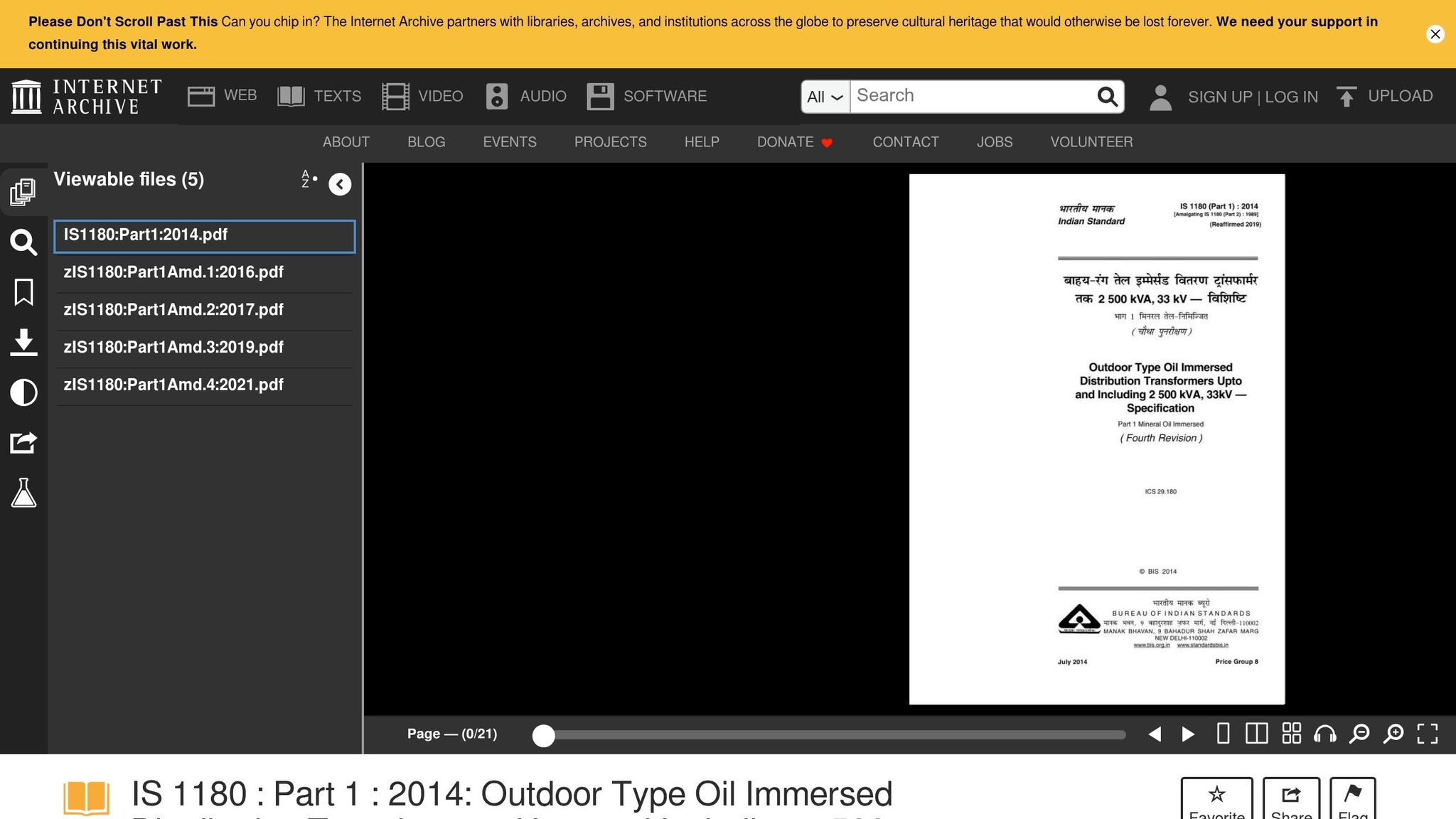
ECBC points to IS 1180 (Part 1): 2014 as the baseline standard for oil-immersed distribution transformers. That standard first used three efficiency levels: Level 1, Level 2, and Level 3. Since January 1, 2017, Level 1 has been phased out, and the two remaining levels were renamed Star-1 and Star-2 under the BEE labeling program.
If BEE is stricter than ECBC, follow BEE. So during procurement, check the current BEE label level instead of assuming the older ECBC table is enough.
Use the stricter ECBC or BEE value before you compare submittals.
Metering and Documentation Requirements
ECBC treats metering as a mandatory provision. The electrical system must include metering and monitoring. Drawings and specs must list:
- Transformer losses
- Motor efficiencies
- Power factor correction details
For metering, CTs and PTs must comply with IS 2705 or IEC 61869 so they meet the required accuracy class for energy monitoring.
Also, check that the nameplate or test report shows both no-load loss and load loss. Those records are the basis for the selection checks that come next.
sbb-itb-501186b
How to Select an ECBC-Compliant Transformer
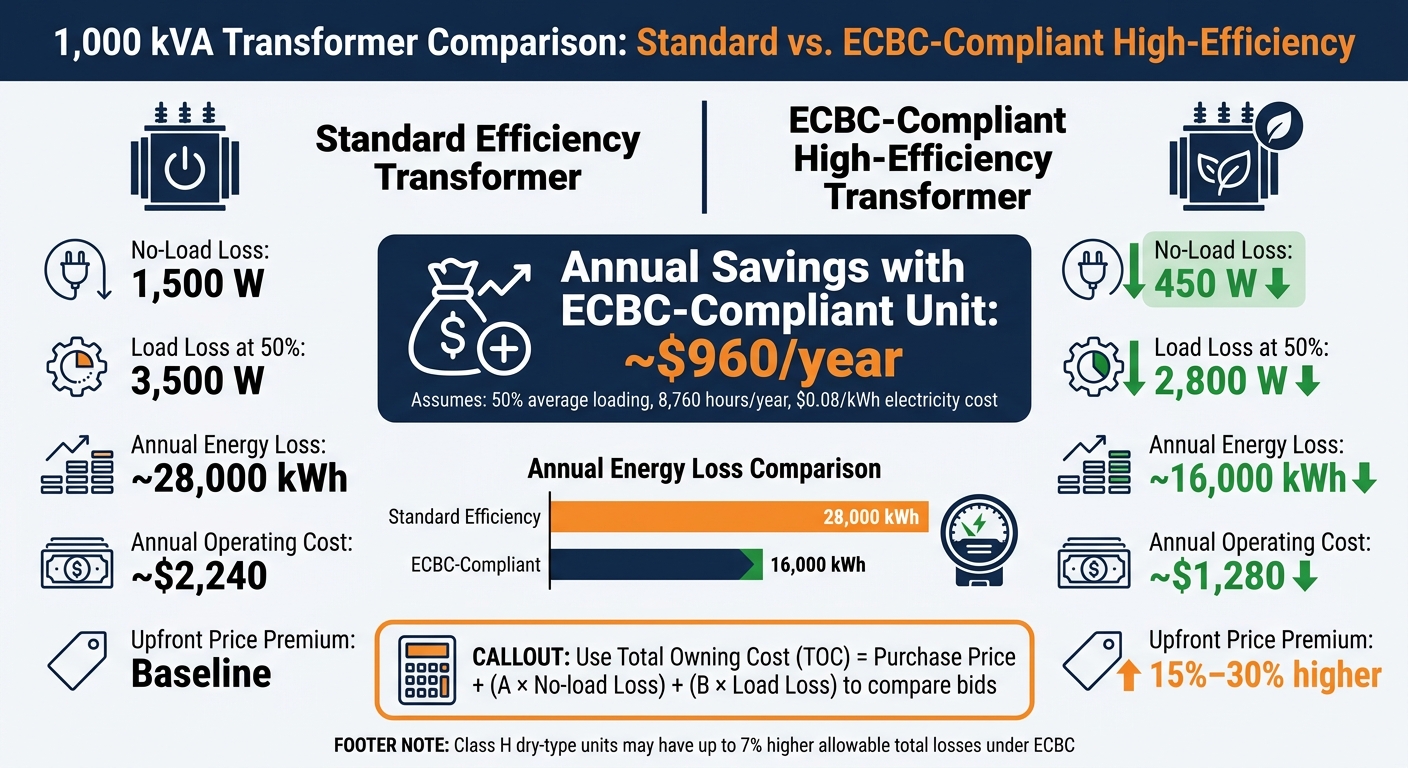
Standard vs. ECBC-Compliant Transformer: Loss & Cost Comparison (1,000 kVA)
Ratings, Voltage Class, and Configuration Checks
Once you have the test data, line up each transformer against the ECBC loss limits and the building's load profile. If the project already falls under ECBC, the transformer should fit the building's connected load and how that load runs during the day. Match the kVA to the actual load profile, and don't oversize it.
Then check the voltage class and intended use. ECBC guidance for distribution transformers usually applies to step-down units from 33 kV or 11 kV to 415 V/230 V. For oil-filled units, use IS 1180. For dry-type units, use IS 2026 Part 11.
For dry-type transformers, there's one more detail that matters: make sure the loss values are calculated at the reference temperature required by IS 2026 Part 11 - average winding rise + 30°C. If that piece is off, the comparison isn't apples to apples.
Approve only the units whose factory test data show compliant no-load and load losses.
Loss-Focused Design Choices That Reduce Lifecycle Cost
After the technical fit checks out, look at where each transformer loses energy. Some losses happen all the time. Others climb when the load climbs.
No-load loss stays constant whenever the transformer is energized, while load loss changes with the square of the load current. That's why the right pick depends on the building's load profile. A building with long energized hours and light average loading may favor one loss pattern. A site with heavier use may favor another.
Use the Total Owning Cost formula to compare bids on the same basis:
TOC = Purchase Price + (A × No-load Loss) + (B × Load Loss)
This puts the purchase price next to the cost of energy lost over the unit's life.
Standard-Efficiency vs. ECBC-Compliant Transformer: Comparison Table
Use this table for bid screening, not final compliance approval.
Illustrative Loss and Cost Comparison - 1,000 kVA Transformer
Assumes 50% average loading, 8,760 hours/year, $0.08/kWh electricity cost.
| Parameter | Standard Efficiency | ECBC-Compliant High-Efficiency Example |
|---|---|---|
| No-Load Loss | 1,500 W | 450 W |
| Load Loss at 50% | 3,500 W | 2,800 W |
| Annual Energy Loss | ~28,000 kWh | ~16,000 kWh |
| Annual Operating Cost | ~$2,240 | ~$1,280 |
| Annual Savings | - | ~$960 |
| Upfront Price Premium | Baseline | 15%–30% higher |
At a glance, the pattern is clear: the ECBC-compliant example costs more upfront, but it cuts both annual energy loss and annual operating cost. That's the kind of trade-off the TOC approach is meant to surface.
ECBC Compliance Workflow: Design, Procurement, and Installation
From Electrical Schedule to Submittal Review
Compliance problems usually begin in the spec, not out in the field. That’s why the electrical schedule needs to spell out the key requirements from the start: loss limits, BEE label, thermal class, kVA, voltage class, and impedance. Class H units are allowed higher losses, so that detail can’t be left vague. Once it’s written into the schedule, it becomes the yardstick for submittal approval and site inspection.
And when bids come in, don’t judge them by purchase price alone. Rank bids by total ownership cost.
During submittal review, ask for the technical specification sheet showing kVA rating, voltage class, and impedance, along with the BEE Star Label Certificate and type-test reports from a NABL-accredited laboratory. The manufacturer also needs to provide the exact no-load loss and load loss values.
Then verify the submitted losses with: P_Total = P_No-load + (load%/100)² × P_Load. If the numbers don’t line up with the schedule, reject the submittal. If they do line up, carry those same checks forward to the delivered equipment.
Inspection, Testing, and Commissioning Checks
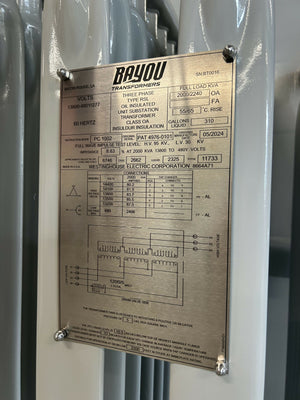
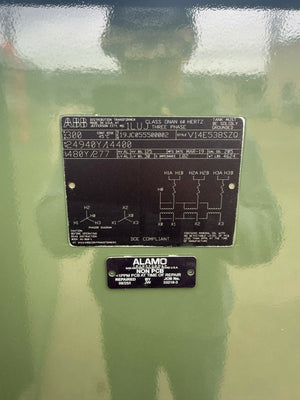
When the equipment reaches the site, match the physical nameplate to the approved documents and the BEE web portal. The serial number and model should match the certified efficiency ratings. Also check the nameplate thermal class, since that determines which loss limit applies. On top of that, confirm that the metering and monitoring system shown on the drawings has been installed. At that point, the review moves from paperwork to the unit in place.
Verify load-loss values at the correct reference temperature and confirm the metering system is installed.
Using Electrical Trader to Support Specification Review
Use the same approved data set to screen transformer options before buying. Electrical Trader can help you review transformer listings and compare nameplate data with the approved submittal before purchase.
Conclusion: What to Verify Before You Approve a Transformer
With the design, submittal, and installation checks done, final approval comes down to one thing: does the submitted unit meet the loss limits at both 50% and 100% load, and can the manufacturer prove it?
Use this final approval checklist:
- Loss values - check no-load and load losses against the approved standard and loss formula.
- Thermal class - Thermal class H allows higher losses.
- Certifications - make sure the transformer has the BIS certification mark and the BEE Star Label. Also confirm that the submitted model matches the current certification record.
- Metering - confirm the required metering and monitoring appear on the drawings and are installed.
The key rule is simple: BEE standards take precedence over ECBC when they are more strict. If a submittal points to an older efficiency tier, reject it.
Test reports matter just as much as the label. Match the test report to the approved nameplate data before sign-off. Then review the test reports for temperature rise, insulation, and short-circuit withstand.
If these checks pass, the transformer is ready for approval.
FAQs
How do I calculate total transformer loss for ECBC?
Add the no-load loss and the load-dependent copper loss:
PTotal = PNo-load + (Percentage Load / 100)^2 × PLoad
Manufacturers provide PNo-load and PLoad values. No-load loss stays constant as long as the transformer is energized. Load loss changes with the square of the load current, so it climbs fast as load goes up. Make sure the final result meets ECBC efficiency requirements for your transformer size and type.
When does BEE override ECBC transformer limits?
Under ECBC, the BEE Standards and Labeling (S&L) program sets the minimum equipment efficiency requirements.
If the S&L schedule changes, ECBC compliance uses the building’s design approval year as the base year.
What documents prove a transformer is ECBC-compliant?
Keep the official technical documentation that shows the transformer’s declared loss values or Peak Efficiency Index (PEI), based on routine factory tests for that specific unit.
Those measured values must meet the applicable requirements without applying tolerances.
For commercial contracts, it’s also a good idea to get the manufacturer’s certification of the as-built efficiency at delivery.