

How to Design Electrical Panels for Fire Safety
Electrical panels are a key part of any building's power system, but they also carry fire risks. Fires caused by electrical systems are common, often due to arc faults or overheating components. To design panels that prioritize fire safety, follow these steps:
- Follow Safety Codes: Use the latest National Electrical Code (NEC) and consult local fire codes. Key articles like 408 (panelboards) and 240 (overcurrent protection) are critical for fire prevention.
- Use Fire-Resistant Materials: Steel and aluminum are safer than wood or plastic. Look for UL-certified components.
- Plan Layouts Carefully: Allow proper spacing, ensure ventilation, and avoid "hot spots" by grouping heat-generating equipment near cooling systems.
- Install Safety Devices: Add GFCIs, AFCIs, and clean agent fire suppression systems to reduce risks.
- Maintain Electrical Rooms: Keep spaces clear of clutter, inspect regularly, and address issues like overheating or damaged wires immediately.
The key takeaway: Proper design, material selection, and maintenance are essential to prevent electrical fires and ensure safety.
Electrical Panel Automatic Fire Suppression System [System Showcase]
sbb-itb-501186b
Fire Safety Codes and Standards You Need to Know
Creating a fire-safe electrical panel starts with a solid understanding of the rules and regulations that govern electrical safety. At the heart of these is NFPA 70, also known as the National Electrical Code (NEC). This code serves as the baseline for safe electrical design across the United States, applying to all 50 states.
The NEC is updated every three years to address new risks. The 2026 edition, priced at $169.00 (or $152.10 for NFPA members), includes clarified requirements for systems operating above 1,000 volts AC and 1,500 volts DC.
For specialized environments like data centers, NFPA 75 complements NEC standards by focusing on protecting Information Technology Equipment from fire-related risks such as smoke, heat, and water damage. If you're working on panels for these spaces, you'll need to align your designs with both NFPA 70 Article 645 and NFPA 75.
NFPA and NEC Guidelines
Several NEC articles are particularly important when it comes to designing fire-safe electrical panels:
- Article 408: Requires panels to be housed in cabinets and accessed from the front.
- Article 240: Focuses on overcurrent protection devices to prevent overheating, a key factor in fire prevention.
- Article 110.26: Establishes mandatory working space clearances around panels to ensure safety during operation and maintenance while allowing for proper heat dissipation.
- Article 250: Covers grounding and bonding to provide a low-impedance path for fault currents, ensuring overcurrent devices trip quickly.
- Article 312: Ensures enclosures are designed to contain sparks and protect against environmental hazards.
One critical requirement is marking each panelboard with its Short-Circuit Current Rating (SCCR) in RMS symmetrical amperes. This rating guarantees the panel can handle the available fault current at its installation site without risking catastrophic failure or fire. Always confirm that the marked SCCR matches or exceeds the fault current available at the installation location.
Another important rule is the continuous loading provision. Overcurrent protection devices should not exceed 80% of their rated capacity for loads lasting three hours or more unless the assembly is specifically rated for 100% continuous operation.
| NEC Article | Focus Area | Fire Safety Relevance |
|---|---|---|
| 110.26 | Working Space | Ensures safe maintenance and prevents overheating |
| 240 | Overcurrent Protection | Stops conductor overheating and fire risks |
| 250 | Grounding and Bonding | Enables quick fault current interruption |
| 312 | Enclosures | Contains sparks and shields against external hazards |
| 408 | Panelboards | Regulates panel assembly and busbar protection |
Additionally, panels should comply with UL 67, the Standard for Panelboards, which confirms they meet safety requirements for fire, shock, and mechanical hazards. Products with the UL Mark have undergone rigorous testing to ensure they meet these standards.
It’s also worth noting that local fire codes may add further requirements.
Local Fire Code Requirements
National standards like NFPA and NEC set the groundwork, but they only become enforceable when adopted by state or local governments. Your local jurisdiction may use an older NEC version or include specific amendments that differ from the national guidelines.
Before finalizing your design, consult your local Authority Having Jurisdiction (AHJ). Local fire codes may require stricter clearances, additional fire suppression systems, or other environmental considerations. Some municipalities even mandate extra permits, inspections, or documentation beyond NEC requirements.
Your local building department is the best resource for determining which NEC version applies and whether there are any local amendments. Skipping this step could lead to failed inspections, expensive redesigns, or even safety violations. Always verify local requirements to ensure your design meets all applicable standards.
Choosing Fire-Resistant Materials for Electrical Panels
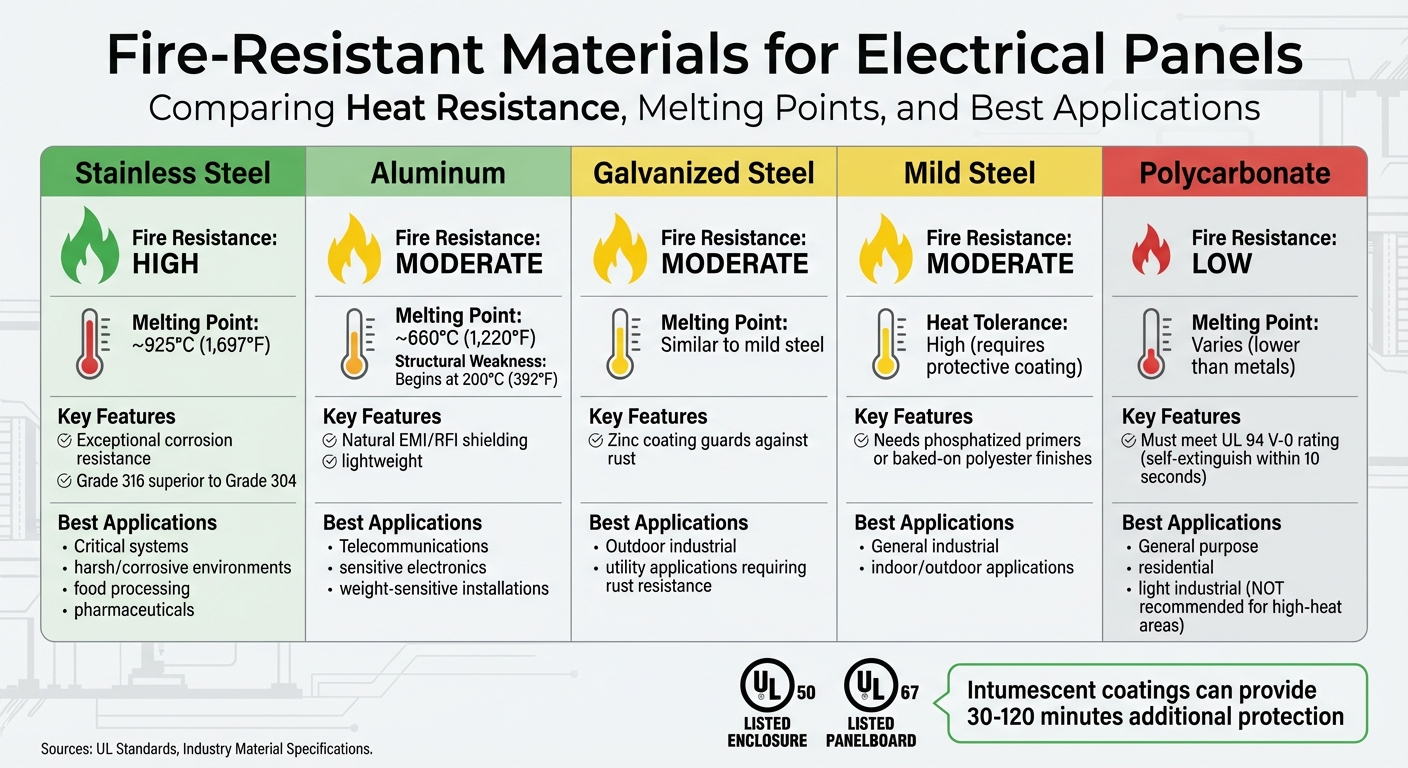
Fire-Resistant Materials for Electrical Panels Comparison Chart
Selecting the right materials for electrical panel enclosures plays a key role in fire safety. Steel enclosures, for instance, are noncombustible and don't add fuel to a fire. In contrast, wood (burning at around 10,000 BTU/lb) and plastics (ranging from 15,000 to 22,000 BTU/lb) can intensify a fire.
Stainless steel is a standout choice. It holds up under extreme heat - up to 925°C (1,697°F) - and resists corrosion and moisture. Grade 316 stainless steel, known for its exceptional corrosion resistance, is particularly effective in environments like coastal areas or facilities dealing with chemicals, such as food processing plants or pharmaceutical operations. It even surpasses Grade 304 in such demanding conditions.
Aluminum offers another option. While it melts at 660°C (1,220°F) and starts weakening structurally at just 200°C (392°F), it provides natural EMI/RFI shielding and is much lighter than steel, making it ideal for telecommunications and electronics applications.
For cost-effective solutions, galvanized steel and mild steel are worth considering. Galvanized steel features a zinc coating that guards against rust, a crucial feature since corrosion can compromise the seal of an enclosure during a fire. Mild steel, on the other hand, requires protective coatings, such as phosphatized primers or baked-on polyester finishes, to maintain its durability.
To further enhance fire resistance, intumescent coatings can be applied to both metal and plastic surfaces. These coatings expand under heat, forming an insulating barrier that can help systems remain functional for 30, 60, or even 120 minutes. When using plastic components, it's essential to ensure they meet the UL 94 V-0 rating, which requires the material to self-extinguish within 10 seconds without dripping flaming particles. Additionally, enclosures should carry a UL 50 listing, and panelboards must comply with UL 67 standards to address fire, shock, and mechanical hazards.
Fire-Resistant Material Comparison
| Material | Fire Resistance | Melting Point / Limit | Best Application |
|---|---|---|---|
| Stainless Steel | High | ~925°C (1,697°F) | Critical systems, harsh/corrosive environments, food processing, pharmaceuticals |
| Aluminum | Moderate | ~660°C (1,220°F); weakens at 200°C (392°F) | Telecommunications, sensitive electronics, weight-sensitive installations |
| Galvanized Steel | Moderate | Similar to mild steel | Outdoor industrial, utility applications requiring rust resistance |
| Mild Steel | Moderate | High heat tolerance (requires coating) | General industrial, indoor/outdoor applications |
| Polycarbonate | Low | Varies (lower than metals) | General purpose, residential, light industrial (not recommended for high-heat areas) |
Panel Layout Design for Fire Safety
Once you've chosen the right materials, the next step is designing a layout that minimizes fire risks. A well-thought-out layout not only reduces heat buildup but also allows for quick access during emergencies.
Arranging components correctly is crucial for preventing electrical arcs and managing heat. For example, placing high-heat equipment like power supplies and VFDs too close together can create "hot spots" that degrade wire insulation over time. To avoid this, group these components near cooling systems such as fans or heat sinks to maintain safe temperatures. This becomes especially important in compact designs, where managing heat is more challenging.
The NEC specifies a "dedicated zone" that extends 6 feet above the equipment - or up to the structural ceiling - that must remain clear of foreign systems like pipes or ductwork. This zone protects the equipment from leaks or obstructions that could cause electrical shorts or fires. Scott Kesler, Principal and Engineering Integration Leader at CannonDesign, highlights its importance:
The working space helps safeguard a clear working zone around all equipment and ensures protection for any workers or occupants within the room.
For 3-phase systems, keeping the load balanced across phases within a 10% margin prevents neutral overloading and excessive heat. Similarly, breakers handling continuous loads - like HVAC systems or EV chargers - should be rated at 125% of the load current to avoid overheating.
Clearance and Spacing Requirements
The NEC also sets strict clearance standards to ensure safety for both workers and equipment. You need at least 3 feet (36 inches) of clear depth in front of electrical panels for safe operation and maintenance. The workspace must also be at least 30 inches wide - or as wide as the equipment, whichever is greater.
Vertical clearances are just as important. The workspace must have a minimum headroom of 6 feet 5 inches, and the highest circuit breaker handle cannot be more than 6 feet 7 inches above the floor. Panel doors must open at least 90 degrees without any obstructions, ensuring easy access during emergencies.
| Requirement | Minimum Standard | NEC Reference |
|---|---|---|
| Front Working Depth | 3 feet (36 inches) | 110.26 |
| Working Width | 30 inches (or equipment width) | 110.26 |
| Headroom Height | 6 feet 5 inches | 110.26 |
| Max Breaker Height | 6 feet 7 inches | 408.37 |
| Door Opening Angle | 90 degrees | 110.26 |
Panels should only be installed in approved, unobstructed locations. Keep the clearance area free of storage - especially flammable materials like cardboard or cleaning supplies. To ensure emergency access, avoid locking electrical room doors.
Ventilation for Heat Management
Proper ventilation is another NEC requirement, designed to prevent the buildup of flammable gases and manage heat from high-amperage circuits. Firetrace International stresses the importance of:
designing the room with adequate ventilation to prevent the buildup of flammable gases.
Position heat-generating components where they can benefit from optimal airflow. Antonio Armenta from Control.com advises:
If the surrounding area is not a major concern, always design for proper spacing between components to improve heat dissipation and make future additions simpler.
Exhaust vents and air intakes should be easy to access for maintenance. In rooms with generators, ventilation not only cools the space but also supplies the air needed for combustion. Using stranded wire instead of solid wire can also help manage heat since stranded wire generates less heat and dissipates it more effectively.
Place heat-sensitive components in areas with the best airflow. Cooling systems should be located near the most heat-prone components, and air intakes must remain unobstructed. Proper spacing between components allows for natural convection, which helps dissipate heat and reduces fire risks.
Installing Electrical Safety Devices
Safety devices play a crucial role in reinforcing the fire safety measures achieved through thoughtful design and material selection. Installing these devices is essential for protecting both people and equipment. For example, Ground Fault Circuit Interrupters (GFCIs) prevent electric shocks, while Arc Fault Circuit Interrupters (AFCIs) shield branch wiring from electrical arcs.
In larger setups or where high-value equipment is involved, clean agent fire suppression systems add another layer of protection. These systems are specifically engineered for electrical environments - they don’t conduct electricity and leave no residue, which helps preserve sensitive components.
Ground Fault Circuit Interrupters (GFCIs)
GFCIs are lifesavers when it comes to preventing electric shocks. They work by detecting ground faults - when electricity strays from its intended path - and cutting off power almost instantly. These devices provide 5mA of ground fault protection, and their impact on safety has been significant. From 1983 to 1993, annual electrocutions in the U.S. dropped from nearly 900 to 650, while consumer product-related deaths fell from about 400 to just over 200 during the same timeframe.
When installing GFCI breakers, it's vital to connect both the hot and neutral conductors correctly. As John Williamson, Chief Electrical Inspector at the Minnesota Department of Labor and Industry, points out:
A GFCI circuit breaker protects the entire branch circuit and everything connected to it, be it receptacles, lights, appliances, etc.
GFCI breakers should be installed at the start of branch circuits within the panelboard. For older systems using multiwire branch circuits that share neutrals, GFCI protection can also be added at the receptacle level. Always check local code requirements to ensure compliance.
For areas with higher risks or valuable equipment, consider pairing GFCI protection with a fire suppression system for added safety.
Fire Suppression Systems
While GFCIs focus on protecting people, clean agent fire suppression systems are designed to safeguard equipment and facilities. Firetrace International highlights their effectiveness for electrical systems:
A clean agent fire suppression system is the best option for those looking to safeguard electrical panels. Clean agents are gaseous fire suppressants that leave no residue and do not conduct electricity.
These systems use gases to flood an area and are effective against Class A, B, and C fires. Depending on the size of the installation, you can choose between self-contained tube-style systems, such as FlexRope, for small electrical cabinets or racks, and larger engineered systems for facilities like data centers.
Electrical failures can result in severe property damage and even loss of life. To ensure reliability, these systems should be designed and maintained in line with NFPA 2001 standards, which provide guidelines for clean agent fire extinguishing systems.
| Safety Device | Primary Function | Best Application |
|---|---|---|
| GFCI | Detects ground faults to prevent shock | Wet locations, kitchens, bathrooms |
| AFCI | Detects dangerous electrical arcs | Bedrooms, living rooms |
| Clean Agent System | Extinguishes fires without leaving residue | Data centers, electrical rooms |
| Tube-Style System | Provides localized fire suppression | Small cabinets, server racks |
To ensure a safe and compliant setup, use components like breakers, contactors, and relays that are UL 508A-listed. Additionally, document the panel's Short-Circuit Current Rating (SCCR) and keep a clear circuit directory, as required by NEC 408.4.
Maintaining Electrical Rooms and Equipment
Keeping your electrical rooms and equipment in top shape is essential for ensuring fire safety and maintaining the performance of your systems. Even the most well-designed electrical panels can turn into hazards if not properly maintained. Regular inspections and upkeep help your equipment stay compliant and safe over time. As Dean Austin, Senior Electrical Specialist at NFPA, emphasizes:
"The one thing they [electrical rooms] are not is storage rooms."
Avoid storing anything in electrical rooms. This includes boxes, cleaning supplies, or any combustible materials. Electrical rooms must have clear access at all times, as required by code. Failing to maintain these clearances can result in hefty OSHA fines of $14,502 per violation.
Control access to electrical rooms with secure locks. Only trained and qualified personnel should have access, and locks should allow emergency access when necessary. To further reduce risks, inspect fire-rated walls, doors, and cable penetration seals regularly.
Set up a consistent inspection schedule. Perform daily checks for hazards, use monthly thermal imaging to spot hot spots, and conduct annual tests to confirm voltage readings, grounding, and insulation. During these inspections, ensure breakers are labeled, test GFCI and AFCI devices to confirm proper operation, and remove any dust or debris that could spark.
If you notice warning signs like a burning smell, smoke, melted wires, or frequent breaker trips, contact a licensed electrician immediately. These issues signal serious problems that require professional attention. For replacing components or upgrading outdated equipment, platforms like Electrical Trader (https://electricaltrader.com) can provide access to both new and used breakers, transformers, and power distribution equipment. Regular inspections form the backbone of any effective safety program.
Electrical Room Safety Checklist
| Task | Frequency | What to Check |
|---|---|---|
| Visual Hazard Inspection | Daily | Exposed wires, overheating signs, and unauthorized storage |
| Clearance Verification | Weekly | Maintain 36-inch depth, 30-inch width, and a clear, level floor |
| Thermal Imaging | Monthly | Identify hot spots on connections, bus bars, and breakers |
| Fire Barrier Inspection | Quarterly | Check fire-rated doors, walls, and cable seals for damage |
| Safety Device Testing | Quarterly | Ensure GFCI and AFCI breakers trip and reset as expected |
| Comprehensive Testing | Annually | Verify voltage readings, grounding continuity, and insulation resistance |
Conclusion
Designing electrical panels with fire safety in mind requires careful attention to current codes, material choices, layout, and ongoing maintenance. The 2026 National Electrical Code (NEC/NFPA 70) and International Building Code (IBC) provide the groundwork for safe installations, while fire-rated enclosures play a critical role in containing heat and flames.
Beyond compliance, ensure layouts adhere to NEC 110.26's clearance requirements for safe access. Adding modern safety devices like AFCIs and GFCIs can provide an extra layer of protection. For electrical rooms with sensitive equipment, consider gas-based clean agent suppression systems such as FM-200, which can control fires without damaging the equipment.
Fire safety doesn’t stop once installation is complete. Regular inspections help catch potential issues early. Outdated or recalled panels should be replaced promptly, as they pose a higher risk of failure during overloads, potentially leading to severe property damage and loss of life.
Keep electrical rooms organized with adequate clearances and accurate circuit labeling. When upgrading or replacing components, trusted platforms like Electrical Trader (https://electricaltrader.com) can provide reliable equipment. These steps collectively contribute to a thorough approach to electrical fire safety.
As the National Fire Protection Association wisely states:
Safety doesn't happen by chance.
FAQs
What are the key NEC guidelines for designing fire-safe electrical panels?
When planning electrical panels with a focus on fire safety, it's crucial to stick to the guidelines set by the National Electrical Code (NEC). For example, Article 110 highlights the importance of proper working space, clearances, and accessibility, all of which are vital for safe installation and maintenance.
Equally important is meeting the NEC's grounding and bonding requirements. These measures help minimize the risk of electrical faults, which can potentially cause fires.
Following these NEC standards ensures your panels are designed to balance safety and performance, lowering fire risks while maintaining reliability over time.
How do materials like stainless steel and aluminum enhance fire safety in electrical panels?
Using materials such as stainless steel and aluminum in electrical panels improves fire safety due to their strong resistance to heat and flames. Unlike more flammable options, these materials are far less likely to catch fire or fuel its spread, making them a safer choice.
On top of that, their ability to withstand high temperatures helps preserve the panel's structure during a fire. This added durability protects the internal components, minimizing risks and potential damage.
Why is regular maintenance important for preventing electrical fires in panel installations?
Regular maintenance plays a key role in reducing the risk of electrical fires in panel installations. It allows for the early detection and correction of potential problems, such as loose connections, corrosion, or worn-out components - issues that often cause overheating or electrical faults, which can lead to fires.
This upkeep also ensures that safety devices like circuit breakers are working properly. Additionally, it helps keep the panel area clean and free of dust, debris, or moisture, all of which can increase the chances of a short circuit. By maintaining electrical panels, you not only improve fire safety but also ensure the system meets safety standards, making it more dependable and secure.