




Data-Driven MPC for Facility Demand Management
Demand charges can take a big bite out of a facility’s power bill, and data-driven MPC helps cut those peaks before they happen.
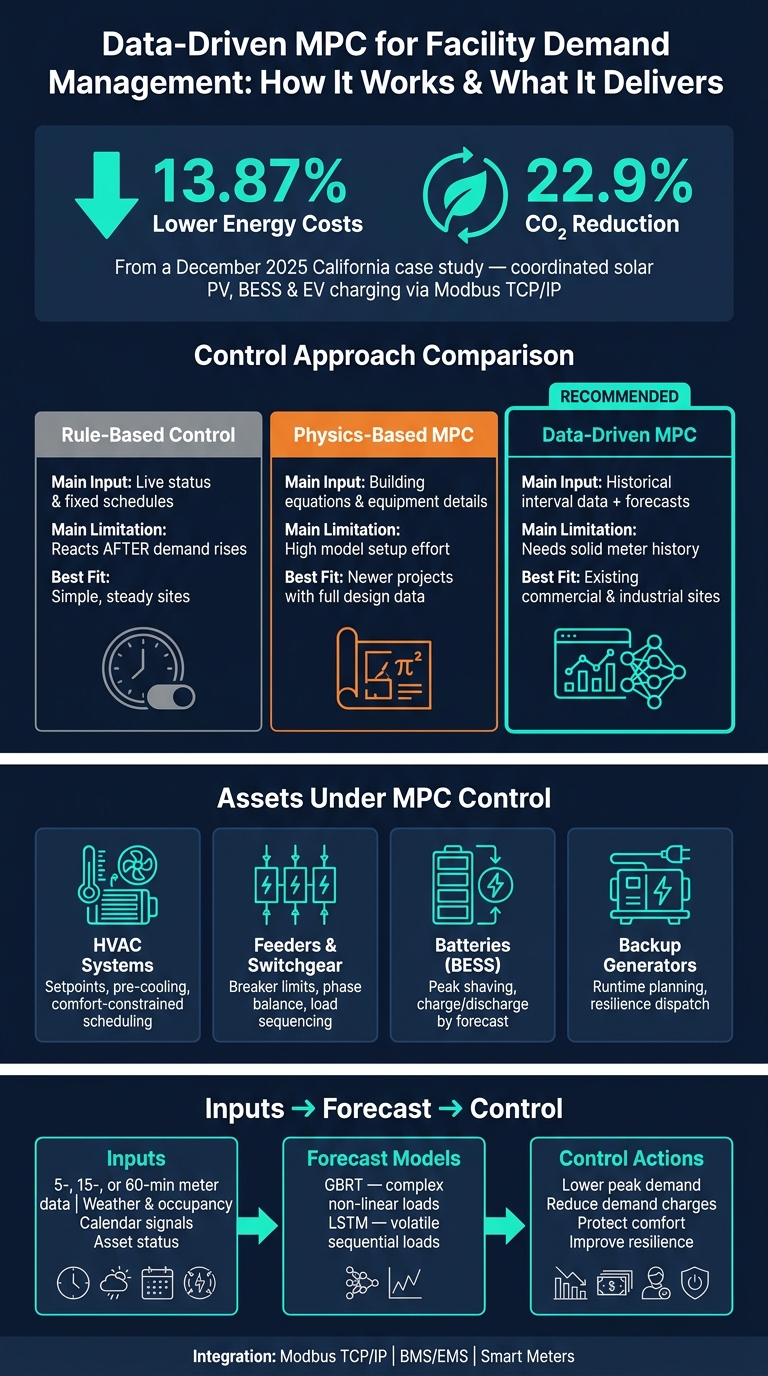
If I had to sum up the whole article in a few lines, I’d say this: data-driven MPC uses interval meter data, short-range forecasts, and asset limits to lower peak demand, protect comfort, and control HVAC, feeders, batteries, and generators in one loop. It sits between simple rule-based control and physics-heavy MPC, which makes it a strong fit for many existing U.S. facilities that already have meter history but not a full building model.
Here’s the short version:
- Why it matters: demand charges can add a large share of a monthly utility bill.
- What it uses: 5-, 15-, or 60-minute meter data, weather, occupancy, calendar signals, and asset status.
- What it controls: HVAC setpoints, pre-cooling, feeder loading, switchgear limits, battery dispatch, and generator run plans.
- What it needs: clean data, forecast testing, hard control limits, and field integration such as Modbus TCP/IP and BMS/EMS links.
- What it can deliver: lower peak demand, lower energy cost, and better backup power use.
- One result from the article: a December 2025 California case study reported 13.87% lower energy costs and a 22.9% CO2 reduction from coordinated control of solar PV, BESS, and EV charging.
If you compare the control options, the tradeoff is simple: rule-based control is easy but reactive, physics-based MPC needs deep building detail, and data-driven MPC learns from how the site actually runs.
| Approach | Main Input | Main Limitation | Best Fit |
|---|---|---|---|
| Rule-based control | Live status and fixed schedules | Reacts after demand starts rising | Simple, steady sites |
| Physics-based MPC | Building equations and equipment details | High model setup effort | Newer projects with full design data |
| Data-driven MPC | Historical interval data + forecasts | Needs solid meter history and setup | Existing commercial and industrial sites |
Bottom line: if you want peak shaving without building a full thermal model from scratch, data-driven MPC is often the clearest path. The rest of the article explains how the data pipeline, forecasts, and control limits come together to make that work.
Data-Driven MPC vs. Rule-Based vs. Physics-Based Control: Which Fits Your Facility?
Case Studies Implementing MPC on a Building
sbb-itb-501186b
The Data Inputs That Drive MPC Decisions
Good control starts with the right meters. Data-driven MPC relies on main meters, submeters, and trended meter data to show how a facility actually behaves. Each data source should tie back to a specific control action. Once that link is clear, every meter stream helps shape a different decision.
Using Historical Load Data to Build Demand Baselines
Main-meter history is the starting point. Interval data shows recurring demand patterns, while HVAC, feeder, backup-system data, weather, occupancy, and calendar data make peak forecasts more precise. Together, these inputs build the demand baseline - the reference point for normal operating behavior.
With that baseline in place, the model can spot deviations, find repeat peak windows, and train forecasts for short-term load prediction. Longer histories tend to produce steadier baselines and cleaner peak detection.
That baseline then serves as the reference for every short-term forecast and each control move.
Reading Meter Trends from Feeders, HVAC, and Backup Assets
Trended meter data shows where load comes from, not just how much total demand the facility pulls. That gives MPC room to trim HVAC, stage storage, and sequence backup assets before peaks arrive.
| Meter Data Source | Control Layer | MPC Action Informed |
|---|---|---|
| Main Meter / Switchgear | Feeder and switchgear limits | Monitoring total facility loading |
| Submetered HVAC (Chillers/RTUs) | HVAC Optimization | Adjusting setpoints and pre-cooling based on predicted thermal load |
| Backup Assets (Generators/UPS) | Backup-power dispatch | Planning runtime to balance supply during peak deficiency periods |
| Batteries / Storage | Storage dispatch | Charging/discharging based on time-based pricing and peak forecasts |
This split helps MPC focus on controllable loads, such as HVAC systems and storage, based on predicted peak hours and time-based pricing.
Those live signals tell MPC which loads to shift, stage, or hold.
Short-Term Forecasting for Peak Avoidance and Control Intervals
Near-term forecasts, ranging from minutes ahead to a full day, give MPC time to act before a peak takes shape. Weather, occupancy, calendar, and HVAC operating status are the core inputs. The right forecast model depends on how much data you have and how much the load swings. Simple models work well for stable loads. Sequence models fit loads that move around more.
| Forecasting Method | Data Requirements | Forecast Horizon | Strengths | MPC Suitability |
|---|---|---|---|---|
| GBRT (Gradient Boosted Regression Trees) | Historical load, weather, calendar | Short-term | Handles complex, non-linear facility data; robust for peak prediction | High - strong fit for complex facility data |
| LSTM (Long Short-Term Memory) | Large sequential datasets | Short to medium | Learns temporal dependencies and complex patterns | Very High - ideal for volatile, sequential load data |
Those forecasts set the control horizon used in the next section.
Applying Data-Driven MPC Across Key Facility Assets
The same predictive setup - past data, live meter trends, and short-term forecasts - guides control decisions across major facility assets. What changes from one asset to another is how MPC uses that information and which limits it must follow.
HVAC Setpoints, Pre-Cooling, and Comfort-Constrained Peak Reduction
HVAC is one of the biggest controllable loads in many facilities, so it’s often the first place teams look for demand reduction. MPC adjusts zone temperatures and equipment staging based on weather and occupancy forecasts, while keeping temperatures inside an acceptable comfort band.
One of the most useful tactics here is pre-cooling. The idea is simple: cool the building during off-peak hours, then let temperatures drift upward within the allowed comfort band during a demand event. Because buildings hold cooling for a while, their thermal mass can absorb part of the shift. That gives the controller room to lower peak demand without giving up occupant comfort.
The main limit is comfort. MPC can’t push setpoints beyond the agreed band, and it also needs enough look-ahead time to pre-condition the space before the peak hits.
That flexibility only works if feeder and switchgear limits still leave enough headroom.
Feeder Loading, Switchgear Limits, and Controllable Load Scheduling
Feeders and switchgear set the hard electrical ceiling for what a facility can draw. MPC treats live current readings, phase balance, and voltage levels as fixed limits inside the optimization, so it can react before equipment crosses those limits.
| Feeder/Switchgear Constraint | Available MPC Action |
|---|---|
| Breaker Loading Limit | Sequence large motor starts to avoid coincident peaks |
| Phase Imbalance | Shift flexible single-phase process loads to underutilized phases |
| Voltage Limits | Adjust controllable load circuits or dispatch local storage |
| Trip Risk | Shed non-critical loads based on real-time current trends |
In practice, MPC can stagger large motor starts and move flexible loads into time periods where feeder headroom is still available. That helps the facility keep work moving without driving switchgear too close to its rated limit.
When electrical headroom gets tight, MPC can switch to battery or generator dispatch instead of pushing deeper into load shedding.
Backup Generators, Batteries, and Dispatch Planning
When load reduction by itself isn’t enough, MPC turns to batteries and generators to fill the gap. Instead of only trimming demand, the controller can dispatch stored or generated power during a peak window so the site can cover part of the load without increasing grid demand.
| Asset Type | Control Objective | Required Data | Operating Constraints |
|---|---|---|---|
| BESS (Batteries) | Peak shaving and cost control | State of Charge (SoC), load forecasts | Max discharge rate, min/max SoC, cycle life, ramp rates |
| Backup Generators | Resilience and peak shaving | Fuel levels, short-term load forecasts | Minimum run times, ramp rates, emissions limits |
MPC dispatches batteries and generators during peak periods to cut demand while still protecting resilience. The controller has to stay within a few hard limits, especially minimum generator run times, ramp rates, and battery state-of-charge bounds that help protect cycle life over time.
Implementation Workflow: From Meter Data to Real-Time Control
Data Pipeline, Model Validation, and Control Setup
This step takes the baselines and forecasts from the earlier sections and turns them into a closed-loop control model. In plain terms, this is where MPC moves from analysis into action.
It starts with data you can trust. Smart meters supply high-resolution interval data, usually in 1-, 15-, or 60-minute increments, and that data feeds the forecasting models. Before training begins, the raw meter data needs to be cleaned and lined up properly. After that, feature engineering adds weather, calendar signals, and building context so the model can learn from more than meter readings alone.
Before you connect any model to live controls, test it on unseen load data. That comparison between training error and testing error shows whether the model can generalize to new load conditions or newly installed meters. If the model clears that step, its forecasting output can feed the control layer that dispatches HVAC systems, batteries, and backup generators.
Once the forecast is validated, the next move is to set the control objective and define the limits the system cannot cross.
Defining Objectives, Constraints, and Operating Horizons
The main goals are peak shaving, demand-charge reduction, and operational continuity. From there, control actions translate into schedules for HVAC equipment, batteries, and generators that the site can actually execute.
Each asset needs hard operating limits. For HVAC, that can mean temperature and setpoint bounds. For batteries, it usually means state-of-charge limits. Other site rules may apply too, depending on how the facility runs and what it must protect. Those guardrails keep the system safe while the controller makes adjustments.
Short-term forecasting horizons usually run from a few minutes to one day ahead. That window gives the controller enough time to respond to changing demand and supply conditions in real time without drifting too far from current operating conditions.
Equipment and Integration Requirements for Deployment
This is where many MPC projects get stuck. If the hardware and connections aren’t ready, the control logic won’t matter much.
At a minimum, the site needs high-resolution smart meters for fine-grained data and a dependable communications layer that links controllers with field assets. Modbus TCP/IP is a common way to connect controllers, meters, and field devices in real time.
The stack only works if meters, controllers, and field devices can send and receive data without delay. Here’s how each asset fits into the MPC setup:
| Asset Type | Measurement Role | Control Role | Integration Requirement |
|---|---|---|---|
| Smart Meters | High-resolution interval logging | Baseline demand tracking | Near real-time data feed |
| BESS | State of charge, power flow | Peak shaving, energy shifting | Modbus TCP/IP communication |
| HVAC Systems | Temperature, setpoint status | Demand reduction, comfort control | BMS/EMS integration |
| Backup Generators | Fuel level, runtime status | Resilience and peak shaving | Controller integration with dispatch logic |
One practical note on cybersecurity and privacy: data-driven models may require anonymized interval data for privacy and compliance.
Conclusion: What a Data-Driven MPC Program Should Deliver
Data-driven MPC uses meter data to make predictive control moves across HVAC, feeders, switchgear, and backup power. In plain English, it helps a facility act early instead of scrambling after a peak hits. That’s where the operating savings come from.
The result is lower demand charges, better resilience, and smarter use of the capacity you already have. The key is timing: MPC works by getting ahead of peaks, not by reacting once the damage is done.
One facility example shows how much this can matter. A December 2025 California case study reported a 13.87% drop in energy costs and a 22.9% cut in CO2 after coordinating solar PV, BESS, and EV charging through Modbus TCP/IP.
But those gains don’t happen by magic. They depend on a solid data and controls setup. High-quality interval data, realistic operating constraints, and control-ready equipment aren’t nice extras. They decide whether MPC performs or gets stuck. High-resolution metering and control integration are what make MPC dependable.
FAQs
How much meter history is enough?
It depends on the model and on how your data is organized. ARIMA can work well with historical time-series data, but it needs clean, high-quality inputs. LSTM models usually do better when they have larger, high-frequency datasets to learn from. SVR, on the other hand, can perform well with smaller or simpler datasets.
Today, load patterns are being pushed around more often by extreme weather and shifts in adoption rates. So historical data is still the starting point, but it shouldn't be the whole story. It also helps to feed in real-time sensor data.
Can MPC work without batteries or generators?
Yes. Model Predictive Control can work without batteries or generators.
People often tie MPC to storage and on-site power. But at its core, MPC is a control method for constrained dispatch and load management.
That means it can coordinate flexible loads such as HVAC, lighting, and industrial equipment to shift or shed demand, stay within system limits, and cut demand peaks.
What can block a successful MPC rollout?
Successful Model Predictive Control (MPC) rollouts usually get stuck on data and day-to-day operating issues. If the data is poor, the model can fall apart fast. That includes telemetry that is missing, noisy, fragmented, or out of sync.
There are other roadblocks too. Some field hardware just can't handle high-frequency data or modern communication protocols. In other cases, heavy computing demands make real-time performance hard to pull off. Teams also run into cybersecurity concerns and U.S. regulatory compliance requirements.





