




Cybersecurity for Decentralized Microgrids
If you run a microgrid, cyber risk starts long before switch-on. In the U.S., the biggest weak points are usually device sprawl, remote access, old protocols, split ownership, and loose buying specs.
Here’s the short version:
- More connected devices = more ways in. Solar inverters, BESS, EV chargers, meters, gateways, and building controls all add risk.
- One firewall is not enough. You need per-device identity, tight network rules, MFA, encryption, and signed firmware.
- Old and mixed gear creates gaps. Protocols like Modbus and DNP3, plus multi-vendor builds, make control harder.
- Shared ownership slows fixes. If owners, utilities, vendors, and contractors all touch the site, someone must own access, patching, and incident response.
- Buying decisions shape cyber risk. If specs do not require UL 2941, UL 1741, logging, signed updates, and clear support terms, weak gear can land in the field.
- Monitoring must focus on bad signals early. Watch for odd sensor drift, traffic on Modbus Port 502, and data changes near safety limits.
- You also need a fallback plan. If digital control fails, critical loads should stay up through manual steps and physical protections.
A cyber event in a microgrid is not just a data problem. It can mean lost power, damaged equipment, bad switching, firmware tampering, and price manipulation. That is why I’d treat security as a buying, design, network, and staffing issue all at once.
For most U.S. teams, the baseline is simple: inventory every asset, rank risk, segment OT from IT, lock down access, secure device traffic, control firmware updates, and write security terms into procurement from day one.
The rest of this article breaks those steps down in plain English.
Offensive and Defensive Strategies in Smart Grid Cybersecurity | Mohammadpourfard | Smart Grid
The Main Cybersecurity Problems in Decentralized Microgrids
Decentralized microgrids spread cyber risk across devices, networks, market interfaces, and the people who run them.
More Entry Points Across DER, Control Networks, and Remote Access
Every connected device in a microgrid can open another way in. Inverter-based assets like batteries, hydrogen systems, and EV charging setups depend on networked, software-driven controllers. Modern microgrids also include responsive loads like HVAC and building controls that shift demand based on price signals.
That means the attack surface gets bigger fast. Vendors, integrators, and maintenance contractors often need remote connections for monitoring and service, which creates multiple access paths into operational systems. On top of that, decentralized market functions bring timing attacks into the picture, where attackers can distort bids and settlements.
The problem gets worse when the system is built from parts that don’t line up well.
Mixed Equipment, Legacy Protocols, and Supply-Chain Risks
Most microgrids don’t run on one vendor stack. They’re a mix of old and new gear, often pulled together over time. That matters because many legacy devices were never built for today’s security needs.
The mix itself creates friction. Equipment from multiple vendors, along with protocols like Modbus and DNP3, makes it harder to enforce one security boundary across the whole system. Put simply, one baseline is hard to apply when the parts speak different languages and follow different rules.
Split Ownership, Limited Staff, and Regulatory Gaps
Decentralized microgrids often involve facility owners, utilities, integrators, aggregators, manufacturers, and maintenance contractors. With that many parties involved, no single group has full visibility or control.
And that’s where things start to slip. Shared ownership can blur accountability, so cybersecurity gets pushed down the road instead of being built into design and deployment from the start. When responsibility is unclear, weak controls, slow remediation, and uneven access management tend to follow across the system.
That’s why microgrid security needs a clear compliance baseline.
U.S. Standards and Compliance Baselines for Microgrid Security
DOE Guidance and Device-Level Standards
For decentralized microgrids, the most practical U.S. baseline starts at the device level: cybersecurity requirements paired with safety standards.
UL 2941 sets a cybersecurity baseline for distributed energy resources and inverter-based devices, including microgrids and battery storage. It covers access management, cryptography, and policy practices, along with data handling and documentation. UL 1741 deals with safety, while UL 2941 adds the cybersecurity controls that safety rules alone don’t cover.
That’s why device-level standards are the first place to start for microgrid security. They help address some of the messiest parts of decentralized systems, like remote access, mixed equipment, and shared-ownership gaps.
Data Privacy in Microgrid Operations
Security isn’t only about keeping bad actors out. It also includes the data a microgrid collects.
Metering and monitoring data can reveal occupancy and work patterns. So if your microgrid collects customer or tenant energy data, set clear rules for who can see it, how long it stays on file, and when it gets deleted. In decentralized microgrids with split ownership, data governance is part of operator accountability.
sbb-itb-501186b
Practical Steps for Securing a Decentralized Microgrid
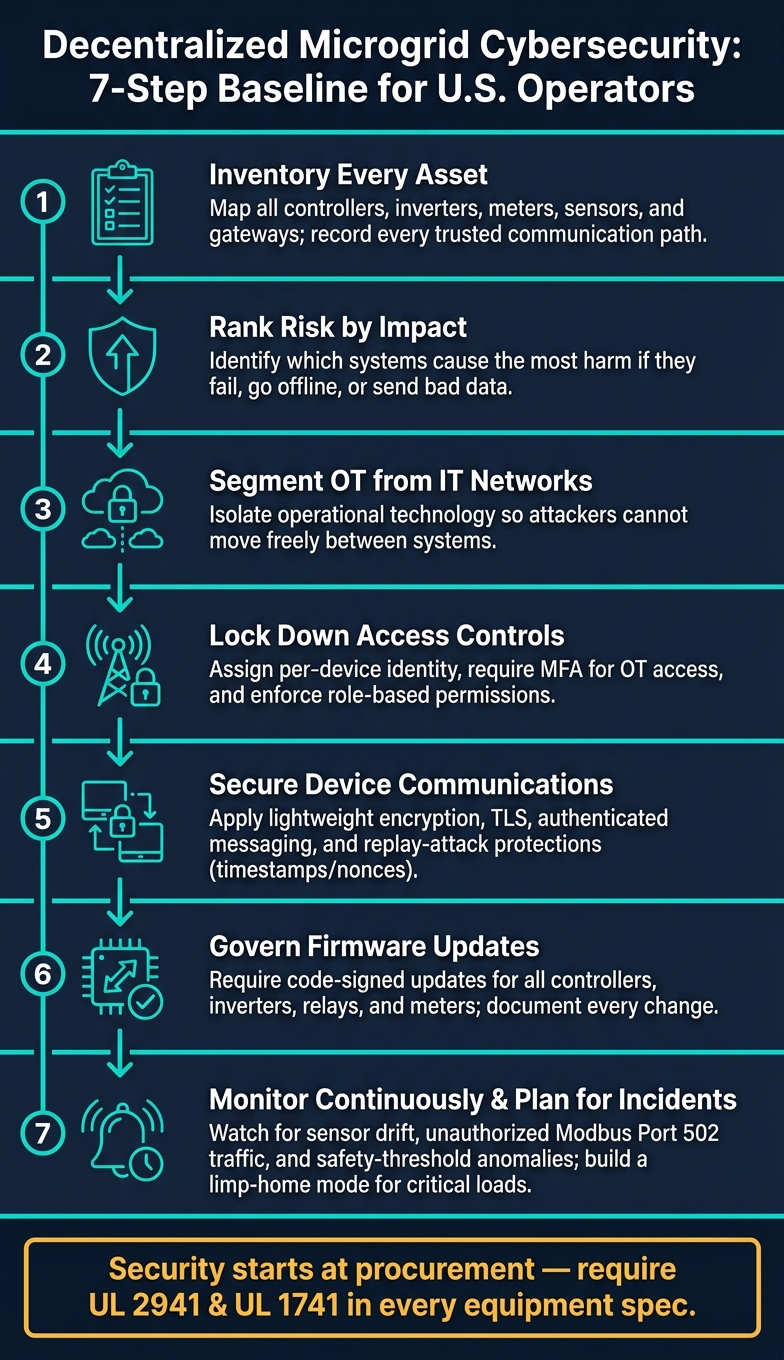
Decentralized Microgrid Cybersecurity: 7-Step Baseline for U.S. Operators
Start With Asset Inventory, Risk Ranking, and Network Segmentation
Start with a full asset inventory. In a decentralized microgrid, control is split across vendors and ownership groups. That makes it hard to protect what you can't clearly see. You need to know exactly what's connected, where it sits, and how data moves between systems.
Map controllers, inverters, meters, sensors, and gateways. Then record every trusted communication path. That map becomes the baseline for everything that follows.
Next, rank assets by outage and safety impact. Which systems would hurt the most if they failed, went offline, or sent bad data? Isolate those high-risk paths first. After that, segment OT and IT networks so an attacker can't move freely from one system to another.
A few rules help here:
- Treat OT traffic as untrusted unless you have clearly allowed it.
- Use micro-segmentation so each device can reach only approved destinations.
- Audit firewall rules for broad "ALLOW" entries that may have been left behind after earlier integrations.
Once the asset map is done, lock down who and what can talk to each system.
Apply Access Controls, Secure Communications, and Firmware Governance
Give every device its own identity. Shared credentials are a mess in any setting, but in OT they can turn one small problem into a site-wide one. Require MFA for OT access, and limit permissions by role so people get only the access they need.
Secure communications matter too. Use lightweight encryption for constrained devices. Add timestamps or nonces to block replay attacks.
Firmware governance deserves the same level of attention. Require code-signed updates for controllers, inverters, relays, and meters. Document each change with an approval record so there's a clear trail of what changed, when, and why.
Patching in OT has to work around uptime and safety limits. That's normal. But pushing fixes off forever leaves the door open longer than it should stay open.
After access is locked down, monitoring becomes the last backstop.
Monitor Continuously and Plan for Incident Response
Watch for telemetry that doesn't line up with nearby sensors or normal operating limits. If one device shows a sharp temperature spike while nearby devices stay steady, or if readings drift away from adjacent sensors, that can point to a False Data Injection (FDI) attack.
Keep an eye on Modbus Port 502 for unauthorized controller traffic. Also audit data changes that cross safety thresholds. Small signals like these can be the first sign that something is off.
You also need a fallback plan. Build a limp-home mode that keeps critical loads running through physical protections if digital control fails. In plain terms, if software goes down, the whole site shouldn't go dark with it.
Train operators to run the system manually when needed. That way, a software failure doesn't automatically turn into a full outage.
These controls work best when security is built into equipment selection.
Procurement and Implementation: Building Security Into Equipment Decisions
Security work doesn’t begin at commissioning. It begins when you decide what equipment to buy. Voltage ratings, compatibility, lead time, and price all matter. But if a controller arrives with default credentials and no firmware update policy, it’s a problem on day one.
That’s why procurement matters so much. It’s the last point where you can stop weak controls before the equipment ends up in the field.
What to Require When Buying Controllers, Breakers, Transformers, and DER Equipment
Include UL 2941 and UL 1741 in every procurement spec. Then go a step further and ask vendors to confirm that security is built into the device itself.
Your specs should cover:
- Standards: UL 2941 (cybersecurity), UL 1741 (safety/interconnection)
- Access control: Multi-factor authentication, role-based access, identity certificates
- Encrypted communications: TLS and authenticated messaging for device and cloud traffic
- Logging: Event logging, real-time status reporting, automated alerting
- Firmware governance: Signed firmware update process, vulnerability disclosure policy
This is the kind of detail that saves headaches later. If it isn’t written into the purchase requirements, there’s a good chance it won’t be enforced once installation starts.
Using Electrical Trader to Support Secure Equipment Sourcing

Use listings as a way to narrow options, then verify security details in the manufacturer’s documentation. When sourcing parts through Electrical Trader - whether you’re looking at new or used breakers, transformers, or power generation equipment - treat listing information as a starting point, not proof of security.
Check model numbers with care. Then compare them against the manufacturer’s documents to confirm firmware functions, supported communication protocols, and authentication features before you buy.
Used equipment needs even more scrutiny. Before purchase, confirm patch history and current firmware support. A used controller may look like a good deal, but it can bring serious risk if it runs unsupported software or comes without configuration records.
Conclusion: Key Steps for U.S. Microgrid Operators
Write security requirements into purchase specs before any equipment reaches the field. Controls that aren’t required during procurement usually don’t get enforced after installation.
FAQs
How are decentralized microgrids harder to secure than traditional power systems?
Decentralized microgrids are tougher to protect because they add more points that attackers can hit. Instead of dealing with one central system, operators now have to watch over many smart, internet-connected devices, including home batteries, rooftop solar systems, and smart meters.
The problem doesn't stop there. These setups often rely on older equipment with weak cybersecurity, and they depend on complex two-way communication that can be exposed to eavesdropping or tampering. On top of that, there’s often no single authority in charge of enforcing the same security rules across the whole system.
What should operators secure first in a microgrid?
Operators should build cybersecurity into the microgrid from day one, not tack it on later.
The main focus areas are pretty clear. Lock down parts like generators and inverters with strong authentication and access controls. Split networks so power systems stay separate from IT networks. And handle the basics that often get missed: default credentials, unused protocols, asset management, and continuous monitoring.
Why do procurement specs matter for microgrid cybersecurity?
Procurement specifications matter because they build security into a microgrid from day one instead of bolting it on later. They set clear security requirements for parts like controllers, generators, and inverters, which helps cut risk from older equipment.
This secure-by-design approach makes cybersecurity part of the system architecture itself and supports long-term grid resilience.





