




Copper vs. Aluminum Wires: Connector Selection Tips
The short answer: use the connector that is listed for the wire you have, and torque it to spec. If you’re working with aluminum, add oxide cleanup, anti-oxidant compound, and the right transition hardware when copper and aluminum meet.
Here’s the whole article in plain terms:
- Copper and aluminum do not terminate the same way.
- Copper is easier to work with at the connector.
- Aluminum needs more care because it forms a nonconductive oxide layer, expands more with heat, and can loosen over time.
- Aluminum has about 61% of copper’s conductivity, so it needs a larger conductor for the same amp load.
- Aluminum is much lighter and far less expensive by raw material price: about $3,000–$3,200 per ton vs. $13,000–$13,400 per ton for copper.
- For aluminum, check for markings like AL, CU/AL, AL/CU, or CO/ALR.
- For copper-to-aluminum joints, use a listed bimetallic connector.
- For new aluminum work, use AA-8000 series conductors, not older AA-1350 for new installs.
- In all cases, match listing, wire size, strand class, temperature rating, and torque value.
If I had to boil it down to one rule, it would be this: copper gives you more room for error, aluminum does not.
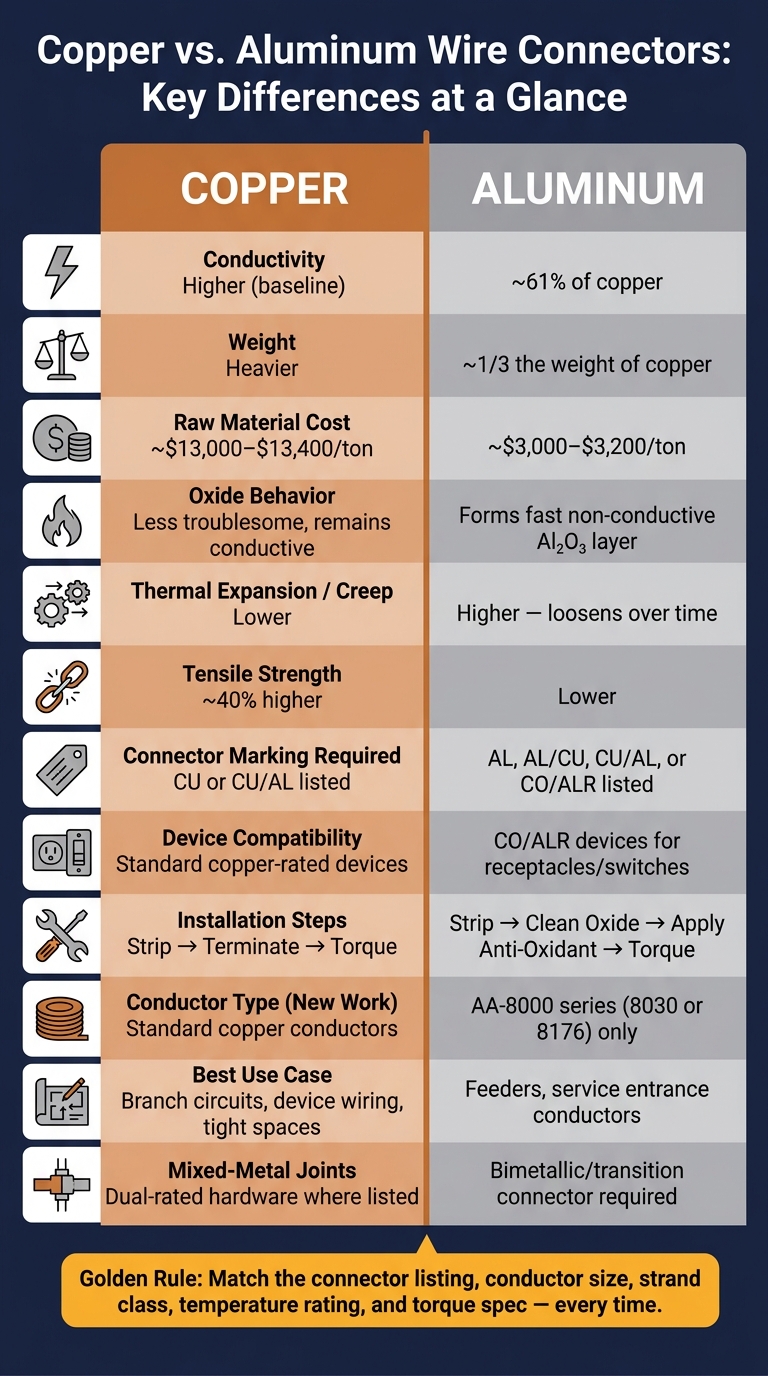
Copper vs. Aluminum Wire Connectors: Key Differences at a Glance
Safely connect Aluminum and Copper Wiring for code compliance
sbb-itb-501186b
Quick Comparison
| Point | Copper | Aluminum |
|---|---|---|
| Common U.S. use | Branch circuits, device wiring | Feeders, service entrance conductors |
| Conductivity | Higher | About 61% of copper |
| Weight | Heavier | About 1/3 the weight of copper |
| Oxide at termination | Less troublesome | Forms fast and blocks conduction |
| Expansion and creep | Lower | Higher |
| Connector needs | Copper-rated or dual-rated listed connector | Aluminum-listed connector only |
| Device rule | Standard copper-rated devices where listed | CO/ALR devices for receptacles/switches |
| Mixed-metal splice | May use dual-rated hardware where listed | Use bimetallic/transition connector |
| Install steps | Strip, terminate, torque | Strip, clean oxide, add anti-oxidant, torque |
So if you’re choosing between copper and aluminum connectors, the job is not just “Will the wire fit?” The job is “Is this connector listed for this conductor, and will the joint stay tight and cool over time?”
Copper Wire: Connector Requirements and Suitable Options
How Copper's Properties Affect Terminations
Copper’s higher conductivity, lower expansion, and lower creep make terminations more stable. In plain English, that usually means easier torque control and joints that stay steadier over time. Its oxide layer also stays fairly conductive, so light surface oxidation is less likely to create a high-resistance joint than it is with aluminum.
That said, copper isn’t foolproof. It gives you a bit more room for error, but torque still decides joint quality. If a termination is under-torqued, it can loosen, overheat, and even start a fire.
Connectors Commonly Used With Copper Conductors
Once you understand how copper behaves at the termination point, picking a connector is mostly about the load, the setting, and the required listing. Common options for copper conductors include mechanical lugs, compression lugs, listed terminals, and shear-bolt lugs.
Single-hole lugs are standard in most jobs. Dual-hole lugs make more sense where vibration resistance and mechanical stability matter.
| Connector Type | Typical Application | Key Verification Step |
|---|---|---|
| Mechanical Lug | General copper terminations | Confirm bolt torque with a calibrated torque tool |
| Compression Lug | Permanent, high-reliability connections | Confirm die size exactly matches the lug and conductor size |
| Listed Terminal | Copper-rated wiring accessories | Confirm the terminal is rated for the copper wire type and rating |
| Shear Bolt Lug | Shear-bolt terminations | Verify the conductor range and shear-off point |
Dual-rated lugs marked AL7CU or AL9CU can also be used on copper conductors. If you go that route, check that the temperature rating and conductor size range match the wire’s AWG or cross-sectional area.
No matter which connector you use, three checks always matter:
- The barrel size must match the wire size.
- The connector must be listed for the conductor type.
- The temperature rating must match or exceed the insulation rating, usually 75°C or 90°C.
Copper tends to be more forgiving. Aluminum doesn’t give you that same margin, so connector listing and surface prep matter much more in the next part.
Aluminum Wire: Connector Rules and Failure Risks
How Aluminum's Properties Change Connector Selection
Aluminum needs tighter control at the termination than copper. The reason is pretty simple: oxide, thermal cycling, and creep can all work against the connection.
Once aluminum is stripped, a hard, non-conductive oxide layer (Al₂O₃) forms on the surface within seconds. If that oxide isn't dealt with, the joint can turn loose and high-resistance, and that can lead to overheating. Aluminum also expands and contracts more than copper. On top of that, it can creep under constant pressure, which means the connection may loosen over time as it heats and cools through normal use. So in practice, listing, surface prep, and torque are what make or break the joint.
Connectors and Devices Listed for Aluminum
Don't use copper-only connectors on aluminum conductors. Use terminals and devices that are listed for aluminum, and check for markings such as AL, AL/CU, or CO/ALR on the device or terminal.
For aluminum-to-copper transitions, use bimetallic (Al/Cu) lugs or tin-plated transition terminals to help reduce galvanic corrosion. Where aluminum conductors terminate on receptacles or switches, use CO/ALR-rated devices. CU-only devices are not listed for aluminum and must not be used.
| Connector Type | Use Case | Key Requirement |
|---|---|---|
| AL/CU Dual-Rated Lug | General aluminum terminations | Must be listed for aluminum and torqued to spec |
| Bimetallic (Al/Cu) Lug | Aluminum-to-copper transitions | Helps prevent galvanic corrosion |
| CO/ALR Device | Branch-circuit receptacles/switches | Must be rated for aluminum conductors |
Apply oxide-inhibiting compound to the stripped conductor and the connector contact surfaces. Then tighten the connector to the manufacturer's exact torque spec with a calibrated torque tool. If the manufacturer requires it, re-tighten after the first thermal cycle.
For new work, use AA-8000 series aluminum alloy conductors. Older AA-1350 series conductors are not acceptable in new work because of poor creep resistance and fire risk. On older installations, confirm the conductor alloy before you pick the connector. That's one of the big differences covered in the side-by-side guide below.
Copper vs. Aluminum Connectors: Side-by-Side Selection Guide
At the terminal, the main question is simple: is the connector listed for that conductor, and will it keep its torque over time?
Comparison Table: Performance at the Termination Point
The gap between copper and aluminum shows up most clearly where the wire lands. That’s where resistance, heat, oxide buildup, and torque control can make or break the joint.
| Feature | Copper conductor + copper-rated connector | Aluminum conductor + listed CU/AL connector | Copper-to-aluminum transitions + bimetallic connectors |
|---|---|---|---|
| Conductivity | Stable at the joint; low resistance under normal torque | Oxide layer raises resistance if not removed and sealed | Depends on the transition connector design |
| Thermal Stability | Copper stays tighter under heat; aluminum demands tighter torque control. | Higher expansion and creep risk if torque isn't controlled | Differential expansion must be managed |
| Oxidation Behavior | Copper oxide remains relatively conductive | Aluminum forms a non-conductive Al₂O₃ layer that must be removed and sealed | Use a bimetallic connector to prevent galvanic corrosion |
| Installation Steps | Copper: straightforward. Aluminum: requires oxide removal, anti-oxidant, and exact torque. | Higher; requires oxide removal, anti-oxidant compound, and correct torque | Higher; requires listed transition hardware |
| Maintenance Needs | Copper: low. Aluminum: check torque after thermal cycling when required. | Periodic torque checks may be needed after thermal cycling | Moderate; inspect for corrosion at the interface |
The next part is avoiding the slipups that lead to failed terminations.
When to Use Copper and When Aluminum Makes Sense
Copper is the better fit for branch-circuit work, tight spaces, and connections that will be moved or reworked often. It also has about 40% higher tensile strength than aluminum, which helps during installation.
Aluminum makes sense on large feeders and service conductors, where lower weight and material cost matter most. The catch? You need stricter control over connector listing, surface prep, and torque.
For modern aluminum terminations, use AA-8000 series conductors such as 8030 or 8176.
Common Connector Selection Mistakes to Avoid
A few mistakes show up again and again in the field:
- Using a CU-only connector on aluminum wire. If the lug or terminal isn't marked AL, CU/AL, or CO/ALR, don't use it on aluminum conductors.
- Skipping the anti-oxidant compound. Strip the conductor, remove the oxide layer, and seal the joint before tightening.
- Direct copper-to-aluminum contact without a listed transition connector. Use a bimetallic lug or listed transition terminal to prevent galvanic corrosion and loose connections.
Before buying, match the connector marking, conductor range, and torque spec.
Sourcing Listed Connectors and Final Recommendations
Use the termination requirements above to verify the exact connector before you buy.
What to Check Before You Buy
Before you purchase any connector or lug, check the specs against your conductor and the job at hand.
- Connector listing: Check the connector listing: CU, AL, CU/AL, AL/CU, AL7CU, or AL9CU.
- Wire size range: Make sure the connector covers your exact AWG or kcmil size.
- Strand class: Confirm the connector is listed for your conductor's strand class, whether compact, compressed, or concentric.
- Temperature rating: Check the connector's temperature marking and make sure it fits the application. For example, AL9CU indicates a connector listed for both copper and aluminum conductors at 90°C.
- Termination type: For aluminum, buy only connectors listed for aluminum; for copper-to-aluminum joints, use a listed bimetallic transition connector.
- Torque value: Follow the manufacturer's torque spec and use a calibrated torque wrench. Some manufacturers also call for re-tightening after the first thermal cycle.
On Electrical Trader, verify lug ratings, conductor compatibility, and AWG/kcmil ranges before buying used or new equipment. That step matters because used equipment can come with different lug ratings and conductor ranges depending on the manufacturer and the equipment's age.
Conclusion: Match the Connector to the Conductor and Its Listing
Aluminum terminations can perform well, but only when the connector is listed for aluminum, the conductor is AA-8000 series alloy, and the installation follows the full process: oxide removal, anti-oxidant compound applied after stripping and before tightening, and calibrated torque.
In both cases, the rule is simple: match the connector to the conductor, the listing, and the torque spec.
FAQs
Can I use a CU/AL connector on copper wire?
Yes - if the connector is rated for copper.
Check the markings on the connector:
- CU = for copper only
- AL-CU = for both copper and aluminum
Also, make sure the connector is listed for your intended use. That helps maintain safety and electrical code compliance.
How do I identify AA-8000 aluminum wire?
Look for markings that show the AA-8000 series aluminum alloy, often printed as “AA-8000” or the exact alloy designation. Then make sure the conductor is aluminum, not copper.
Connector markings need to match the conductor material. Use AL or AL-CU for terminations that work with this conductor. Do not use connectors marked CU for AA-8000 aluminum conductors.
When should I use a bimetallic connector?
Use a bimetallic connector any time you need to join an aluminum conductor to a copper conductor.
When these two different metals touch directly, they can trigger galvanic corrosion. Over time, that corrosion can increase electrical resistance and add fire risk.
A bimetallic connector helps avoid that problem. It creates a secure connection that limits corrosion and supports long-lasting electrical continuity.





