

How to Choose Connectors for Stranded and Solid Wire
The short answer: match the connector to the wire type, wire size, and listing before you install it. If the connector is wrong for solid or stranded wire, the result can be loose contact, heat, failed inspection, or a code issue.
Here’s the simple rule I’d follow:
- Check the conductor type: solid or stranded
- Check the wire size: AWG must be within the listed range
- Check the listing: use connectors marked for that wire type and material
- Check the job: vibration, flexing, and current level change what works
A few points matter most:
- Solid wire is common in fixed building runs
- Stranded wire is common in cords, equipment leads, and control wiring
- Spring-style terminals often hold up better where vibration is present
- Push-in terminals are often for solid wire unless the product says otherwise
- Low contact resistance matters: many listed connectors are tested to 10 mΩ or less
- Strip length and torque matter just as much as connector choice
If I had to reduce the whole article to one checklist, it would be this: confirm wire type, AWG, material, connector listing, strip length, and final termination quality before energizing.
| What to check | What I’d look for |
|---|---|
| Wire type | Solid, stranded, or fine-stranded |
| Wire size | Exact AWG, not “close enough” |
| Material | Copper or aluminum |
| Connector label | Listed for the wire type and size |
| Job conditions | Vibration, movement, panel use, low-voltage, or high current |
| Installation | Correct strip length, full strand control, proper torque |
That’s the whole decision in plain terms: the wire has to fit the connector on paper, not just in the opening.
Which Wire Connector Should You Use?
sbb-itb-501186b
How Solid and Stranded Conductors Behave in Connectors
Solid conductors are easier to seat because they keep their shape. Stranded conductors are less forgiving. The connector has to hold every strand, or resistance and heat can climb. That’s why connector choice matters so much, especially in equipment that shakes, hums, or runs for long periods.
The main mechanical difference comes down to strand capture. A connector gripping solid wire clamps a single piece of metal. A connector gripping stranded wire has to secure a bundle. If strands spread outside the clamp area, the termination can end up with poor contact. Poor strand capture raises resistance and can overheat the termination, damaging insulation or causing a short. Add vibration to the mix, and the risk gets worse. Screw-type terminals can loosen under repeated mechanical stress. Spring-cage clamps keep constant pressure and resist loosening under vibration better than screw terminals.
Where Solid Wire Is Typically Used
In the U.S., solid wire is the standard for fixed, permanent building wiring, such as branch-circuit wiring. That makes sense: fixed wiring doesn’t need to bend much once it’s in place. It also means the connector has to match the conductor type. Connectors listed for rigid conductors are the right fit here. Solid conductors can work with push-in or IDC terminations only when the connector is listed for solid wire.
That last point matters. A wire sliding into a connector doesn’t mean the connection is approved or safe. Use only listed solid-wire connectors.
Where Stranded Wire Is Typically Used
Stranded wire is used where movement, flexing, or vibration is part of the job. That includes equipment whips, motor leads, and flexible cords. In these cases, the connector needs to do two things well:
- keep all strands inside the clamp area
- maintain contact pressure over time
That’s a big deal in motor-driven equipment like pumps and compressors. Heat cycles and vibration can slowly work against a weak termination. In those settings, spring-clamp terminals are strongly preferred over screw terminals because they maintain consistent contact pressure through thermal cycling and vibration.
How to Verify Connector Listings for Wire Type, AWG, and Conductor Class
A connector may look like a match and still be wrong for the job. Don’t judge by whether the wire slides into the opening. Check the label, packaging, or datasheet first. Once that lines up, then look at connector family and install details.
Read Labels for Solid Only, Stranded Only, or Solid/Stranded Ratings
Every listed connector should spell out what it supports. Before you install anything, check the supported wire type - solid, stranded, or both - the AWG range, and any material limits, such as copper-only. The datasheet gives the exact wire range and wire type, so you’re not left guessing.
For U.S. installs, look for UL 486A-486B listings. That standard covers pull-force testing plus mechanical and electrical integrity checks. In plain English, it means the connector was tested for the wire types it says it can handle.
Why Using Out-of-Range Wire Is a Safety and Code Problem
Using wire that falls outside the listed range - or a wire type the connector doesn’t support - can increase resistance, create heat, and put you on the wrong side of code. Connectors are typically tested to a maximum contact resistance of 10 mΩ or less. Go past that point, and the joint can overheat under a steady load.
Aluminum in a copper-only terminal is another problem. It can creep and loosen unless the connector is listed for aluminum and installed exactly as specified.
Use Product Documentation on Electrical Trader to Confirm Compatibility
Electrical Trader shows product markings and specs so buyers can verify conductor type and AWG before ordering. Once the listing matches, you can move on to the connector family, strip length, and strand-capture method that make sense for the job.
How to Match Connector Type to the Job Before Installation
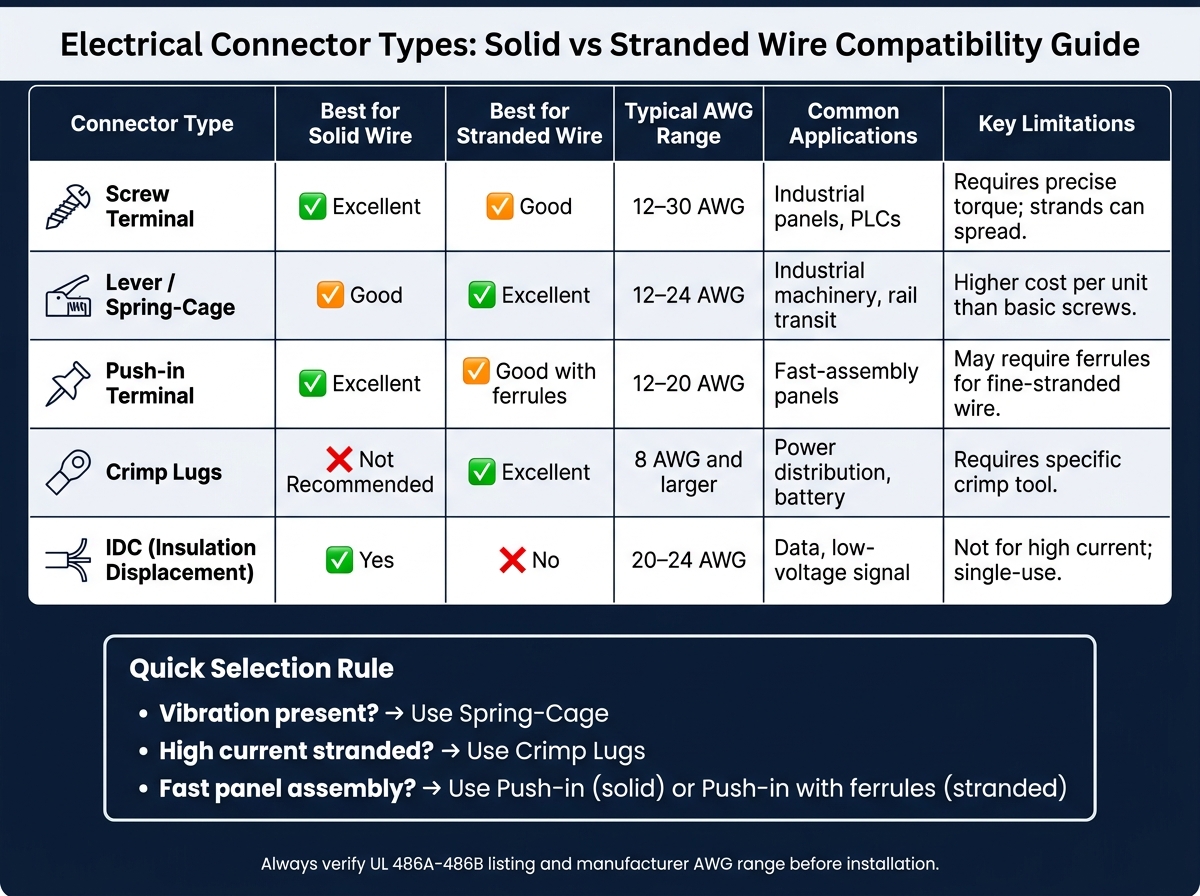
Electrical Connector Types: Solid vs Stranded Wire Compatibility Guide
Once you’ve confirmed the listing matches your wire type and AWG, the next step is choosing the connector family that fits the job.
That part matters more than it sounds. Electrical compatibility is only half of it. The connector also needs to match how the wire will be used in the field. Before installation, check the product label and circuit rating. Then confirm the strip length and how the connector handles strand capture.
Pick the Right Connector Family for the Wire
Lever-style connectors work best for serviceable joints. If you may need to open, inspect, or redo the connection later, they’re a solid pick.
Screw terminal blocks fit compact panel wiring well. They can handle both solid and stranded conductors, but stranded wire needs extra care. Keep the strands tightly bundled before insertion so they don’t spread. If the setup involves vibration, use spring-cage terminals instead. Save push-in terminals for stable installations.
Push-in terminals are handy for fast-assembly panels. They’re mainly meant for solid wire. If you want to use stranded wire, use ferrules only when the listing allows it.
Crimp lugs are the right fit for permanent, high-current stranded connections. When the connection needs to stay put and carry more current, this is usually the way to go.
IDC connectors are meant for low-voltage signal wiring, usually 20–24 AWG solid wire. They’re not built for heavier current loads.
Check Strip Length and Strand Capture Before Finalizing the Connection
Strip 8–10 mm of insulation, or use the manufacturer’s stated length, so the conductor seats fully without leaving exposed copper.
With stranded wire, keep the strands tightly bundled before insertion. Also check that no stray strands sit outside the clamp zone, since that can lead to arc faults.
For screw terminals, use a calibrated torque driver and tighten to the manufacturer’s spec.
Connector Comparison Table
| Connector Type | Best for Solid | Best for Stranded | Typical AWG Range | Common Applications | Key Limitations |
|---|---|---|---|---|---|
| Screw Terminal | Excellent | Good | 12–30 AWG | Industrial panels, PLCs | Requires precise torque; strands can spread |
| Lever / Spring-Cage | Good | Excellent | 12–24 AWG | Industrial machinery, rail transit | Higher cost per unit than basic screws |
| Push-in Terminal | Excellent | Good (with ferrules) | 12–20 AWG | Fast-assembly panels | May require ferrules for fine-stranded wire |
| Crimp Lugs | Not Recommended | Excellent | 8 AWG and larger | Power distribution, battery | Requires specific crimp tool |
| IDC (Insulation Displacement) | Yes | No | 20–24 AWG | Data, low-voltage signal | Not for high current; single-use |
Common Compatibility Mistakes and a Final Selection Checklist
Mistakes That Lead to Loose or Noncompliant Terminations
After you’ve picked the connector, the last big risk is the install itself. A lot of failures come from skipping the same basic checks discussed earlier: wire type, AWG, and installation method.
One common slip is using a connector that isn’t listed for the wire’s wire type. Another is picking a wire gauge that doesn’t match the pin or connector series. With stranded wire, things can go wrong fast if the conductors aren’t twisted into a tight bundle before insertion, or if stray strands sit outside the clamp zone. That can create high-resistance points and even shorts.
Torque errors show up again and again. Tighten the connection to the connector’s listed torque. Too much force can strip threads. Too little can leave the conductor loose.
Aluminum terminations are another trouble spot. For aluminum conductors, remove oxide and apply anti-oxidant compound only when the connector listing calls for it.
A Short Selection Checklist for Buyers and Installers
Use this checklist to catch the issues most likely to cause a failed termination.
Before energizing any connection, go through these steps:
- Confirm conductor material - copper or aluminum, and whether the terminal is rated for it.
- Identify wire type - solid or stranded, and whether the connector listing covers that class.
- Verify AWG - make sure the wire gauge falls within the connector’s rated range, not just somewhere close.
- Check the environment - vibration or outdoor exposure may call for spring-cage, locking, or sealed connectors.
- Inspect the finished termination - then run a continuity test and a thermal check under load.
When sourcing parts, product specs and markings on Electrical Trader can help confirm AWG range and wire type compatibility before purchase.
Conclusion: Match the Connector to the Wire, Check the Listing, and Inspect the Result
Match the wire type, AWG, torque, and installation method to the connector listing. Then inspect the finished termination before energizing.
FAQs
Can I use stranded wire in a push-in connector?
Yes - if the push-in connector is rated for stranded wire.
Many push-in, or splicing, connectors work with both solid and stranded conductors. But this isn’t something to guess on. Check the manufacturer’s specs for the right AWG range and approved wire type.
One more thing: avoid using standard connectors with fine-stranded wire unless the product is rated for it. If not, you can end up with loose strands, a weak hold, or outright connection failure.
Do I need ferrules for stranded wire?
Yes, ferrules are strongly recommended for stranded wire, especially in industrial and commercial settings.
They hold the wire strands together in a neat, even cylinder. That helps stop fraying and keeps the connection from loosening when the terminal clamps down.
The result is a more secure connection and better mechanical strength. It also cuts the risk of short circuits or connection failure caused by stray or loose strands.
Ferrules can also help the wire stand up better to vibration, corrosion, and repeated bending.
What happens if the wire gauge is slightly off?
If the wire gauge is even a little off, the connection might fail basic safety or performance standards. And that’s not a small issue.
A wire that’s too small can increase electrical resistance. Under load, that extra resistance creates heat. Enough heat can melt insulation, damage the connection, or even start a fire.
There’s also the fit problem. Terminals are made for specific conductor sizes, so if the wire and terminal don’t match, you may not get a secure mechanical or electrical connection.