Cooling System Maintenance Checklist for Transformers
A reliable transformer cooling system starts with regular maintenance. Neglecting it can lead to overheating, insulation damage, and reduced lifespan. This guide provides a detailed checklist to ensure your cooling system operates efficiently and avoids costly failures.
Key Takeaways:
- Daily checks: Monitor oil levels, temperatures, and silica gel breather color.
- Weekly tasks: Inspect cooling system operation and cleanliness.
- Monthly inspections: Check bushing oil levels and clean breather holes.
- Annual maintenance: Test fans, pumps, and control circuits; perform infrared scans and oil sampling.
- Every 2 years: Calibrate sensors and test bushings.
Proactive maintenance saves time and money. Recordkeeping is essential to track trends and identify issues early. Follow this systematic approach to extend your transformer's lifespan and minimize unplanned outages.
Transformer maintenance and checklist
sbb-itb-501186b
Visual Inspection of Cooling Components
Regular visual inspections are a crucial step in preventing cooling system failures. Issues like blocked airflow, corrosion, or damaged seals are often visible early on, allowing you to address them before they cause major problems. To cover all bases, focus on specific components such as fans, ducts, and seals during your checks.
Inspecting Fans and Radiators
Take a close look at radiator fins and fan assemblies. Watch for dust, dirt, bird nests, or debris that can accumulate on fins and hinder heat dissipation. Also, check for rust, bent fins, physical damage to the tank surface, loose bolts, or anything that might obstruct blade motion or cause vibrations. A well-functioning cooling fan should reach its full operating speed within about 5 seconds of activation. If you notice a fan running sluggishly or wobbling, schedule maintenance immediately.
As Edvard Csanyi, Founder of EEP, points out:
"Dust and dirt on the transformer leads to reduced dielectrical strength and cooling due to different environmental conditions."
Examining Cooling Ducts and Air Passages
In dry-type transformers, dust buildup inside cooling ducts can block airflow and weaken the insulation's dielectric strength. Inspect louvers, vents, and exhaust openings for debris. If you notice heavy dust near these areas, it's a sign that an internal inspection is needed.
When cleaning, use a vacuum for horizontal surfaces and dry compressed air or nitrogen at a pressure no greater than 3 bar (about 44 psi) for coil cooling ducts. Avoid using water or solvents inside the enclosure to prevent damage.
Checking Filters, Enclosures, and Seals
Beyond fans and ducts, it's important to inspect the enclosure and sealing components to protect against environmental wear. Look for rust, bare metal spots, or weather seal damage on the control cabinet and conduits. If you find paint damage on zinc-coated surfaces, repair it promptly. For exposed areas larger than 50 mm² (approximately 0.08 in²), apply zinc-rich paint with at least 92% metallic zinc in the dry film.
Pay attention to gaskets and seals. Look for oil stains, seepage, or signs of brittleness or deformation in the gasket material. If you spot a minor leak at a gasket joint, tighten the bolts carefully to avoid cracking the gasket or stripping threads. If a gasket has lost its elasticity, it should be replaced. Lastly, check the silica gel breather. When about two-thirds of the material has changed color (e.g., from blue to red, pink, or white), it's time to replace it.
Monitoring Fan and Pump Operation
Once you've completed visual inspections, the next step is verifying that all cooling components are functioning as they should. Operational testing ensures these components perform effectively under real-world conditions, complementing the earlier physical checks by confirming that observed functionality aligns with inspection results.
Testing Fan and Pump Functionality
To get the most accurate assessment of your cooling components, bypass the automatic controls and switch the fan to the manual position. Observe how the fan responds. According to EEP:
"The fans should rotate at full speed within approximately five seconds. The fans should rotate smoothly with minimal vibration."
If a fan doesn't reach full speed in five seconds or shows excessive vibration, further investigation is necessary. For liquid-cooled systems, ensure both pumps and fans start quickly and operate quietly.
Additionally, check the base and enclosure for vibrations, as these can indicate mechanical stress. These inspections should be part of routine walkarounds (daily or weekly), while a full manual test should be scheduled annually.
It's also critical to evaluate the control circuits to ensure the system operates seamlessly.
Assessing Control Circuits and Sensors
Even with properly functioning fans and pumps, the system can fail if the control circuits aren't in good condition. As Electrical4U explains:
"The automatic, remote, and manual functions of the cooling system of transformer - including oil pumps and air fans - should be checked annually. If issues arise, investigate the control circuits and the physical condition of pumps and fans."
Perform annual checks of sensor oil levels in the OTI and WTI pockets, calibrate these sensors every two years, and inspect control wiring against the system's wiring diagram. Tighten all terminal connections in the marshalling box to ensure reliability. In areas with high humidity, verify that anti-condensation heaters in control cabinets are working, as moisture can lead to intermittent failures in control circuits.
The table below outlines essential maintenance tasks and their recommended intervals:
| Maintenance Task | Frequency | Key Action |
|---|---|---|
| Fan/pump manual start test | Annual | Confirm full speed (~5 seconds) and minimal vibration |
| Noise and vibration check | Daily/Weekly | Listen for unusual buzzing; inspect the base and enclosure |
| Control wiring inspection | Annual | Examine insulation and weather seals |
| Terminal tightening | Annual | Secure all control and relay wiring in the marshalling box |
| OTI/WTI oil pocket check | Annual | Replenish oil in sensor pockets if needed |
| OTI/WTI calibration | Every 2 years | Calibrate sensors for accurate setpoint triggering |
Thermal Monitoring and Temperature Readings
Once you've checked the cooling components, it's time to evaluate the transformer's thermal behavior. Temperature data is one of the most reliable indicators of potential problems, offering early warnings before they escalate.
Conducting Infrared or Thermographic Scans
Infrared (IR) scanning helps identify issues that standard gauges might overlook. For accurate results, always perform scans while the transformer is energized and operating under load. A transformer that's cold or lightly loaded won't display the true thermal patterns.
Electrical engineer Ahmed Sheikh emphasizes:
"On larger transformers, check for hot spots on the transformer enclosure; they may indicate localized overheating because of poor cooling, arcing in liquid-filled units, or possible shorted windings."
As a general guideline, the top of the transformer enclosure should not exceed 149°F above the ambient temperature. For instance, if a hot spot is detected at the bushing terminals during an IR scan, it might signal a loose or dirty connection rather than a cooling system failure. Aim to perform these scans annually, ideally before de-energizing the unit for scheduled maintenance, so any issues can be addressed promptly.
Comparing Operating and Ambient Temperatures
After conducting thermographic scans, compare the transformer's operating temperature with the ambient temperature. Simply reading the Oil Temperature Indicator (OTI) or Winding Temperature Indicator (WTI) in isolation won't provide the full picture. To interpret these readings effectively, you need to measure the ambient temperature and kVA load at the same time.
Edvard Csanyi, an electrical engineer at EEP, explains:
"Gauge readings, ambient temperature, and kVA load should be measured and recorded. Any abnormal reading suggests that further diagnostic testing or inspection should be done."
If the oil temperature rises without a corresponding increase in load, it's a warning sign. According to NPC Electric:
"Any spikes in oil temperature without a corresponding increase in load could point to internal issues, like core hot spots or blocked cooling paths."
For liquid-filled transformers, always document the liquid level alongside the temperature. This is critical because liquid levels fluctuate with temperature changes.
Tracking Temperature Trends Over Time
While individual readings are helpful, tracking temperature patterns over time provides deeper insights. A slow, steady increase in winding temperature - though still within acceptable limits - might indicate developing problems like partially blocked cooling passages or degrading insulation.
Ahmed Sheikh highlights the importance of context:
"Any winding temperature readings should also include a record of ambient temperature, which affects the amount of heat transfer from the transformer."
To identify meaningful trends, record ambient temperature alongside winding temperature at consistent times of day and under similar load conditions. This approach helps distinguish between normal daily variations and genuine concerns. The table below outlines key temperature-related tasks and their recommended frequencies:
| Task | Frequency |
|---|---|
| Record OTI, WTI, and oil level | Daily |
| Record gauge readings, ambient temperature, and kVA load | Monthly / Annually |
| IR scan of terminals, top dome, and joints | Annually |
| Calibrate OTI and WTI sensors | Every 2 years |
Up next, we'll look at cooling fluid checks and leak inspections to round out the maintenance checklist.
Cooling Fluid and Leak Checks
Keeping the cooling system in top shape depends on maintaining fluid quality, much like regular checks on fans and sensors. For liquid-cooled transformers, the oil serves two critical purposes - it insulates and cools. If the oil becomes contaminated or its level drops, both functions are compromised, leading to potential overheating.
Checking Oil Levels and Radiator Integrity
Start by checking the Magnetic Oil Gauge (MOG) readings daily on both the main and conservator tanks to ensure oil levels are within their normal range. If you notice a low reading, don’t just top it off - inspect the tank and all joints for possible leaks.
For transformers equipped with oil-filled bushings, make it a habit to visually inspect the bushing oil indicator monthly. Only refill the oil during scheduled shutdown periods. Once a year, check the oil levels in the Oil Temperature Indicator (OTI) and Winding Temperature Indicator (WTI) pockets located on the transformer’s top cover. Replenish the oil if necessary.
Radiators also deserve close attention. Look for signs of seepage, staining, or corrosion, especially around welded seams and flanged connections. If you find leaks in welded joints, they should only be repaired by a qualified welder under oil-filled or inert gas conditions.
Once you’ve confirmed the oil levels and radiator integrity, shift your focus to seals and any potential moisture issues.
Inspecting Gaskets, Seals, and Moisture Intrusion
After confirming the oil levels, examine the seals and gaskets for any signs of leakage. Pay particular attention to gaskets around bushings, covers, and valves. As EEP’s Electrical Engineering Portal explains:
"If the gaskets are leaking, leaks can usually be sealed by tightening the screws (bolts). When these gaskets have to be replaced, it is recommended to contact manufacturer."
If tightening the screws doesn’t resolve the issue, the gasket may have lost its elasticity due to heat or aging and will need replacement. Common materials for gaskets include nitrile rubber, liquid-resistant vulcanized cork sheet, and silicone sealant.
The silica gel breather is another critical component to check monthly. Replace it if its color changes - blue to red for older types, or pink to white for newer ones. Don’t forget to clean the breather holes to maintain proper airflow. Additionally, schedule semiannual oil sampling to test for dielectric strength (BDV), moisture content (PPM), acidity, and sludge. As Edvard Csanyi, Founder of EEP – Electrical Engineering Portal, points out:
"Oil acts as a good electrical insulation only as long as it is satisfactorily dry and clean."
If the moisture content in the solid insulation becomes excessive, specialized equipment like low-frequency heating may be required to dry it out. This process can take one to two weeks and requires de-energizing the transformer, making routine checks crucial to catch issues early.
| Task | Frequency |
|---|---|
| Check MOG on the main tank and conservator | Daily |
| Inspect silica gel breather color; check for visible oil leaks | Daily |
| Check bushing oil levels; inspect breather oil cup | Monthly |
| Test oil for BDV, moisture, acidity, and sludge | Every 6 months |
| Check OTI/WTI pockets; replenish oil if low | Annually |
| Test OLTC oil for dielectric strength and moisture | Every 2 years |
Maintenance Intervals and Recordkeeping
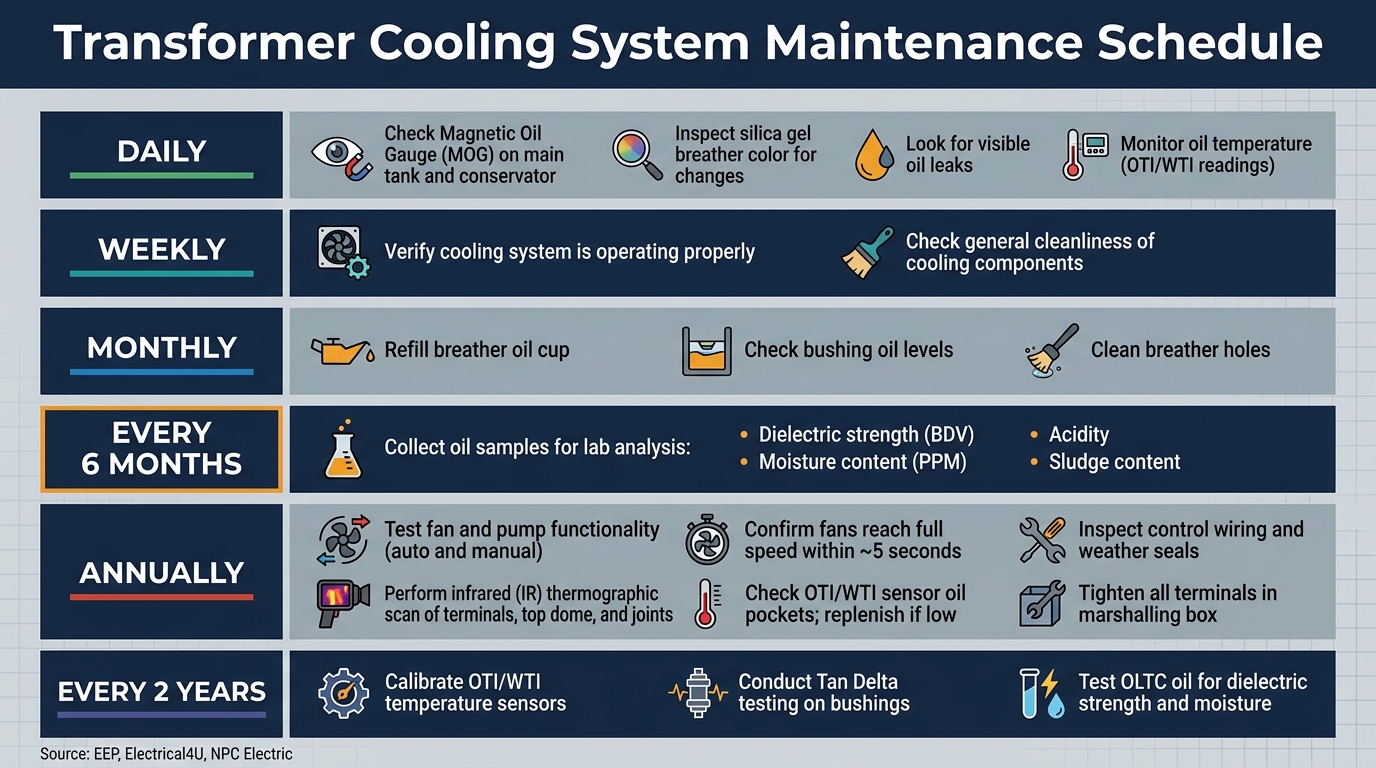
Transformer Cooling System Maintenance Schedule: Complete Interval Checklist
This section wraps up the cooling system checklist by outlining routine maintenance intervals and stressing the importance of keeping detailed records.
Routine Maintenance Schedule
Following a consistent maintenance schedule is the key to avoiding costly emergency repairs. For transformer cooling systems, the timing of tasks depends on how quickly issues can arise and the potential damage caused by delays.
- Daily: Check MOG readings, inspect silica gel color, look for oil leaks, and monitor oil temperature.
- Weekly: Verify that the cooling system is operating properly and ensure it’s clean.
- Monthly: Refill breather oil, check bushing oil levels, and clean breather holes.
- Every 6 months: Collect oil samples for lab analysis to test dielectric strength, moisture levels, acidity, and sludge content.
- Annually: Test fan and pump functionality (both automatic and manual), inspect control wiring, perform IR scans, and check OTI/WTI sensor pockets.
- Every 2 years: Calibrate OTI/WTI sensors and conduct Tan Delta testing on bushings.
As Electrical4U highlights:
"By proper condition maintenance, one can avoid emergency and breakdown maintenance. That is why technical personnel should mainly concentrate on condition maintenance. As 100% of condition maintenance causes 0% breakdown of equipment."
These regular tasks not only keep the system running smoothly but also serve as the foundation for accurate and reliable recordkeeping.
| Interval | Key Cooling System Tasks |
|---|---|
| Daily | MOG readings, silica gel color, oil leak check, oil temperature |
| Weekly | Cooling system operation check, general cleanliness |
| Monthly | Breather oil top-off, bushing oil levels, breather hole cleaning |
| Every 6 months | Oil quality testing (dielectric strength, moisture, acidity, sludge) |
| Annually | Fan/pump auto and manual tests, IR scans, wiring inspection, OTI/WTI pocket checks |
| Every 2 years | OTI/WTI calibration, Tan Delta testing on bushings |
Documenting Inspection and Maintenance Activities
Accurate documentation is a cornerstone of effective preventive maintenance. A logbook should include daily oil temperature and level readings, visual inspection results, any leaks identified (and how they were resolved), and detailed lab test outcomes like Dissolved Gas Analysis (DGA) reports.
It’s also important to schedule follow-up inspections after certain maintenance activities. For instance, after replacing gaskets, conduct a follow-up six months later to retighten and confirm the seal. These follow-ups help catch small issues before they escalate into costly repairs.
Over time, well-maintained records become a powerful tool. As NPC Electric notes:
"No maintenance plan is complete without proper documentation... Over time, this log becomes an invaluable tool for identifying patterns, forecasting issues, and making data-driven replacement decisions."
For example, tracking gradual rises in DGA gas concentrations or Tan Delta values over multiple inspections can reveal early signs of insulation aging or moisture intrusion. Without historical data to compare, these subtle warning signs might go unnoticed.
Conclusion and Key Takeaways
A transformer's cooling system is only as dependable as the effort put into maintaining it. Regular checks - ranging from visual inspections and fan tests to oil sampling and infrared scans - create a strong, layered defense against overheating and unexpected breakdowns. Daily oil and temperature monitoring can catch fast-developing problems, while annual infrared scans and sensor calibrations help address wear and tear over time. Skipping even one step weakens the system's reliability. As CIGRE aptly states:
"It is the goal of good maintenance practice to pre-emptively detect issues before they cause unnecessary damage."
This proactive approach doesn’t just prevent failures - it also saves money. Consistent maintenance reduces costs over time. For example, the Arrhenius equation's "10-degree rule" shows that every 8°C (about 14°F) to 10°C (about 18°F) rise in operating temperature above the design limit can cut the thermal life of a transformer's paper insulation by nearly half. Spotting issues like blocked radiator fins or malfunctioning fan motors early can significantly extend the transformer's operational life.
Another key factor in maintaining cooling efficiency is using dependable replacement parts. Sites like Electrical Trader offer a wide range of new and used transformers and power distribution equipment, making it easier to find the right components.
Stick to the checklist, document every inspection, and act quickly on warning signs. A well-maintained cooling system not only prevents costly failures but also safeguards your overall investment in the transformer.
FAQs
What are the first warning signs that a transformer is overheating?
If a transformer is overheating, there are several signs to watch for. Look out for discolored insulation, charring, or carbon buildup around the equipment. Burning odors or unusual smells can also be a major red flag. On top of that, visible damage such as cracks or bulging panels might signal trouble. Catching these issues early can help avoid more severe damage and maintain safe operation.
When should I escalate from routine checks to an outage and deeper inspection?
When routine checks reveal issues like low dielectric strength of oil, high moisture content, overheating, unusual noises, or hot spots exceeding 212°F, and these problems can’t be addressed through standard maintenance, it’s time to escalate the situation.
Pay close attention to critical signs like abnormal gauge readings, shifts in pressure or vacuum levels, or elevated gas levels identified through Dissolved Gas Analysis (DGA). These indicators often signal deeper issues that, if ignored, could lead to transformer failure. Prompt investigation is key to avoiding outages and ensuring system reliability.
Which oil tests matter most for cooling performance, and how often should they be done?
The most important oil tests for assessing cooling performance include dielectric strength, moisture content, and dissolved gas analysis. To maintain reliable cooling and avoid overheating, these tests should be performed every year - or even more often in environments with heavy usage.