

Ultimate Guide to Circuit Breaker Performance in Extreme Weather
When it comes to extreme weather, circuit breakers face unique challenges that can affect their reliability and safety. High temperatures can lower a breaker's current capacity, while cold delays tripping mechanisms. Humidity and corrosion weaken components, and high altitudes reduce cooling efficiency. Here's what you need to know:
- Heat: A 100A breaker may only handle 70A–80A at 140°F–158°F.
- Cold: Slower response times due to stiffened mechanisms and delayed thermal activation.
- Humidity: Causes condensation, rust, and insulation breakdown.
- Altitude: Requires derating by 1% for every 1,640 feet above 6,562 feet.
- Breaker Types: Molded case, vacuum, and air circuit breakers are better suited for harsh conditions.
Key Solutions:
- Apply temperature and altitude derating factors.
- Use enclosures with proper ventilation or heating.
- Choose electronic trip units for precise performance.
- Replace damaged breakers promptly to avoid risks.
Extreme weather demands careful planning, regular maintenance, and the right equipment to ensure circuit breakers operate safely and efficiently.
How Circuit Breakers Work and How Weather Affects Them
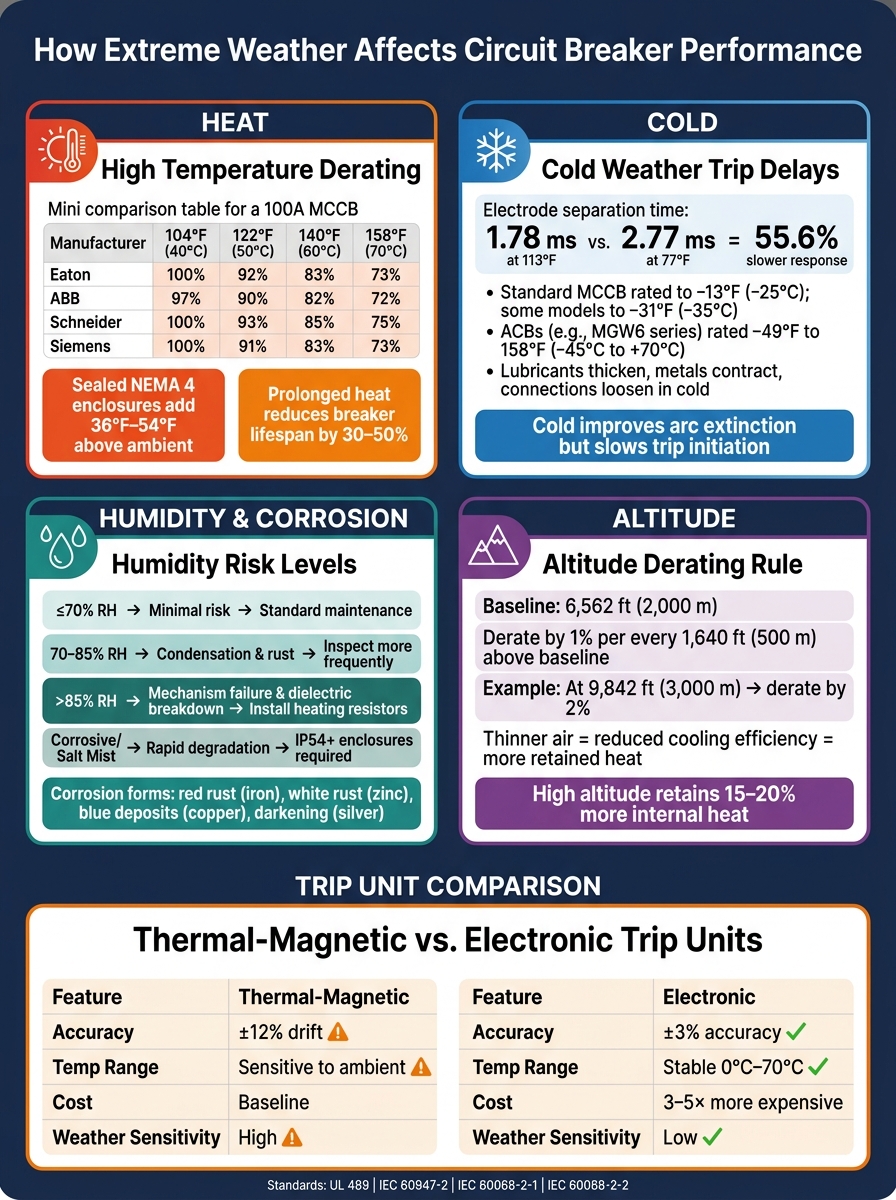
Circuit Breaker Performance by Temperature & Environment: Key Derating Facts
Circuit breakers are designed to stop the flow of electricity when it exceeds safe levels. But did you know that weather conditions can significantly influence their performance? Let’s break down how their mechanisms work and how temperature and environmental factors come into play.
Thermal-Magnetic and Electronic Trip Mechanisms
Circuit breakers generally use one of two mechanisms to trip: thermal-magnetic or electronic.
- Thermal-magnetic trip mechanisms are common in homes and small businesses. These breakers rely on a bimetallic strip that bends when heated by excessive current, triggering the trip. They also use an electromagnetic coil to detect and respond to short circuits. However, the bimetallic strip doesn’t just react to the heat from current - it’s also affected by the surrounding temperature. For instance, a 20°C rise in ambient temperature can lower the breaker’s trip threshold by 10–20%.
- Electronic trip units, on the other hand, use current transformers (CTs) to measure the load and feed the data to a microprocessor. This allows them to compare the current against preset trip curves. Unlike thermal-magnetic breakers, electronic units maintain consistent performance across a wide temperature range (0°C to 70°C) with an accuracy of ±3%. In contrast, thermal-magnetic units can experience accuracy drift up to ±12% at these temperatures.
"Electronic trip units maintain ±3% accuracy up to 70°C, versus ±12% for thermal-magnetic units at the same temperature." - Sinobreaker Expert Insight
While electronic units provide greater precision, they come with a higher price tag - typically 3 to 5 times more than thermal-magnetic breakers.
Standard Operating Conditions and Ambient Temperature Ratings
Circuit breakers are calibrated at a standard ambient temperature of 104°F (40°C), as defined by UL 489 and IEC 60947-2 standards. Most molded case circuit breakers (MCCBs) are designed to operate within a range of –13°F to 158°F (–25°C to +70°C). However, the actual temperature at the mounting location matters more than the room temperature. For example, sealed NEMA 4 enclosures can trap heat, raising internal temperatures by 36°F–54°F (20°C–30°C) above the surrounding air.
Here’s how leading manufacturers adjust the current rating of a 100A-frame MCCB as temperatures climb:
| Ambient Temp | Eaton | ABB | Schneider Electric | Siemens |
|---|---|---|---|---|
| 104°F (40°C) | 100% | 97% | 100% | 100% |
| 122°F (50°C) | 92% | 90% | 93% | 91% |
| 140°F (60°C) | 83% | 82% | 85% | 83% |
| 158°F (70°C) | 73%* | 72%* | 75%* | 73%* |
*Extrapolated from manufacturer trends.
As the table shows, higher temperatures reduce the breaker’s capacity to handle current effectively.
Altitude also affects performance. Above 6,562 feet (2,000 meters), thinner air reduces cooling efficiency, requiring an additional 1% current derating for every 1,640 feet (500 meters) of elevation gain.
Circuit Breaker Types for Harsh Environments
Not all circuit breakers are built to handle extreme conditions. Choosing the right type depends on the application, voltage, and environmental challenges.
- Molded case circuit breakers (MCCBs) are widely used in commercial and industrial settings. High-performance versions are tested to IEC 60068-2-1 and IEC 60068-2-2 standards, ensuring they can operate in temperatures as extreme as –40°F to 185°F (–40°C to +85°C). For corrosive environments, such as coastal areas, breakers rated to Pollution Degree III and tested for salt mist (IEC 60068-2-52) are recommended.
- For medium- and high-voltage systems, vacuum circuit breakers (VCBs) and SF6 breakers are preferred. VCBs use vacuum technology for arc suppression and often feature maintenance-free designs, with some models rated for up to 30,000 mechanical operations. SF6 breakers, used in systems over 110 kV, rely on sulfur hexafluoride gas for arc quenching. This gas provides a dielectric strength about three times greater than air but requires regular monitoring for gas density and moisture.
- In extremely cold environments, air circuit breakers (ACBs), such as the MGW6 series, are designed to function in temperatures ranging from –49°F to 158°F (–45°C to +70°C). These breakers are suitable for virtually any climate across the United States.
Understanding how different circuit breakers respond to environmental conditions is essential for ensuring safe and reliable electrical systems in any setting.
How High Temperatures Affect Circuit Breaker Performance
Heat poses a serious challenge to circuit breaker reliability, especially in harsh environments like manufacturing plants in Phoenix or outdoor panels exposed to Gulf Coast summers.
Thermal Derating and Trip Curve Shifts
Circuit breakers are typically calibrated to operate at 104°F (40°C). When the surrounding temperature exceeds this baseline, thermal-magnetic breakers can behave unpredictably.
"The bimetallic strip cannot differentiate internal current heat from ambient heat." – Onesto-ep
This means that the bimetallic strip, which responds to both the heat from electrical current and the surrounding environment, may trip at a lower current than its rated capacity. For instance, a 20°C (36°F) temperature rise above the calibration point can lower the effective trip current by 10–20%. A 100A breaker operating at 140°F (60°C) may only handle 82A to 85A safely. In industrial settings, an unexpected trip can cost anywhere from $5,000 to $50,000 due to unplanned downtime. Prolonged exposure to high temperatures can also reduce a circuit breaker's service life by 30–50%.
Now, let’s explore how the design of enclosures impacts internal heat levels and affects breaker performance.
Heat Buildup in Enclosures and Panels
The temperature inside an electrical panel is often significantly higher than the ambient temperature of the room. For example, general-purpose NEMA 1 enclosures can run 10–15°C (18–27°F) hotter, while sealed NEMA 4 enclosures can experience temperature rises of 20–30°C (36–54°F). This means that if your facility is maintained at 77°F (25°C), a sealed panel could reach internal temperatures of 131°F (55°C). When calculating derating, you must use the internal enclosure temperature rather than the room temperature. Additionally, confined spaces can cause mutual heating effects, requiring a 20% reduction in load capacity for breakers.
To manage these temperature increases, thoughtful design and installation practices are essential.
Design and Installation Practices for Hot Climates
In high-temperature environments, proper planning can help ensure that circuit breakers perform reliably. Here are some practical strategies to reduce heat stress on breakers:
- Increase spacing: Leave at least 1 inch (25 mm) between breakers to reduce thermal coupling.
- Shade outdoor panels: Use shading or reflective coatings to lower temperatures by 8–12°C (14–22°F).
- Ventilation: Install thermostatically controlled filtered ventilation fans, which cost $150–$300 per panel, to cut internal heat buildup by 40–60%. This reduces the risk of downtime and extends system life.
- Upsize breaker frames: Moving from a 100A to a 150A frame costs $40–$120 per unit. However, if this requires a coordination study, engineering fees could range from $1,500 to $4,000.
If ventilation upgrades or upsizing are not feasible, switching to electronic trip units can eliminate concerns about thermal derating. For safety, always round up to the next temperature tier when consulting a manufacturer's derating table if your measured internal temperature falls between two values.
How Cold Temperatures and Winter Conditions Affect Circuit Breakers
Cold weather might not get as much attention as heat when it comes to circuit breaker performance, but it brings its own set of challenges. Just like high temperatures can strain circuit breakers, extreme cold affects their response times and mechanical reliability. Low temperatures can stiffen and slow the mechanisms that protect your circuits, creating unique operational hurdles.
Delayed Trip Behavior in Cold Weather
Thermal-magnetic breakers, which rely on a bimetallic strip to detect overcurrent, are directly affected by cold temperatures. In colder conditions, the bimetallic strip contracts, slowing its response. This means the breaker may take longer to trip or might require a higher current to activate. For instance, data shows that electrode separation time increased from 1.78 ms at 113°F (45°C) to 2.77 ms at 77°F (25°C) - a 55.6% increase as temperatures dropped.
Interestingly, while the trip mechanism slows down, cold weather can make arc extinguishment more efficient. Lower ambient temperatures help the splitter plate cool hot gases faster, improving dielectric recovery and speeding up arc extinction once the breaker trips. However, the slower trip response still creates risks, especially when quick action is needed to prevent damage.
Mechanical Problems at Low Temperatures
Cold weather doesn’t just affect the tripping mechanism - it also causes mechanical problems. For starters, lubricants inside the breaker thicken in low temperatures, slowing down moving parts and delaying response times. Additionally, metals and polymers in the breaker contract at different rates when it’s cold. This can loosen electrical connections or make mechanical parts stick, sometimes leading to nuisance tripping even when there’s no fault.
Another issue is with contact materials. As temperatures drop, these materials harden, altering the electromagnetic repulsive (Holm) force required to separate contacts during a fault. Standard molded case circuit breakers (MCCBs), like the Schneider Electric Compact NSX series, are typically rated to operate reliably down to –13°F (–25°C), with some models functioning as low as –31°F (–35°C). Breakers with LCD control units, however, have stricter limits, with storage ratings of –40°F (–40°C) compared to –58°F (–50°C) for mechanical components.
Practices to Keep Breakers Reliable in Cold Climates
To ensure circuit breakers perform reliably in cold conditions, proactive maintenance is essential. Keeping breakers warm is one of the most effective strategies. Panel heaters with thermostatic controls can maintain internal enclosure temperatures above the minimum operating threshold, preventing lubricant hardening and mechanical stiffness. For outdoor installations in colder states like Minnesota, Montana, or North Dakota, this step is crucial.
Other important practices include:
- Scheduling pre-winter inspections to identify and address rust, moisture, or worn components before freezing temperatures hit.
- Running trip tests during cold spells to ensure thickened lubricants aren’t slowing down the mechanism beyond acceptable limits.
- Monitoring for rapid temperature changes, as repeated expansion and contraction can loosen terminal connections over time.
- Verifying cold-weather certifications for breakers installed in extreme environments. Look for compliance with IEC 60068-2-1 (dry cold), which tests performance down to –67°F (–55°C).
When selecting replacement breakers for use in cold climates, always check the manufacturer’s temperature ratings. Platforms like Electrical Trader provide a variety of industrial-grade breakers, making it easy to compare specifications and choose the right one for your needs. This extra step can save you from significant headaches down the line.
sbb-itb-501186b
Moisture, Corrosion, and Storm-Related Risks
Beyond extreme temperatures, moisture introduces another layer of challenges to circuit breaker performance. Water and humidity are some of the most harmful environmental factors, often weakening internal components long before they fail entirely.
How Humidity and Corrosion Damage Internal Components
Humidity affects circuit breakers in several ways. When relative humidity exceeds 85%, the risk of failure increases, as mechanisms may stop working properly and insulation strength weakens. Even at levels between 70% and 85%, condensation on cold metal surfaces can speed up rust formation and raise contact resistance over time.
These effects show up in distinct patterns. For instance:
- Iron develops red rust.
- Zinc forms white rust.
- Copper gets blue deposits.
- Silver darkens.
Each of these changes increases friction and resistance, leading to excess heat and further performance degradation.
Plastic parts aren't immune either. Extended moisture exposure can leave white marks on breaker casings, which signal insulation breakdown. High humidity also encourages the growth of conductive filaments, or dendrites, on circuit boards in electronic trip units. These can cause false trips or disrupt communication and protection functions.
Condensation is especially troublesome during temperature swings from night to day when internal metal surfaces cool below the dew point. In areas with corrosive gases like sulfur dioxide (SO₂) or hydrogen sulfide (H₂S), the rate of moisture-driven corrosion increases significantly.
The table below outlines humidity levels, associated risks, and suggested preventive measures:
| Humidity Level | Risk | Recommended Action |
|---|---|---|
| ≤ 70% | Minimal deterioration | Standard periodic maintenance |
| 70%–85% | Condensation; accelerated rusting | Increase inspection frequency; test insulation resistance every 5 years |
| > 85% | Mechanism failure; dielectric breakdown | Install heating resistors; test insulation resistance every 2 years |
| Corrosive/Salt Mist | Rapid contact degradation; mechanical rupture | Use IP54+ enclosures and install heating resistors |
For areas where humidity consistently exceeds 85%, installing heating resistors inside the switchboard can help keep internal temperatures above the dew point, preventing condensation. Energy-efficient options like smart-controlled heaters or Peltier-effect coolers, which activate based on critical humidity-to-temperature ratios, are also worth considering.
Water Intrusion and Flooding Risks
While humidity gradually wears down components, direct water exposure is far more immediate and severe. Water entering a breaker disrupts current sensors, often causing nuisance trips.
"Water will interfere with normal operation of the current sensors, reporting more current to the trip unit than actually exists, resulting in tripping with Ir, Ii, Ig, Ap indication, or no indication." - Schneider Electric
Once a breaker has been water-damaged, it cannot be repaired. Methods like drying, rinsing, or pressure washing won't fix damage to sensors, insulation, or internal contacts.
"Attempting to reuse damaged electrical equipment by air drying, rinsing, cleaning, washing down or pressure washing creates a significant safety hazard." - Schneider Electric
For outdoor installations or panels in flood-prone areas, IP-rated enclosures are a must. In industrial or corrosive settings, enclosures with at least an IP54 rating are recommended to shield internal components from dust and water spray. High-performance breakers are often tested for damp heat resistance - up to 95% relative humidity and 131°F (55°C) - under standards like IEC 60068-2-30.
Storm Preparation and Post-Storm Inspections
Given the risks of water intrusion, preparing for storms is essential to protect circuit breakers. After a major storm or flood, safety should always come first. Never enter a building with standing water until a licensed electrician or utility worker has cut power, as submerged wiring and equipment can pose life-threatening electrocution risks.
Once it's safe to inspect, look for signs of water exposure, such as floor stains, mud lines, or debris near the electrical panel, which may indicate equipment submersion. Any breaker that has been underwater should be replaced outright rather than reused.
If flooding didn't occur but storm damage is suspected, proceed carefully when restoring power. Start by switching off all individual breakers, then turn on the main power, and finally restore individual circuits one at a time. If you notice burning smells, heat coming from the panel, or a breaker immediately re-tripping, shut off the main power and contact a professional. Unplugging all corded equipment before restoring power can also help prevent residual faults.
For regions prone to storms, increasing inspection frequency during storm seasons is a wise approach. These checks should include testing insulation resistance, inspecting breaker casings for white marks, and looking for signs of increased mechanical friction - early indicators of moisture damage.
For durable replacements in extreme weather conditions, Electrical Trader offers industrial-grade breakers built to meet stringent specifications.
Testing, Maintenance, and Replacement Guidelines
Routine Inspection and Preventive Maintenance
Regular inspections are your best defense against weather-related breaker issues. The frequency of these checks should correspond to the environmental conditions the equipment is exposed to.
"Actual circuit breaker performance is not a static value." - Tosunlux
Schneider Electric's guidelines suggest that in areas with annual average temperatures between 77°F and 113°F (25°C–45°C), inspections should occur more often than in cooler climates. For instance, a 1,000A breaker operating at 80% load sees its lifespan decrease from 30 years at 77°F (25°C) to 25 years at 113°F (45°C).
During these inspections, focus on key warning signs: discoloration of plastic components, grease hardening in contact clusters, burning odors, or missing labels - all of which can point to deterioration.
Seasonal maintenance builds on these routine checks, ensuring breakers are ready to handle the challenges posed by extreme weather conditions.
Seasonal Maintenance for Extreme Weather
Seasonal adjustments are essential to keeping breakers reliable during periods of intense heat or cold.
Before summer:
- Check that panel temperatures comply with updated derating guidelines. Remember, panels exposed to direct sunlight can exceed 122°F (50°C).
- Maintain at least a 10mm gap between high-load breakers to allow for proper airflow.
- For environments consistently above 95°F (35°C), consider adding forced-air ventilation or air conditioning to the electrical room.
Before winter:
- Inspect for thickened lubricants or contracted metal parts, which can slow internal mechanisms and delay trip response times.
- Look for carbon tracking on insulation materials, as this can lead to short circuits or ground leakage.
When to Replace a Weather-Damaged Breaker
If preventive efforts aren't enough, replacing a damaged breaker promptly is critical. Look for signs of irreversible damage, such as visible carbon trails, salt corrosion, or deformed bimetallic strips. For example, a warped bimetallic strip caused by prolonged heat exposure will lead to nuisance tripping that can't be fixed through cleaning or adjustment. On the other hand, extreme cold may prevent the strip from deforming properly, allowing dangerous overcurrents to go unchecked.
| Environmental Factor | Impact on Breaker | Action Required |
|---|---|---|
| Extreme heat (above 104°F / 40°C) | Nuisance tripping; warped bimetallic strip | Apply derating factors; replace if tripping persists |
| Extreme cold (below -13°F / -25°C) | Failure to trip during overcurrent | Verify cold-start ratings; replace if trip response is delayed |
| High humidity (above 90%) | Carbon tracking; short circuits | Replace if carbon trails are visible on insulation |
| Coastal/corrosive environments | Salt corrosion on internal components | Replace if terminal corrosion is confirmed |
| High altitude (above 6,560 ft / 2,000m) | 15–20% more internal heat retained | Consult altitude derating tables; upsize frame if needed |
For installations in tough climates, upsizing the breaker frame can provide a buffer against heat-related failures. For instance, using a 125A frame for a 100A load offers better thermal capacity. When sourcing replacements, platforms like Electrical Trader offer a variety of industrial-grade breakers designed for demanding environments.
Conclusion: Key Takeaways for Circuit Breaker Reliability in Extreme Weather
Extreme weather events put circuit breakers to the test, often with serious consequences. For instance, during the February 2011 cold weather event in the Southwest U.S., grease in a breaker mechanism thickened due to low temperatures, slowing its operation and causing six generators to trip offline, resulting in an 89 MW power loss. Similarly, the June 1999 heatwave in Ohio, Michigan, and Indiana saw high temperatures lead to a breaker malfunction, which caused the loss of a 345 kV circuit.
These incidents highlight the need for proactive strategies to maintain reliability. Here’s a quick recap of essential practices:
- Derate breakers operating outside conditioned enclosures to account for environmental stresses.
- Choose magnetic (MO) breakers for areas with wide temperature variations, as they use solenoids rather than bimetal strips, making them less sensitive to ambient temperature changes.
- Inspect and update lubricants seasonally, particularly before winter, ensuring grease in outdoor or unheated enclosures is rated for low temperatures.
- In coastal or industrial areas, prioritize equipment certified to Pollution Degree III and compliant with salt mist standards like IEC 60068-2-52.
- Replace breakers showing signs of flashover damage, fretting corrosion, or sluggish mechanics - cleaning is often insufficient, and timely replacement prevents larger failures.
When replacements are necessary, sourcing the right equipment is critical. Platforms like Electrical Trader provide a wide range of industrial-grade breakers, including models from Siemens, ABB, GE, Square D, and Eaton. They also offer reconditioned units at 40%–70% of the cost of new ones, with filtering options to match voltage, capacity, and environmental needs, including outdoor-rated configurations.
FAQs
How do I figure out the real panel temperature for breaker derating?
When figuring out the actual panel temperature for breaker derating, focus on measuring the ambient temperature inside the enclosure, not the temperature of the surrounding room. The air inside the enclosure often runs 18°F to 27°F hotter, particularly near the top or around high-loss equipment. Use this highest temperature as your reference when checking the manufacturer's ambient rerating table. If the temperature doesn't match an exact value, always round up to ensure safety.
When should I choose an electronic trip unit instead of thermal-magnetic?
When you need precise adjustments, advanced protection, or system coordination - think factories or data centers - an electronic trip unit is the way to go. Unlike thermal-magnetic units, these offer extra features like ground fault protection, real-time monitoring, and diagnostics. Plus, they shine in environments with temperature swings since their performance remains stable regardless of ambient conditions.
After a flood, can a water-exposed breaker be safely reused?
Molded-case circuit breakers that have been exposed to water should never be reused. Floodwater can cause severe internal damage, including corrosion, contamination, and the breakdown of essential lubrication. These issues make the breakers unsafe and increase the risk of electrical shock or fire.
Industry standards are clear: such breakers must be replaced rather than reconditioned. However, for high-voltage or specialized equipment, it's worth consulting the original manufacturer. In some cases, larger units may be eligible for professional reconditioning under strict guidelines.