

Top Blockchain Use Cases in Energy Sector
Blockchain is reshaping the energy sector by enabling direct transactions, improving efficiency, and reducing costs. Key applications include peer-to-peer energy trading, smart grid management, renewable energy tracking, and electric vehicle charging. Here’s what you need to know:
- Peer-to-Peer Energy Trading: Households and businesses can trade energy directly, cutting electricity bills by up to 40% and reducing reliance on centralized utilities.
- Smart Grid Management: Blockchain automates billing and metering, speeding up settlements by 95% and ensuring data accuracy.
- Renewable Energy Certification: Tracks renewable energy certificates and carbon credits transparently, eliminating errors and double-counting.
- Electric Vehicle Charging: Simplifies payments and incentivizes off-peak charging, reducing grid strain and costs.
- Cross-Border Energy Trading: Automates international energy trades, cutting transaction costs by 30–40%.
- Tokenization of Energy Assets: Allows fractional ownership of renewable energy projects, making investments more accessible.
Blockchain is driving efficiency and transparency in energy systems, paving the way for decentralized, automated, and cost-effective energy markets.
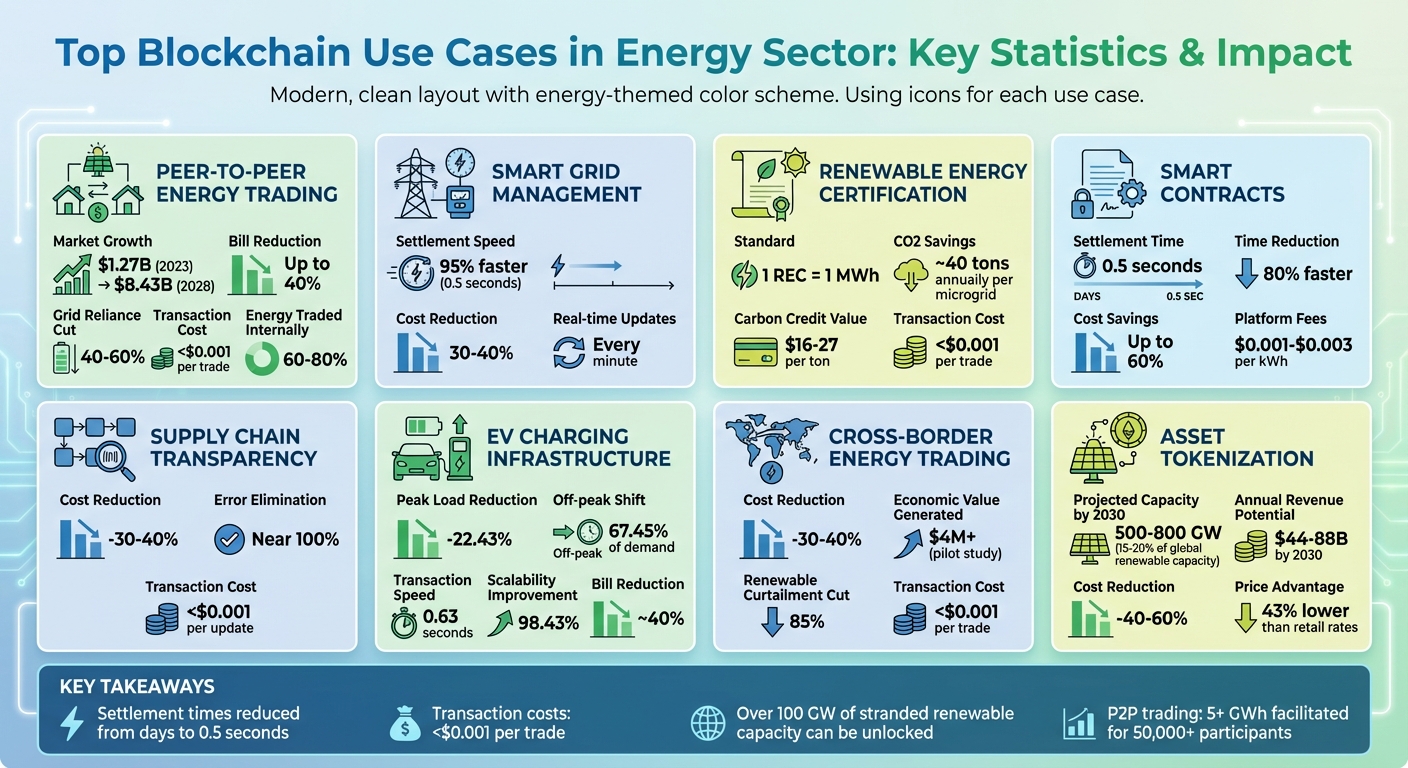
Blockchain Use Cases in Energy Sector: Key Statistics and Benefits
Blockchain-based peer-to-peer energy trading with Dr Jemma Green (Powerledger)
sbb-itb-501186b
1. Peer-to-Peer Energy Trading and Microgrids
Blockchain technology is transforming how energy is traded, allowing homeowners and businesses to act as both producers and consumers - often referred to as "prosumers." Through this system, electricity can be traded directly with neighbors, bypassing traditional energy providers. Blockchain enables the tokenization of future power production, with each digital token representing 1 kWh of energy. These tokens are traded on decentralized platforms, where smart contracts instantly match supply and demand, executing trades as soon as conditions are met.
Scalability and Adoption Potential
The market for peer-to-peer (P2P) energy trading is expanding quickly. In 2023, it was valued at $1.27 billion and is expected to reach $8.43 billion by 2028. Advanced solutions, like Polygon and Arbitrum, are making these transactions more cost-effective, reducing fees to less than $0.001 per trade. This makes even small-scale energy trades viable. For example, a neighborhood of 250 solar-powered households can generate up to 100 transactions per second - far exceeding the 7 transactions per second limit of older Proof-of-Work blockchains.
Community microgrids are also thriving. These systems allow members to trade 60–80% of their energy internally, cutting reliance on external grids by 40–60%. In Denmark, the Sonderborg Community reduced its dependence on the main grid by 37% during winter months through P2P energy trading. On a larger scale, Powerledger's TraceX marketplace executed 1.2 million renewable energy certificate trades in January 2025, representing 167 GWh of green energy. This level of scalability is helping to integrate these systems into the broader energy market.
Impact on Energy Efficiency and Transparency
One of the biggest benefits of localized P2P energy trading is the reduction in energy distribution losses, which average 6.2%. This is because energy is sourced from nearby rooftops rather than distant power plants. Decentralized oracles also ensure accuracy by verifying meter data, preventing issues like "double-counting" of green energy assets. The system's transparency allows participants to monitor supply and demand in real time, creating a more efficient market.
"Blockchain doesn't replace the physical grid. It optimizes the financial layer (who pays whom) without modifying the physical layer (how electrons flow)."
Integration with Existing Energy Systems
Blockchain-powered microgrids work alongside traditional energy systems. They remain connected to the main grid while also using local energy resources. Blockchain handles the financial transactions, while the physical grid continues to manage the actual flow of electricity. A 15-minute reconciliation cycle ensures payments are settled instantly via smart contracts, with adjustments made based on data from smart meters.
This approach has already been tested successfully. For example, Switzerland's Quartierstrom project in 2019 involved 37 households trading solar energy locally. The system used a digital portal for 15-minute bidding cycles and blockchain to automate transactions. Similarly, the Port of Rotterdam launched its Distro platform in 2020 to facilitate energy trading among commercial users, leveraging both AI and blockchain. These examples highlight how blockchain can integrate seamlessly with existing infrastructure.
Cost-Effectiveness and Ease of Deployment
Blockchain-based P2P trading significantly reduces costs, cutting out intermediaries and lowering expenses by 40–60%. Setting up smart meters typically costs between $150 and $400, with monthly subscription fees ranging from $5 to $15. Energy rates within microgrids are usually set between wholesale prices ($0.08/kWh) and retail prices ($0.35/kWh), benefiting both buyers and sellers. Platform fees are minimal, averaging 1–3% per transaction.
To implement these systems, internet-connected smart meters that meet standards like IEEE 2030.5 or OpenADR 2.0 are essential. Adoption tends to be higher in communities with strong environmental values or close social ties. For businesses sourcing energy equipment through platforms like Electrical Trader, understanding these requirements is crucial as blockchain reshapes energy system designs and operations.
2. Smart Grid Management and Metering Automation
Blockchain technology is reshaping the way grid operations and metering are managed. Unlike traditional systems that depend on centralized data control and monthly billing cycles, blockchain introduces a secure, tamper-proof ledger for smart meter data. This ensures data integrity and prevents unauthorized changes. Additionally, smart contracts streamline financial settlements, completing them in just 0.5 seconds - an impressive 95% faster than conventional billing systems.
Impact on Energy Efficiency and Transparency
This automated framework significantly improves grid performance by optimizing pricing and load management. With real-time price signals updated every minute, the grid can adjust itself automatically through demand response mechanisms. Granular pricing encourages consumers to shift their energy usage to off-peak times, while blockchain-enabled virtual power plants (VPPs) handle tasks like load shedding and battery discharge within milliseconds to keep the grid stable.
Data accuracy is ensured through decentralized verification. Independent oracles, such as Chainlink, validate meter readings, ensuring that only reliable data initiates contract executions. A notable example comes from BTL Group, which partnered with energy companies ENI, BP, and Wien Energie in a pilot project. This initiative reduced trading and management costs by 30–40% by improving data visibility and communication between systems.
Integration with Existing Energy Systems
Adopting blockchain in energy systems also requires compatibility with older infrastructure, which many utilities still rely on. For instance, SCADA systems from the 1970s and 1980s were not designed for modern internet connectivity. Rather than replacing these systems entirely, blockchain implementations often use protocol adapters and API gateways to bridge the gap between old hardware and new networks. Germany's Innogy demonstrated this approach in a blockchain pilot, managing automated billing for electric vehicle charging stations while integrating with existing systems.
"The challenge isn't the blockchain part - it's ensuring data accuracy at the point of entry. Garbage in, garbage out applies regardless of how immutable your ledger is." - Arthur C. Codex, Reintech
Cost-Effectiveness and Ease of Deployment
Blockchain automation removes the need for manual tasks like billing and metering. Settlement times, which previously took days or even months, now occur almost instantly. A standout example is WePower's project in Estonia, which tokenized the national grid by converting 24 TWh of energy data into 39 billion "Smart Energy Tokens." This allowed for automated, self-settling power purchase agreements. For companies considering energy infrastructure upgrades, platforms like Electrical Trader provide insights into how blockchain automation can transform grid management. These advancements not only simplify operations but also deliver financial and operational benefits across energy systems.
3. Renewable Energy Certificate and Carbon Credit Tracking
Blockchain is now playing a key role in ensuring transparent and reliable certification of renewable energy production, further enhancing grid efficiency.
By creating an unchangeable record for renewable energy certificates (RECs) and carbon credits, blockchain ensures complete transparency throughout their lifecycle. Each REC serves as proof that 1 megawatt-hour (MWh) of electricity was generated from a renewable source. Traditional systems often depend on centralized registries, which are vulnerable to manual errors and even double-counting. Blockchain eliminates these issues, providing a clear and trustworthy system for tracking these certificates.
Impact on Energy Efficiency and Transparency
One of the biggest challenges in renewable energy markets is verifying the legitimacy of green energy claims. Blockchain tackles this by using decentralized oracles, like Chainlink, to validate smart meter data in real time. This approach eliminates the risk of misreporting and replaces slow, periodic audits with immediate, automated verification. Renewable energy producers can now prove their environmental contributions almost instantly.
"Blockchain technology provides an unalterable, tamper-proof record of ownership, making it easier to track and verify the legitimacy of RECs and ensure that they are retired correctly." - Jay Schulman, Information Security and Technology Innovation Expert
For example, microgrids that save 37% energy can prevent about 40 tons of CO2 emissions annually, resulting in $650–$1,100 worth of carbon credits. These verified reductions in emissions typically trade for $16 to $27 per ton on blockchain platforms. In April 2018, the Chilean National Energy Commission showcased this transparency by launching an Ethereum-based project. This initiative records market prices and compliance data, making all transaction records publicly accessible.
This level of transparency not only builds trust but also makes renewable energy systems more efficient and cost-effective to implement.
Cost-Effectiveness and Ease of Deployment
Blockchain also reduces costs significantly. Layer 2 solutions like Polygon and Arbitrum handle energy transactions for less than $0.001 per trade, a fraction of the fees associated with traditional registries. Settlement times shrink from months to mere seconds, improving cash flow for renewable energy producers.
One practical example is PowerLedger’s implementation at Chiang Mai University in Thailand. Here, 142 buildings equipped with 12 MW of solar capacity are using blockchain to track carbon intensity in real time and enable peer-to-peer energy trading. By 2024, the platform had facilitated over 1.67 GWh of energy trading globally. For organizations looking to upgrade power distribution systems to better support renewable energy, Electrical Trader offers equipment compatible with modern grid automation technologies.
These advancements in certification and tracking are crucial for driving the digital transformation of power generation. Blockchain is proving to be a powerful tool for making renewable energy systems more transparent, efficient, and accessible.
4. Automated Settlement and Smart Contracts
Smart contracts are changing the way energy transactions are handled. These self-executing programs operate on blockchain networks, automatically completing transactions when pre-defined conditions are met - no human involvement required. For example, when a solar panel generates electricity and sends it to the grid, a smart contract can instantly verify the delivery and process payment in just 0.5 seconds. This level of automation brings greater efficiency and clarity to the energy market.
Impact on Energy Efficiency and Transparency
Smart contracts are taking settlement processes to a whole new level. Traditional billing systems can be slow and prone to errors, but smart contracts speed things up dramatically - cutting settlement times by 80%. This quick processing helps prevent billing disputes and eliminates manual mistakes. Plus, every transaction is securely recorded on an unchangeable ledger, visible to all parties involved. This ensures full transparency in both pricing and energy distribution.
"Smart contracts and energy transactions go hand in hand to avoid the pitfalls of traditional grid operators: a lack of reliability and consistency." – IEEE Blockchain Technical Community
Real-world examples highlight their impact. In Uttar Pradesh, India, Power Ledger's blockchain platform enabled neighbors to trade energy directly, speeding up transactions and lowering costs. Similarly, the Brooklyn Microgrid project demonstrated how instant settlements through smart contracts resolved payment delays and disputes for over 250 participants .
Cost-Effectiveness and Ease of Deployment
By cutting out intermediaries and automating processes, smart contracts slash costs by up to 60%. Even with Layer 2 fees, transaction costs remain incredibly low - often under $0.001 per trade . Platforms like Power Ledger charge between $0.001 and $0.003 per kilowatt-hour, making this technology both cost-effective and scalable.
Integration with Existing Energy Systems
For smart contracts to deliver their full potential, they need to work seamlessly with current energy systems. This requires smart meters capable of capturing real-time data on energy production and consumption, triggering contract execution when energy changes hands. Bridging older systems - like SCADA, DNP3, and Modbus - with blockchain networks involves using protocol adapters and API gateways to translate legacy formats into smart contract–readable data. Companies like Electrical Trader offer equipment such as smart meters and modern transformers, designed to support automated grid management and simplify upgrades to existing infrastructure.
5. Supply Chain Transparency and Equipment Traceability
Blockchain offers an unchangeable record that tracks every step of a component's journey - from manufacturing to installation. This is especially important for energy infrastructure, which must meet strict safety and performance standards. For example, when a transformer or circuit breaker enters the supply chain, blockchain logs its origin, certifications, and every party involved in its handling. This process helps keep counterfeit parts out of critical systems and ensures that equipment like solar panels, batteries, and other components meet their stated technical specifications. Beyond ensuring product integrity, this level of traceability aligns with broader grid optimization goals mentioned earlier.
Impact on Energy Efficiency and Transparency
Blockchain also plays a role in verifying ethical sourcing of materials like cobalt and lithium, ensuring they are mined responsibly. It tracks embodied carbon during manufacturing and shipping, reducing errors in data and lowering supply chain costs by 30–40%. For instance, a pilot project conducted by BTL Group with energy companies ENI, BP, and Wien Energie in early 2024 showed how blockchain-based tracking could eliminate data management errors and settlement delays.
"Blockchain technology excels at providing multi-stakeholder information sharing, especially for asset tracking." – Consensys
Integration with Existing Energy Systems
Integrating blockchain with older energy systems can be tricky. Many of these systems still rely on SCADA technology from the 1970s and 80s, which wasn't built for internet connectivity, let alone blockchain. Just as legacy metering systems needed protocol adapters to work with modern technology, supply chain systems also require tools like protocol adapters and API gateways. These tools translate data from outdated formats into something blockchain networks can process. Companies like Electrical Trader offer modern equipment such as smart meters and updated transformers, which are designed to integrate seamlessly with automated tracking systems. This helps bridge the gap between legacy systems and new technologies.
Cost-Effectiveness and Ease of Deployment
Using Layer 2 blockchain solutions keeps transaction costs extremely low - often less than $0.001 per update. However, the main challenge lies not in the blockchain itself but in ensuring accurate data entry. As Arthur C. Codex from Reintech explains:
"The challenge isn't the blockchain part - it's ensuring data accuracy at the point of entry. Garbage in, garbage out applies regardless of how immutable your ledger is."
Automating data collection with IoT sensors can significantly reduce human error, making the system more reliable and scalable. These advancements in supply chain management highlight how blockchain is helping to modernize energy infrastructure.
6. Electric Vehicle Charging Infrastructure Management
Blockchain is reshaping how electric vehicle (EV) charging networks function by introducing transparent and automated payment systems. It enables direct transactions for EV charging, cutting out the need for centralized billing systems. A notable example comes from February 2026, when researchers at Gaziantep University, led by Al Mothana Al Shareef and Serap Ulusam Seçkiner, launched the SMARGE platform in Turkey’s Gaziantep Province. This system utilized a custom ERC-20 token on the Ethereum Sepolia testnet to implement dynamic pricing incentives. The results were impressive: peak load dropped by 22.43%, 67.45% of energy demand shifted to off-peak hours, and the average transaction confirmation time was just 0.63 seconds. This is just one example of how blockchain is optimizing energy trading for EV charging.
Scalability and Adoption Potential
Decentralized blockchain systems eliminate central bottlenecks, making it easier to handle increased EV usage. AI-enhanced blockchain frameworks have shown a 98.43% improvement in scalability, which is critical for managing the growing number of EVs. Additionally, blockchain enables EV owners to sell surplus battery power back to the grid using automated smart contracts, effectively turning their vehicles into mobile income sources. With global EV sales hitting 6.6 million units in 2021 and forecasts suggesting EVs could account for 30% of the global fleet by the early 2030s, blockchain provides the infrastructure necessary to support this rapid growth. These advancements promise greater efficiency and transparency in EV charging systems as adoption scales.
Impact on Energy Efficiency and Transparency
Blockchain’s immutable ledger ensures data integrity, protecting against losses from hacking or system failures. When paired with AI-driven load forecasting, blockchain-enabled smart contracts allow for real-time pricing adjustments based on grid conditions. In simulated urban settings, blockchain-managed charging systems achieved a 94.86% charging fulfillment rate, even under grid constraints.
"By removing any kind of intermediaries, the incorporation of blockchain technologies motivates individuals to share their energy surplus with others to charge their EVs, ensures better availability of clean energy, and eventually reduces range anxiety".
Cost-Effectiveness and Ease of Deployment
Using native ERC-20 tokens for microtransactions eliminates high fees and delays. Blockchain-based platforms that directly connect users to the grid could potentially cut consumer electricity bills by around 40%. Additionally, shifting energy demand to off-peak hours reduces the need for costly grid upgrades and prevents wear and tear on transformers and other distribution equipment. High-throughput blockchain networks ensure the system remains responsive, even as charging demand grows. Modern equipment from Electrical Trader integrates smoothly with blockchain systems, allowing older infrastructure to adapt to next-generation charging networks. For businesses managing EV charging infrastructure, tools like smart meters and updated transformers help bridge the gap between legacy hardware and blockchain-based solutions.
7. Cross-Border Energy Trading
Blockchain is reshaping how countries trade electricity by cutting out brokers and middlemen. Instead, it uses smart contracts to execute trades in seconds or minutes, based on real-time supply and demand data. This speed is especially useful when renewable energy production fluctuates. For example, one region's solar panels might produce excess power while a neighboring area faces shortages. Blockchain’s quick execution works seamlessly with existing P2P and smart grid systems, further embedding it into global energy markets.
Impact on Energy Efficiency and Transparency
Blockchain’s immutable ledger ensures that utilities can’t alter historical pricing or meter data, creating a transparent system where everyone has access to the same real-time supply and demand information. This transparency boosts market efficiency. A real-world example from December 2025 illustrates this: researchers used a Multi-Objective Cross-Border Trade Optimization model on the Baja California–California interconnection between Mexico and the U.S. They analyzed data from Mexico's National Center for Energy Control (CENACE), spanning June 2023 to June 2024. The blockchain-driven approach generated over $4 million in economic value and slashed renewable energy curtailment by more than 85% compared to traditional methods.
Cost-Effectiveness and Ease of Deployment
Traditional cross-border energy trading is expensive, with intermediaries adding up to 30% in extra costs. Blockchain significantly reduces these expenses. For example, Layer 2 solutions like Polygon and Arbitrum can process energy transactions for less than $0.001 per trade. By automating settlements and cutting out intermediaries, blockchain reduces transaction costs by 30–40%. A pilot project with ENI, BP, and Wien Energie demonstrated this for natural gas trades. Smart contracts handle settlements automatically, eliminating the need for high collateral reserves and reducing credit risk. Additionally, blockchain opens up international markets to smaller players who previously couldn’t meet the capital requirements of traditional wholesale trading. These streamlined processes not only improve domestic energy markets but also facilitate global integration. For businesses managing power distribution equipment, innovations like these complement platforms such as Electrical Trader, simplifying procurement in the increasingly interconnected energy market.
8. Tokenization of Renewable Energy Assets
Blockchain technology has already transformed energy transactions, but tokenization is taking it a step further. By dividing renewable energy projects into digital shares, tokenization allows for fractional ownership, making investment more accessible. Take a 5 MW solar farm, for example - it can be divided into thousands of tokens, with each token representing 1 kWh of production capacity. This approach opens the door for retail investors to contribute with smaller amounts of capital, broadening participation in renewable energy projects.
Scalability and Adoption Potential
The growth potential for tokenized energy assets is immense. Peer-to-peer (P2P) traded energy is expected to expand from 2–3 GW in 2026 to a staggering 500–800 GW by 2030, which could account for 15–20% of global renewable energy capacity. The associated platforms and infrastructure are projected to generate annual revenues of $44–88 billion by the same year. Companies like Powerledger are already making strides, operating in over 10 countries and facilitating more than 5 GWh of P2P energy trades for over 50,000 participants as of 2026. These numbers highlight how tokenization is reshaping investment strategies in the renewable energy sector.
Impact on Energy Efficiency and Transparency
Tokenization doesn’t just scale markets - it also enhances efficiency and transparency. Blockchain’s immutable ledger ensures that historical pricing and meter data remain tamper-proof. Decentralized oracles, such as Chainlink, play a crucial role by verifying real-world meter readings before executing smart contracts. This guarantees that investors receive returns based on actual energy generation. For instance, in a 2026 German microgrid project, blockchain-driven trading reduced annual electricity bills by 37% for a community of 100 homes. Additionally, tokenization could unlock over 100 GW of renewable capacity currently deemed unprofitable to connect to the grid.
Cost-Effectiveness and Ease of Deployment
Tokenization also tackles traditional investment hurdles by cutting costs and simplifying processes. Conventional energy investments often face high intermediary fees (adding 30–40% in costs) and long capital lock-up periods. In contrast, tokenization reduces expenses by 40–60% through automated settlements and direct P2P transactions. Modern Layer 2 blockchain solutions like Polygon and Arbitrum make transactions incredibly affordable, with fees dropping to less than $0.001 per trade. Platforms like Powerledger charge minimal fees - around $0.001–$0.003 per kWh - and upgrading to blockchain-compatible smart meters can cost as little as $200. Additionally, tokenized assets are traded on decentralized exchanges, offering better liquidity and easier exit strategies.
For businesses handling power distribution equipment, these advancements align with platforms like Electrical Trader, which simplify procurement and digital market operations in this rapidly evolving energy landscape.
Conclusion
Blockchain technology is reshaping the energy sector in ways that are both practical and forward-thinking. Innovations like peer-to-peer energy trading have shown the potential to cut electricity bills by as much as 40%, while smart contracts can settle transactions in just 0.5 seconds, significantly reducing operational costs. Projections suggest that by 2030, P2P trading platforms could manage between 500 and 800 GW of renewable energy capacity - representing about 15–20% of global capacity.
These advancements aren’t just theoretical; they’re backed by real-world examples. Projects like Power Ledger and WePower demonstrate how blockchain can deliver tangible benefits. Power Ledger, active in over 10 countries, offers electricity at prices roughly 43% lower than standard retail rates. Meanwhile, WePower successfully tokenized Estonia’s national grid into 39 billion Smart Energy Tokens. In Brooklyn, participants in the Brooklyn Microgrid initiative have seen bill savings of 6–12%, while producers have earned 18–37% more revenue.
However, challenges remain, particularly around scalability. Traditional blockchains can only handle about 15 transactions per second, far below the thousands required for large-scale energy networks. Solutions like Polygon and Arbitrum are stepping in to bridge this gap, offering transaction costs as low as $0.001. Much like the earlier integration of SCADA systems, overcoming regulatory and legacy system hurdles continues to drive innovation in this space.
This evolution points to a future of self-optimizing, transactive energy networks. Virtual Power Plants are already aggregating distributed resources to improve grid stability. Tokenization is making renewable energy investments more accessible, and blockchain’s immutable ledgers are helping to combat fraud in carbon credit markets.
For those navigating this rapidly changing landscape, platforms like Electrical Trader are becoming essential. They simplify procurement and enable efficient digital market operations. As the energy sector embraces this digital transformation, blockchain is proving to be the foundation for unlocking over 100 GW of stranded renewable capacity. This shift sets the stage for a more efficient, transparent, and inclusive energy future.
FAQs
Do I need special smart meters to use blockchain for energy trading?
Smart meters aren't a necessity for blockchain-based energy trading. Peer-to-peer energy exchanges can operate effectively using digital systems without requiring specialized meters. That said, incorporating smart meters can enhance the process by offering better monitoring and streamlined management, ultimately making the system more efficient.
How does blockchain verify energy data is accurate in real time?
Blockchain plays a crucial role in maintaining the real-time accuracy of energy data. It achieves this by securely logging every transaction across a decentralized network of computers. This method ensures clarity, unchangeable records, and automated checks, allowing for immediate validation and settlement of data related to energy production, distribution, and consumption.
What are the biggest regulatory hurdles for blockchain energy markets in the U.S.?
Blockchain energy markets in the U.S. face several hurdles, with unclear federal guidance on tokenization and trading standing out as key issues. Without a well-defined framework, businesses struggle to navigate compliance while exploring blockchain applications in energy.
Another obstacle is the lack of sufficient opportunities to test blockchain-based solutions. Regulatory sandboxes - controlled environments where new technologies can be trialed under relaxed regulations - are limited. This restricts the ability of innovators to refine and demonstrate blockchain's potential in the energy sector.
Recent discussions involving the SEC and lawmakers highlight a growing awareness of these challenges. They stress the importance of developing clearer policies to encourage blockchain innovation while ensuring regulatory compliance within the energy industry.