Best Practices for Medium Voltage Cable Accessories
Medium voltage cable accessories - like terminations, joints, and separable connectors - are critical for reliable power distribution. But did you know that 60–80% of underground cable faults stem from poorly installed accessories? Here's what you need to know:
- Types of Accessories: Includes terminations (heat-shrink, cold-shrink, pre-molded), joints, and separable connectors. Each serves specific roles, such as connecting cables or managing electrical stress.
- Key Standards: IEEE 404, IEEE 48, and OSHA regulations ensure safety and performance. For example, cold-shrink terminations are often preferred for outdoor setups due to weather resistance.
- Installation Tips: Proper cable preparation (cleaning, stripping, grounding) is crucial. Avoid rushing - 80% of faults occur due to poor installation.
- Testing and Maintenance: Use insulation resistance (IR), very low frequency (VLF), and partial discharge (PD) testing. Regular inspections can help prevent failures like moisture ingress.
Types of Medium Voltage Cable Accessories and Their Functions
Overview of Accessory Types
Medium voltage cable accessories play a vital role in managing electrical stress, ensuring insulation integrity, and enabling reliable connections. Here's a closer look at the main types and their functions:
-
Terminations: These seal the cable's end and control electrical stress where the conductor is exposed. Without proper stress management, the cable's insulation can deteriorate over time. Terminations come in three primary forms:
- Heat-shrink: This type uses a heat-sensitive sleeve that contracts around the cable when exposed to a torch. It's a cost-efficient option for straightforward installations but requires a heat source on-site.
- Cold-shrink: Pre-expanded components held by a removable core. Once the core is removed, the sleeve contracts around the cable. It allows for quicker installation and performs well in challenging weather conditions.
- Pre-molded slip-on: These are factory-formed with built-in stress control features, offering precise dimensions. They're ideal for installations where consistency and accuracy are crucial.
- Joints (splices): Joints connect two cable sections while restoring full insulation and shield continuity. Like terminations, they are available in heat-shrink, cold-shrink, and pre-molded formats. The choice of technology often depends on the installation environment and maintenance considerations.
- Separable connectors: Designed for situations where cables need frequent disconnection and reconnection. Outdoor-rated versions are made with UV-resistant materials and extended creepage distances to handle exposure to rain and pollution. Indoor versions are compact, making them suitable for tight spaces like switchgear cabinets.
These technologies are chosen based on specific needs, ensuring that the right accessory is used for each role within utility networks.
Common Applications in Utility Networks
The functional characteristics of these accessories dictate their use in various utility scenarios:
- Terminations: Commonly used where cables transition to above-ground equipment. Examples include riser poles, pad-mounted transformers, and substation switchgear. Outdoor-rated terminations are especially important at substation exits, where cables experience mechanical stress from thermal cycling and exposure to weather.
- Joints: Typically found mid-circuit, such as in underground splice boxes or direct-buried splice kits along feeder lines. They are essential for maintaining insulation and continuity in long cable runs.
- Separable connectors: Frequently used in underground residential distribution (URD) systems. Their plug-in design makes them perfect for pad-mounted transformer connections in neighborhoods, where cables may need to be disconnected for switching or fault isolation.
These accessories are not limited to traditional utility grids. They're also essential in renewable energy projects, connecting underground collector cables from wind turbines or solar inverters to the distribution network. Additionally, they play a critical role in railway electrification, powering traction substations along transit routes. Each application underscores the importance of selecting the right accessory for reliable and efficient operation.
sbb-itb-501186b
10 Installation Checks for MV Termination Kits & Joints! 📌
Selecting the Right Medium Voltage Cable Accessories
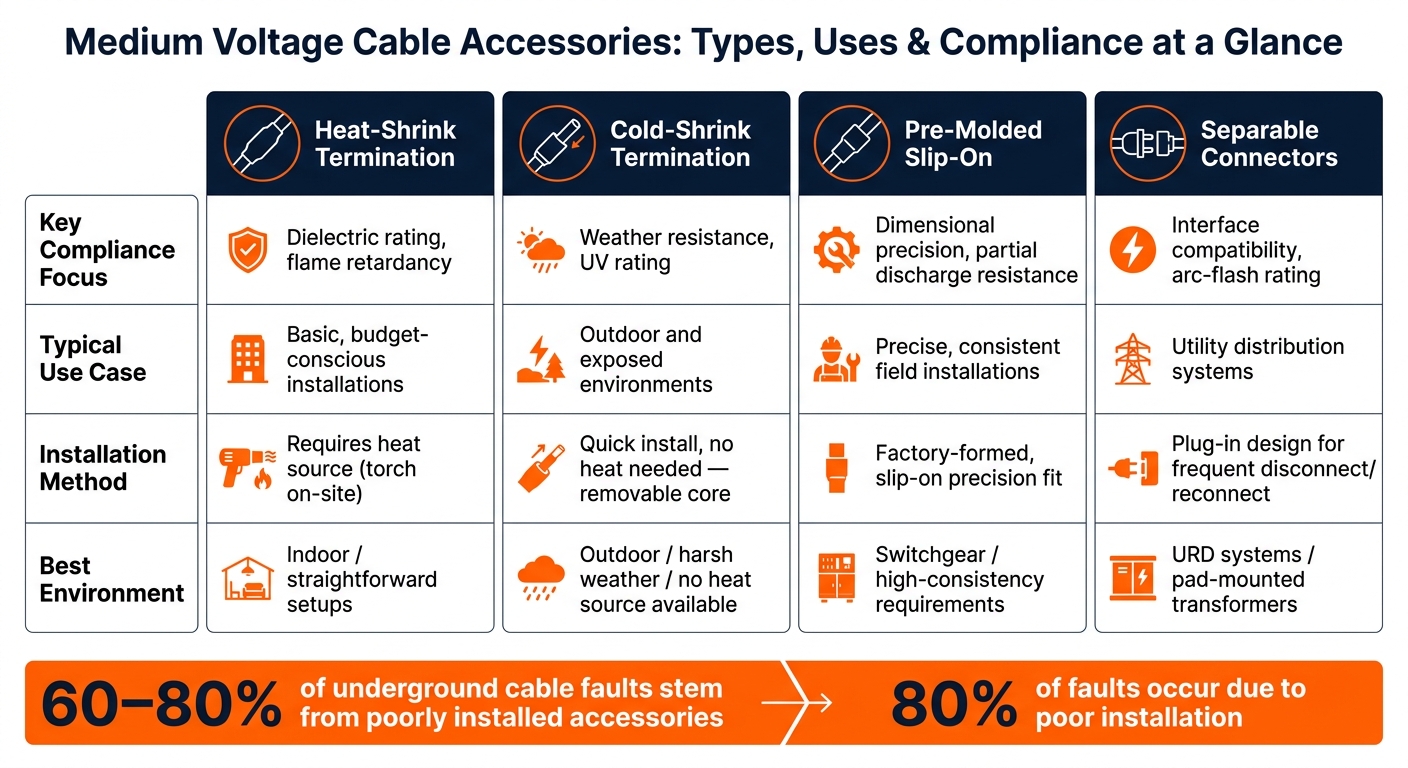
Medium Voltage Cable Accessories: Types, Uses & Compliance at a Glance
Matching Accessories to Cable Specifications
Choosing the right accessory for medium voltage cables is crucial for maintaining system reliability. The selection process should start with the cable's electrical and physical properties. Key considerations include system voltage, whether the cable is single-core or multi-core, and if it is armored. Medium voltage systems typically operate between 5 kV and 35 kV, so accessories must be rated accordingly. A mismatch in ratings can lead to serious issues. As Jaylan Solutions explains:
"Incorrect accessory selection can create partial discharge and early failure."
Environmental conditions also play a big role. For outdoor setups, accessories need UV protection and weatherproofing. Cold-shrink terminations, for example, work well in situations where a heat source isn't available. Compact designs are better suited for indoor environments like switchgear cabinets. In harsher industrial settings, you might need accessories with added resistance to chemicals or salt spray. The key is matching the accessory to both the cable's specifications and the conditions it will operate in.
If your team isn't experienced with torch-applied installations, pre-molded slip-on terminations offer a user-friendly alternative with factory-engineered precision.
Compliance with Standards and Ratings
Accessories must meet established regulatory standards, such as those from IEEE and IEC. These standards ensure that the accessory performs well in terms of dielectric strength, insulation, and resistance to partial discharge, while also handling physical stresses like tension and bending.
Safety is non-negotiable. Accessories for utility networks should include features like flame retardancy, arc-flash protection, and integrated grounding where necessary. Always check supplier documentation for factory test reports and certifications to confirm compliance.
Here's a quick comparison of accessory types and their compliance focus:
| Accessory Type | Key Compliance Focus | Typical Use Case |
|---|---|---|
| Heat-shrink termination | Dielectric rating, flame retardancy | Basic, budget-conscious installations |
| Cold-shrink termination | Weather resistance, UV rating | Outdoor and exposed environments |
| Pre-molded slip-on | Dimensional precision, partial discharge resistance | Precise, consistent field installations |
| Separable connectors | Interface compatibility, arc-flash rating | Utility distribution systems |
Procurement Tips for Utilities
Once you've matched accessories to cable specs and confirmed regulatory compliance, smart procurement practices can help ensure project success. Standardizing accessory families across your inventory simplifies procurement and reduces training needs. Aligning with consistent cable specifications, like those in IEC 60502, can also cut down on storage requirements.
Keep in mind that lead times for medium voltage components range from 6 to 14 weeks, with demand expected to triple by 2030. To avoid delays, plan ahead by forecasting demand and securing production slots early. It's also wise to maintain a safety stock of critical items like splices and terminations for emergency replacements.
For sourcing, platforms like Electrical Trader provide access to both new and used medium voltage equipment, including transformers and distribution components. If you're considering secondary market purchases, always request storage history and documentation to verify the insulation's condition.
With the right accessories and procurement strategies in place, the next step is ensuring they are installed correctly.
Best Practices for Installing Medium Voltage Cable Accessories
Pre-Installation Preparation
Did you know that over 80% of medium voltage faults are caused by poor installation? That’s why getting the preparation right is so important.
Start by verifying that all tools and materials meet the manufacturer’s specifications. Angelo Roviello, Area Sales Manager at Ensto DSO, emphasizes this point:
"When the installer uses the same methods and the same tools as we do, the performance of the accessory in the field is virtually guaranteed."
Next, confirm the cable’s voltage, conductor type, and shielding. If you’re working with aluminum conductors, be sure to use proper copper-aluminum transition terminals and apply conductive paste. Also, make sure the work area is clean, dry, and free of contaminants - this helps avoid insulation issues down the line.
Cable Preparation Techniques
Once the pre-installation steps are out of the way, proper cable preparation is key to maintaining insulation integrity. The preparation process usually involves the following steps:
- Stripping the outer sheath
- Removing armor layers
- Welding the copper grounding wire securely to the shield
- Stripping the insulation shield
- Cleaning the insulation surface
- Stripping the conductor shield
Each step matters - skipping or rushing can create weak points that might lead to partial discharge or even total failure.
One tricky aspect, even for seasoned installers, is dealing with insulation shields. For 10 kV cables, the shield is typically peelable and easier to remove. But with 35 kV cables, the shield is often non-peelable, requiring specialized tools and careful handling. A single nick can trigger partial discharge. After removing the shield, cleaning the insulation surface thoroughly is essential to meet high-voltage standards.
When stripping the conductor, shape the insulation and conductor shield into a "pencil head" profile. This tapered design ensures the accessory fits snugly and creates a reliable seal where the cable insulation meets the terminal.
Installing Different Types of Accessories
The installation process varies depending on the type of accessory, but the goal is always the same: to match the cable’s structure, maintain insulation integrity, ensure a solid galvanic connection, and manage the electric field effectively.
Start by crimping the terminals from the conductor end, making sure they’re fully seated before moving forward. For utility-grade installations, cold-shrink accessories are often the go-to choice. While they may cost more than heat-shrink options, they offer better safety and long-term reliability.
Post-Installation Testing and Long-Term Maintenance
After installation, ensuring the system's performance through immediate testing and regular upkeep is just as important as the installation itself. Even the highest-quality components can fall short if installation errors go unnoticed. Post-installation testing and ongoing maintenance are key to keeping your system running smoothly over time.
Post-Installation Testing
To confirm the quality of the installation, several testing methods are commonly used:
- Insulation Resistance (IR) Testing: This measures the resistance between the conductor and its surroundings. Low resistance values may signal moisture intrusion or contamination.
- Very Low Frequency (VLF) Testing: By applying a low-frequency AC voltage, this test can uncover voids that IR testing might miss.
- Partial Discharge (PD) Testing: The most sensitive of the three, PD testing identifies tiny electrical discharges within the insulation. These discharges can be early signs of defects, especially at the cable-accessory interface.
Using these tests in sequence provides a thorough validation of installation quality.
Preventing Common Failure Modes
The most frequent causes of failure in medium voltage cable systems are moisture ingress and poor grounding. In fact, over two-thirds of interruptions in these systems are linked to installation issues. To avoid these problems, ensure shield connections are continuously and securely bonded, and carefully inspect sealing surfaces for any gaps or imperfections.
Proactive checks like these can significantly reduce the risk of failure and improve system reliability.
Maintenance and Replacement Strategies
Routine maintenance is critical for identifying and addressing potential issues before they escalate. Conduct annual visual inspections to look for signs of physical damage, corrosion, or thermal stress, such as discoloration. For systems with high operational importance, condition-based monitoring - using tools like online PD sensors or thermal imaging - can spot early signs of wear without requiring the system to be taken offline.
When components show signs of failure, replace them immediately with reliable parts. Electrical Trader is a convenient resource for utilities, offering a wide selection of medium voltage cable accessories and power distribution components, including both new and used options with short lead times.
Conclusion
Achieving reliable medium voltage systems hinges on choosing the right accessories, following disciplined installation practices, and staying on top of proactive maintenance. It all starts with selecting accessories that match your cable's voltage class, insulation type, and operating environment. From there, sticking to manufacturer installation instructions and conducting thorough post-installation testing ensures everything is set up for success.
Even the best accessory can fail prematurely if installed improperly. Details matter - precise stripping, clean surfaces, effective stress control, and verified grounding are what distinguish durable connections from early breakdowns.
Beyond installation, condition-based maintenance is key. Regular testing and detailed inspections help catch potential issues before they lead to outages. Keeping records tied to specific accessories, crews, and installation dates creates a feedback loop that improves standards and training over time.
For sourcing quality components, Electrical Trader offers a marketplace for new and used medium voltage accessories. However, procurement decisions should always prioritize engineering requirements - confirming voltage ratings, compliance with standards, and manufacturer guidelines should come first.
When selection, installation, and maintenance follow a consistent, standards-driven approach, the benefits are clear: fewer unplanned outages, reduced rework costs, and safer conditions for field teams.
FAQs
How do I choose the right termination type for my site?
To pick the best termination type, think about the specific needs of your application and the conditions it will face. Here are some common options:
- Heat shrink: A budget-friendly choice that's simple to install, making it great for straightforward applications.
- Cold shrink: Quick to set up, it offers excellent weather resistance, making it ideal for outdoor or challenging environments.
- Pre-molded slip-on: Designed for accuracy and dependable performance, this option works well in demanding scenarios.
If you're dealing with outdoor installations, make sure the terminations include protection against weather and UV exposure.
What are the most common installation mistakes that cause failures?
Improper installation of medium voltage cable systems can lead to significant issues, with two common mistakes standing out: faulty terminations and insufficient conductor protection.
Using the wrong tools or techniques during terminations can damage the insulation, create weak connections, and even let moisture seep in. This combination increases the likelihood of system failures. Another frequent misstep is skipping proper jointing procedures, which can result in partial discharges and dangerous arc faults.
To ensure reliability and safety, it's crucial to follow correct installation practices, use the right tools, and apply adequate protective measures. These steps help maintain the integrity of the system and reduce the risk of costly failures.
Which post-installation tests should I run, and when?
After installing medium voltage cables, it's essential to carry out post-installation tests to ensure both safety and system reliability. Two critical tests to focus on are the dielectric withstand test (Hi-Pot), which checks the insulation's strength, and specific fault detection protocols to identify any weaknesses or issues. Conduct these tests immediately after installation to verify compliance with established safety and performance standards, such as the NEC and NFPA 70.