AI demand forecasting for breaker inventory planning
If you forecast breaker demand with averages alone, you will miss the parts that matter most. I’d boil the article down to this: breaker inventory works better when I plan by SKU and location, factor in lumpy demand, and adjust for lead-time swings before a stockout hits.
Here’s the short version:
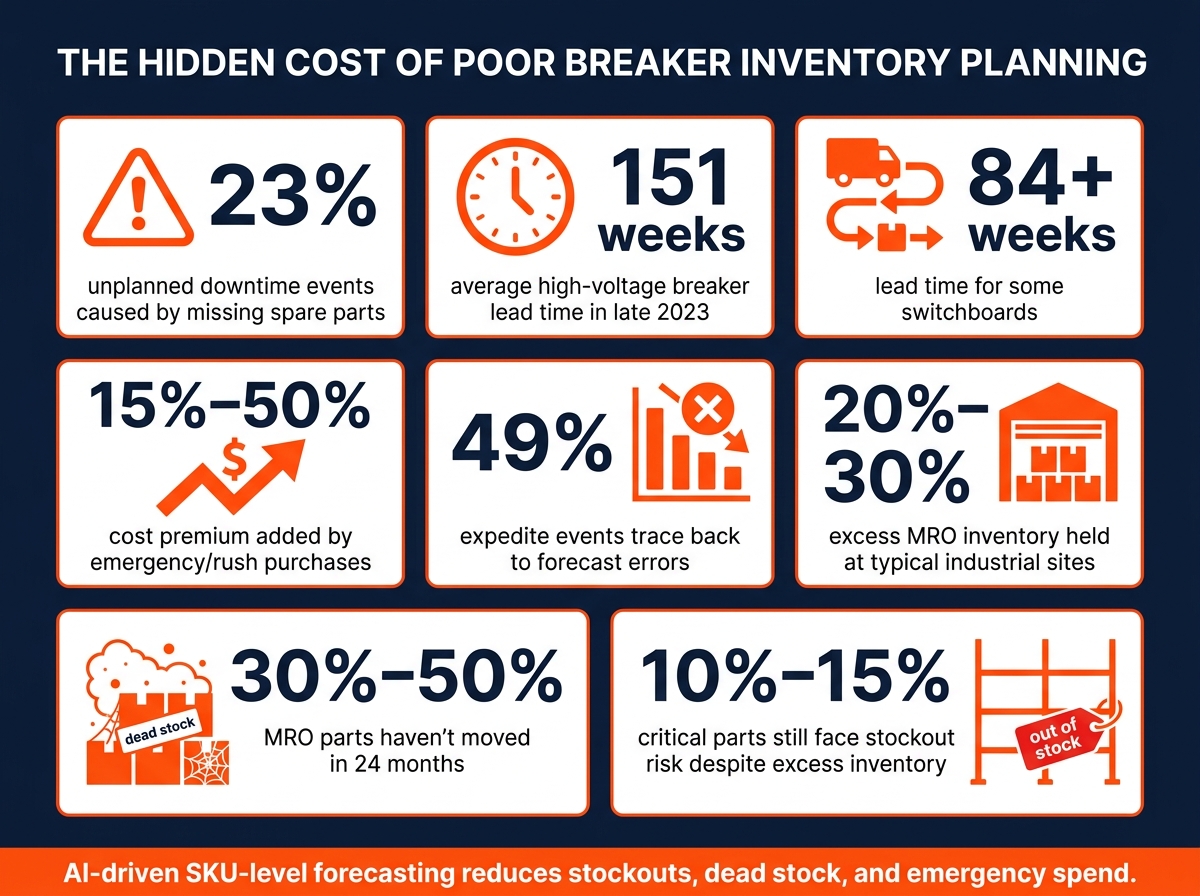
- Stockouts are costly: 23% of unplanned downtime events happen because spare parts are missing.
- Lead times are brutal: high-voltage breaker lead times hit about 151 weeks in late 2023, and some switchboards can take 84+ weeks.
- Rush buying adds cost: emergency purchases often add 15% to 50% to total cost.
- Bad forecasts cause many expedites: 49% of expedite events tie back to forecast errors.
- Too much stock is a problem too: many sites hold 20%–30% excess MRO inventory, and 30%–50% of MRO parts may not move for 24 months.
What I’d do instead is simple:
- clean SKU data first
- rank breakers by criticality and lead time
- use ERP, CMMS, and project data together
- set reorder points, safety stock, order quantities, and review cadence by SKU and site
- use a backup supply source when OEM timing will not work
- move extra stock before it turns into dead inventory
The main point: AI forecasting does not fix inventory by itself. It gives me earlier signals, better buying rules, and fewer bad surprises on the breaker SKUs that can shut work down.
That’s the lens I’d use for the rest of the article.
Breaker Inventory Planning: Key Stats & Cost of Poor Forecasting
How AI Agents Solve Demand Forecasting - The New AI Supply Chain Stack
sbb-itb-501186b
What makes breaker demand hard to forecast
Breaker demand comes in bursts. It can swing hard from one site to the next, from one frame to another, and from one job type to the next.
A manufacturing plant, a commercial office building, and a data center may all sit in the same portfolio. But they don't behave the same way. Their equipment ages differ. Their failure patterns differ. Their compliance needs differ too. So when planners use the same reorder rules across all of them, things go sideways fast. Quiet sites end up overstocked, while higher-risk sites run too close to empty.
That mismatch shows up in the numbers. Asset-heavy manufacturers often carry 20–30% excess MRO inventory and still face stockout risk on 10–15% of critical parts. That's the core issue: one forecast won't work for every breaker family across every facility.
Stockouts, dead stock, and long lead times
A stockout on the wrong breaker is more than a purchasing delay. It can push a planned shutdown back by weeks.
Electricians can't safely re-energize equipment without the right rating, the right trip curve, or the right UL-listed replacement. In healthcare and commercial settings, a missing breaker can hold up a life-safety system upgrade or delay a tenant fit-out until the part finally shows up.
Lead times make this worse. When lead times are long or hard to pin down, buyers often purchase extra units just to play it safe. Then plans change. Equipment gets retired. Those extra breakers turn into dead stock.
Dead stock eats shelf space and gets in the way of active parts. And breaker inventory has another problem: OEMs update or discontinue frames over time. That means excess stock can age into obsolescence or stop matching newer gear. Across typical U.S. industrial facilities, 30–50% of MRO parts haven't moved in 24 months.
Fast-moving and slow-moving SKUs need different planning rules
Not all breaker SKUs should be planned the same way.
Fast-moving branch breakers can often run on simple reorder rules. Low-volume feeder breakers and specialty breakers usually need a separate approach built around intermittent demand and longer lead times. That's why AI forecasting works better when it uses different rules for different breaker classes, instead of treating every SKU like it's part of the same pile.
Data signals buyers already have
Most procurement and maintenance teams already have more signal in their systems than they think.
ERP data holds purchase history and backorder records. Compare need dates with receipt dates, and you can spot where lead times keep slipping and which suppliers miss the mark again and again. CMMS work orders and failure codes can show maintenance activity climbing on certain switchgear lineups, which usually means replacement demand is climbing too. Capital project records and inspection logs add demand that hasn't happened yet, which matters because historical consumption alone won't see it coming.
On their own, those data points are just scattered clues. The payoff comes when a model turns them into forecasted demand, reorder points, and safety stock.
How AI forecasting improves breaker inventory decisions
ERP, CMMS, and project data can do more than sit in separate systems. They can feed AI forecasts that adjust inventory before shortages show up. In plain terms, AI turns the buyer data teams already track into SKU-level demand signals.
AI models for intermittent and project-driven demand
Most breaker SKUs don't move in a smooth pattern. They may sit for months, then suddenly move in volume when a job starts. That's where machine learning helps. It can look at sales history, project schedules, and supplier lead-time data at the same time instead of leaning on one average.
Probabilistic forecasting pushes this a step further. Instead of giving buyers one fixed number, it gives a range of likely outcomes. That makes the decision clearer: hold safety stock for a critical SKU, or lean on secondary markets for slow-moving items.
The day-to-day impact is simple. AI picks up signals spreadsheets often miss, like project schedules, maintenance plans, and shifts in supplier lead times, then connects each forecast to a direct business risk: stockout or dead stock.
Better reorder points, safety stock, and lead time planning
Static reorder points fall apart when demand shifts and lead times slip. AI-refreshed reorder points change on a regular basis. If a supplier's on-time delivery rate drops, the model can increase reorder points and widen the safety stock buffer for SKUs tied to that supplier.
If project activity starts to climb, the model can increase reorder points for the affected SKUs before the shortage hits. That's the key difference. You're not waiting for the problem to land on your desk.
For fast-moving breakers, this can mean less extra inventory sitting on shelves. For critical low-usage breakers, it can mean keeping backup supply for the SKUs that matter most without loading up on a huge emergency buffer.
Standard planning vs. AI-driven planning
The table below shows the operational difference.
| Planning Factor | Standard (Min-Max/Spreadsheet) | AI-Driven Planning |
|---|---|---|
| Forecast accuracy | Low for intermittent or project-driven demand; relies on historical averages | Higher; identifies patterns in lumpy demand across multiple variables |
| Stockout risk | High during project spikes or lead-time slips | Lower; probability ranges buffer against demand variability |
| Dead stock exposure | High for slow-moving SKUs due to static safety stock | Reduced; stock levels adjust based on real-time signals |
| Reorder point and lead time updates | Manual and infrequent; reactive only after a delay has occurred | Automated and frequent; reflects current supplier performance and anticipates disruptions |
That turns forecast output into SKU-by-SKU buying rules.
A practical workflow for procurement teams
Those SKU-by-SKU forecasts need a clear buying workflow. The forecast only matters if it changes how each breaker SKU gets bought at each site.
Start with SKU criticality and clean data
Before the model runs, clean the item master. Make sure fields like voltage, amperage, site, unit cost, and lead time are accurate. Then classify each SKU based on criticality and lead time.
That classification shapes the reorder rules at each site. A low-cost breaker with short lead times shouldn't be treated the same way as a high-risk item that takes weeks to replace.
Turn forecasts into buying rules by SKU and location
Next, turn each forecast into rules at the SKU-and-site level. For every SKU and location, set:
- a reorder point
- a safety stock target
- an order quantity
- a review cadence
Review cadence should also be set by SKU and location. Then update reorder points as lead times, project timing, and live stock levels shift. Add alerts for outliers so buyers can spot problems before they turn into stockouts or late orders.
Use Electrical Trader for backup supply and excess stock moves
If the forecast shows a gap that the normal replenishment cycle can't fix in time, use a backup supply path. When a breaker is at risk of stockout or delayed replenishment, check Electrical Trader for new or used units that can cover the gap.
The same marketplace can also help move excess stock instead of letting it sit on the shelf and tie up working capital.
Conclusion: What better breaker forecasting changes
When buyers turn forecasts into SKU-level rules, the inventory picture changes in three clear ways. Lumpy demand stops blindsiding planners, reorder rules start matching what’s happening on the ground, and lead times that run longer - or swing more than expected - stop pushing teams into emergency buys.
AI forecasting helps by reading demand at the SKU-and-location level, factoring in lead-time variability, and turning those signals into practical inventory moves: reorder points, safety stock levels, and backup sourcing choices.
That change shows up where procurement teams feel it most. For U.S. teams, the payoff is fewer stockouts on critical breakers, less dead stock tying up working capital, and lower spending on rush orders.
From there, teams can focus on the highest-risk SKUs first. A simple path looks like this:
- Clean data for critical and volatile items
- Set clear service-level targets based on item criticality
- Apply the forecasting model
- Use backup sourcing for hard-to-find or discontinued breakers when OEM lead times stretch - like Electrical Trader - to cover gaps before they turn into emergencies
Better forecasting doesn’t replace buyer judgment. It gives buyers earlier, SKU-level signals so they can step in sooner and make better calls.
FAQs
How does AI handle lumpy breaker demand?
AI deals with uneven breaker demand by matching procurement to predicted risk instead of fixed replacement cycles.
It uses digital twin analytics to estimate failure probability and remaining useful life for key parts. That gives teams a clearer picture of when a component is likely to become a problem, not just how old it is.
If a meaningful failure window lands inside the supplier’s lead time, the system triggers a reorder. If the asset isn’t critical, or the likely failure point is still far off, AI helps keep stock levels leaner while still weighing carrying costs against stockout risk.
Which breaker SKUs need the most safety stock?
Prioritize safety stock for breaker SKUs that are critical, have long lead times, or show near-term failure risk in predictive maintenance models.
Breakers linked to critical assets that could stop operations need higher service levels, even when the part cost is low. It also makes sense to keep common frames in stock to cut moderate to high lead-time risk.
When should buyers use backup supply options?
Use backup supply options when a stockout could shut down a critical asset. The call comes down to a simple tradeoff: compare the expected cost of downtime with carrying costs and lead-time risk.
If your failure model shows a meaningful risk window before supplier lead times run out, reorder right away. If you're dealing with noncritical assets or parts that likely won't fail for a while, keep inventory leaner to cut carrying costs.