




AI-Driven Pricing: Impact on Electrical Brand Competition
AI pricing changes electrical brand competition in two ways at once: it helps sellers react faster, and it can make prices move closer together. For U.S. buyers of breakers, transformers, switchgear, and generators, that means less time to lock in a deal, fewer price gaps on common SKUs, and more focus on lead time, stock, and compliance.
Here’s the short version:
- I see faster repricing as the main shift. Prices can change within hours, not days.
- Research cited in the article says firms using AI well could add 30% to 70% of EBIT over five years.
- On common products, AI can pull competing prices into a narrow range.
- That can reduce discounting and make buyers rely more on:
- Smaller resellers can now use cloud pricing tools, but they still face weaker data depth than large firms.
- For procurement teams, a listing price is best treated as a live market signal, not a fixed promise.
If I had to sum it up in one line: AI pricing makes the market move faster, but not always in the buyer’s favor.
| What changes | What it means for you |
|---|---|
| Faster price updates | You get less time to approve purchases |
| Tighter price clustering | It gets harder to win on price alone |
| Shared pricing signals | Competing sellers may move in similar ways |
| More weight on non-price factors | Lead time and compliance matter more |
| Better tools for small sellers | Access improves, but data gaps still hurt |
So if you buy electrical equipment in the U.S., the takeaway is simple: watch price movement, verify the terms, and do not assume today’s listing will still hold tomorrow.
What Research Shows About AI Pricing and Market Outcomes
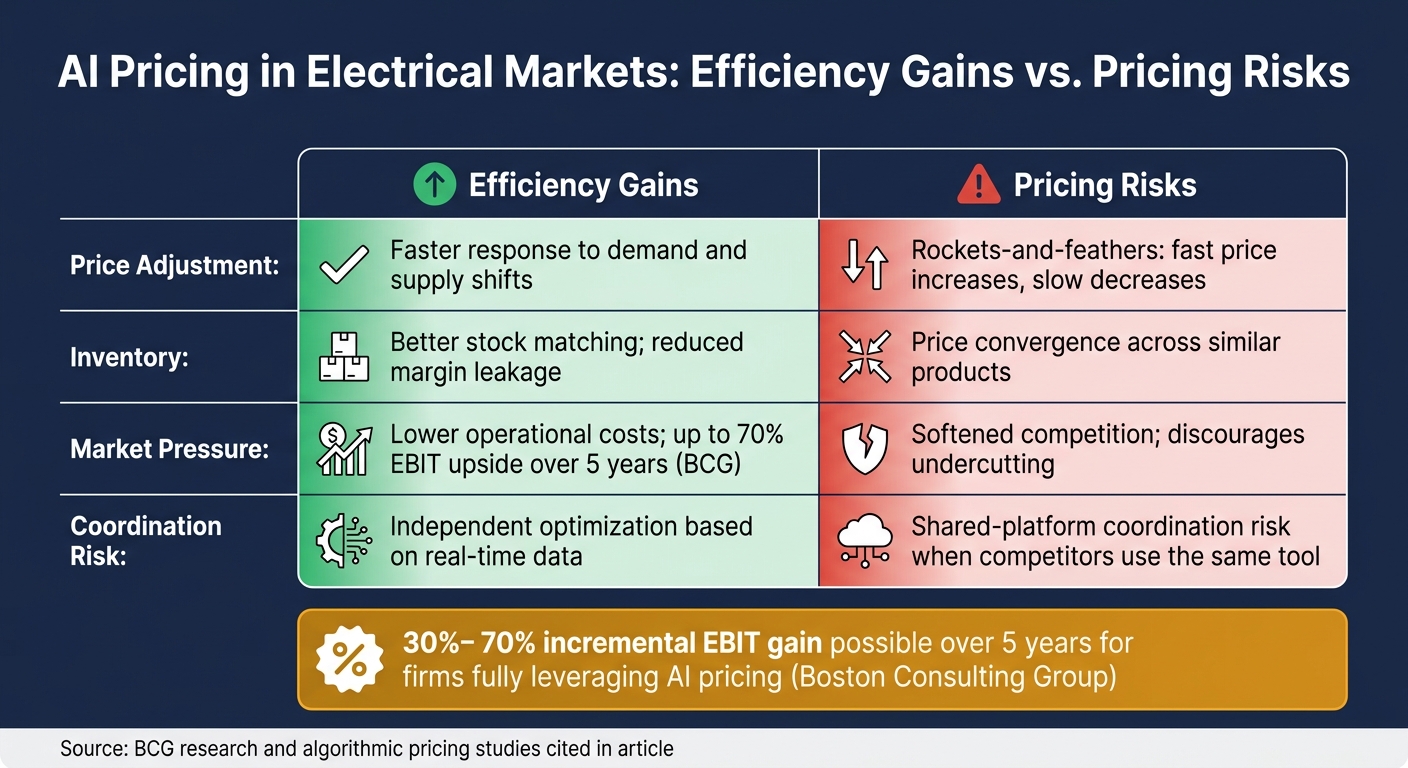
AI Pricing in Electrical Markets: Efficiency Gains vs. Pricing Risks
Research across energy and industrial markets points in two directions at once. AI pricing helps sellers move faster. But it can also ease price pressure among electrical brands selling breakers, transformers, and switchgear.
How AI Pricing Helps Sellers Manage Speed, Inventory, and Margins
The clearest upside is speed. AI algorithms can process large datasets almost instantly, which lets sellers react to changes in demand or supply within hours instead of days. In electrical equipment, that matters. A rush order, a delayed shipment, or a project deadline can shift demand fast, and pricing teams often need to react on the fly.
Boston Consulting Group found that companies making full use of AI could see incremental profits equal to 30% to 70% of EBIT over a five-year period.
AI systems are also used to spot logistics issues before they eat into margins. That includes scheduling conflicts, missing documentation, and rising demurrage costs.
Still, the same speed that helps sellers stay on top of the market can also pull prices closer together.
When Algorithms Push Prices Up or Reduce Competitive Pressure
When competing brands rely on the same kinds of inputs, repricing can start to sync up. If several sellers use similar data and similar software, prices may move together instead of against each other. For buyers, that can mean fewer surprise deals and less room for sharp discounting on similar products.
There’s also the rockets-and-feathers pattern, where costs go up fast but come down slowly. In plain English, algorithms may be set to protect margins first, so buyers might not get relief right away when wholesale costs drop. Algorithmic pricing can also set off price spikes that move past what demand alone would justify.
Pro-Competitive vs. Anti-Competitive Effects: A Direct Comparison
The research doesn’t point to a simple good-or-bad story. AI pricing can trim waste and help sellers react faster, while also creating market behavior that looks a lot less competitive.
| Outcome Area | Efficiency Gains | Pricing Risks |
|---|---|---|
| Price Adjustment | Faster response to demand and supply shifts | Rockets-and-feathers: fast increases, slow decreases |
| Inventory | Better stock matching; reduced margin leakage | Price convergence across similar products |
| Market Pressure | Lower operational costs; significant EBIT upside | Softened competition; discourages undercutting |
| Coordination Risk | Independent optimization based on real-time data | Shared-platform coordination risk when competitors use the same platform |
That shared-platform coordination risk has drawn attention from regulators. U.S. antitrust cases filed in 2024 and 2026 against algorithmic pricing platforms in other industries show that officials are taking a hard look at shared pricing tools. The same basic concern applies anywhere several competitors lean on the same algorithmic recommendations.
For electrical brands, the issue comes down to rivalry on the same SKUs - and whether these tools sharpen competition or quietly cool it off.
sbb-itb-501186b
How AI-Driven Pricing Changes Competition Among Electrical Brands
Faster Repricing Shifts Rivalry Across Common Electrical Products
In standard circuit breakers, low-voltage gear, and common transformers, AI repricing cuts down the time sellers have to hold a price edge. High-volume SKUs face the most intense price pressure. When several sellers offer the same common electrical product, pricing systems often pull prices into a narrow band. That leaves less room to win on price alone.
This shows up most in products that are easy to compare side by side. If the specs match and buyers can check listings in seconds, price gaps tend to close fast. Competition then moves away from broad pricing plans and becomes a fight at the SKU level.
There’s more room to stand apart in technical, certified, or specialty items. In those categories, price still counts. But buyers are less likely to make the call on price alone.
Small Brands and Resellers Gain Pricing Tools but Face Data Gaps
Cloud-based AI pricing tools have lowered the barrier to entry for smaller distributors and independent resellers. That changes the game. A regional electrical reseller with aging transformer inventory can now use AI to find a price that helps move stock without giving away margin.
Large firms still have the edge, though. They work with richer data, tighter system connections, and faster use of unstructured signals. Smaller sellers usually don’t have that same depth. Their tools may run on thinner demand histories, which increases the risk of what researchers call false precision: models that look confident but are overfit to patterns that don’t hold.
So yes, more sellers can now use pricing software. But access to tools doesn’t mean equal pricing power. And when price gaps get smaller, buyers start looking harder at everything else.
Why Non-Price Factors Matter More When Prices Cluster Together
When prices converge, procurement teams put more weight on compliance, lead time, and service risk. For teams sourcing breakers, transformers, or backup power equipment, condition, lead time, certifications, and seller reliability move to the top of the list.
A new, unopened unit with a verified UL or CSA mark carries real weight in critical infrastructure purchases. A guaranteed ship date matters too, especially when the project schedule is locked in. For more complex equipment, warranty terms and technical support can matter more than a small price gap.
Seller ratings and documentation quality also become major filters. When two listings show the same algorithm-driven price for the same SKU, procurement teams lean on code compliance confidence: the assurance that the equipment will pass inspection and perform as specified. At that point, marketplace visibility and disciplined procurement matter more than ever.
What AI Pricing Means for U.S. Electrical Marketplaces and Procurement Teams
How Marketplace Price Visibility Helps Buyers and Speeds Up Repricing
As prices bunch together across common electrical SKUs, marketplace listings often become the fastest way to gauge market pressure. They give buyers a live reference point for AI-set prices. And they give sellers the data they need to reprice with less lag.
On Electrical Trader, listings for breakers, transformers, voltage equipment, and power generation tools can update fast as supply and demand shift. That same visibility also feeds AI repricing models, which makes price movement across product groups more responsive and continuous. In plain English: the marketplace doesn’t just show the market. It helps shape how fast prices move inside it.
For buyers, that kind of speed is useful. But there’s a catch. A live marketplace price should work as a short-term signal, not a fixed quote.
That speed helps buyers, but it also shortens the window for procurement decisions.
What Procurement and Operations Teams Should Watch in AI-Priced Listings
The main risk in an AI-priced market is simple: acting on a listing that has already changed. When repricing happens fast, brands get less time to compete on price. So procurement teams need to watch price movement, not just the price level.
If supply and demand start moving fast, quick price swings can signal that it’s time to double-check whether the item still fits the project timeline. A low price may look good at first glance, but if timing is off, that deal can fall apart fast.
Before treating any listing price as fixed, procurement teams should verify:
- Condition
- Availability
- Delivery terms
In a market like this, the number on the screen matters. But the terms behind that number matter just as much.
Conclusion: What AI Pricing Likely Means Next for Electrical Brand Competition
AI pricing is changing how electrical brands compete, and that shift is already happening.
The first change is simple: speed. Prices now move faster than manual procurement cycles can keep up with. And that edge doesn't land evenly across the market.
Brands with cleaner data and connected workflows can get more out of AI pricing. Smaller resellers with data gaps tend to fall behind. So this isn't just about having better software. It's about having better data infrastructure behind it.
Once pricing gets tighter, the fight moves past the number itself.
When prices start to cluster, price matters less. In electrical sourcing, compliance and delivery risk can matter more than a small gap in price. If multiple listings show the same algorithm-driven price for the same SKU, buyers start looking harder at what sits behind that listing:
- Availability
- Lead time
- Reliability
- Compliance
For U.S. buyers, live listings show where the market is heading, not where it will stay. Treat AI-priced listings as signals, not fixed quotes. Check condition, specs, and timing before you commit.
That's the long-term divide taking shape in the market: brands that invest early in usable data and connected workflows will pull farther ahead.
FAQs
How often can AI-driven prices change?
AI-driven prices can change often because these systems make real-time adjustments based on buying trends and market conditions.
When several algorithms interact without human oversight, prices can move fast and keep shifting in response to one another.
Why do prices on similar electrical SKUs cluster together?
Prices for similar electrical SKUs often end up in the same range because manufacturers are dealing with the same market pressures - not because they’re secretly working together.
Take raw materials. When the cost of copper or grain-oriented electrical steel goes up, it pushes costs higher across the whole sector at once.
The same thing happens with supply chain bottlenecks, import tariffs, and long lead times. Those pressures make it harder for brands to compete hard on price, so the gap between major manufacturers tends to stay narrow.
What should buyers verify before trusting an AI-priced listing?
Before trusting an AI-priced listing, buyers should put safety and regulatory compliance ahead of price.
Start by checking for third-party certification from a Nationally Recognized Testing Laboratory such as UL or ETL. And don’t stop at the logo. Look for Listed status, not just Recognized.
AI can miss odd market conditions. So it still helps to use human judgment, look into the seller’s reputation, and weigh price-adjustment clauses that can help manage market swings.





