

Age vs Performance: When to Replace Electrical Equipment
When should you replace electrical equipment? The answer lies in balancing safety, reliability, and costs. Aging systems like circuit breakers, transformers, and switchgear degrade over time, leading to higher risks of failure, expensive downtime, and compliance issues. Here's what you need to know:
- Lifespan Matters: Most electrical systems last 20–30 years, but factors like heavy use, poor maintenance, and harsh conditions can shorten this.
- Warning Signs: Look for overheating, frequent breaker trips, unusual noises, or visible damage (e.g., cracks, burns, leaks).
- Cost of Waiting: Emergency repairs cost 3–5x more than planned replacements, and downtime can cost up to $5M per hour.
- Safety Risks: Older equipment is prone to arc flashes, electrical fires, and may not meet modern safety codes.
- Energy Loss: Outdated systems use 10–30% more energy, adding to long-term costs.
Key Takeaway: Replace critical components once they reach 80% of their lifespan or show signs of wear. Regular inspections and maintenance can delay replacements but don’t ignore safety risks or escalating costs. Platforms like Electrical Trader can help source new or used replacement parts efficiently.
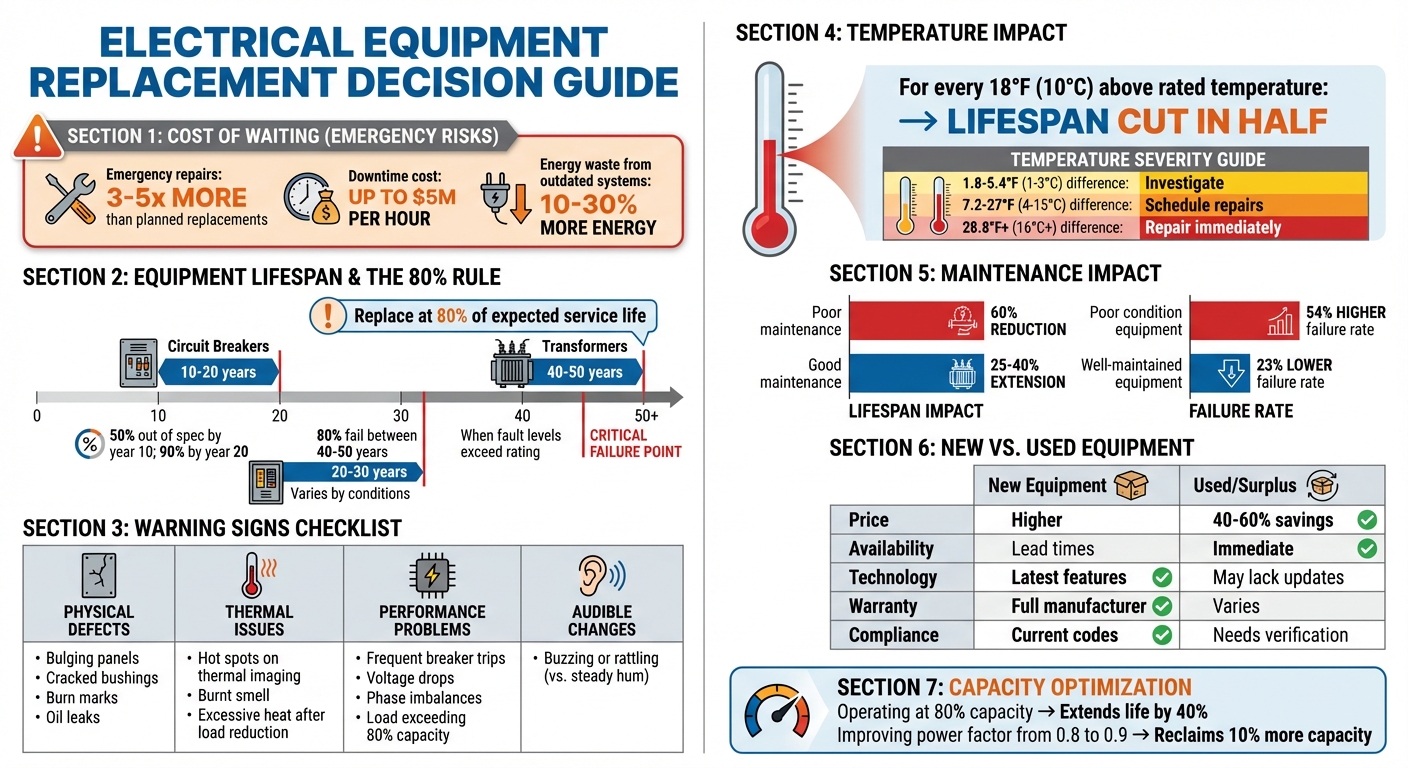
Electrical Equipment Replacement Decision Guide: Warning Signs, Costs, and Lifespan Data
Replacing Old Breakers Acceptable Replacement Guide
Performance Warning Signs That Mean Replacement
Spotting performance warning signs early can make all the difference when it comes to minimizing risks and planning timely replacements. Electrical equipment rarely fails without some form of warning. In most cases, systems exhibit clear signs of trouble well before a complete breakdown. The challenge lies in recognizing these signals and addressing them before a small issue escalates into a major problem.
Common Performance Problems
Some of the earliest warning signs include physical defects, such as bulging panels, cracked bushings, burn marks, or oil leaks. You might also notice audible changes, like a shift from the usual steady hum to harsher sounds like buzzing or rattling - both of which suggest internal wear and tear.
Thermal issues are another red flag. Hot spots detected through thermal imaging, a burnt smell, or unusually warm ventilation can indicate internal damage. If the equipment remains excessively hot even after reducing the load, it’s often a sign of insulation failure.
Frequent problems like breaker trips, voltage drops, or phase imbalances suggest the equipment is struggling to handle demand, especially if the power load exceeds 80% of its capacity. For oil-filled systems, Dissolved Gas Analysis (DGA) results showing active arcing or high furan levels usually signal that replacement is a better option than repair.
When Replacement Parts Aren't Available
A lack of manufacturer-approved spare parts is a strong indicator that equipment has reached the end of its life. When parts are no longer being produced, it’s a clear sign that the manufacturer has moved on - and you should, too. This isn’t just an inconvenience; it can significantly increase Mean Time to Repair (MTTR), as standard maintenance becomes impossible. What might typically be a quick repair could instead lead to extended and costly downtime.
"The hard truth is that 80% of transformers fail when they are between 40 and 50 years old." - Doug Post, President, EC&M
If approved replacement parts aren’t available - especially for equipment with high arc flash risks or inadequate fault-current ratings - replacement becomes an immediate priority.
Safety Standards and Code Requirements
Older equipment often falls short of meeting modern NFPA 70 standards. Systems that rely on manual closing mechanisms or use plain break contacts without advanced arc control devices present serious safety hazards.
Expanding systems can also create problems. If fault levels exceed the original switchgear’s rating, the equipment becomes a liability, often requiring either replacement or a reconfiguration of the network. Older systems also take longer to clear faults, increasing arc flash risks and the level of Personal Protective Equipment (PPE) required for workers. Additionally, missing documentation, like single-line diagrams, can hinder essential safety measures like lock-out/tag-out (LOTO), further compromising operational safety.
"Aging electrical equipment and components are not only inefficient, they're potentially dangerous." - Schneider Electric Blog
These warning signs make it clear: when equipment shows its age, it’s time to weigh the risks of repair against the benefits of replacement to maintain safety and reliability.
What Makes Equipment Age Faster
Electrical equipment doesn’t last forever, but certain factors can speed up its wear and tear. Understanding these factors can help you spot potential issues before they lead to safety risks or unplanned downtime. The primary culprits are environmental conditions like temperature, humidity, and ventilation. Let’s break down how these elements contribute to faster aging.
Environmental Damage
Heat is a major enemy of electrical equipment. For every 18°F (10°C) increase above the rated temperature, the equipment’s lifespan is cut in half. Standards set by IEEE and ANSI cap electrical insulator temperatures at 221°F (105°C), which combines a 104°F (40°C) ambient temperature with a 149°F (65°C) internal rise. Going beyond this limit can severely degrade insulation and lead to short circuits. Even small temperature changes, as little as 1°C to 3°C, detected through thermal scans, can signal potential problems.
Humidity is another significant factor. High moisture levels can corrode components and weaken electrical connections, leading to overheating and insulation breakdown. In extreme cases, condensation can cause immediate short circuits, while long-term exposure may encourage mold growth on insulation. Poor ventilation makes matters worse by trapping heat, pushing internal temperatures beyond safe operating limits.
Contaminants like dirt and dust, especially in equipment with basic NEMA 1 enclosures meant for dry indoor environments, can interfere with moving parts and trap heat. Additionally, improper installation - such as loose bolts - can create localized heating, further accelerating equipment wear.
| Temperature Difference (ΔT) | Severity | Recommended Action |
|---|---|---|
| 1.8°F to 5.4°F (1°C to 3°C) | Possible deficiency | Investigate further |
| 7.2°F to 27°F (4°C to 15°C) | Deficiency | Schedule repairs |
| 28.8°F or higher (16°C or higher) | Major deficiency | Repair immediately |
Usage and Maintenance Issues
How equipment is used and maintained plays a big role in its longevity. Running equipment at full capacity all the time generates excess heat, which accelerates aging. Operating at 80% capacity, on the other hand, can extend its life by about 40%.
Frequent use and operational stress also take a toll. For instance, circuit breakers in motor circuits that are switched on and off repeatedly wear out 4.3 times faster than those used less often. Similarly, high starting currents during motor startups create electrical stress on conductors and breakers.
Non-linear loads, such as those from variable frequency drives (VFDs), LED drivers, and servers, introduce high harmonics. These harmonics generate hot spots and even audible buzzing, which can hasten equipment failure. Equipment in poor condition is also more likely to fail - its failure rate is about 54% higher compared to equipment in average condition. Skipping preventive maintenance can reduce equipment lifespan by up to 60%. On the flip side, a well-executed maintenance plan can extend it by 25–40%.
"Maintenance is directly related to equipment lifetime." - Fitzemeyer & Tocci, Inc.
sbb-itb-501186b
Repair vs. Replace: How to Decide
When faced with aging equipment, deciding whether to repair or replace hinges on three critical factors: safety, cost-effectiveness, and reliability. Start by evaluating safety risks, conducting an economic analysis, and reviewing the equipment’s integrity based on visual inspections and maintenance history. To set a benchmark for replacement, calculate justified annual expenditure by multiplying downtime days, cost per day, and failure probability. Then, multiply this figure by the required payback period - commonly four years.
Some situations demand immediate replacement. For instance, rising repair costs due to scarce spare parts or safety concerns, such as outdated manual closing mechanisms, plain break contacts without arc control, or equipment operating beyond its fault rating, leave no room for delay.
Maintenance Programs That Extend Life
If repairing is the chosen path, proactive maintenance becomes essential to prolong the equipment’s lifespan. Regular inspections and advanced diagnostics can help catch issues early. For example, partial discharge testing identifies insulation problems in cables and switchgear before they escalate into major failures. Similarly, thermal imaging can detect hot spots caused by unbalanced loads or deteriorating components. A comprehensive system evaluation every 10 years is also recommended to spot aging parts and address safety concerns. These evaluations should be paired with visual inspections to check for loose connections, corrosion, and physical damage.
Transformers, in particular, benefit from replacing worn accessories during their "grey zone" period - when their core components are still functional. This approach is often the most cost-efficient. Additionally, improving the power factor from 0.8 to 0.9 can reclaim up to 10% more capacity, potentially delaying the need for a full replacement.
Expected Lifespans and Replacement Triggers
While regular maintenance can delay the inevitable, understanding the typical service life of equipment helps determine when repairs are no longer practical. For example, circuit breakers degrade quickly: by year 10, half are already out of spec, and by year 20, that number jumps to 90%. Doug Post, President of EC&M, summarizes the reality of transformer lifespans:
"The hard truth is that 80% of transformers fail when they are between 40 and 50 years old".
Here’s a quick reference for service life and replacement triggers:
| Equipment Type | Expected Service Life | Key Trigger |
|---|---|---|
| Circuit Breakers | 10–20 years | 50% out of spec by year 10; 90% by year 20 |
| Transformers | 40–50 years | 80% failure rate reached at this age |
| MV Switchgear | 40–50 years | Fault levels exceeding rating |
| Motor Circuit Breakers | Varies | Frequent operations (over 1 per month) |
Equipment condition also plays a major role in failure probability. Units in poor condition are 54% more likely to fail compared to those in average condition, while well-maintained systems can reduce failure rates by 23%. Replacement becomes unavoidable when systems consistently operate beyond 80% capacity, trip frequently, or lack modern safety features.
Where to Find Replacement Equipment
Once you've determined that replacing equipment is necessary, the next step is figuring out where to find the right components. Whether you're considering new or used equipment, weighing the pros and cons of each option is essential for making a smart decision.
New vs. Used Equipment Comparison
Choosing between new and used equipment often comes down to balancing cost, availability, and features. New equipment typically includes the latest safety features, cutting-edge technology, and full manufacturer warranties, making it an attractive option for those seeking reliability and compliance with current standards.
On the other hand, used or surplus equipment can offer substantial savings - up to 40–60% off the cost of new components. As Daniel T. Meis, President & Systems Designer at Jackson Lumber Harvester Inc., notes:
"We typically purchase refurbished units to provide our customers with the most economical solution, and have been very satisfied with the quality of the equipment".
This approach is particularly useful for sourcing obsolete parts for older systems or when time is of the essence.
| Factor | New Equipment | Used/Surplus Equipment |
|---|---|---|
| Price | Higher initial cost | 40–60% savings compared to new |
| Availability | May involve manufacturing lead times | Often available for immediate delivery |
| Technology | Includes the latest safety features | May lack modern updates |
| Warranty | Standard manufacturer warranties | Varies by seller |
| Code Compliance | Meets current safety codes | Requires independent integrity checks |
Understanding these differences can help you decide based on your specific needs and budget. If you’re leaning toward used equipment, take extra precautions - verify its condition, service history, and ensure an independent assessor evaluates its safety and operational reliability before purchase. Keep in mind that emergency repairs can cost 3–5 times more than planned replacements.
Using Electrical Trader for Equipment Sourcing
Once you've decided on the type of equipment, finding a reliable source is crucial. Electrical Trader simplifies the process by offering a centralized marketplace where buyers can connect directly with sellers across the country. This platform specializes in breakers, transformers, power generation components, and low to high voltage equipment, making it a one-stop shop for your replacement needs.
Through Electrical Trader, you can verify equipment specifications, review service histories, and negotiate pricing - all before making a commitment. The platform is especially valuable for sourcing rare or obsolete components, which are critical for facilities with aging systems. For example, facilities with systems over 40 years old often face challenges finding original parts, as manufacturers may no longer produce them.
Electrical Trader also offers a "Power Quote" service, allowing you to submit specific requirements and receive tailored solutions. This ensures compatibility with your existing systems and helps streamline the sourcing process. Whether you need a single circuit breaker or a complete switchgear replacement, having access to multiple sellers in one place can save time and money. And when downtime can cost up to $5 million per hour, minimizing delays is essential for protecting your bottom line.
Conclusion: Making Smart Replacement Decisions
When it comes to replacing aging electrical equipment, careful evaluation is key. Factors like safety, reliability, energy costs, and liability risks should guide your choices. Equipment failures can lead to billions in damages and cause significant downtime. To streamline the decision-making process, consider the 3 Rs framework: Replace, Refurbish, or Retain. Always address life safety hazards first to protect people and reduce legal risks.
A practical approach is the 80% Rule - plan to replace critical components when they reach 80% of their expected service life. This strategy helps avoid unplanned outages, which are far more expensive than planned upgrades - emergency repairs can cost 3–5 times more.
"Replacement of electrical systems is a study of economics and risk." – Consulting-Specifying Engineer
Conduct a thorough review of your equipment every 10 years to ensure it aligns with your business needs and to spot signs of aging, such as flickering lights, overheating, or unusual noises. If parts become hard to find or failures happen more often, it's time to act. By using a clear framework, you’ll be equipped to make timely decisions and secure reliable, compliant systems.
Once you've decided to replace, sourcing your equipment is the next step. Platforms like Electrical Trader simplify this process by connecting you directly with sellers across the country, cutting out middlemen. Their Power Quote service helps you find equipment that matches your needs, reducing delays and ensuring compatibility. When downtime can cost millions, having access to verified equipment with documented service histories - and potential savings of 40% to 60% - can make all the difference.
FAQs
How do I know when it’s time to replace my electrical equipment?
Determining when to replace your electrical equipment often hinges on its age, performance, and physical condition. Generally, most equipment is designed to last anywhere from 20 to 30 years. However, this lifespan can shift depending on factors like how often it’s used, the quality of maintenance it receives, and the conditions it operates in.
Pay attention to warning signs such as frequent malfunctions, declining efficiency, overheating, or visible damage. Regular inspections, paired with following maintenance standards like those outlined in NFPA 70B, can help spot problems early - before they turn into major failures. If your equipment is no longer dependable or poses safety risks, it might be time to think about replacing it.
What safety risks are associated with outdated electrical equipment?
Using old electrical equipment isn’t just inefficient - it’s downright dangerous. As components age, their reliability decreases, making them more prone to failures. This can lead to serious risks like electrical fires, shocks, and even hazardous arc flash incidents. Problems such as overheating, loose connections, and worn-out enclosures tend to worsen over time, creating unsafe conditions.
On top of that, older systems often fall short of today’s safety standards, including those outlined in NFPA 70B and NFPA 70E. These standards stress the importance of preventive maintenance and proper safety practices. Regularly inspecting and replacing outdated equipment isn’t just a good idea - it’s critical for protecting both people and property from costly or catastrophic failures.
How do environmental conditions affect the lifespan of electrical equipment?
Environmental factors can take a serious toll on the lifespan of electrical equipment, wearing it down and causing gradual damage. Things like extreme heat, high humidity, moisture, and corrosive surroundings can wreak havoc on insulation, corrode metal parts, and weaken mechanical components. For instance, prolonged exposure to high temperatures can result in thermal fatigue, while moisture often leads to corrosion and insulation failure.
Other stressors, including constant vibrations, frequent power cycling, and dust accumulation, can speed up the aging process by damaging internal parts. Over time, these problems compromise reliability and increase the likelihood of equipment failure. To keep your equipment running longer, it’s crucial to perform regular maintenance and address environmental challenges proactively.