ABB vs. Siemens: Reliability in Industrial Applications
Choosing between ABB and Siemens for industrial reliability comes down to your specific needs. Both companies are leaders in their fields, offering advanced technologies to reduce downtime and improve efficiency. Here's a quick summary:
- ABB focuses on heavy electrification and predictive maintenance, with tools like the ABB Ability™ platform and specialized testing facilities. It’s ideal for industries like power distribution, marine, and manufacturing.
- Siemens excels in automation and digital integration, leveraging platforms like the TIA Portal and Digital Twin Composer. It’s a strong choice for automotive, pharmaceuticals, and energy sectors.
Key Takeaways:
- Downtime Costs: Unplanned downtime can cost up to $500,000/hour, making reliability critical.
- ABB Strengths: Advanced testing, predictive maintenance, and global field support.
- Siemens Strengths: Integrated software solutions, digital twins, and AI-driven maintenance.
- Industry Fit: ABB suits power-heavy industries; Siemens thrives in automation-focused sectors.
Quick Comparison:
| Feature | ABB | Siemens |
|---|---|---|
| Core Focus | Electrification, predictive maintenance | Automation, digital integration |
| Key Technology | ABB Ability™ platform | TIA Portal, Digital Twin Composer |
| Industry Fit | Power, marine, manufacturing | Automotive, pharmaceuticals, energy |
| Support Network | 1,200+ field engineers | Comprehensive global support |
| Testing Facilities | 9,000 sqm across 4 global locations | Advanced simulation and AI tools |
Bottom Line: ABB is the go-to for power-intensive operations, while Siemens offers unmatched automation tools. Your choice depends on your industry, existing infrastructure, and long-term goals.
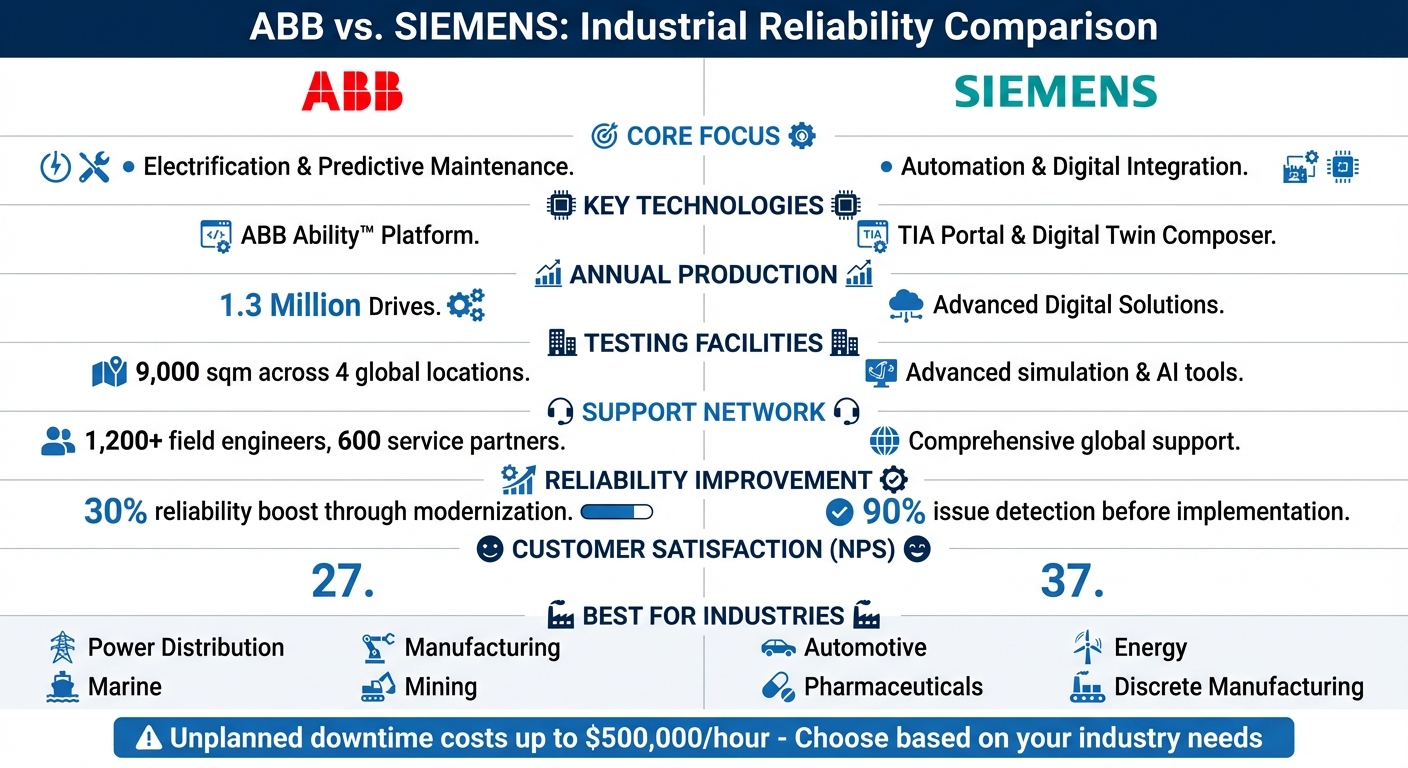
ABB vs Siemens Industrial Reliability Comparison Chart
Before You Upgrade Your PLC - Siemens vs ABB vs Schneider | Which One Fits Your Plant?
ABB: Reliability and Performance Features
ABB ensures uninterrupted industrial operations by embedding reliability at every stage, from initial design to final deployment. Across 9,000 square meters of testing facilities in Helsinki, Beijing, New Berlin, and Bangalore, ABB engineers push components to their limits to identify weaknesses using a "Physics of Failure" approach. This method ensures reliability is not an afterthought but a core focus from the very beginning.
Among these facilities is the Sahara Room, Finland's largest controlled environment for simulating extreme heat and humidity. ABB also operates specialized EMC laboratories and corrosion chambers that mimic harsh conditions like salt mist and corrosive gases encountered in marine and offshore environments. When failures occur, ABB employs advanced tools like high-magnification X-ray imaging and plasma grinding - removing material layer by layer at an atomic level - to isolate microscopic flaws. Interestingly, about 90% of failures uncovered during testing are linked to component issues rather than overall design flaws.
ABB's Core Technologies
ABB delivers over 1.3 million drives each year, equipped with cutting-edge technologies to proactively prevent failures. The ABB Ability™ Digital Suite plays a key role by offering real-time monitoring for drives, motors, and shaftlines. This system detects anomalies early through condition monitoring and predictive maintenance. For motors and generators, ABB Ability™ LEAP (Life Expectancy Analysis Program) evaluates stator winding insulation to estimate remaining service life - without requiring the rotor to be removed.
Backing these technologies is ABB's extensive service network, which includes more than 1,200 certified field engineers and 600 service partners. These teams provide 24/7 support, both remotely and on-site. ABB's Motion OneCare program offers a flexible, data-driven approach to maintenance, moving away from rigid schedules to strategies tailored to the actual health of assets. These innovations have consistently delivered positive results in real-world applications.
ABB Performance Examples
ABB's advanced technologies translate directly into improved uptime and efficiency. For instance, at the Ash Grove cement plant in Mississauga, Canada, ABB Ability™ Condition Monitoring ensures continuous operation by tracking drive health and preventing unexpected production halts. Similarly, a Swiss waste-to-energy plant benefited from ABB Ability™ LEAP, which allowed the team to predict the life expectancy of generator stator winding insulation, enabling better maintenance planning and avoiding unplanned outages.
Modernization projects also showcase ABB's impact. At Al Bardi Paper Mill in Egypt, upgrading an ACS600 multidrive system boosted reliability by about 30% and extended the equipment's lifespan by at least 12 years. In another example, Changan Ford Automobile Co., Ltd. invested $52 million in ABB's high-automation welding solutions for a new factory in Harbin, China, in July 2015. The installation featured IRB 6700 and IRB 7600 robots equipped with ABB's GateFramer car body positioning system. This setup allowed six different vehicle models to be produced on a single line with just an 18-second switch time. The IRB 6700 robots also improved energy efficiency by 15% compared to earlier models, while maintaining the lowest total cost of ownership in their class.
Siemens: Reliability and Performance Features
Siemens has built its reputation for reliability by combining digitalization and autonomous operations into industrial systems. A prime example is the Digital Twin Composer, introduced in January 2026. This software creates physics-accurate 3D models of entire facilities, enabling companies to simulate changes and identify up to 90% of potential issues before any physical implementation. By integrating with NVIDIA Omniverse, Siemens offers a virtual testing ground for everything from product designs to factory logistics, paving the way for precise diagnostics and efficient maintenance strategies.
Siemens also excels in AI-driven predictive maintenance. Using edge AI sensors, their systems monitor key metrics like vibration, temperature, and energy consumption in real time. These sensors automatically adjust machine settings to prevent breakdowns. For power generation, Siemens developed robotic in-situ inspection technology, which performs diagnostics on air-cooled generators without removing the rotor. This innovation reduces inspection costs by 90% and cuts outage time by up to 80%, a game-changer for operational efficiency.
Another standout is the Siemens Xcelerator platform, paired with the Totally Integrated Automation (TIA) portfolio. Together, they create a seamless ecosystem where IT and operational technology merge. This "plug-and-operate" setup supports "adaptive production", enabling systems to adjust and optimize operations autonomously with minimal disruptions. In the European Union, Siemens' autonomous power plant solutions already allow for unsupervised operation for up to three days.
Siemens' Core Technologies
Siemens' reliability is underpinned by a trio of key technologies. First, the Omnivise T3000 control system offers real-time decision-making capabilities for power plants. By working with AI-driven analysis algorithms, it eliminates the need for manual inspections. As Jan Weustink, a Siemens Energy expert on simulations and digital twins, explains:
"Autonomy doesn't start with the autopilot. Long before that, power plants are supported by smart analyses, smart forecasts, smart recommendations, and smart instructions".
Next is the SIMATIC Process Device Manager (PDM), which supports over 4,500 devices from more than 200 manufacturers. This tool standardizes diagnostic data across controllers, eliminating the need for separate diagnostic programming and speeding up troubleshooting. For applications requiring high availability, Siemens offers redundant automation systems and Sm@rtGear Dynamic Automatic Throw Over (ATO), which ensures continuous operation by managing multiple power sources during failures.
Lastly, Siemens' digital twin technology extends beyond planning into ongoing operations. With knowledge graphs, teams can quickly trace the functional chain of a defect, while valve monitoring apps detect anomalies and wear to fine-tune maintenance schedules. Massive data sets from plant sensors are processed through industrial cloud computing, enabling smarter, data-driven decisions.
Siemens Performance Examples
The real-world impact of Siemens' technologies is undeniable. For instance, PepsiCo used the Digital Twin Composer and NVIDIA Omniverse to optimize select U.S. manufacturing and warehouse facilities. By virtually modeling machines and processes with physics-level precision, PepsiCo achieved a 20% increase in throughput, nearly 100% design validation, and a 10% to 15% reduction in capital expenditure by identifying hidden capacity. Joe Bohman, Executive Vice President of PLM Products at Siemens Digital Industries Software, highlighted the importance of this innovation:
"The new Digital Twin Composer delivers on our vision for the industrial metaverse. It helps manufacturers to overcome the unprecedented challenges of mastering complexity, accelerating production, reducing costs and increasing profitability".
In another example, Tenaris, a global energy tubing supplier, implemented automation and networking technology through Siemens' TIA Portal. The upgrades enhanced testing throughput, improved safety, and delivered a 50% return on investment.
For municipal applications, the City of Decatur, Texas adopted Siemens’ SITRANS store IQ solution for its wastewater treatment plant. Using the HydroRanger 200 and MindSphere cloud platform, the plant achieved greater operational transparency and streamlined data collection for its polishing pond and effluent discharge basin.
In the battery sector, KORE Power partnered with Siemens to automate and optimize manufacturing at its Arizona gigafactory. This collaboration aims to boost U.S. production of batteries for electric vehicles and energy storage systems through advanced manufacturing processes. These examples underscore Siemens' ability to deliver reliable results across diverse industries.
sbb-itb-501186b
ABB vs. Siemens: Direct Comparison
ABB and Siemens both shine in the realm of industrial reliability, though they take different approaches to achieve their success. ABB, for instance, produces an impressive 1.3 million drives annually and prioritizes predictive maintenance through its ABB Ability™ platform. This tool monitors asset health, aiming to prevent equipment failures before they occur. ABB's "Physics of Failure" methodology digs deep into the causes of malfunctions, using advanced tools like forensic X-rays and microscopic analysis to uncover that 90% of failures stem from component-related issues.
Siemens, on the other hand, focuses heavily on integrated software solutions and advanced digital tools to ensure operational consistency. A key feature of their approach is the TIA Portal, which streamlines programming and diagnostics. This integration minimizes software fragmentation and enhances long-term system performance.
When it comes to industry strengths, ABB leads in power and utilities, while Siemens stands out in sectors like automotive, pharmaceuticals, and energy. ABB’s extensive global support network - comprising over 1,200 field engineers and 600 service partners - enables rapid response times. A 2018 study by Azima, Inc., which analyzed two decades of field tests on 250,000 motors, found ABB to be a top performer in reliability. Siemens also ranked among the world’s most reliable brands, but ABB stood out as the leader. Burt Hurlock, CEO of Azima, Inc., remarked:
"Azima reliability data proves beyond question that ABB's global reputation for reliability and engineering excellence is well-earned and well-deserved".
Reliability Metrics Comparison Table
| Metric | ABB | Siemens |
|---|---|---|
| Downtime Reduction | 30% reliability improvement through modernization and predictive maintenance | Integrated systems ensure operational continuity |
| Technology Maturity | Over 140 years of expertise; 1.3 million drives delivered annually | Advanced digital twin technology via the Digital Twin Composer and Xcelerator platform |
| Application Range | Steel mills, HVAC, marine, and offshore drilling | Automotive, pharmaceutical, and energy applications |
| Warranty & Support | Global network of 1,200+ field engineers and 600 service partners | Comprehensive global support infrastructure |
| R&D Investment | 9,000 sqm of specialized testing facilities spread across Finland, China, the US, and India | Strong focus on digital innovation through the Xcelerator platform and simulation tools |
| Customer Ratings | NPS: 27; Product Quality: 80/100; Customer Service: 79/100 | NPS: 37; Product Quality: 81/100; Customer Service: 81/100 |
This side-by-side comparison highlights the strengths of each manufacturer, helping businesses make informed decisions based on their specific industrial requirements.
Selecting the Right Manufacturer for Your Application
Choosing the right manufacturer isn’t just about comparing reliability metrics - it’s about aligning your facility's specific operational needs with the strengths each brand brings to the table. Your industry and its unique demands will often dictate the best fit. For instance, sectors like oil, gas, mining, chemicals, and marine typically lean toward ABB. Why? ABB’s System 800xA integrates power and automation seamlessly, combining DCS, SCADA, HMI, and asset management. This makes it a go-to solution when you need deep integration between power systems like switchgear and transformers with automation.
On the other hand, industries with distinct automation needs, such as automotive, pharmaceuticals, and machinery manufacturing, often prefer Siemens. The TIA Portal creates a unified ecosystem for software and hardware, simplifying PLC programming, HMI design, and networking. This streamlined approach reduces engineering time and makes maintenance more manageable - especially for large-scale manufacturing operations where IT/OT connectivity is a priority. As Michael Batchelor, an experienced engineering professional, aptly put it:
"A plant with a room full of Siemens spare parts and 25 Siemens processors on the manufacturing floor isn't likely to see Allen Bradley [or ABB] as a cost effective or logical choice".
Another critical factor is your existing equipment setup. Sticking with your current vendor can simplify spare parts management and reduce the need for extensive training for maintenance teams. And don’t underestimate the importance of local support. With unplanned downtime costing an average of $170,000 per hour, having nearby qualified support can be the difference between a quick recovery and prolonged losses.
Matching Equipment to Industry Requirements
The key to making the right choice lies in aligning your operational priorities with each manufacturer’s capabilities. If your facility requires heavy electrification paired with robotics integration - think steel mills, offshore platforms, or marine propulsion systems - ABB’s expertise in power electronics makes it an obvious contender.
For facilities focused on cloud connectivity and Industrial Internet of Things (IIoT) integration, Siemens’ MindSphere platform and TIA Portal are hard to beat. But remember, lifecycle costs go well beyond the initial hardware investment. While 91% of industry leaders agree that modernizing equipment reduces downtime, only 20% actively maintain proactive strategies for modernization. ABB retrofits can enhance reliability by around 30%, while Siemens’ TIA Portal helps lower long-term operational costs. Whether your facility relies on reactive maintenance or is moving toward predictive, condition-based strategies, the right ecosystem will depend on your long-term goals.
Conclusion
The comparison between ABB and Siemens reveals that both manufacturers bring unique strengths to the table, catering to different industrial needs. ABB stands out in power distribution, utilities, and grid stability, particularly in environments where predictive maintenance and resilience under extreme conditions are critical. Their "Physics of Failure" methodology, which attributes 90% of major failures to component-related issues, makes ABB an ideal choice for industries like electrical grids, offshore platforms, and mining operations.
On the other hand, Siemens excels in manufacturing automation and software integration. With a higher Net Promoter Score (37 compared to ABB's 27), Siemens demonstrates stronger customer satisfaction. Its TIA Portal simplifies system integration, reducing engineering time and configuration errors - key benefits for sectors like automotive, pharmaceuticals, and discrete manufacturing.
Ultimately, the decision comes down to your specific industry needs, existing infrastructure, and long-term maintenance goals. For facilities focused on seamless power management and predictive maintenance, ABB's Ability™ System 800xA offers a compelling advantage. Meanwhile, Siemens provides exceptional value with energy-efficient motors and robust software integration, particularly for operations in Europe or the automotive sector.
Considering unplanned downtime can cost an average of $170,000 per hour, minimizing lifecycle costs through accessible spare parts, local support, and system compatibility is critical. Whether you prioritize ABB's expertise in failure prevention or Siemens' integrated automation solutions, aligning your choice with your facility's operational demands will pave the way for sustained success.
FAQs
What should I consider when choosing between ABB and Siemens for industrial applications?
When choosing between ABB and Siemens, it's essential to weigh a few key factors to make the best decision for your operations. Start by looking into their reliability. ABB is known for its rigorous testing at both the component and system levels, ensuring their products can withstand the demands of tough industrial environments. Be sure to also examine Siemens' reliability measures to confirm they align with your operational standards.
Another critical consideration is the total cost of ownership (TCO) and the potential costs of unplanned downtime. ABB highlights that downtime can cost anywhere from $10,000 to $500,000 per hour, emphasizing the importance of designs focused on reliability and proactive maintenance. Compare this with Siemens' TCO data to determine how their solutions fit within your budget while delivering the performance you need.
Finally, evaluate the service and support ecosystem. ABB offers a global network of certified engineers and service partners, along with maintenance plans that include predictive analytics and lifecycle management. Make sure Siemens provides similar levels of support to meet your long-term operational goals.
By prioritizing these factors - reliability, TCO, and service support - you can make a well-informed decision that aligns with your industry’s specific requirements. If you're looking to source ABB or Siemens components, Electrical Trader provides a convenient marketplace for both new and used equipment.
How do ABB and Siemens differ in their predictive maintenance technologies?
ABB provides a variety of predictive maintenance tools designed to keep industrial systems running smoothly. One standout offering is the ABB Ability™ Predictive Maintenance program for motors and generators. This program combines condition monitoring with AI-powered analytics to detect issues before they become major problems. Another key solution is the ABB Ability™ Digital Powertrain, which offers real-time data, advanced diagnostics, and expert-guided monitoring to ensure systems stay reliable and efficient.
Details about Siemens' predictive maintenance technologies were not available from the sources provided, making it hard to directly compare the two companies' approaches. However, ABB's solutions are well-documented and trusted for their performance in industrial settings.
Which industries benefit more from ABB's electrification focus compared to Siemens' automation expertise?
ABB offers electrification solutions that are ideal for industries like power generation, transmission, and distribution, as well as large-scale infrastructure projects. Their lineup includes low- and medium-voltage drives, motors, generators, and smart distribution hardware. These products are engineered to maintain a steady and efficient electricity flow, making them a reliable choice for utility networks and industrial operations.
Siemens, on the other hand, shines in automation-driven sectors such as manufacturing, robotics, process plants, and digital factories. Their offerings - ranging from precision motion control systems to energy-efficient drives and integrated control software - are crafted to boost productivity and optimize performance in highly automated environments.
Both ABB and Siemens products can be found on Electrical Trader, a trusted platform where U.S. buyers can purchase new and pre-owned electrical components tailored to these industries.