

Ultimate Guide to Medium Voltage Cables in Overhead Systems
Medium voltage (MV) cables, operating between 1 kV and 35 kV, are essential for efficiently transporting electricity in power distribution networks. These cables bridge the gap between low-voltage building wiring and high-voltage transmission lines, playing a key role in powering urban areas, industrial facilities, and renewable energy projects. The global MV cable market was valued at $31.86 billion in 2023 and is expected to exceed $43.93 billion by 2028, driven by urban expansion, renewable energy adoption, and grid modernization.
Key Takeaways:
- MV Cable Structure: Includes a conductor (copper or aluminum), insulation (XLPE or EPR), metallic shield, and protective outer jacket.
- Applications: Used in overhead systems, renewable energy sites, and temporary/emergency setups.
-
Types:
- Insulated Overhead Cables: Durable, weather-resistant, and safer than bare conductors.
- Aerial Bundled Cables (ABC): Compact, insulated, and tamper-resistant, ideal for urban and rural areas.
- Messenger-Supported Systems: Designed for longer spans and harsh conditions.
- Installation Guidelines: Avoid damage by adhering to proper tension, bending radius, and grounding practices.
- Maintenance: Regular inspections, diagnostic testing, and condition-based monitoring extend service life up to 40–65 years.
These cables are critical for reliable power distribution, ensuring safe and efficient electricity delivery across various applications.
Medium Voltage Cable Construction and Design
sbb-itb-501186b
Types of Medium Voltage Cables for Overhead Systems
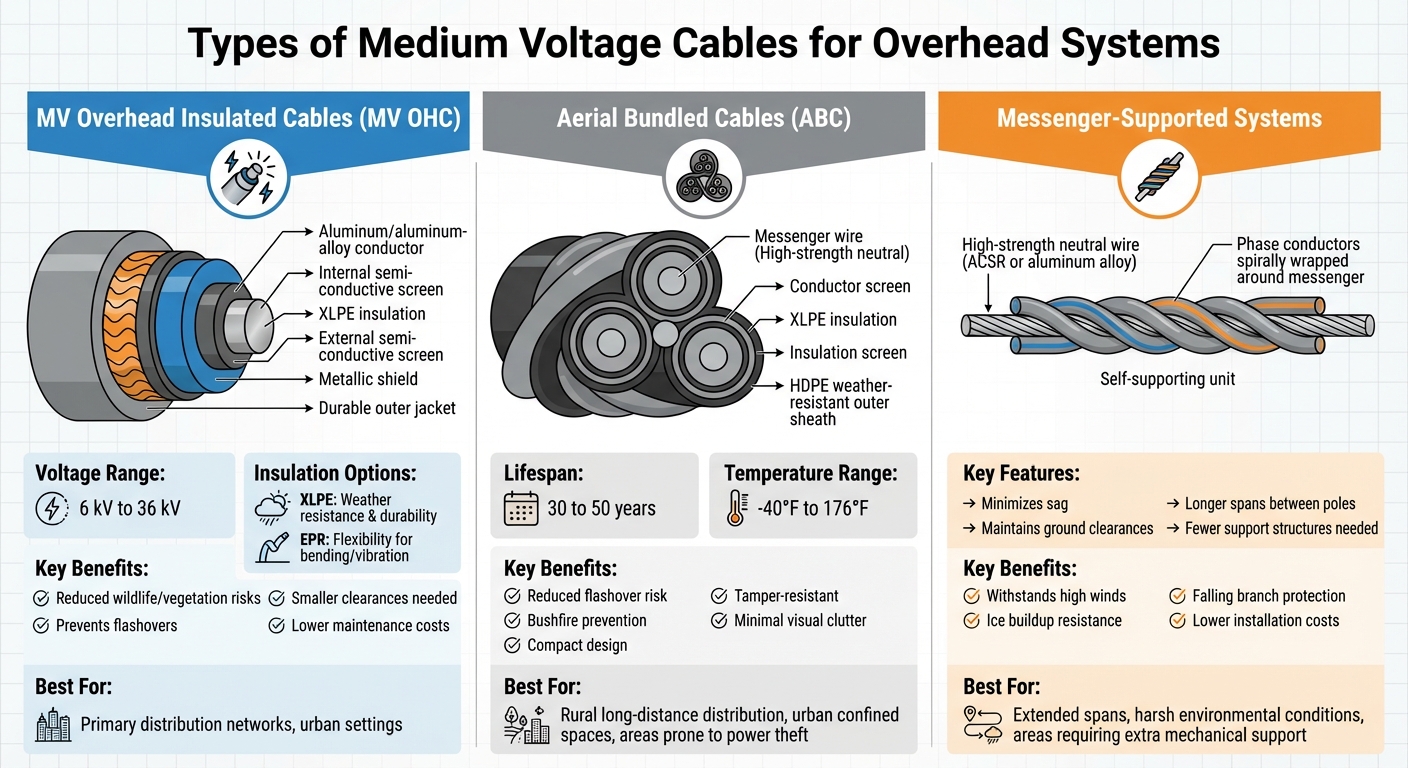
Medium Voltage Cable Types Comparison for Overhead Systems
Overhead power distribution systems require cables that can handle environmental challenges while offering durability, safety, and ease of installation. Here’s a closer look at the main types of medium voltage cables used for overhead applications.
Medium Voltage Overhead Insulated Cables (MV OHC)
MV OHC cables are built with multiple protective layers to withstand outdoor conditions. These cables feature an aluminum or aluminum-alloy conductor, surrounded by an internal semi-conductive screen, XLPE insulation, an external semi-conductive screen, a metallic shield, and a durable outer jacket. They typically operate within a voltage range of 6 kV to 36 kV, making them ideal for primary distribution networks.
The choice of insulation material is crucial. XLPE offers excellent weather resistance and durability, while EPR provides flexibility for applications involving frequent bending or vibration. This insulation significantly reduces risks from wildlife, vegetation, or human activity - common issues with bare conductor systems. Moreover, it prevents flashovers in areas prone to high humidity, pollution, or dense vegetation.
Insulated cables offer additional benefits, such as reduced right-of-way requirements and lower maintenance costs. Their design allows for smaller clearances from buildings and trees, making them particularly useful in urban settings where space is limited.
For an alternative design with added safety features, aerial bundled cables are another option.
Aerial Bundled Cables for Medium Voltage
Aerial bundled cables (ABC) consist of multiple insulated aluminum conductors twisted around a central messenger wire. Each conductor is protected by several layers, including a conductor screen, XLPE insulation, an insulation screen, and a weather-resistant outer sheath made of high-density polyethylene (HDPE). These cables are designed for standard medium voltage applications.
The bundled design enhances safety and reliability. Insulation reduces the risk of flashovers caused by external factors, helping to prevent bushfires in dry areas and reducing accidental electrocutions. With proper care, these cables can last 30 to 50 years and function effectively in temperatures ranging from -40°F to 176°F.
ABC systems are particularly well-suited for specific scenarios. In rural areas, they manage long-distance power distribution with minimal oversight and can handle dense vegetation. In urban environments, their compact design minimizes visual clutter and reduces the risk of accidental contact in confined spaces. Additionally, the insulated construction makes them harder to tamper with, discouraging power theft.
When longer spans and enhanced mechanical support are needed, messenger-supported configurations are a practical solution.
Messenger-Supported Configurations
Messenger-supported systems rely on a high-strength neutral wire - commonly ACSR (Aluminum Conductor Steel Reinforced) or aluminum alloy - to bear the weight of the insulated phase conductors. The phase conductors are spirally wrapped around this messenger wire, forming a self-supporting unit that simplifies installation and allows for longer spans between poles.
The messenger wire plays a critical role in maintaining proper ground clearances by minimizing sag. This reduces the need for additional support structures, lowering overall costs. These systems are designed to withstand external forces like high winds, ice buildup, or falling tree branches, ensuring reliable performance even in challenging conditions. Proper tensioning during installation is essential to maintain structural integrity without compromising the insulation. Using the right suspension clamps and hardware ensures that the system remains secure and functional over time.
This configuration is particularly effective for areas requiring extended spans or where environmental factors demand extra mechanical support.
Applications of Medium Voltage Cables in Overhead Systems
Medium voltage (MV) cables play a crucial role in power distribution, bridging the gap between substations and end-users while maintaining efficient electricity transport over moderate distances. From bustling urban areas to remote renewable energy sites, these cables ensure reliable power delivery with minimal voltage loss.
Utility and Distribution Networks
MV cables are indispensable in utility and distribution systems, connecting substations to residential, commercial, and industrial facilities. They link substation transformers to MV switchgear and interconnect substations, often incorporating devices like reclosers, sectionalizers, and ring main units (RMUs). These components create loop and ring networks that improve system reliability during faults. On industrial campuses, these cables are used to power unit substations and large motors, typically operating at voltages like 15 kV or 25 kV.
In areas where aesthetics or safety is a concern, MV cables facilitate transitions between overhead and underground systems. For example, in wooded regions, insulated "covered" line wires are used to reduce outages caused by tree contact while also protecting wildlife.
"Medium voltage cable is used to move power efficiently over moderate distances, feed large loads such as motors and substations, and connect distributed generation sources such as solar farms or wind turbines to the grid."
– Pro Wire & Cable
This adaptability also supports the integration of renewable energy sources into the grid.
Renewable Energy Integration
Renewable energy installations, such as wind and solar farms, depend heavily on MV cables to transfer power from turbines or inverter skids to central collection points. Wind turbines, for instance, generate electricity at low voltages (around 600 V to 700 V), which can lead to significant energy losses over distance. By stepping up these voltages to distribution levels - usually between 12 kV and 33 kV - energy losses are minimized, ensuring efficient power delivery across large renewable sites.
Aluminum conductors are a popular choice in these installations due to their lighter weight and cost-effectiveness compared to copper, even though they offer about two-thirds the conductivity of copper. Concentric neutral MV cables are also commonly used in overhead-to-underground transitions within renewable systems, providing greater flexibility in system design.
The versatility of MV cables also makes them a reliable choice for temporary and emergency power solutions.
Temporary and Emergency Installations
In urgent repair or restoration scenarios, MV cables are vital for mobile substations and temporary setups. Their ability to efficiently transport power over moderate distances makes them ideal for emergency use. EPR-insulated cables, known for their flexibility and resistance to bending, are particularly suited for such applications.
Emergency situations often expose cables to harsh conditions. MV cables are engineered to withstand interference, chemicals, fire, and mechanical stress, ensuring they perform reliably even when deployed quickly. For installations in waterlogged areas, cables with longitudinal waterblocking are used to prevent moisture from spreading if the outer jacket is damaged. Additionally, proper grounding of the metallic sheath is critical to avoid induced currents that can cause overheating and damage.
From everyday power distribution to renewable energy projects and emergency setups, MV cables continue to prove their importance across a wide range of applications.
Installation Guidelines for Overhead Medium Voltage Cables
Installing overhead medium voltage cables correctly is crucial for both safety and performance. Statistics show that around 20% of industrial electrical fires stem from installation errors, while over 80% of medium voltage cable line faults result from poorly installed accessories.
Installation Techniques
Before starting, inspect the cable route thoroughly. Use tools like a wire brush and test mandrel to ensure ducts are clear of debris. Always store cable drums upright to prevent damage from telescoping. Protect the cable ends with heat-shrink caps to block moisture. Avoid installations in temperatures below 32°F (0°C). If you must work in cold conditions, preheat the cable drums to 68°F (20°C) for 24 hours to prevent brittleness and potential failure.
"A single scratch on the outer sheath or a crush injury from an improper winch setup... creates a microscopic stress point that guarantees failure, often years later when the system is under peak load."
– Richard Zi, General Manager, ZW Cable
To prevent damage, use bell mouth guides at entry points to avoid sheath shaving. Replace single rollers with conveyor quadrants to evenly distribute loads during the pull. Reduce friction by applying polymer lubricants compatible with the cable material. Maintain a dynamic bending radius of at least 15 times the cable's outer diameter (OD) to prevent issues like screen delamination or partial discharge. Real-time tension monitoring and proper hardware are also essential for a successful installation.
Tension Control and Hardware Usage
Keep a close eye on tension with a calibrated dynamometer and incorporate a break-away swivel to act as a mechanical fuse. This setup prevents dangerous torsion or snapping when tension exceeds design limits. To avoid twisting stress, install anti-twist devices at the pulling head. For securing cables, opt for stainless steel or composite cleats that can handle a system’s short-circuit fault levels. Plastic ties, while common, are insufficient and can fail during a fault. Ensure metallic screens are bonded with constant force springs to create a vibration-resistant earth path. Once the cable is in place, proper grounding becomes the next critical step.
Grounding and Shielding Requirements
After securing the cable, grounding and shielding protect the system from overheating and electrical faults. The alternating current in the conductor generates a magnetic field, which induces voltage in the metal sheath. This induced voltage must be safely grounded. Use single-point grounding to maintain ampacity, or multiple-point grounding to eliminate shield voltage. According to IEEE Standard 575, standing voltage on single-point grounded shields should not exceed 25V.
To verify proper installation, perform a sheath integrity test. Apply 5,000V–10,000V DC between the metallic screen and earth; the resistance should measure above 1 MΩ/km to pass. Even minor cuts can allow groundwater to corrode the copper screen, compromising the earth path within just 2–5 years. For XLPE cables, avoid DC Hipot testing as it can trap harmful space charges. Instead, use Very Low Frequency (VLF) AC testing at 0.1 Hz to ensure reliability without risking immediate failure upon re-energization.
Maintenance and Safety for Overhead Medium Voltage Cables
Once overhead medium voltage cables are installed, keeping them in good shape through regular maintenance is key to ensuring their longevity, which can range from 40 to 65 years. The industry is moving away from rigid, calendar-based maintenance schedules and adopting Condition-Based Maintenance (CBM). This approach uses diagnostic data to determine when maintenance is actually needed, ensuring efficiency and cost-effectiveness. Additionally, the NFPA 70B-2023 has introduced mandatory maintenance requirements for electrical equipment, making it enforceable rather than just a recommendation.
Inspection and Damage Prevention
Testing cables right after installation and monitoring them over time is crucial for spotting early issues. Visual inspections are particularly effective - look for signs like corrosion, leaks, damaged hardware, or inadequate supports. A CIGRE utility survey highlights that 32% of operators prioritize checks on earthing and bonding systems, serving tests, and screen currents to assess cable condition. Another 23% rely on partial discharge monitoring or spot measurements for evaluating system health.
Thermal inspections, especially with infrared imaging, are excellent for identifying hot spots at connections before they escalate into flashovers. Outdoor terminations should be cleaned regularly, and sheath voltage limiters must be checked for proper functioning. For cables older than 20 years, VLF Tan Delta and Partial Discharge (PD) tests are recommended to evaluate insulation health without causing damage. Tools like Time Domain Reflectometry (TDR) can pinpoint faults along the cable route with precision. Always conduct diagnostic tests before performing withstand tests - if Tan Delta results show significant aging, high-voltage tests could lead to immediate failure. These diagnostics are critical for adhering to industry standards.
Compliance with Standards
Standards like IEEE 1808-2024 guide the consistent collection and tagging of inspection data, helping utilities plan maintenance based on risk. Proper documentation of all tests, repairs, and replacements is essential. Personnel handling cable assembly and repairs should undergo continuous training certified by manufacturers. It’s also wise to keep critical spare parts - like joints, terminations, and cable segments - on hand, as lead times for acquiring medium voltage equipment often exceed the time available during emergencies.
An Emergency/Repair Preparedness Plan (EPP/RPP) is vital. This plan should outline potential failure scenarios, stockpiled spare parts, and access to specialized repair teams. For fluid-filled systems, which are still used by 67% of surveyed utilities, pressure monitoring is essential. Tracers can be added to the cable fluid to quickly locate leaks, preventing further damage and environmental contamination. Protecting the environment remains a key focus.
Surge Protection and Environmental Safeguards
Overhead cables face constant exposure to harsh conditions like UV radiation, extreme temperatures, humidity, and corrosive elements, all of which can degrade their protective layers. Regular route inspections, along with clear marker stones and warning signs, can help prevent third-party damage from activities like excavation or construction. Advanced monitoring tools, such as Distributed Temperature Sensing (DTS) and Distributed Acoustic Sensing (DAS), use optical fibers to continuously track critical parameters without interrupting service. Real-time monitoring methods, used by 24% of utilities, provide data on temperature and partial discharge activity, enabling quick responses to emerging issues. Balancing the costs of preventive maintenance with those of emergency repairs is essential for keeping operations reliable without overspending.
Conclusion
Wrapping up our discussion on cable types, installation, and maintenance, it's clear that creating a reliable MV overhead system hinges on three key factors: choosing the right cables, precise installation, and proactive maintenance.
When selecting cables, consider the grounding type and insulation requirements:
- Solidly grounded systems need 100% insulation.
- Impedance-grounded systems require 133%.
- Ungrounded systems call for 173% insulation.
For conductors, copper is ideal for smaller sizes due to its superior conductivity, while aluminum is better for longer runs to reduce costs. On the insulation side, XLPE is the go-to choice for its compact build and high dielectric strength, whereas EPR is preferred for its flexibility and resistance to vibration.
During installation, pay close attention to these critical guidelines:
- Work in temperatures above 32°F to avoid cable damage.
- Follow a bending radius of at least 15× the cable diameter.
- Properly ground metallic shields to ensure safety.
When stripping semi-conductive layers, always use specialized scoring tools instead of knives. Even tiny nicks can create stress points, leading to partial discharge and potential failure.
Maintenance has shifted from rigid schedules to condition-based monitoring using advanced diagnostic tools. With quality installation and regular monitoring, service life can stretch to 35–40 years. Before conducting high-voltage withstand tests, always run diagnostic checks, and avoid these tests if insulation shows significant wear.
Finally, sourcing high-quality components is essential for both new and existing MV systems. Platforms like Electrical Trader provide a range of transformers, breakers, and distribution equipment to keep your system running smoothly and safely.
FAQs
How do I choose between MV OHC, ABC, and messenger-supported cable?
Choosing between MV overhead cable (OHC), Aerial Bundled Cable (ABC), and messenger-supported cable comes down to understanding your specific needs, safety concerns, and the environment where the cables will be used.
- MV Overhead Cable (OHC): Designed with insulation to withstand weather conditions, making it a reliable choice for urban and industrial areas.
- Aerial Bundled Cable (ABC): Known for being safer and requiring minimal maintenance, it's an excellent option for residential or rural electrification projects.
- Messenger-Supported Cable: Ideal for covering long distances and handling high-capacity power transmission.
Your decision should align with factors like voltage requirements, safety priorities, and the installation environment.
What insulation level do I need for my grounding system (100%, 133%, 173%)?
The level of insulation you need hinges on the duration of potential faults in your system. Here’s how it breaks down: 100% insulation is suitable for faults cleared within 1 minute, 133% insulation is recommended for faults lasting up to 1 hour, and 173% insulation is necessary for faults that persist beyond 1 hour. Selecting the correct insulation level based on your system’s fault clearing time is critical to maintaining both safety and reliability.
What tests are best for checking MV cable condition without damaging XLPE?
Dielectric response measurements are among the best methods to assess the condition of medium voltage (MV) cables without risking harm to XLPE insulation. Techniques like time domain dielectric response and dielectric spectroscopy are particularly effective. They help evaluate the health of the insulation and identify issues like water-tree deterioration, all without causing any damage.