

Ultimate Guide to Generator Fuel Storage
- Fuel Degradation: Gasoline breaks down in 30–60 days, while diesel lasts 6–12 months. Use stabilizers to extend shelf life up to 24 months.
- Approved Containers: Use UL-listed HDPE plastic or metal containers with flame arrestors and pressure-relief vents. Leave 5% space for expansion.
- Safe Storage: Keep fuel in a detached, ventilated shed or garage, away from living spaces and ignition sources. Avoid storing over 25 gallons indoors.
- Regulations: Follow NFPA 30 codes and EPA SPCC rules for larger volumes (1,320+ gallons). Use secondary containment systems to prevent spills.
- Prevent Contamination: Monitor for water and microbial growth, especially in diesel. Use biocides and water-removal filters to maintain fuel quality.
- FIFO System: Rotate fuel every 90 days to ensure freshness. Label containers with purchase dates for easy tracking.
Proper storage ensures your generator works when needed, reduces risks, and keeps you compliant with safety standards.
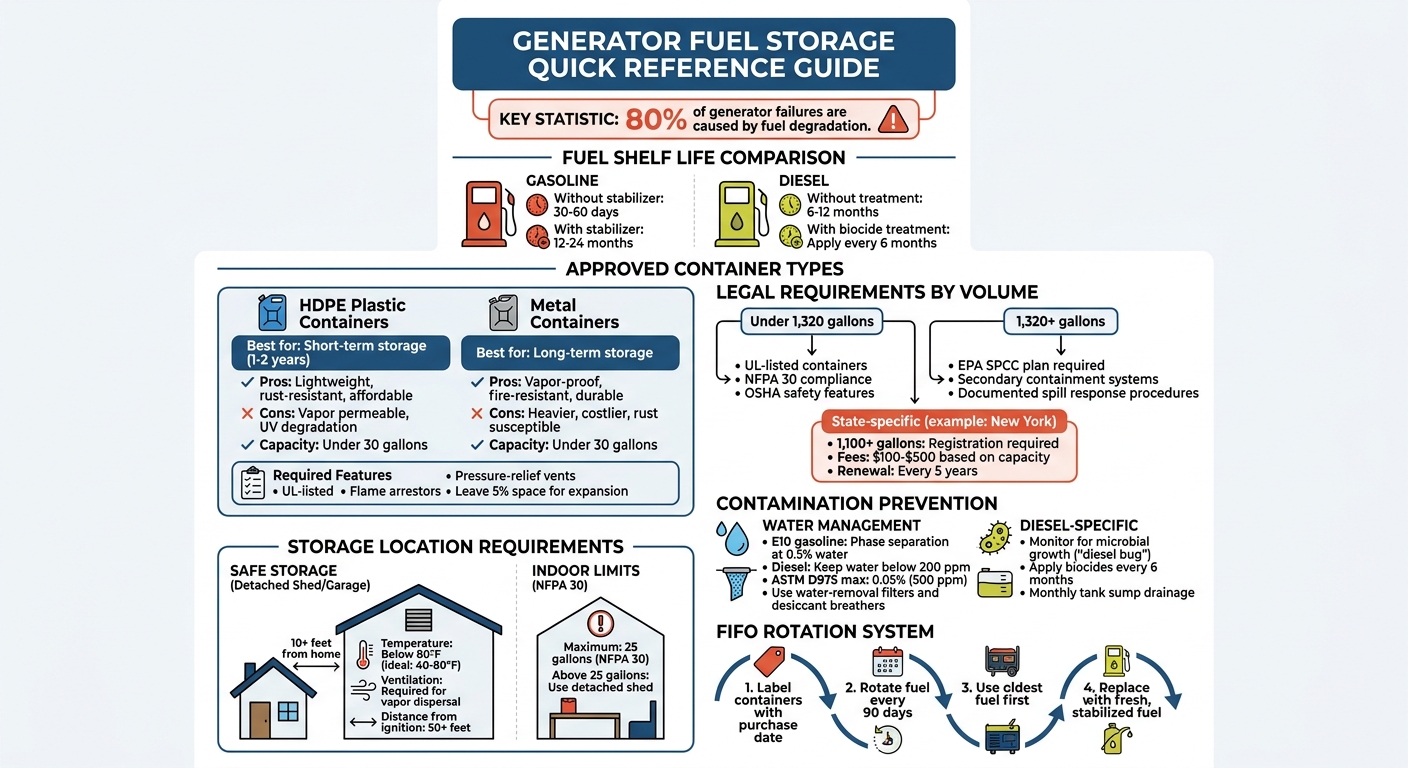
Fuel Storage Quick Reference Guide: Gasoline vs Diesel Requirements
STOP Storing Gas Like This: The EMERGENCY Fuel Storage Checklist
sbb-itb-501186b
Choosing Fuel Storage Containers
When it comes to fuel storage, safety and compliance hinge on selecting the right container. Approved options include high-density polyethylene (HDPE) plastic and metal containers, both designed with features like pressure-relieving vents, child-resistant closures, and tight seals. These features help reduce evaporation and prevent spills. It's also important to leave 5% of the container's volume empty to allow for fuel expansion caused by temperature changes.
Plastic vs. Metal Containers for Small Volumes
For smaller storage needs (under 30 gallons), HDPE plastic containers are a practical choice. They’re lightweight, resistant to rust, and relatively affordable. These containers work well for short-term storage (1–2 years) and are easy to transport. However, they do have drawbacks: they’re slightly permeable to vapors and can degrade with prolonged UV exposure.
Metal containers, typically made from powder-coated steel, are better suited for long-term storage. They are vapor-proof, fire-resistant, and more durable overall. On the downside, they’re heavier, costlier, and susceptible to rust if their protective coating gets damaged.
"Choosing the right container is the first and most critical step in any fuel storage plan. It's the difference between having a reliable energy source and a useless, hazardous liquid." - CLiX Fueling
When choosing safety cans, the Type I design offers a single opening for both filling and pouring. Meanwhile, Type II safety cans feature a flexible metal hose and a vacuum-release vent, making pouring easier and reducing the risk of spills. Look for key safety features like flame arrestors (mesh screens that prevent ignition inside the container) and Viton gaskets, which provide better resistance to chemicals compared to standard rubber.
Medium and Large Volume Storage Options
For larger storage needs, additional safety measures and regulations come into play. If your total storage exceeds 1,320 gallons, you’re required to develop an EPA Spill Prevention, Control, and Countermeasure (SPCC) plan. This plan ensures you have secondary containment systems and documented spill response procedures in place.
In many areas, regulations also require double-walled tanks or spill containment berms to protect soil and groundwater from contamination. Regardless of the storage size, adhering to these safety protocols is essential for maintaining reliable fuel access and minimizing risks.
U.S. Approved Container Standards
Compliance with national safety standards is non-negotiable for fuel storage. Containers must be UL-listed and meet NFPA 30 standards, which outline requirements for flammable liquid storage. OSHA also mandates the inclusion of safety features like pressure-relieving vents and flame arrestors.
For diesel storage, it’s crucial to monitor for microbial contamination, often called the "diesel bug." Keep water levels below 200 ppm to avoid fuel degradation. According to ASTM D975, the maximum allowable water and sediment content is 0.05% by volume (500 ppm), though maintaining levels around 200 ppm is recommended to ensure generator reliability. Additionally, portable tanks used for transportation must meet DOT approval standards and be clearly labeled.
Safe Storage Locations and Practices
Where to Store Fuel Safely
The safest place to store generator fuel is in a detached garage or shed, away from living spaces. This setup keeps flammable vapors at a distance, reducing the risk of fires. Jack Pleavin, Owner of Pleavin Power, emphasizes this point:
"Much like a generator, you shouldn't store it inside your home but the best place you can store your fuel is inside your garage or a shed".
It’s crucial to ensure these storage areas have good airflow to disperse heavy gasoline vapors, which can pose fire and respiratory hazards. If outdoor storage isn’t an option, make sure the area has proper ventilation and a direct exit to the outdoors.
Store fuel in a cool and dry spot where temperatures stay below 80°F. Avoid placing it near pilot lights, electrical devices, sparks, or anything that could ignite it. Higher temperatures can speed up evaporation and increase pressure inside containers, which might lead to seal failure.
For larger quantities, stricter rules apply. According to NFPA 30 codes, residential storage of Class I flammable liquids is capped at 25 gallons inside a home. If you need to store more than that, use a detached shed located at least 10 feet from your house.
Installation and Safety Guidelines
Once you’ve chosen a secure storage spot, proper installation and safety measures are key. Secondary containment is vital to limit environmental damage and prevent fires from spreading. For larger fuel volumes, using a spill containment tray or bund is a smart precaution - especially since oil spills contribute to over 15% of pollution incidents annually. For extra safety, consider using a fire-resistant flammable liquid storage cabinet.
Leave enough space around storage containers for routine inspections to check for leaks, rust, or signs of wear. Never dispense fuel from a tank stored inside your home, and always let your generator cool completely to room temperature before covering it or placing it in an enclosed space.
To keep your fuel supply fresh, use a first-in, first-out (FIFO) system. Label each container with the purchase date so you can use the oldest fuel first, preventing it from degrading over time.
Storage Capacity and Legal Requirements
Legal Requirements by Storage Volume
In the U.S., regulations become stricter as the volume of fuel storage increases. Following these rules is not just about staying compliant - it’s also about maintaining safety. For gasoline, storage must be in OSHA- and NFPA-approved containers, and it needs to be kept at least 50 feet away from ignition sources due to its extremely low flashpoint of –45°F.
If you’re storing 1,320 gallons or more aboveground, federal law requires adherence to the EPA's SPCC Rule. This includes having secondary containment systems in place and developing a formal spill response plan.
On the state level, additional requirements may apply. For instance, in New York, petroleum bulk storage facilities with combined capacities over 1,100 gallons must register with the Department of Environmental Conservation. Registration fees vary by capacity, starting at $100 for 1,101 to 2,000 gallons and reaching $500 for capacities between 5,000 and 399,999 gallons. Renewals are required every five years.
Diesel storage comes with its own set of rules. It must be stored in corrosion-resistant tanks, such as those made from stainless steel or double-walled UL-rated materials, and secondary containment is necessary to prevent contamination of soil and water. Gasoline storage, on the other hand, demands additional safeguards like specialized ventilation systems to reduce vapor buildup in low-lying areas.
These legal frameworks set the stage for understanding the rigorous standards required for bulk tank designs.
Bulk Storage Tank Design Rules
Compliance doesn’t stop with regulations - it extends to how storage tanks are designed and spaced. For emergency power systems, NFPA 110 enforces a "133% rule", meaning tanks must hold at least 133% of the fuel required for the system’s designated runtime. For example, a Class 48 system, designed to run for 48 hours, must have enough fuel for 48 hours plus a 33% reserve.
Spacing and containment rules are equally strict. Single-wall tanks must be placed in a diked area that can hold 110% of the largest tank’s capacity, as outlined by NFPA 30. OSHA regulations also require a minimum three-foot separation between flammable storage tanks.
"Single-wall tanks are required to be located in a diked area that will contain 110% of the largest tank's capacity in accordance with NFPA30".
Other design requirements include:
- Tank vents must discharge at least 5 feet away from building openings and 15 feet from powered air intakes.
- Tanks must be clearly labeled with content information, hazard warnings, storage capacity, and a unique ID number.
- Monthly tank inspection records must be maintained for at least three years.
Maintaining Fuel Quality and Safety
Keeping fuel in top condition is essential for ensuring your generator works when you need it most. Beyond proper storage and following regulations, you need to actively prevent contamination and manage fuel stability.
Preventing Contamination and Fuel Degradation
Did you know that most generator failures during emergencies are caused by poor fuel quality? Gasoline starts to degrade within 30 to 60 days, while diesel stays stable for 6 to 12 months before issues arise.
Water is the number one culprit when it comes to fuel problems. E10 gasoline, which contains ethanol, absorbs moisture from the air. Once water saturation hits 0.5%, phase separation occurs. This means the water-ethanol mix sinks to the bottom of the tank, leaving behind fuel that’s low in octane and corrosive. Jeff Hansen, Regional Branch Manager at Conrad & Bischoff, highlights another issue:
"One of the biggest risks with diesel storage - especially in extreme climates like Idaho and Wyoming - is algae and microbial contamination. Water buildup encourages microbial growth, leading to clogged filters, fuel degradation, and equipment damage."
To combat these problems, here are some crucial steps:
- Use water-removal filters and desiccant breathers to keep water out of your fuel system.
- Regularly test for water at the bottom of your tank and use purge valves to remove it.
- Treat diesel with biocides every six months to stop microbial growth.
- Add chemical stabilizers to gasoline to extend its life from 30–90 days to 12–24 months.
It’s also smart to adopt a "First-In, First-Out" (FIFO) rotation system. Label fuel containers with purchase dates and rotate your stock every 90 days. Store fuel in a temperature-controlled environment, ideally between 40°F and 80°F, to avoid chemical breakdown and excessive vapor loss. And remember, don’t overfill containers - leave at least 5% empty to allow for expansion.
Pressure Relief and Ventilation Systems
Managing pressure and ventilation in your fuel storage setup is just as important as preventing contamination. Without proper venting, you risk dangerous pressure buildup from heat or vacuum formation when fuel is withdrawn.
Temperature changes can cause "tank breathing", where air flows in and out of vents to balance pressure. If vents are compromised, this can let water into the tank. To minimize these risks:
- Use Type II safety cans with a flexible metal hose and vacuum-release vent for spill-free pouring.
- Make sure storage areas are well-ventilated. Gasoline vapors, which are heavier than air, can settle in low spots, creating fire and health hazards.
- Store fuel in a detached shed located at least 10 feet from your home.
- Inspect tank vents and caps monthly to ensure proper sealing.
Required Safety Equipment
Approved containers are just one part of a comprehensive safety strategy. To protect yourself and your surroundings:
- Stick to UL-listed Type II safety cans, which have pressure-relieving vents to reduce evaporation and prevent container warping.
- Always wear safety goggles and gloves when refueling to avoid skin and eye contact with fuel.
- For larger quantities, use fire-resistant flammable liquid storage cabinets for added protection.
- Keep fuel stabilizers for gasoline and biocides for diesel readily available to maintain fuel quality.
- If storing more than 200 liters for business purposes, install secondary containment systems to prevent environmental harm from leaks or spills.
To further ensure fuel quality, store containers in areas where the temperature stays below 80°F to reduce evaporation and pressure buildup. For critical uses, professional fuel testing and polishing services can be invaluable. Certified labs charge between $150 and $300 per sample for testing, while fuel polishing costs range from $0.50 to $1.50 per gallon. These services can help keep your fuel free of water and contaminants, ensuring it’s ready when you need it most.
Conclusion
Fuel storage revolves around four key principles: choosing the right containers, following safety guidelines, complying with regulations, and maintaining fuel quality.
Opt for UL-listed Type II safety cans and leave about 5% of the container's capacity for fuel expansion. Clearly label each container with the fuel type and purchase date to avoid confusion.
Store fuel in a detached, well-ventilated shed, far from living areas. Be aware that NFPA 30 codes typically limit residential storage of Class I flammable liquids to 25 gallons inside a home. If you need to store larger amounts, you might require secondary containment systems or permits. Picking the right containers and a safe storage location lays the groundwork for preserving fuel effectively.
Fuel degradation is the leading cause of 80% of generator failures. To prevent this, add a high-quality stabilizer to gasoline as soon as you purchase it. This step can extend its shelf life from just 30–60 days to as long as 24 months. Use a first-in, first-out (FIFO) system by running the oldest fuel in your daily vehicle every 90 days, then replacing it with fresh, stabilized fuel. For diesel, apply biocides twice a year and drain tank sumps monthly. These practices help ensure your generator will be ready when you need it most.
FAQs
How can I tell if stored fuel has gone bad?
Look out for signs such as cloudiness, sediment buildup, sludge, or a bad smell. These can indicate degraded fuel, which may cause engine trouble, difficulty starting, or uneven performance. Diesel fuel generally remains usable for about 6 to 12 months, though proper storage conditions or the use of additives can extend its lifespan. Regular fuel checks are key to keeping your generator running smoothly when you need it most.
What fuel stabilizer or biocide should I use for my generator?
To keep your diesel fuel in top condition, consider using a fuel stabilizer or biocide specifically formulated for diesel. These additives help combat microbial growth, oxidation, and contamination, which can compromise fuel quality over time. Pairing these treatments with proper storage practices can significantly extend the fuel's shelf life and ensure your generator stays dependable when you need it most. Always make sure to follow the product instructions and adhere to safety guidelines when handling these additives.
What should I do if water gets into my fuel can or tank?
If water finds its way into your fuel can or tank, using a fuel stabilizer can be a smart solution. This product treats the fuel, preventing water-related problems and keeping the fuel in good condition, especially during storage.
However, if you'd rather remove the water entirely, an automotive-style siphon can help. Carefully use it to drain the fuel through the fill opening. Just remember to handle fuel with care - safety first!