

UL 1741 vs. IEEE 1547: Certification Differences
UL 1741 and IEEE 1547 are two key standards for grid-connected renewable energy systems, but they serve different purposes:
- UL 1741 ensures the safety of equipment like inverters, focusing on fire, shock, and fault protection.
- IEEE 1547 sets performance rules for how Distributed Energy Resources (DERs), such as solar and battery systems, must interact with the grid.
Key Highlights:
- UL 1741 certifies equipment safety and compliance with grid rules. It’s required for electrical inspections and utility approval.
- IEEE 1547 governs how DERs behave on the grid, including voltage regulation, frequency response, and anti-islanding protection.
- UL 1741 includes Supplement B (SB) to align with advanced grid-support functions in IEEE 1547-2018, such as ride-through capabilities and reactive power support.
- Both standards are mandatory for grid-tied systems under the U.S. National Electrical Code (NEC).
Quick Comparison:
| Feature | UL 1741 | IEEE 1547 |
|---|---|---|
| Focus | Product safety and testing | Performance and interconnection |
| Purpose | Certifies equipment is safe | Defines how DERs behave on the grid |
| Covers | Inverters, converters, controllers | System-level grid interaction |
| Enforcement | Required by NEC and inspectors | Adopted by utilities and regulators |
For grid-tied projects, both certifications are essential. UL 1741 ensures equipment is safe, while IEEE 1547 ensures it operates correctly within the grid. Always verify products are UL 1741 SB-certified for compliance with modern standards like IEEE 1547-2018.
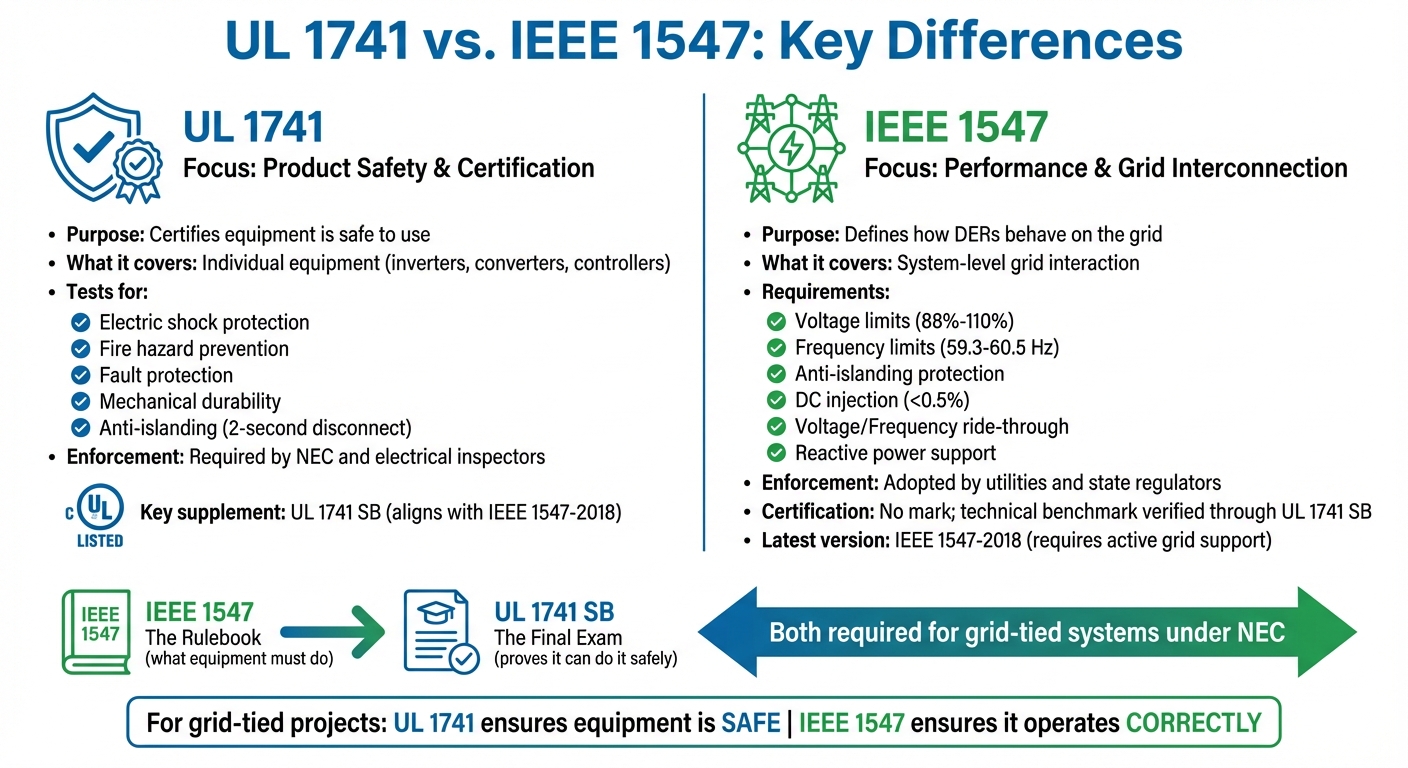
UL 1741 vs IEEE 1547 Standards Comparison for Grid-Connected Solar Systems
IEEE Standard 1547: DER Requirements and Implementation to Interconnection Processes
sbb-itb-501186b
IEEE 1547: Interconnection and Performance Requirements
IEEE 1547 outlines the rules for how Distributed Energy Resources (DERs) connect to the electrical grid. Officially adopted as the national interconnection standard under the Energy Policy Act of 2005, it applies to various DER technologies, including solar inverters, battery storage systems, and both synchronous and induction machines. These standards typically govern connections at primary or secondary distribution voltage levels.
"Think of IEEE 1547 as the set of rules that governs how a solar inverter interacts with the electrical grid."
– Bob Wu, Solar Engineer, Anern
At the Point of Common Coupling (PCC), IEEE 1547 establishes criteria for performance, operation, testing, and safety. While UL 1741 certifies that equipment is safe to use, IEEE 1547 focuses on how that equipment behaves once it’s connected to the grid.
Main Requirements of IEEE 1547
To maintain grid stability and safety, IEEE 1547 enforces strict technical requirements. For instance, DERs must operate within specific voltage limits (88%-110% of nominal voltage) and frequency limits (around 59.3–60.5 Hz). If these limits are exceeded, systems must respond appropriately to protect both the grid and connected devices.
A key safety feature is anti-islanding protection. This ensures that DERs detect when the grid loses power and immediately stop energizing their circuits. This prevents utility workers from encountering live equipment unexpectedly. Additionally, DC injection must stay below 0.5% of the rated output to avoid transformer saturation and failures in protection systems.
To maintain power quality, IEEE 1547 limits harmonics and voltage flicker in alignment with IEEE 519. It also requires reactive power support through Volt-VAR control, which helps stabilize local grid voltage by balancing real and reactive power.
IEEE 1547-2018 Updates
The 2018 revision introduced changes to how DERs interact with the grid. While the original 2003 version required systems to disconnect during any grid disturbance, the updated standard mandates that DERs actively support the grid during minor fluctuations instead of shutting down.
"The 2018 revision... marked a significant shift. It requires DERs to be active grid participants, capable of supporting the grid during minor fluctuations."
– Bob Wu, Solar Engineer, Anern
Under IEEE 1547-2018, DERs must employ Voltage Ride-Through (VRT) and Frequency Ride-Through (FRT) capabilities to stay connected during temporary deviations in voltage and frequency. This reduces the risk of widespread disconnections that could destabilize the grid. Additionally, frequency response functions allow DERs to adjust power output based on grid frequency changes.
Interoperability is now a requirement. DERs must support standardized communication protocols like Modbus, DNP3, or IEEE 2030.5, enabling utilities to remotely monitor and adjust device settings. This is particularly critical in states like California, Texas, and New York, where evolving grid support needs have driven the adoption of the 2018 standard.
IEEE 1547 vs. IEEE 1547.1
While IEEE 1547 and IEEE 1547.1 are closely linked, they serve different purposes. IEEE 1547 defines performance requirements - what the equipment must do - whereas IEEE 1547.1 outlines the testing procedures to verify compliance with those requirements.
"IEEE 1547 sets the performance requirements while IEEE 1547.1 is the corresponding test procedure."
– Bob Wu, Solar Engineer, Anern
A helpful way to think about it: IEEE 1547 is like traffic laws (speed limits, stop signs), while IEEE 1547.1 is the driving test that proves you can follow those laws. Manufacturers design equipment to meet IEEE 1547 performance criteria, and testing labs use IEEE 1547.1 procedures to confirm compliance. This certification process often leads to UL 1741 approval, verifying that equipment meets both performance and safety standards.
This distinction matters when choosing equipment: a product "designed to meet" IEEE 1547 is not the same as one that has been formally tested using IEEE 1547.1 and carries the necessary certifications. Next, we’ll explore how UL 1741 complements these performance standards with its focus on product safety certification.
UL 1741: Product Safety and Certification Requirements
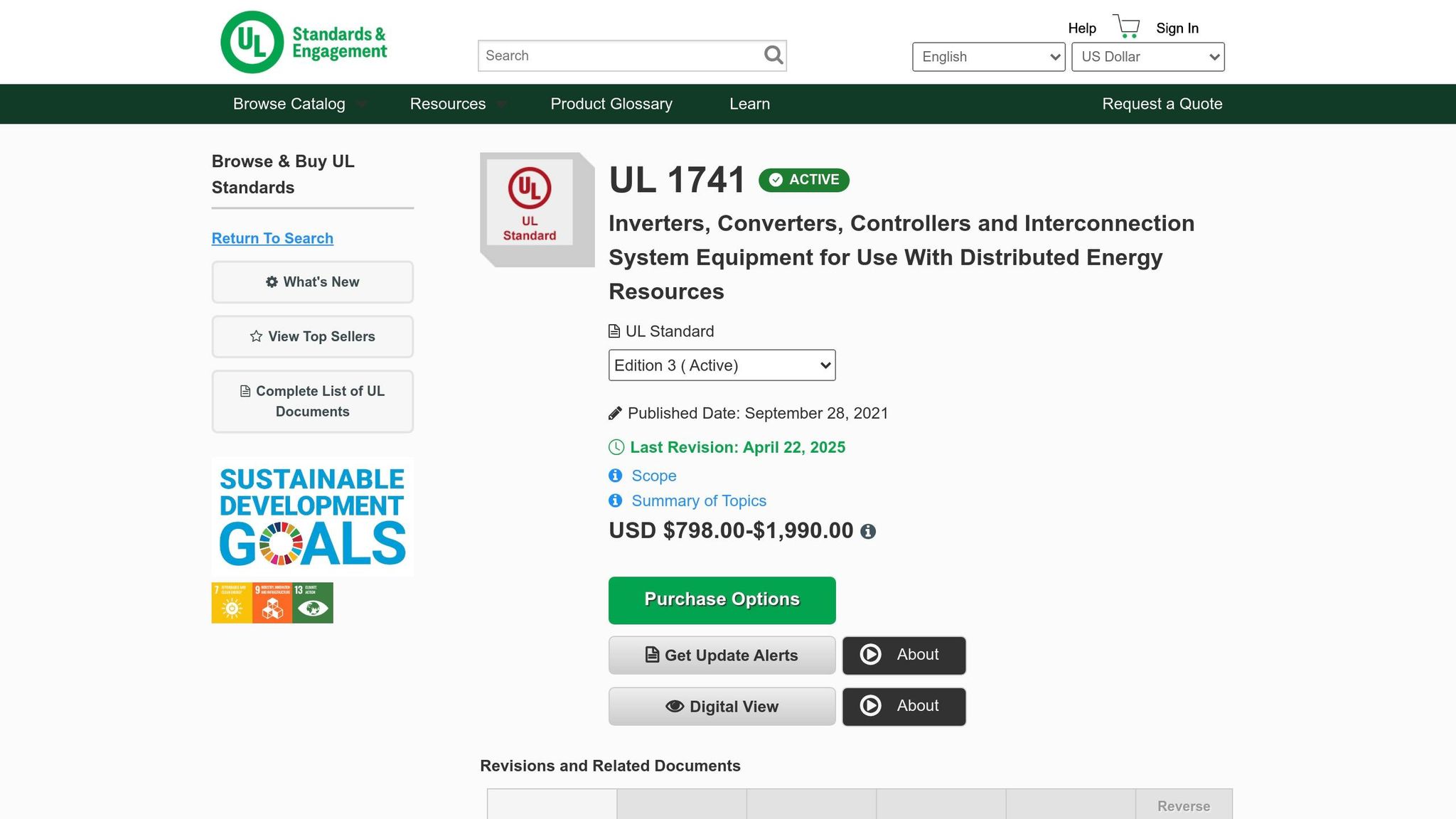
While IEEE 1547 defines how grid-connected equipment should perform, UL 1741 ensures that equipment operates safely under both normal and fault conditions. This certification is critical for inverters, converters, charge controllers, and interconnection system equipment used in grid-connected or stand-alone power systems. Without UL 1741 certification, equipment cannot legally connect to the U.S. electrical grid or pass electrical inspections.
What UL 1741 Tests For
UL 1741 certification involves rigorous safety testing to ensure equipment reliability. These tests focus on:
- Electric shock protection, including dielectric voltage withstand and ground continuity checks.
- Fire hazard prevention, which assesses enclosure materials and temperature rise during operation.
- Fault protection, verifying overcurrent, short-circuit, and overload safeguards.
- Mechanical durability, ensuring enclosures can handle environmental stresses like extreme temperatures, humidity, and UV exposure.
- Anti-islanding protection, which requires inverters to disconnect within 2 seconds of a grid outage for safety.
How UL 1741 Aligns with Grid Standards
UL 1741 works hand-in-hand with IEEE 1547, ensuring equipment meets both safety and performance expectations. Its supplements are particularly important:
- Supplement A (SA) focuses on "smart inverter" functions, such as voltage and frequency ride-through, power factor control, and basic grid-support capabilities.
- Supplement B (SB), introduced in 2020, aligns with IEEE 1547-2018 by providing testing protocols for advanced grid-support features.
"UL 1741 SB was developed to provide a clear testing methodology for the advanced 'smart inverter' functions mandated by IEEE 1547-2018."
– Bob Wu, Solar Engineer, Anern
UL 1741 SB includes tests for Rate of Change of Frequency (ROCOF) response, ground fault overvoltage protection (GFOV), and load rejection overvoltage protection (LROV). It also mandates interoperability conformance testing using communication protocols like DNP3, IEEE 2030.5, or SunSpec Modbus, enabling utilities to remotely monitor and control distributed energy resources. States such as California and Hawaii now require UL 1741 SB certification for new installations, with other states expected to follow suit.
What UL 1741 Certification Covers
UL 1741 certifies individual pieces of equipment, such as inverters, converters, or controllers, rather than entire systems. This certification ensures that the equipment’s internal components, construction, and grid-interaction capabilities meet strict safety and performance criteria.
"UL 1741 SB is your assurance that an inverter is both safe and equipped with modern grid-stabilizing capabilities."
– Bob Wu, Solar Engineer, Anern
A UL 1741-certified inverter guarantees the product is safe and grid-ready. However, proper system design, wiring, and integration remain the installer’s responsibility to maintain overall safety and functionality. For complete system certification, additional standards like UL 1973 (for battery modules) and UL 9540 (for energy storage systems) are required. Currently, around 98% of utility-scale and residential PV projects in North America rely on UL 1741-certified components, which can lower fire and electrical failure risks by 70%.
Main Differences Between UL 1741 and IEEE 1547
This section breaks down the key distinctions between these two standards, focusing on their specific roles and how they impact equipment and system requirements.
Product Certification vs. System Performance
IEEE 1547 outlines how distributed energy resources (DERs) should perform when connected to the grid. It sets technical guidelines for utilities and regulators, covering areas like voltage and frequency ride-through, reactive power support, and anti-islanding protection. Essentially, it defines the system-level behavior expected from DERs.
On the other hand, UL 1741 is a safety and certification standard. It ensures that individual equipment - such as inverters, converters, and charge controllers - is built safely and functions as required. The "UL Listed" mark signifies that the equipment has passed testing by a Nationally Recognized Testing Laboratory (NRTL) and meets both safety and grid-support performance standards.
"IEEE 1547 can be thought of as the baseline requirements to interconnect a DER with the public utility."
– Anton Patton, Product Management & Applications Engineering Director, CPS America
How Certification Works for Each Standard
UL 1741 offers a certification process that is essential for installations to gain approval from electrical inspectors and utilities. Manufacturers submit their equipment to an NRTL, such as UL, CSA, or Intertek, which tests it according to UL 1741's safety criteria. For grid-tied equipment, these tests also include procedures from IEEE 1547.1. Once approved, the equipment earns the "UL Listed" mark and is added to public NRTL directories.
IEEE 1547, however, doesn’t provide a certification mark. Instead, it serves as a technical benchmark adopted by utilities and state regulators. For instance, California’s Rule 21 and Hawaii’s Rule 14H mandate compliance with IEEE 1547-2018. To verify this compliance, UL 1741 Supplement B (SB) certification is required. Published in September 2021, UL 1741 SB standardizes testing for the advanced grid-support functions introduced in the 2018 update to IEEE 1547.
"IEEE 1547 is the rulebook and UL 1741 SB is the final exam that grants the license."
– Bob Wu, Solar Engineer, Anern
When choosing equipment, always confirm the NRTL mark on the datasheet. Claims of "IEEE 1547 compliance" without UL 1741 certification won’t satisfy inspectors or utility requirements.
How These Standards Affect Equipment Selection
The relevance of these standards depends on the type of renewable energy system being installed. For grid-tied solar or storage systems, both IEEE 1547 performance requirements (verified via UL 1741 SB) and UL 1741 safety certification are mandatory under the National Electrical Code (NEC) Articles 690 and 705. In contrast, off-grid or stand-alone systems don’t require IEEE 1547 compliance, as they aren’t connected to a utility. However, UL 1741 safety certification remains crucial for code compliance and fire safety.
| System Type | IEEE 1547 Applies? | UL 1741 Applies? | Primary Regulatory Code |
|---|---|---|---|
| Grid-Tied Solar | Yes | Yes (Safety + SB) | NEC Article 690/705 |
| Grid-Tied Storage | Yes | Yes (Safety + SB) | NEC Article 705 |
| Off-Grid / Stand-Alone | No | Yes (Safety only) | NEC Article 710 |
| Microgrids | Yes (at grid interface) | Yes | NEC Article 705 |
This comparison highlights the importance of UL 1741 SB certification for grid-tied projects. Modern U.S. installations require both performance verification and safety certification, making UL 1741 SB essential for compliance. States like California and Hawaii already mandate this certification for new projects, with other regions expected to follow. Notably, in December 2025, Enphase Energy’s IQ8 Microinverter became the first product certified to the 3rd edition of UL 1741, including Supplement SB, confirming compliance with both safety and grid-support standards.
These distinctions play a major role in determining the right equipment for grid-tied and off-grid systems, which we’ll explore further in the next section.
Using These Standards in U.S. Renewable Energy Projects
This section dives into practical steps for aligning with utility and state requirements in U.S. renewable energy projects, building on the certification standards discussed earlier.
Meeting Utility and State Requirements
UL 1741 certification plays a critical role in utility interconnection agreements across all 50 states. This requirement stems from the Energy Policy Act of 2005, which designates IEEE 1547 as the national standard for Distributed Energy Resources (DERs) interconnection. Without a UL 1741 listing, grid-connected installations cannot proceed.
Some states have taken this a step further by enforcing IEEE 1547-2018 compliance. For instance, California’s Rule 21, Hawaii’s Rule 14H, and New York’s interconnection rules now require UL 1741 SB certification for new projects. This certification ensures equipment can handle advanced grid-support tasks, like voltage and frequency ride-through, which are vital for maintaining grid stability.
The approval process typically involves two steps. First, the equipment must be UL 1741 SB certified to confirm it supports grid operations. Second, during commissioning, the installer configures the inverter to match the utility’s specific settings and documents these adjustments. This documentation allows utilities to grant Permission to Operate without needing to test each device individually.
Finding Certified Equipment
When sourcing equipment, it’s essential to confirm certification through directories maintained by Nationally Recognized Testing Laboratories (NRTLs), such as UL, CSA Group, or Intertek. Claims like “compliant” or “designed to meet” a standard are not enough to satisfy electrical inspectors or utility requirements.
"For any grid-connected project, a UL 1741 listing is the definitive mark of approval."
– Bob Wu, Solar Engineer, Anern
For grid-tied installations, ensure the equipment is explicitly listed as UL 1741 SB. Older certifications, like UL 1741 or UL 1741 SA, may no longer meet utility requirements for IEEE 1547-2018 compliance. Use official NRTL directories to verify that the product datasheet displays the required NRTL mark. Online platforms like Electrical Trader can simplify the process by offering a marketplace for both new and used UL 1741-certified inverters and power distribution components. This ensures installations meet both safety and performance criteria.
Required Documentation for Project Approval
To obtain Permission to Operate, you’ll need to submit documentation confirming the product’s UL 1741 listing - specifically UL 1741 SB certification for smart inverter projects - along with the IEEE 1547 compliance statement found on the datasheet.
Some utilities and Authorities Having Jurisdiction (AHJs) also require documentation of device setpoints for features like voltage ride-through and frequency response to confirm proper grid-interactive functionality.
"A manufacturer's claim of being 'compliant' or 'designed to meet' the standard is not the same as being officially listed."
– Bob Wu, Solar Engineer, Anern
It’s wise to consult your local AHJ and utility company early in the project to understand regional requirements, as these can vary. States like California, Hawaii, and New York have already implemented UL 1741 SB certification deadlines, and other regions are likely to follow suit.
Understanding UL 1741 and IEEE 1547 for Your Projects
What Electrical Professionals Should Remember
When it comes to grid-connected energy systems, IEEE 1547 and UL 1741 are complementary standards that work together rather than competing. Here's how they differ: IEEE 1547 establishes the performance requirements - essentially the "rulebook" for how distributed energy resources should behave when connected to the grid. On the other hand, UL 1741 focuses on safety, ensuring equipment has been tested for risks like fire, shock, and mechanical hazards.
Both standards are crucial for meeting NEC guidelines, specifically Article 690 (Solar Photovoltaic Systems) and Article 705 (Interconnected Electric Power Production Sources). For grid-tied systems, an inverter must first comply with IEEE 1547's performance protocols before it can earn UL 1741 certification. This ensures the equipment is both safe and capable of functioning properly within the grid.
A UL 1741 SB-certified inverter demonstrates that the equipment supports advanced grid functions. However, compliance doesn't stop there. Proper commissioning and adherence to local utility requirements are essential. During commissioning, the inverter must be configured to meet the specific settings required by the utility, and these configurations should be documented in the interconnection application. It's also important to verify equipment through Nationally Recognized Testing Laboratory (NRTL) directories. Manufacturer claims like "designed to meet" or "compliant with" standards aren't enough for electrical inspectors.
Once you're clear on certification requirements, the next step is sourcing the right equipment. Electrical Trader offers a streamlined solution for finding certified products.
Finding Certified Equipment on Electrical Trader
Electrical Trader simplifies the process of sourcing certified equipment for renewable energy projects. If you're looking for inverters or power distribution components, verifying UL 1741 certification should be your top priority. Their online marketplace offers a wide selection of UL 1741-certified inverters and grid-tied equipment that meet IEEE 1547 standards.
The platform's categorized listings make it easy to pinpoint equipment with the necessary certifications. For projects requiring compliance with IEEE 1547-2018 standards, look for products displaying the UL 1741 SB mark on their datasheets. This mark confirms that the equipment supports advanced functions like voltage ride-through and frequency response - features now required in key states like California, Texas, and New York.
FAQs
Do I need both UL 1741 and IEEE 1547 for a grid-tied project?
Yes, both certifications are usually necessary for grid-tied projects because they address different but complementary aspects. IEEE 1547 establishes the technical standards for the safe and reliable interconnection of distributed energy resources (DERs) with the grid. On the other hand, UL 1741 focuses on verifying the safety, performance, and grid support capabilities of inverters. Together, these certifications ensure that your system complies with the latest technical and safety requirements for grid interconnection.
What does UL 1741 SB add compared to UL 1741 or UL 1741 SA?
UL 1741 SB brings in advanced grid interaction capabilities by incorporating additional grid support and protection functions, known as Supplements A and B. These features go beyond what is offered in the standard UL 1741 or UL 1741 SA, making UL 1741 SB specifically tailored for more sophisticated grid operations.
How can I verify an inverter is actually UL 1741 SB listed?
To verify if an inverter is UL 1741 SB listed, start by reviewing the product documentation or checking the label for the UL mark that confirms compliance. Another reliable option is to search for the inverter in the UL certification database, which provides a detailed list of certified products. If you're still unsure, reach out directly to the manufacturer for confirmation. Certification bodies like UL maintain trustworthy records to help confirm whether a product meets UL 1741 SB standards.