Checklist for Transformer Maintenance Scheduling
Transformers are critical for electrical systems, yet failures cost U.S. industries over $3.5 billion annually. The majority - 75% - of these failures are avoidable with proper maintenance. A solid maintenance schedule reduces unplanned outages by 73% and extends a transformer's lifespan by up to 20 years. Neglecting maintenance can lead to expensive downtime, higher insurance premiums, and fines.
Key Maintenance Tasks:
- Daily/Weekly: Check oil levels, temperatures, and cooling systems. Look for leaks, unusual sounds, or damage.
- Monthly/Quarterly: Inspect gaskets, clean components, test relays, and perform thermal scans.
- Annually: Conduct in-depth testing (DGA, insulation resistance, TTR) and service key components like cooling systems and tap changers.
Why It Matters:
Routine inspections, testing, and servicing can prevent costly failures, improve reliability, and ensure compliance with standards like IEEE C57.104 and NFPA 70B. Detailed documentation is essential for tracking trends and addressing issues early.
By following a structured checklist, you can minimize disruptions, save costs, and maximize transformer performance.
The Ultimate Power Transformer Maintenance Schedule: From Daily Checks to DGA
sbb-itb-501186b
Key Parts of a Transformer Maintenance Schedule
A well-rounded transformer maintenance schedule revolves around four essential components: inspection, testing, servicing, and documentation. Each one contributes to keeping transformers running smoothly, and neglecting even one can lead to costly, unexpected failures. Together, these elements create a comprehensive approach to reliability.
Inspection Tasks
Routine inspections are the foundation of transformer maintenance. Start by visually checking the transformer tank and bushings for any cracks, rust, or physical damage. Ensure bolts and external components are tightly secured. Look for discoloration or soot marks, which could indicate overheating or arcing, and pay attention to any unusual humming, buzzing, or vibrations - these might signal mechanical stress.
Leak detection is another critical step. Even minor oil leaks around gaskets, seals, or valves can reduce dielectric strength over time. Lastly, examine the silica gel breather. If its color has shifted from blue to pink, it means it has absorbed moisture and needs immediate replacement.
Testing Procedures
While inspections focus on what you can see and hear, testing dives deeper into the internal health of the transformer. Dissolved Gas Analysis (DGA) is a key tool in predictive maintenance, as it tracks gases like acetylene (arcing), hydrogen (partial discharge), and ethylene (thermal faults above 300°F). As one Senior Electrical Engineer put it:
"DGA pays for itself the first time it saves you from catastrophic failure."
Other critical tests include insulation resistance checks and the Polarization Index - values below 2.0 typically suggest moisture or contamination. Transformer Turns Ratio (TTR) testing is another must, as deviations beyond ±0.5% from the nameplate can indicate tap changer issues. Additionally, infrared thermography is invaluable for spotting hotspots on bushings and terminal connections without needing to take the transformer offline.
Servicing Requirements
Regular servicing is all about maintaining the transformer’s physical and mechanical integrity. Clean radiator fins quarterly to prevent debris buildup, and confirm that cooling fans and pumps are working correctly at their designated temperature setpoints. Ensure vents and exhausts are clear of obstructions.
Tightening electrical connections and verifying proper grounding are also crucial to avoid unnecessary heat buildup. For oil-filled transformers, oil quality is a top priority. Keep dielectric breakdown voltage above 30 kV, moisture content under 25 ppm, and acidity below 0.15 mg KOH/g. If these thresholds are exceeded, consider re-filtering or replacing the oil.
Documentation Practices
Good documentation turns maintenance into a proactive, strategic process. Record every observation and reading, even when everything seems normal, to establish a baseline for future trend analysis. Annual testing logs should include ambient conditions, load levels, equipment temperatures, and any anomalies discovered during inspections.
Adding photographs of defects alongside written notes can make records even more useful. Aligning your documentation with standards like IEEE C57.104, NETA MTS, and NFPA 70B ensures compliance and keeps you ready for audits.
Maintenance Tasks by Schedule Frequency
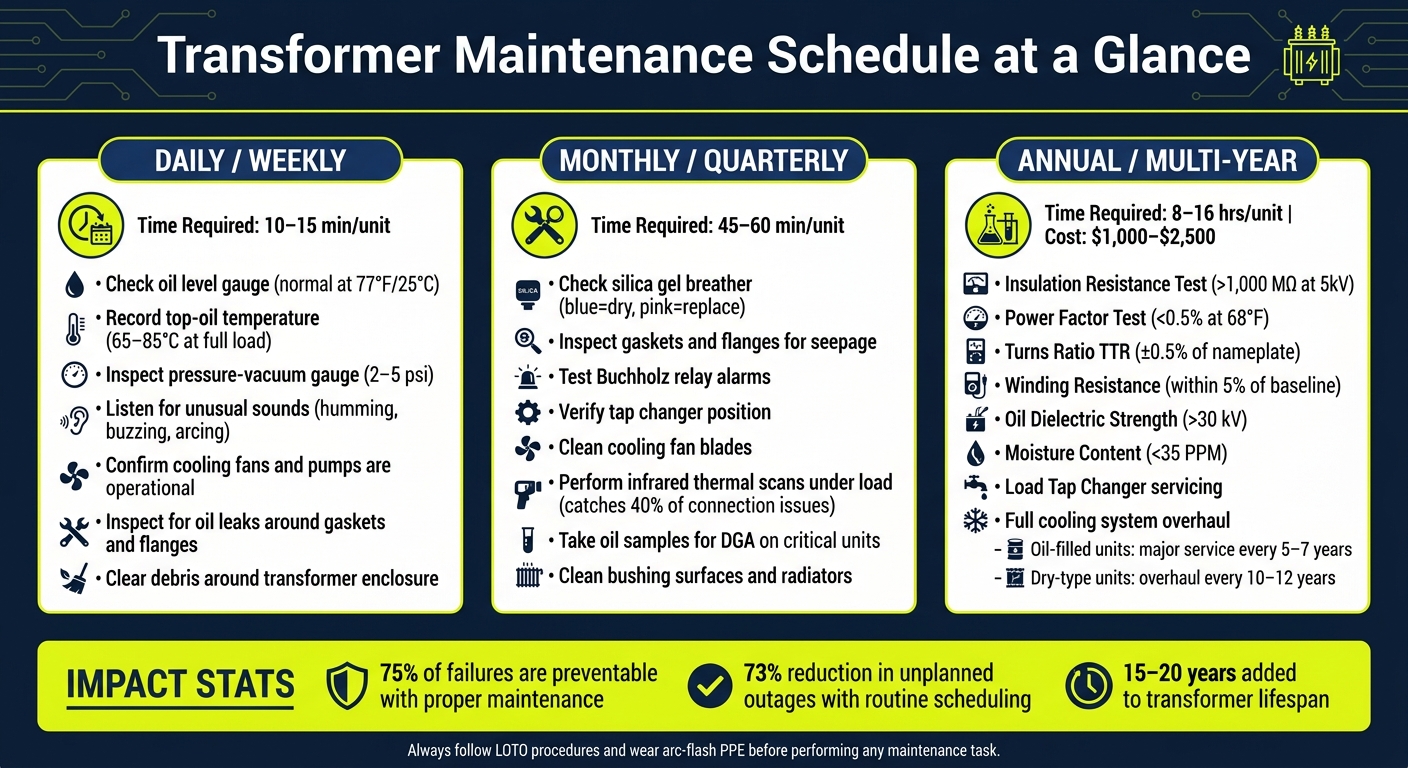
Transformer Maintenance Schedule: Tasks, Time & Frequency
Organizing transformer maintenance by how often tasks need to be done helps ensure nothing gets missed. Tasks are grouped into three main timeframes: daily/weekly, monthly/quarterly, and annual/multi-year. Each schedule addresses issues at different stages of development.
Daily and Weekly Checks
Start with the basics: check oil levels and temperature gauges daily. The top oil temperature should stay between 65–85°C under full load. If it goes above 90°C, it’s time to inspect the cooling system. Make sure pressure relief devices aren’t activated, and pay attention to any unusual sounds like humming or arcing. Also, confirm that cooling fans and pumps are working properly.
On a weekly basis, take a closer look at the cooling system. Inspect radiator fins and check the silica gel breather. If the gel appears pink, it’s a sign of moisture intrusion and needs attention.
Daily checks deal with immediate issues, while weekly inspections help track gradual changes over time.
Monthly and Quarterly Tasks
Monthly tasks dig a little deeper. Check the Buchholz relay, inspect gaskets for signs of wear, and confirm that tap changer positions are correct. It’s also a good time to test auxiliary equipment to ensure it’s functioning as expected.
Quarterly maintenance focuses on cleaning and more detailed inspections. Clean fan blades, wipe down bushing surfaces, and inspect radiators. This is also the right time to perform infrared thermal scanning while the transformer is under load. Thermal scanning is excellent for spotting connection issues before they escalate. If the environment is particularly dusty or corrosive, clean bushings every quarter as well.
Annual and Multi-Year Testing
Annual maintenance is the most comprehensive and time-consuming, often requiring 8–16 hours per unit. During this process, perform critical tests such as insulation resistance, Power Factor (following IEEE C57.152 standards), Turns Ratio, winding resistance, and dissolved gas analysis (DGA).
"Annual dissolved gas analysis is the cornerstone of predictive maintenance." - Industrial Monitor Direct
Maintenance intervals depend on the transformer type. Oil-filled transformers usually require a major service every 5–7 years, while dry-type transformers can go 10–12 years between overhauls. Industrial facilities often conduct full offline electrical testing every three years. For critical or high-voltage transformers, manufacturers might recommend more frequent checks, with DGA performed semi-annually or annually.
Here’s a quick breakdown of the time and focus needed for each maintenance frequency:
| Frequency | Time Required | Key Focus |
|---|---|---|
| Daily/Weekly | 10–15 min/unit | Oil levels, temperatures, cooling, sounds |
| Monthly/Quarterly | 45–60 min/unit | Gaskets, breathers, cleaning, thermal scans |
| Annual/Multi-Year | 8–16 hrs/unit | Electrical testing, DGA, winding analysis |
Transformer Maintenance Checklist
This checklist translates key maintenance tasks into actionable steps for qualified electrical personnel. Always follow your facility's Lockout/Tagout (LOTO) procedures and wear proper arc-flash PPE before starting any task. Refer to your transformer's manufacturer manual for specific instructions - this checklist is meant to complement, not replace, those guidelines.
Daily and Weekly Tasks Checklist
These quick checks (10–15 minutes per unit) help catch early signs of trouble.
Daily:
- [ ] Check the oil level gauge at 77°F (25°C).
- [ ] Record the top-oil temperature (normal range: 149–185°F / 65–85°C at full load).
- [ ] Inspect the pressure-vacuum gauge (normal: 2–5 psi).
- [ ] Listen for unusual sounds - loud humming may indicate overloading, while buzzing or zapping could signal internal arcing.
- [ ] Ensure no pressure relief devices have been activated.
- [ ] Confirm cooling fans and pumps are operating without abnormal noises.
Weekly:
- [ ] Look for oil leaks around gaskets, flanges, and fittings. De-energize the unit immediately if a leak is found.
- [ ] Inspect the external enclosure for signs of tampering, weather damage, or physical wear.
- [ ] Remove any debris or obstructions around the transformer.
- [ ] For dry-type units: Check that ventilation ports are clear and fan blades are intact.
Monthly and Quarterly Tasks Checklist
These tasks take more time (45–60 minutes per unit) but address deeper issues. Around 75% of transformer failures can be prevented with this level of care.
Monthly:
- [ ] Check the silica gel breather - blue indicates dry, pink means it needs replacement.
- [ ] Inspect gaskets and flanges for oil seepage or wear.
- [ ] Test Buchholz relay alarms to ensure proper function.
- [ ] Verify the tap changer position aligns with operational needs.
- [ ] Clean cooling fan blades and confirm they activate at the correct temperature.
- [ ] Inspect the conservator tank bladder (for oil-filled units).
- [ ] Check any auxiliary heaters if installed.
Quarterly:
- [ ] Perform infrared thermal scans while the unit is under load - these identify 40% of connection issues before they escalate.
- [ ] Take oil samples for Dissolved Gas Analysis (DGA) on critical or high-load units.
- [ ] Clean bushing surfaces and radiators to prevent blockages.
- [ ] Test sudden pressure relays.
- [ ] For dry-type units: Use a vacuum or compressed air to remove dust from coils.
- [ ] Measure ground grid resistance.
Log all readings. High moisture levels in oil (above 35 PPM) or bushing temperatures exceeding ambient by more than 27°F (15°C) require immediate attention.
Annual Testing Checklist
Annual testing, conducted by licensed professionals, takes 8–16 hours per unit and costs between $1,000 and $2,500.
| Test | Standard | Acceptance Criteria |
|---|---|---|
| Insulation Resistance | IEEE 43-2013 | >1,000 MΩ at 5kV |
| Power Factor | IEEE C57.152 | <0.5% at 68°F (20°C) |
| Turns Ratio (TTR) | IEEE C57.12.90 | ±0.5% of nameplate |
| Winding Resistance | IEEE C57.12.90 | Within 5% of baseline |
| Oil Dielectric Strength | ASTM D877 | >30 kV minimum |
| Moisture Content | ASTM D1533 | <35 PPM |
Annual inspections should also include Load Tap Changer (LTC) servicing, protective relay calibration, and a full cooling system overhaul. When collecting oil samples, flush about 500 ml from the sample valve first, then fill the container from the bottom to reduce air exposure. For dry-type units, avoid water or wet cleaning methods - stick to vacuuming or compressed air.
Document all test results and compare them to baseline measurements. Following these annual protocols can extend a transformer's service life by an average of 15–20 years, ensuring reliable performance over the long term.
Conclusion and Next Steps
Sticking to a maintenance schedule that includes daily, monthly, quarterly, and annual checks is essential for keeping transformers running safely and efficiently. Neglecting routine maintenance can lead to costly transformer failures, which collectively cost U.S. industries over $3.5 billion each year. With downtime potentially costing more than $100,000 per hour and insurance premiums increasing by 15–30% due to poor maintenance records, the stakes are high.
"Smart operations teams don't view maintenance as a cost - they see it as insurance against catastrophic failure." - Delta Wye Electric
This perspective highlights the importance of monitoring even the smallest changes. Consistently log readings, compare them to baseline data, and address abnormalities early to prevent minor issues from becoming major problems. For example, tracking changes in oil condition or insulation resistance can help identify faults before they spiral out of control.
If inspections uncover worn components - like bushings, tap changers, or cooling fans - replace them with quality parts as soon as possible to maintain the integrity of your maintenance program. For reliable replacement parts and components, visit Electrical Trader, an online marketplace specializing in electrical equipment.
FAQs
How do I customize this maintenance schedule for my transformer’s load and environment?
Tailor your maintenance routine to match the specific conditions your equipment operates in. For areas prone to industrial pollution, coastal salt exposure, or high humidity, it’s wise to inspect more often to avoid problems caused by moisture or contaminants. In dusty environments, make it a habit to clean surfaces and filters every 3–6 months to keep things running smoothly.
Stick to the manufacturer’s recommendations, but don’t stop there. Use historical performance data to refine your schedule and make informed decisions. For equipment under heavy loads, conduct annual infrared scans to catch potential issues before they escalate. Lastly, maintain a detailed log of all maintenance activities. This helps you spot patterns and address minor concerns before they turn into costly repairs.
Which test results mean I should take the transformer offline immediately?
If you notice a sudden drop in oil levels in a transformer without any visible leaks, take it offline immediately. This could indicate internal faults that are consuming the oil. Similarly, be alert to unusual sounds - buzzing, arcing, or crackling noises often point to mechanical or electrical issues. These changes are critical warning signs that demand prompt investigation and, if necessary, shutting down the transformer to avoid severe damage or safety risks.
What’s the simplest way to set up baseline readings and trend tracking?
The easiest approach is to stick to a consistent, documented inspection routine. During each check, log critical operational details like gauge readings, temperature, and load levels. Over time, this builds a historical record, making it easier to compare current performance with past data. To keep everything organized, you can use digital logs, maintenance software, or even spreadsheets. Regularly reviewing these records can help you spot trends or gradual changes that might signal potential problems.