

Guide to Diagnosing and Replacing Transformer Insulation
Transformer insulation is critical for preventing electrical faults and ensuring heat transfer in your system. Over time, factors like moisture, heat, and contamination degrade insulation, which can lead to efficiency loss or failure. Regular diagnostics, such as oil testing and electrical measurements, can help identify issues early. This guide explains:
- Types of insulation (solid materials like cellulose, liquid oils like mineral or esters) and their strengths.
- Causes of failure, including heat, moisture, and mechanical stress.
- Diagnostic methods, like Dissolved Gas Analysis (DGA) and physical inspections.
- When to repair or replace, based on condition and cost.
Transformer Insulation Systems and How They Fail
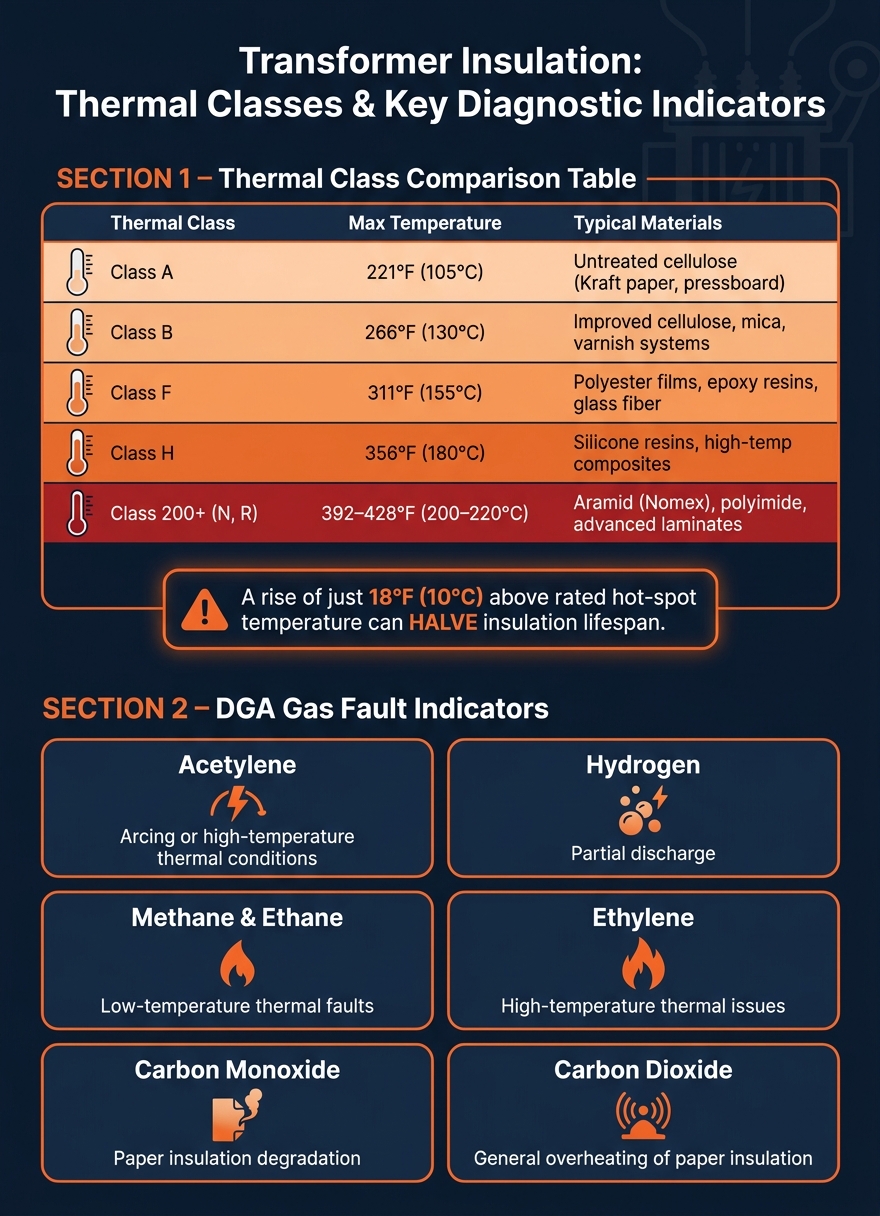
Transformer Insulation Thermal Classes & Materials Compared
Types of Transformer Insulation
Transformer insulation relies on a combination of solid and liquid components working in harmony.
Solid insulation materials, like cellulose (Kraft paper), pressboard, and aramid fibers (such as Nomex), serve multiple roles. They separate energized parts, support windings, and withstand the mechanical stresses generated during regular operation. Meanwhile, liquid insulation - typically mineral oil, natural esters, or synthetic esters - fills the spaces between solid materials, prevents arcing, and helps transfer heat from the core and windings to the radiators.
Frank Baker, Technical Editor, explains it well:
"Oil in transformers serves as a dielectric barrier and an active thermal transport medium, preventing arcing while transferring heat to radiators."
Each material has its strengths and trade-offs. Cellulose paper is cost-effective but sensitive to moisture and limited by temperature. Aramid (Nomex) can handle extreme heat and stress but comes at a higher price. Mineral oil offers strong dielectric properties at a lower cost, while natural and synthetic esters improve fire safety and manage moisture better, making them increasingly popular in urban substations and renewable energy setups.
Insulation materials are also classified by their thermal class, which determines the maximum temperature they can handle before degradation accelerates. Here’s a quick overview:
| Thermal Class | Max Temperature (°F) | Typical Materials |
|---|---|---|
| A | 221°F (105°C) | Untreated cellulose (Kraft paper, pressboard) |
| B | 266°F (130°C) | Improved cellulose, mica, varnish systems |
| F | 311°F (155°C) | Polyester films, epoxy resins, glass fiber |
| H | 356°F (180°C) | Silicone resins, high-temp composites |
| 200+ (N, R) | 392–428°F (200–220°C) | Aramid (Nomex), polyimide, advanced laminates |
These ratings not only reflect performance but also highlight how different materials respond to heat, moisture, and electrical stresses. This understanding is crucial for evaluating how insulation systems age and fail.
What Causes Insulation to Deteriorate
Insulation failures rarely happen all at once. Instead, they result from years of accumulated stress. Johannes Maihöfner, Development Manager at Reinhausen, puts it succinctly:
"Power transformer failure begins with insulation aging, thermal stress, moisture intrusion, and partial discharge."
Heat is the primary factor. A rise of just 18°F (10°C) above the rated hot-spot temperature can halve the lifespan of insulation. Even minor overloading or an inefficient cooling system can silently reduce a transformer's operational life.
But heat isn’t the only concern. Moisture and electrical stress also play significant roles. Moisture can degrade insulation, while localized defects can trigger partial discharge (PD). These small electrical breakdowns gradually eat away at the insulation. As Maihöfner explains, "although individual discharge events are small, repeated activity gradually erodes insulation material". Over time, this erosion can escalate into a complete system failure.
Mechanical stress adds another layer of complexity. Electromagnetic forces, vibration, and the constant expansion and contraction caused by thermal cycling weaken the structural integrity of the insulation system. This makes it increasingly vulnerable to the combined effects of electrical and thermal stresses.
Understanding these failure mechanisms is essential for diagnosing problems and planning effective repairs, which we'll explore in the next section.
sbb-itb-501186b
How to Diagnose Transformer Insulation Problems
Understanding the causes of transformer failures is just the starting point. To truly assess the condition of a transformer's insulation, a structured diagnostic approach is necessary. By combining oil analysis, electrical testing, and physical inspections, you can gain a comprehensive understanding of the transformer's overall health. This detailed diagnosis is crucial for deciding whether repairs or replacements are needed to maintain reliable performance.
Oil Analysis and Gas Diagnostics
Simon Sutton, Ph.D., Director of Services at Altanova, highlights the importance of Dissolved Gas Analysis (DGA):
"Dissolved gas analysis, or DGA, is arguably the most powerful tool in the industry when it comes to assessing transformer condition."
DGA focuses on measuring the levels of specific gases dissolved in transformer oil. When insulation deteriorates, it releases distinct gases, each pointing to specific fault types. For example:
- Acetylene: Indicates arcing or high-temperature thermal conditions.
- Hydrogen: A sign of partial discharge.
- Methane and Ethane: Linked to low-temperature thermal faults.
- Ethylene: Points to high-temperature thermal issues.
- Carbon Monoxide and Carbon Dioxide: Suggest degradation or overheating of paper insulation.
Here's a quick summary of these fault indicators:
| Gas Type | Primary Fault Indicator |
|---|---|
| Acetylene | Arcing or high-temperature thermal conditions |
| Hydrogen | Partial discharge |
| Methane & Ethane | Low-temperature thermal faults |
| Ethylene | High-temperature thermal issues |
| Carbon Monoxide | Paper insulation degradation |
| Carbon Dioxide | General overheating of paper insulation |
However, a single DGA reading isn't enough to draw conclusions. It’s essential to monitor trends over time to determine if a fault is active, stable, or worsening . Proper sampling techniques are also critical - use glass or metal containers, flush several liters of oil before collection, and store samples in lightproof containers to ensure accuracy .
In addition to gas diagnostics, oil quality tests provide further insights. Measurements like dielectric breakdown voltage, power factor, interfacial tension, and oil color reveal the chemical and physical state of the insulating oil. For example:
- Dielectric breakdown voltage: Should be at least 30 kV with a 2.5 mm gap for in-service oils.
- Dielectric dissipation factor: Should stay below 0.5% at 77°F (25°C). A power factor above 1.0% may indicate oil degradation.
These tests, combined with electrical diagnostics, offer a more complete picture of insulation health.
Electrical Testing Methods
Electrical tests go beyond oil analysis to directly evaluate insulation integrity. Basic tests like insulation resistance (IR) and the polarization index (PI) help determine if the insulation is dry, contaminated, or moisture-saturated. The PI, calculated as the ratio of resistance measured at 10 minutes to that at 1 minute, is particularly useful for identifying moisture-related issues.
Another key parameter is the dielectric dissipation factor (DDF), also known as the power factor. A rising DDF can indicate moisture ingress, oxidation, or overall aging of the insulation.
More advanced electrical tests provide even deeper insights:
- Capacitance deviations: Changes from factory baselines suggest insulation deterioration or shifts in winding geometry.
- Winding resistance: A variation exceeding 5% compared to reference values may indicate winding damage.
- Turns ratio: Should remain within 0.5% of the nameplate rating.
- Leakage reactance: Shifts of more than 1% call for further investigation, often using frequency response analysis (FRA).
These tests help pinpoint developing issues that might not be immediately visible through other methods.
Physical Inspections and Diagnostics
Not all problems can be detected through oil analysis or electrical testing. That’s where physical inspections come in. Regularly check for:
- Oil leaks.
- Discoloration or corrosion on bushings.
- Signs of overheating on external surfaces.
Thermographic (infrared) imaging is another effective tool, as it can identify hot spots that might otherwise go unnoticed during routine inspections.
For deeper insights, partial discharge (PD) testing is invaluable. This technique detects small electrical breakdowns within voids, cracks, or gas bubbles in the insulation. Catching PD activity early allows for timely intervention, preventing further damage and extending the transformer's lifespan.
Repair or Replace: How to Decide
After diagnosing the issue, the next step is deciding whether to repair or replace the transformer. This choice depends on several factors, including its condition, associated costs, and potential risks.
Assessing Insulation Condition and Risk Level
By linking diagnostic results with observed symptoms, you can identify the root cause of the problem. Here's a quick reference table for common scenarios:
| Symptom | Probable Cause | Recommended Action |
|---|---|---|
| Low insulation resistance | Humidity or contamination | Clean using dry air or a vacuum; improve ventilation; check for aging signs. |
| Inflammable gas in Buchholz relay | Local overheating or arcing | De-energize immediately and perform a Dissolved Gas Analysis (DGA). |
| Abnormal operating temperature | Overload or poor ventilation | Reduce the load or replace with a higher-rated transformer. |
| Smoke | Insulation failure | Consult the manufacturer for a replacement or major repair. |
| Leaking gaskets | Loss of elasticity | Replace the gasket if tightening bolts doesn’t resolve the issue. |
Certain diagnostic benchmarks can signal critical issues. For instance, a Polarization Index (PI) below 2.0 suggests deteriorating insulation, while an oil Power Factor exceeding 2% at 77°F (25°C) indicates a high likelihood of failure, necessitating immediate action. It's crucial to compare these findings against manufacturer standards and historical data, as trends over time often reveal more than a single data point.
These evaluations help determine if repairs can restore the transformer to safe and efficient operation.
Repair Options and Methods
For large distribution and power transformers, repair is frequently both practical and cost-effective. Electrical engineer Edvard Csanyi highlights the benefits of insulation drying:
"Drying of the insulation and oil is recommended for large distribution and power transformers since this can be technically and economically motivated."
Using low-frequency heating to dry insulation can reduce residual moisture to less than 1%, significantly extending the transformer's lifespan.
In addition to drying, in-service oil reclaiming - where oil is filtered, degassed, and purified of aging by-products - can often be done while the transformer remains energized. Only a brief shutdown is needed during connection and disconnection. Other repairs, like replacing bushings, tap changers, or gaskets, are feasible when the unit's overall condition is stable. Gaskets that have lost elasticity must be replaced entirely, as tightening bolts alone won’t fix leaks.
For dry-type transformers, maintenance typically involves vacuuming horizontal surfaces and using compressed air to clear cooling ducts. This process helps maintain dielectric strength without requiring extensive disassembly.
When Full Replacement Makes More Sense
Although repairs are often an option, there are cases where replacing the transformer is the better choice. Transformers under 1,500 kVA, for instance, are rarely worth rewinding, as replacement is faster and more economical. Similarly, units older than 50 years are poor candidates for repair due to outdated core lamination and efficiency standards, making replacement a more practical solution.
Efficiency losses over time also play a role. Consider a 10 MVA, 33/11 kV transformer: a refurbished unit might cost around $55,000 upfront, compared to $100,000 for a new one. However, over a decade, the refurbished unit could incur over $100,000 more in energy losses, resulting in a total cost of ownership of $415,000 versus $368,000 for the new unit. In cases where the transformer consistently exceeds its rated capacity, upgrading to a higher-rated model is more sensible than trying to preserve aging insulation.
Finally, if smoke is detected or DGA results indicate severe internal arcing, the damage is often beyond repair. In such situations, full replacement is the safest and most cost-effective solution.
Next, we’ll explore the steps involved in planning, executing, and verifying insulation work.
Planning, Executing, and Verifying Insulation Work
Pre-Work Preparation and Safety Steps
Before starting any maintenance, it's critical to de-energize and ground the transformer. Electrical engineer Edvard Csanyi emphasizes this point:
"Before starting maintenance work, the transformer has to be disconnected from the network and earthed."
Once disconnected, follow Lockout/Tagout (LOTO) procedures to lock all circuit breakers and isolators in the open position. Csanyi further explains:
"When the circuit breaker and the isolator have been opened, they shall be locked in an open position to prevent inadvertently closing during maintenance work."
Additional safety measures include specific handling procedures. For instance, only weld leaking joints when the transformer is filled with oil or inert gas like nitrogen. When cleaning porcelain bushings, use methylated spirit to avoid contamination. For cooling ducts, limit compressed air pressure to 3 bar to prevent damage.
Internal inspections of windings and cores should only be conducted when absolutely necessary. Using a thermographic camera during these inspections can help identify overheating components early, reducing the risk of contamination and insulation damage.
Once safety measures and repairs are complete, move on to post-repair testing to ensure everything is functioning as expected.
Post-Repair Testing and Validation
After insulation repairs, testing is essential to confirm the transformer meets safety and performance standards. Key tests include insulation resistance, turns ratio, winding resistance, and dissolved gas analysis (DGA).
| Test | Purpose | Passing Criteria |
|---|---|---|
| Insulation Resistance (IR) | Evaluates dielectric strength between windings and ground | High MΩ reading, trending upward over 10 minutes |
| Polarization Index (PI) | Detects moisture or contamination in insulation | Ratio above 2.0 |
| Turns Ratio (TTR) | Checks primary-to-secondary voltage ratio | Deviation under 0.5% from nameplate |
| Winding Resistance | Identifies loose connections or shorted turns | Consistent resistance across phases |
| DGA (oil-filled units) | Detects internal arcing, overheating, or partial discharge | No flammable gases present |
For accurate results, always correct insulation resistance readings to 68°F (20°C) before comparing them with manufacturer data or past records. During TTR testing, check all tap positions - not just the "as found" position - to ensure proper performance across the full operating range. These tests establish a new baseline for future performance tracking.
Long-Term Monitoring and Maintenance
Maintaining insulation health over time requires regular monitoring and consistent upkeep. For oil-filled transformers, conduct oil testing 12 months after the initial fill and annually thereafter. This includes checks for dielectric strength, moisture levels, and DGA to catch potential issues early.
For dry-type transformers, implement a routine vacuum cleaning schedule. Dust accumulation on horizontal surfaces can lower dielectric strength and reduce cooling efficiency, both of which accelerate insulation aging. Additionally, during planned downtime, cycle through all positions of off-circuit tap changers to maintain proper contact condition.
Finally, good record-keeping is key. Log all test results, maintenance activities, and any anomalies. Over time, these records can highlight trends and potential issues that individual data points might miss.
Conclusion and Key Takeaways
Transformer insulation doesn't fail suddenly - it deteriorates over time due to factors like thermal stress, contamination, and aging. The damage often worsens when left unaddressed. As Raymundo V. Talaue aptly states:
"Good and effective maintenance prolongs the life of the equipment and ultimately contribute to reliable plant operation."
The key takeaway here? Condition-based maintenance outperforms rigid, fixed schedules. Regular practices like annual oil testing, dissolved gas analysis, thermographic inspections, and diligent record-keeping provide critical insights into insulation health, helping you take timely action.
Moisture, in particular, is a major concern. Edvard Csanyi, Electrical Engineer and Founder of EEP, highlights:
"Moisture in insulation is one of the dominant ageing accelerators."
Addressing moisture early is essential. For large power transformers, reducing residual moisture to below 1% can add several years to their lifespan. While the drying process often requires de-energizing the transformer for one to two weeks, this proactive step is far more cost-effective than dealing with unplanned outages or full replacements.
Lastly, sourcing quality replacement components - whether it’s gaskets, bushings, silica gel for breathers, or testing tools - is crucial for minimizing downtime. Platforms like Electrical Trader offer a range of new and used electrical components and power distribution equipment, ensuring you have access to what you need when you need it.
FAQs
What are the earliest warning signs of insulation failure?
Changes in the appearance of oil can be an early warning sign of insulation failure. Watch for oil that looks dark or cloudy, has a milky appearance (often a sign of water or particle contamination), or shows sludge buildup. Another key indicator is a low dielectric breakdown voltage, which signals reduced insulating effectiveness.
How often should I run DGA and oil quality tests?
Annual Dissolved Gas Analysis (DGA) and oil quality tests are crucial for keeping transformers in good condition. These tests help identify problems such as insulation breakdown, moisture contamination, or oil degradation before they escalate. By routinely conducting these checks, asset managers can schedule maintenance proactively and reduce the risk of expensive outages.
What test results indicate I should replace the transformer now?
Replace the transformer if tests indicate low dielectric breakdown voltage (BDV), significant insulation failure, ongoing overheating, or unusual oil contamination (such as dark, cloudy, or milky oil). Physical signs like bulging panels or oil leaks also point to serious issues that can jeopardize both safety and performance.