




Top Tools for EMS Energy Data Analysis
Want to cut energy costs and improve efficiency? Choosing the right Energy Management System (EMS) tool can help you save money and reduce waste by turning raw energy data into actionable insights. Here's a quick breakdown of six leading platforms to help you decide:
- EnergyElephant: User-friendly, real-time monitoring; affordable for small to medium facilities ($27/meter/month). Best for quick setup and ease of use.
- EnergyCAP: Focuses on utility bill auditing and financial insights; ideal for organizations managing large utility data ($5,000/year starting price).
- Spacewell Energy: Hardware-neutral with real-time insights and anomaly detection; great for granular sub-metering ($495/year starting price).
- Enersee: AI-powered platform with strong anomaly detection, saving time and costs for large portfolios.
- Measurabl: Tailored for real estate portfolios, automates sustainability reporting and operational decisions.
- Deepki: Designed for enterprises, managing large portfolios with automated data collection and multi-country support.
Quick Comparison:
| Tool | Best For | Starting Price | Key Strength |
|---|---|---|---|
| EnergyElephant | Small-medium facilities | $27/meter/month | Ease of use, quick setup |
| EnergyCAP | Utility bill management | $5,000/year | Financial insights, bill auditing |
| Spacewell Energy | Granular sub-metering | $495/year | Hardware-neutral, real-time analytics |
| Enersee | Large portfolios | Custom pricing | AI-powered anomaly detection |
| Measurabl | Real estate portfolios | Custom pricing | Real-time data for property managers |
| Deepki | Enterprise portfolios | Custom pricing | Multi-country, portfolio-level insights |
Each tool excels in specific areas, from real-time analytics to financial management. The right choice depends on your facility size, budget, and energy goals.
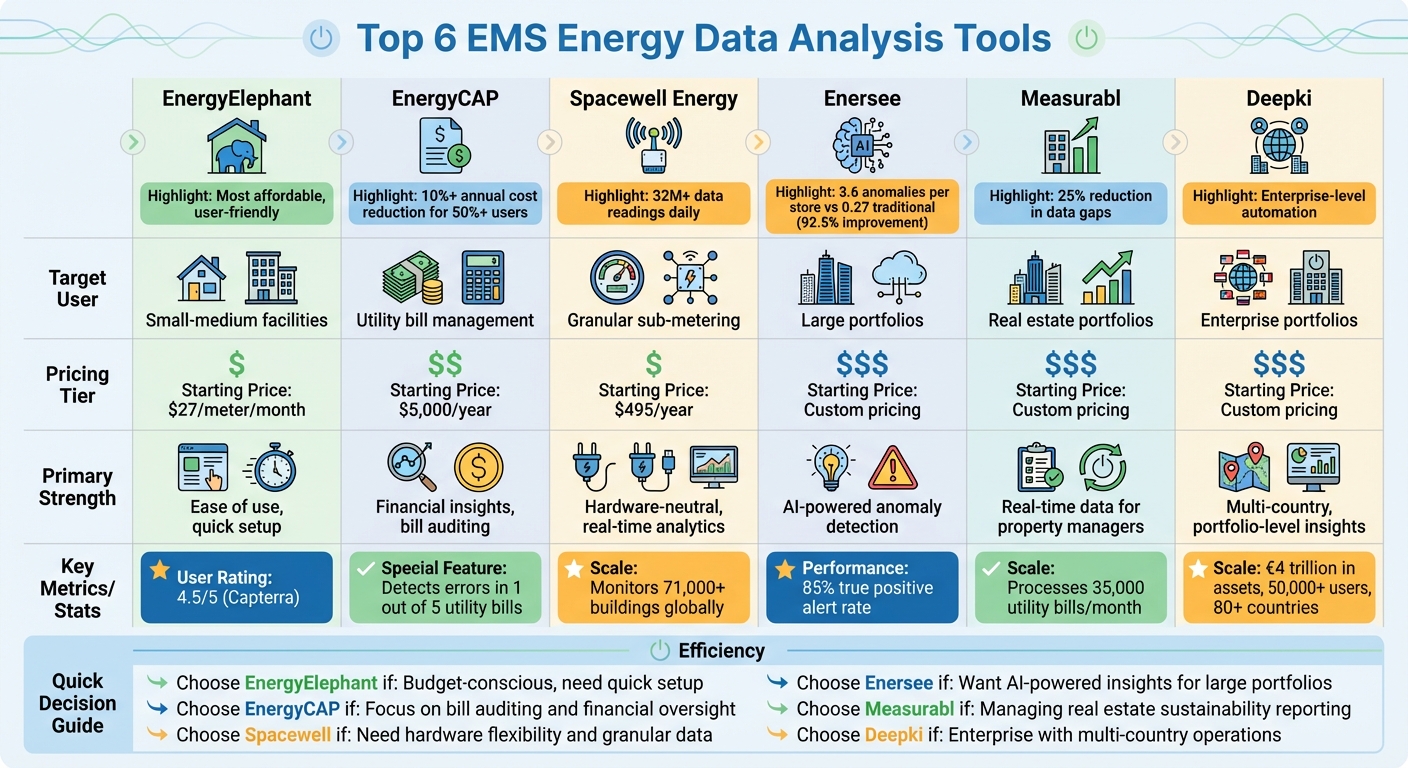
EMS Energy Data Analysis Tools Comparison: Features, Pricing, and Best Use Cases
Energy Data Analysis and Machine Learning Real Life Examples
1. EnergyElephant
EnergyElephant offers an easy-to-use platform for real-time energy monitoring. By connecting directly to smart meters and utility portals, it gathers data on electricity, gas, water, and even waste. This information is then transformed into clear, user-friendly dashboards for better understanding and decision-making.
Real-Time Analytics
With EnergyElephant, users don’t have to wait for monthly utility bills to understand their energy consumption. The platform provides immediate access to energy data, allowing users to track real-time usage patterns. Its historical data features also help forecast future consumption and flag potential overspending before it happens.
Integration with Systems
EnergyElephant simplifies energy management by centralizing data from multiple sources, such as utility bills, smart meters, and even manual readings, into one dashboard. This functionality is especially helpful for teams working on building retrofits, as it allows them to compare performance before and after upgrades. The platform also automates the calculation of Scope 1 and Scope 2 emissions, ensuring compliance with standards like ISO 50001 and TCFD.
Cost-Effectiveness
EnergyElephant stands out for its affordability, earning a 4.4/5 rating for Value for Money on Capterra. It’s also praised for its user-friendly design, with a 4.6/5 Ease of Use rating, and holds an overall score of 4.5/5 based on 18 reviews. Pricing for similar software ranges from $2.84 to $96.34+ per month. However, some users have noted that the platform may face challenges when managing very large portfolios.
Next, let’s take a look at another platform with its own approach to energy data management.
2. EnergyCAP Utility Management
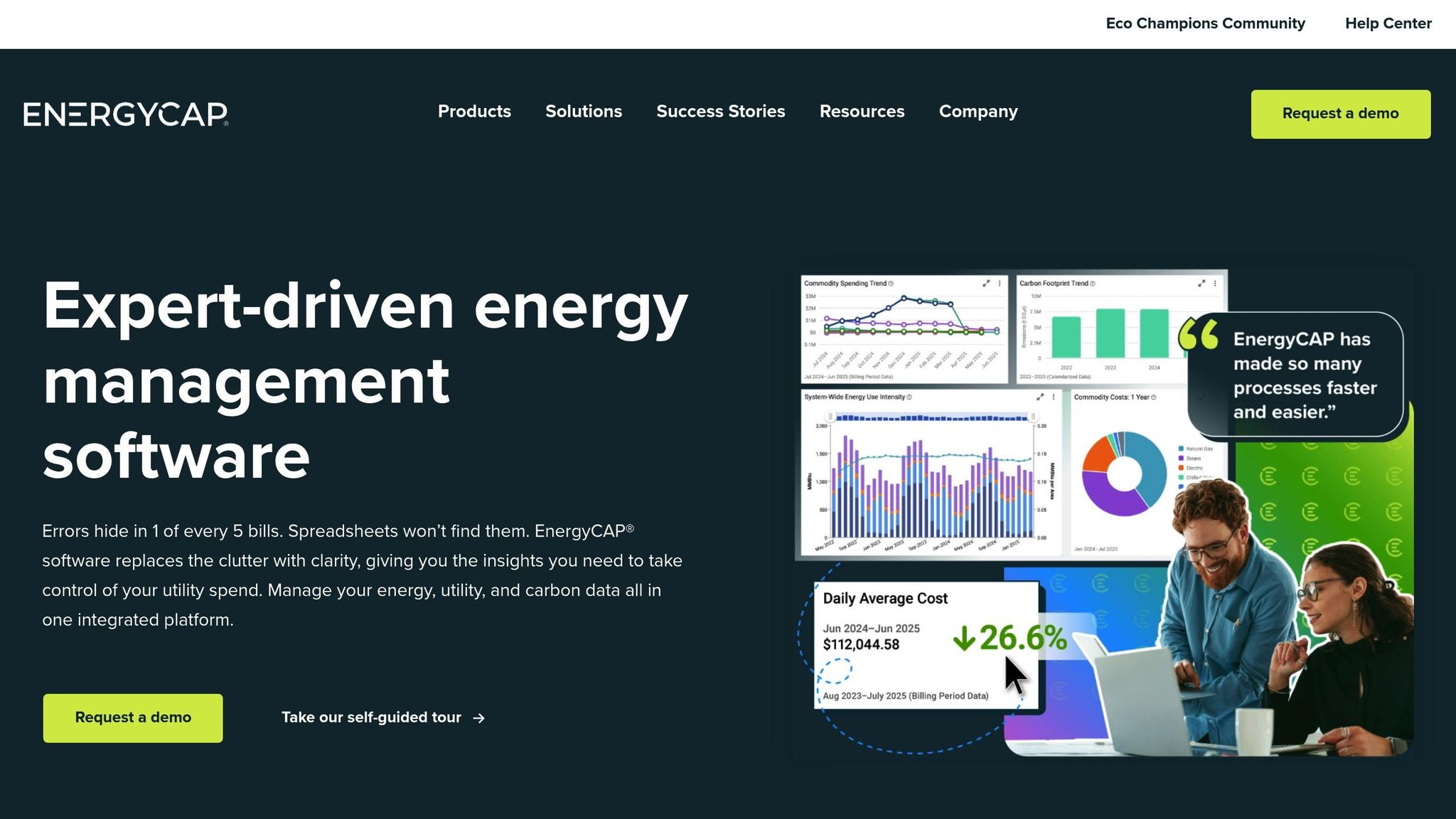
EnergyCAP Utility Management focuses on energy data analysis with a finance-first mindset, turning disorganized utility data into actionable insights while identifying billing errors. Its Smart Analytics module (previously Wattics) merges high-frequency interval data with traditional billing details in a cloud-based platform. This allows teams to address issues as they arise instead of waiting for monthly reports.
Real-Time Analytics
The Smart Analytics module uses interval data to uncover real-time energy usage patterns. A standout feature, Sentinel, employs machine learning to analyze four weeks of building behavior, creating consumption baselines and quickly spotting operational deviations.
"We have over 500 billion data points and weren't getting any value out of it. With EnergyCAP, we can finally unlock that insight and drive action." - Ian Beynon, Head of Energy, Royal Mail
The platform also supports custom formula-based meters for tailored reporting and alerts. It analyzes power usage trends, tracks peak loads, and monitors air quality factors like PM2.5, CO2 levels, and humidity.
On top of this, EnergyCAP's anomaly detection tools ensure data accuracy.
Anomaly Detection
EnergyCAP's automated auditing system examines every bill for errors before approval. Each year, it flags approximately 375,000 bills with unusual usage, costs, or demands and identifies 900,000 duplicate or overlapping bills. Using its AI-powered engine, Watts AI, the platform validates bills and notifies users of irregularities via email, SMS, or in-app alerts. Impressively, it detects errors in one out of every five utility bills, helping organizations avoid overpayments and late fees. Additionally, its built-in tools, aligned with the International Performance Measurement and Verification Protocol (IPMVP), calculate savings from energy conservation efforts by comparing current data to normalized baselines.
Integration with Systems
EnergyCAP enhances operational efficiency by integrating with key systems. It connects to ENERGY STAR Portfolio Manager for automated benchmarking and compliance reporting. The platform exports data directly to General Ledger and Accounts Payable systems, saving about 350 hours of administrative work annually. It also works with business intelligence platforms like Power BI and Tableau through its Report Designer BI feature, enabling organizations to link utility data with broader reporting frameworks. Moreover, its Bill CAPture service automates utility data collection, ensuring 100% audit-ready records - particularly useful for organizations managing multiple vendors.
Cost-Effectiveness
More than half of EnergyCAP users reduce their utility costs by at least 10% annually. The platform oversees over $100 billion in bill value for more than 26,000 users each year. By identifying issues early, customers save nearly 5% on utility bills monthly. Its Tariff Analytics feature reviews 12 months of past data against updated utility rates to uncover further savings opportunities. Additionally, chargeback tools allow organizations to allocate energy costs to tenants or departments using submeters, promoting cost recovery and accountability. By consolidating data sources and automating validation, EnergyCAP not only trims utility expenses but also cuts down on operational overhead.
3. Spacewell Energy
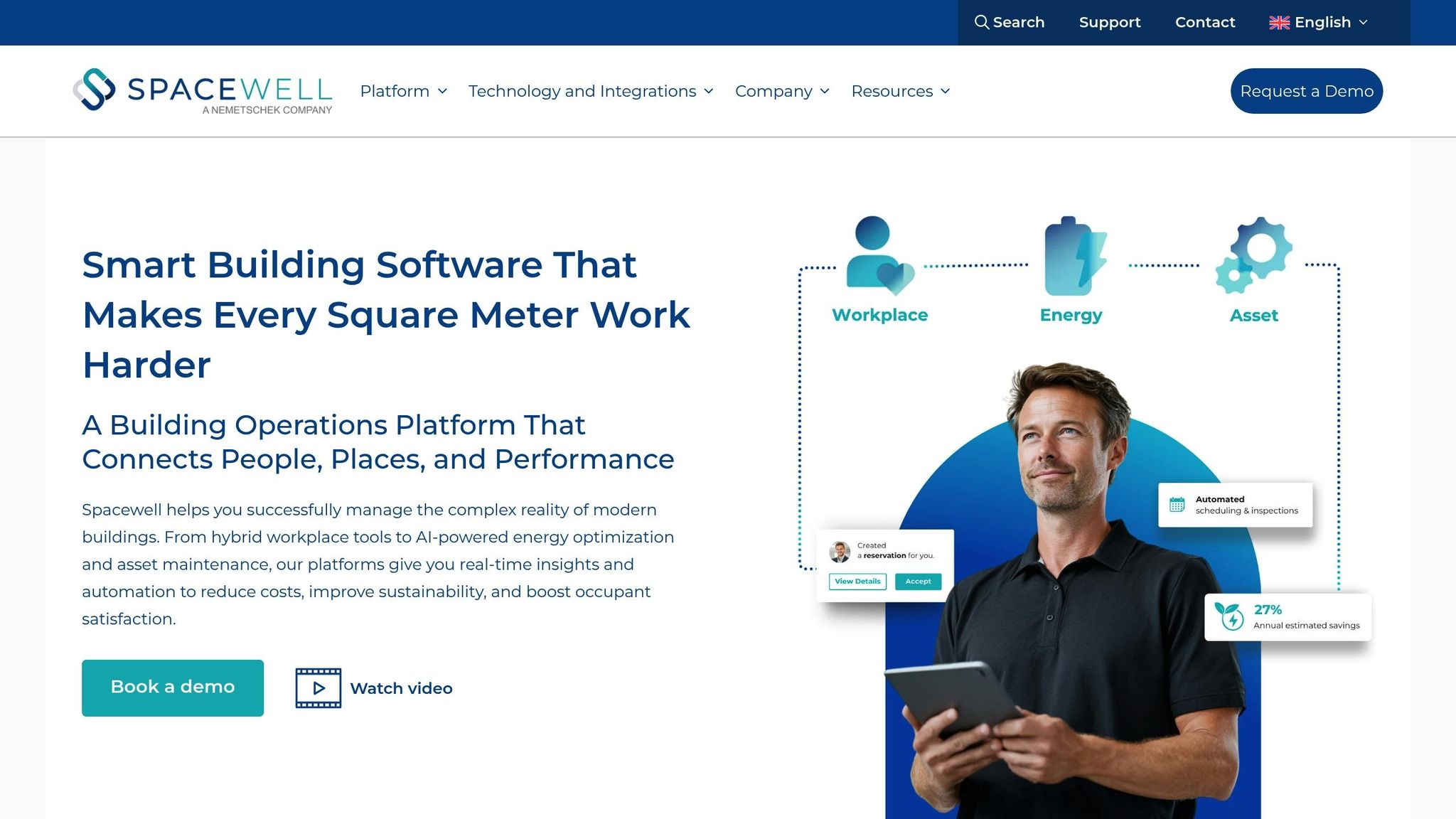
Spacewell Energy keeps tabs on over 71,000 buildings globally, processing more than 32 million data readings every day. By collecting data every 15 minutes from over 200 sources - including BMS, SCADA, sensors, and utilities - it leverages existing infrastructure effortlessly. This comprehensive approach enables real-time analytics, anomaly detection, seamless system integration, and efficient cost management.
Real-Time Analytics
The platform synchronizes live data, monitoring more than 250 parameters such as electricity, water, gas, thermal energy, compressed air, and even occupancy. This provides immediate insights into building performance. It also integrates hourly environmental data from 100,000 virtual weather stations, helping distinguish between natural variations and operational inefficiencies.
"The Platform is being used day-to-day to monitor the use of energy with real-time data, as well as to evaluate the outcomes of energy efficiency measures already implemented." – Technical Officer of the Energy Department, BonÀrea
These real-time capabilities allow for swift identification of inefficiencies and anomalies.
Anomaly Detection
Using AI-powered tools, Spacewell identifies 5,200 inefficiencies daily across its monitored buildings. By analyzing consumption patterns, it flags unusual activity that might signal equipment issues or energy waste. For example, in September 2024, Spanish tower crane manufacturer Comansa adopted Spacewell's smart monitoring solutions. Through real-time data, they identified inefficiencies and slashed energy use by 74%. On top of that, the platform's automated energy audits are up to 100 times faster than manual processes.
Integration with Systems
Spacewell Energy’s open API supports various data transfer protocols, including HTTP/HTTPS, FTP/S, email, and Excel uploads. It works seamlessly with any sensor, meter, or gateway capable of cloud data transfer, ensuring compatibility with equipment from diverse manufacturers.
"Spacewell Energy makes it easy to integrate equipment we already have installed on site and use it with the software. Plus, the platform is very intuitive and visual, both for us as energy managers and for our clients." – Joan Bassa i Honstangas, Energy Engineer, Audit Energia
Cost-Effectiveness
The platform’s robust analytics and integration features simplify cost analysis, leading to measurable savings. Spacewell offers three pricing tiers, starting with an Entry Plan for 500 data points and one admin user, up to an Ultimate Plan with tailored features and dedicated support. To validate ROI, it uses Measurement and Verification tools based on the IPMVP protocol, which calculate baselines and track savings from energy efficiency projects. Its Automated Baseline Calculations further reduce manual efforts, speeding up the detection of deviations.
"Spacewell Energy not only has great analytical tools, but also the visual tools necessary to be able to convey precise energy savings in financial terms." – Tim Whitaker, Technical Director, IDM Solutions
4. Enersee
Enersee is a round-the-clock virtual energy manager that uses AI to analyze building behavior and uncover patterns that traditional systems often miss. By pulling real-time data from meters, Building Management Systems (BMS), IoT sensors, occupancy sensors, and weather feeds, it provides a detailed view of energy consumption. Unlike tools that just focus on visualization, Enersee prioritizes continuous intelligence and automated decision-making. This approach not only automates processes further but also broadens operational capabilities.
Real-Time Analytics
Enersee combines data from occupancy sensors, weather inputs, and meters to establish a baseline for normal operations and quickly identify actual issues. By consolidating fragmented data from multiple monitoring tools into one platform, it enhances data accuracy and speeds up decision-making. Users have reported spending 55% less time on reporting tasks due to its automated data collection and analysis features.
Anomaly Detection
Enersee’s AI algorithms deliver an 85% true positive rate for alerts. For example, a large German retailer managing 1,000 stores saw Enersee detect 3.6 anomalies per store - a sharp increase compared to their previous system, which found only 0.27 per store. This improvement reduced their average resolution time from 38 days to just 8 days, saving the company approximately $3.8 million annually. The platform also prioritizes anomalies based on urgency and potential financial impact, ensuring faster and more effective resolutions.
Integration with Systems
Enersee uses APIs and connectors to integrate seamlessly with existing infrastructure. It works alongside legacy monitoring systems, adding the context and intelligence those systems often lack. For example, a logistics real estate group used Enersee to manage 10 times more buildings with the same staff while maintaining operational efficiency.
Cost-Effectiveness
Enersee calculates the financial risks tied to anomalies and provides ROI-focused recommendations, increasing CapEx deployment ROI by 15%. It also automates compliance checks for BACS (Building Automation and Control Systems) and EPC-NR regulations, instantly identifying subsidy opportunities without the need for manual audits. Organizations using tools like Enersee typically experience 10% to 25% reductions in energy consumption.
sbb-itb-501186b
5. Measurabl
Measurabl supports real estate portfolios by simplifying sustainability reporting and improving operational workflows. The platform gathers asset-level data every five minutes, providing property managers with a detailed view of energy usage, expenses, and emissions. This frequent data collection allows teams to shift from outdated annual reporting to making informed, daily operational decisions based on current conditions. The platform's detailed interval data ensures precise insights, setting it apart from other energy analysis tools.
Real-Time Analytics
Measurabl taps into data from over 1,000 utility providers and connects directly to building meters. By automating data collection, it eliminates manual entry and reduces data gaps by 25% compared to third-party services. The platform also monitors Distributed Energy Resources (DER), enabling real-time comparisons between onsite renewable energy generation and net consumption. This gives operators instant insight into building performance. For example, in August 2025, Boston Properties (BXP) used Measurabl's data to identify energy-saving opportunities, ultimately saving $1.4 million in energy costs.
Integration with Systems
Each month, Measurabl processes around 35,000 utility bills and offers two-way integration with ENERGY STAR Portfolio Manager. It also works seamlessly with third-party tools, aligning data with global frameworks like GRESB, SFDR, and ISSB [27, 28]. Chad Engle, Vice President of Corporate Engineering at Hines, praised the platform's adaptability:
"As a global owner and operator of world-class assets, it's critical that we adapt our operating approach to the unique needs of each property. Measurabl's versatility across our portfolio - collecting bill data, meter data, and equipment information - enables us to deliver above expectation."
Cost-Effectiveness
Using outdated annual averages can inflate emissions estimates by as much as 33% compared to real-time tracking. Measurabl counters this by leveraging precise location-based data from balancing authorities and the Energy Information Administration (EIA). In April 2025, Unico Properties utilized the platform to gain better visibility into energy usage and costs, achieving consistent energy efficiency and savings. Automated data collection and verification allow teams to create accurate budgets, monitor variances, and avoid unexpected utility expenses before they affect financial performance.
6. Deepki
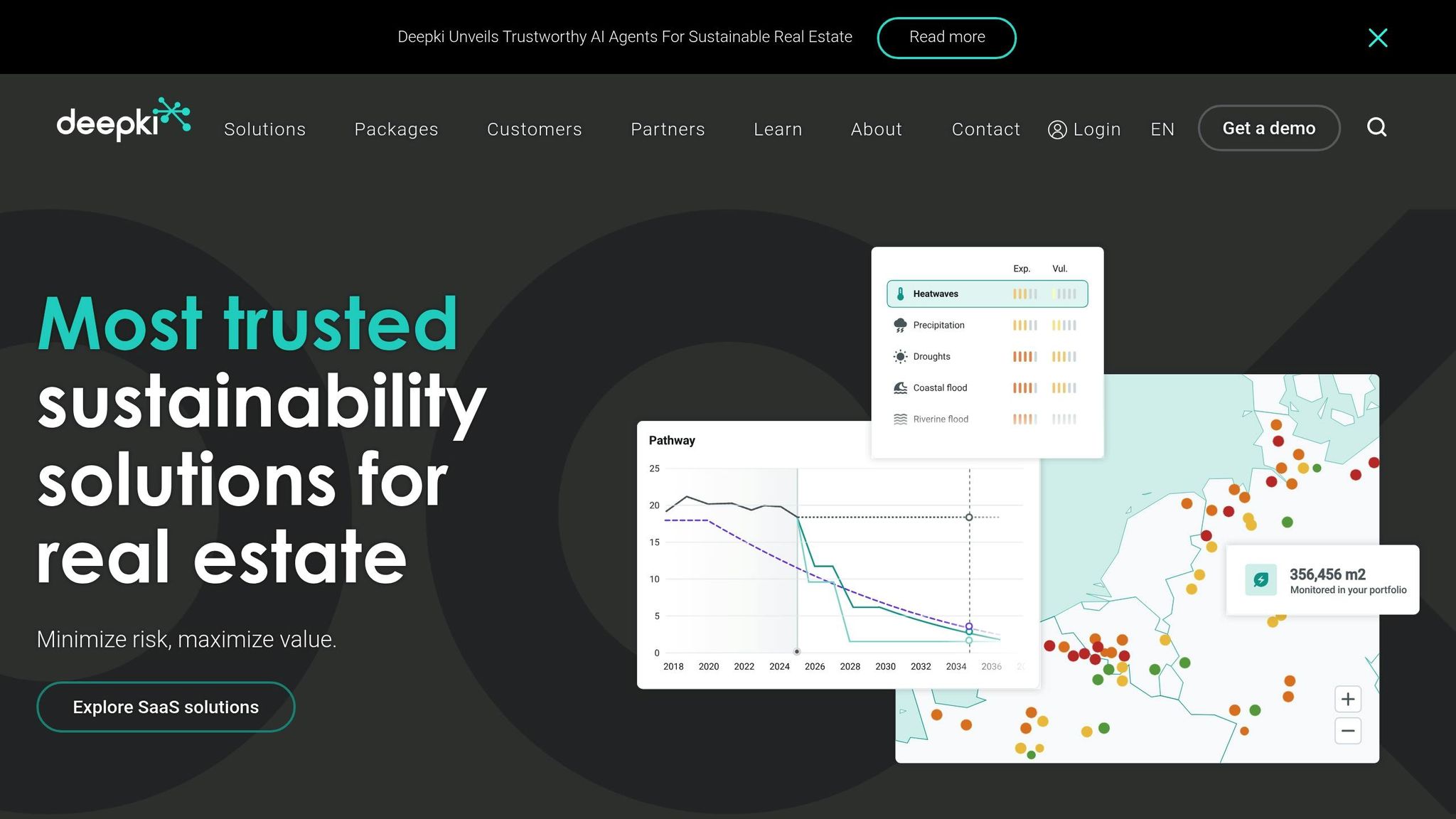
Deepki operates at the portfolio level, managing an impressive €4 trillion in assets and serving over 50,000 users across 80+ countries. Its platform centralizes key data - like energy, water, waste, and carbon - through automated collection. This makes it especially valuable for real estate organizations managing multiple properties. Unlike tools that focus on individual buildings, Deepki provides a comprehensive view of entire portfolios while still allowing users to zoom in on specific asset performance when needed.
Real-Time Analytics
Deepki's real-time analytics are a cornerstone of its platform. Through visual dashboards, users can track key performance indicators, energy benchmarks, and decarbonization strategies. Utility data collection is fully automated, ensuring constant visibility into energy use. Recently, the platform introduced AI Agents to enhance analysis, offering actionable insights that support sustainable real estate management.
Anomaly Detection
Deepki's alert system is designed to adapt to the scale and needs of its users. The Essential package offers basic alerts for identifying unusual consumption patterns. The Professional tier builds on this with advanced alerts that include energy and CO₂ benchmarks. For Enterprise users, customized alert reports are sent via email, enabling quick responses to spikes in consumption or equipment issues. Beyond immediate concerns, Deepki also evaluates climate vulnerabilities and Value at Risk (VaR), helping organizations identify long-term threats to their assets.
Integration with Systems
The platform seamlessly integrates with major ESG frameworks like GRESB, CSRD, SFDR, and TCFD, ensuring audit-ready data for compliance reporting. Its flexible design connects with various technology partners to meet infrastructure needs. For large-scale operations, the Enterprise package offers tailored exports and KPI visualizations. This hardware-agnostic approach allows organizations to centralize data from diverse building systems without needing to replace existing equipment.
Cost-Effectiveness
By automating data collection, Deepki helps reduce labor costs, while its AI-driven planning tools optimize retrofit investments. Stéphane Timossi, Works Director at Kiloutou, highlighted the financial benefits:
"With Deepki's help, we set up an efficient energy management system that lets us target and resolve any excess consumption, prioritizing actions with rapid return on investment".
Deepki’s pricing is structured into three tiers - Essential, Professional, and Enterprise - allowing organizations to choose a plan that aligns with their decarbonization goals and operational needs.
Feature Comparison
This section breaks down the key features of various EMS tools to help you align their capabilities with your specific needs. Each platform offers a unique approach to real-time analytics, anomaly detection, system integration, and pricing, making it easier to identify the best fit for your energy management priorities. By focusing on the core strengths of each tool, this comparison simplifies the decision-making process.
When it comes to real-time analytics, these tools are essential for staying ahead in energy management. Platforms like EnergyElephant, EnergyCAP, Spacewell Energy, Enersee, and Deepki provide real-time insights through smart meter data, interval analysis, and AI-powered tools. EnergyElephant leans on bill-level data via smart meters, prioritizing simplicity. EnergyCAP and Spacewell Energy take it further with interval data analysis, with Spacewell Energy excelling in granular sub-metering and HVAC integration. Enersee uses AI to analyze data from metering systems, building management systems (BMS), IoT devices, and even weather patterns. Deepki, on the other hand, is tailored for enterprise-level portfolios, offering automated solutions and multi-country data normalization. These features are crucial for making quick, informed decisions in energy management.
Anomaly detection is another area where these tools shine, though their methods vary. For example, in 2025, a major German retailer used Enersee across its stores and uncovered 3.6 significant anomalies per store - nearly all of which had been overlooked by traditional tools. By addressing these within just 8 days, the retailer projected annual savings of up to €3.5 million. EnergyCAP focuses on financial anomalies, like duplicate bills or estimated readings, to avoid unnecessary fees. Spacewell Energy sends alerts for unusual loads and peak events, while Deepki offers a range of alert systems, from basic notifications in its entry-level package to advanced, customized reports for enterprise users.
System integration is another area where these platforms differ. EnergyCAP supports integration with APIs and ERP systems, using a usage-based pricing model. Spacewell Energy, starting at €459 per year, provides hardware-agnostic connections compatible with BACnet, Modbus, and MQTT protocols. EnergyElephant follows a tiered pricing model, charging €25 per meter monthly for smaller setups, with costs dropping to €13.80 per meter for medium-scale deployments. Meanwhile, Enersee and Deepki offer custom enterprise pricing, catering to large portfolios that need extensive automation and multi-country data handling. These varied integration strategies highlight the unique value each platform brings.
Conclusion
Selecting the right EMS energy data analysis tool comes down to matching your facility's unique needs with the strengths of each platform. For small- to medium-sized facilities with limited technical resources, EnergyElephant is a standout choice. Its quick setup, user-friendly interface, and transparent pricing - $27 per meter per month (about €25) - make it accessible. Plus, its 4.7/5 rating on Capterra highlights how easy it is to deploy and use with minimal training required.
If your priority is real-time monitoring and anomaly detection, Spacewell Energy and Enersee are both strong contenders. Spacewell Energy offers a hardware-neutral approach, supporting BACnet, Modbus, and MQTT protocols, with subscriptions starting at $495 annually (about €459). On the other hand, Enersee’s AI-driven platform shines in anomaly detection, identifying 3.6 anomalies per store compared to just 0.27 with traditional methods - a striking 92.5% improvement.
For those focused on financial oversight, particularly utility bill management, EnergyCAP is a well-established option. Starting at $5,000 per year, it’s known for its robust bill auditing features. Meanwhile, enterprise-level platforms like Deepki cater to large portfolios with custom pricing, though they may exceed the needs of a single small building.
FAQs
How can I select the best EMS tool for my facility and budget?
Selecting an Energy Management System (EMS) tool comes down to your facility's size, operational needs, and budget. For smaller or multi-site facilities, prioritize platforms that are both scalable and budget-friendly. Look for tools offering real-time energy monitoring and centralized control. These features are particularly helpful for facilities with limited resources, providing much-needed insight into energy consumption without breaking the bank.
For larger or more complex operations, it’s worth exploring software solutions that offer advanced analytics, predictive maintenance capabilities, and seamless integration with existing systems. While these options may require a higher initial investment, they can lead to significant long-term savings by improving energy efficiency and reducing waste.
When choosing an EMS, focus on what matters most to your facility. Consider factors like the utilities you need to monitor, how easily the system integrates with your current setup, and whether the user interface is straightforward. The right tool should align with your facility’s scale and financial objectives, providing both immediate benefits and long-term value.
What are the advantages of using real-time analytics in energy management?
Real-time analytics in energy management brings a host of benefits by allowing constant monitoring of energy usage. With this continuous oversight, organizations can spot inefficiencies as they happen, fine-tune energy consumption, and make quicker, well-informed decisions. Fixing issues in the moment can lead to better energy efficiency, lower costs, and improved system performance.
Another key advantage is the ability to catch equipment problems early, reducing the chances of breakdowns and downtime. Real-time insights also enable flexible adjustments to energy usage, which is particularly useful when incorporating renewable energy sources and ensuring grid stability. By tapping into real-time data, businesses can improve reliability, cut down on waste, and work toward their sustainability goals more effectively.
How does anomaly detection in Energy Management Systems (EMS) help save on energy costs?
Anomaly detection in Energy Management Systems (EMS) plays a key role in cutting energy costs by spotting unusual energy use patterns. These irregularities often point to inefficiencies, equipment issues, or system faults. Identifying these problems early allows facility managers to act quickly and address concerns like equipment failures or energy leaks, preventing unnecessary waste and inflated utility bills.
With continuous system monitoring, advanced EMS tools equipped with automated fault detection can identify deviations from standard operations. They can even suggest adjustments or maintenance actions. This proactive strategy not only lowers energy consumption but also boosts operational efficiency, ensuring organizations keep energy use in check while saving money.