

Ultimate Guide to N+1 Redundancy for UPS Systems
N+1 redundancy is a practical way to ensure uninterrupted power for critical systems. Here's how it works: if "N" is the minimum number of UPS units needed to handle your load, adding "+1" means you have an extra unit as a backup. This setup protects against hardware failures, allows maintenance without downtime, and balances cost and reliability.
Key points:
- How it works: All UPS units share the load. If one fails, the others take over instantly.
- Applications: Used in data centers, hospitals, financial institutions, and manufacturing facilities.
- Efficiency: Modular systems improve scalability and reduce energy costs.
- Cost: N+1 is more affordable than 2N redundancy while still offering high reliability.
For businesses where downtime costs can reach $5,600 per minute or more, N+1 is a smart choice to minimize risk without overspending.
Understanding N plus 1 UPS Redundancy Explained Simply
How N+1 Redundancy Works
N+1 redundancy is built on a straightforward concept: all UPS (Uninterruptible Power Supply) modules work together, sharing the load equally. Let’s say your facility needs 80 kVA of power (this is the "N" capacity). In an N+1 setup, you might install five 20 kVA UPS modules.
If one module fails or needs maintenance, it disconnects itself through its output static switch. The remaining modules instantly pick up the slack, keeping power uninterrupted. Since all modules are synchronized on a shared output bus, there’s no delay or power loss during the transition. This immediate response is the backbone of N+1 redundancy, ensuring continuous operation.
"Redundancy protects the operation from single failure points."
– Secure Power
For environments where downtime isn’t an option, choosing between modular and standalone UPS designs can make a difference. Modular systems, often housed in a single chassis, allow for hot-swapping, which speeds up repairs and saves space. On the other hand, standalone systems connected in parallel also provide redundancy but may take up more room and require longer repair times.
An important consideration is load management. Your power demand should never exceed the "N" capacity. If it does, the system becomes non-redundant (N+0), leaving it vulnerable to a complete outage if another failure occurs. This highlights the importance of precise planning when designing N+1 systems.
Key Components of N+1 Redundancy
Several critical components ensure the reliability of N+1 systems. First, all UPS modules must use identical hardware to maintain synchronization. Mixing different models or capacities can lead to synchronization issues, which might compromise redundancy.
The system’s architecture also plays a crucial role. A centralized configuration uses a Centralized Static Switch (CSS) as a shared component, which can lower initial costs but introduces a single point of failure. In contrast, decentralized systems equip each module with its own static switch and control logic, eliminating this vulnerability.
"For full redundancy, decentralised parallel architecture should be used; that is, each module should be capable of operating independently, without reliance on any centralised or common components."
– Kenny Green, Technical Support Manager at KOHLER Uninterruptible Power Ltd
Capacity planning is another essential factor. For example, if your critical load is 120 kVA, you might deploy three 60 kVA modules (two for the load and one as a spare). Under normal conditions, the modules operate at about 66% capacity, which maximizes efficiency while ensuring there’s enough headroom to handle a single module failure without overloading the others.
Modern modular UPS systems, especially transformerless designs, also help reduce the physical footprint and weight. Traditional 50 kVA transformer-based units can weigh around 400 kg (882 lbs), while modern equivalents can weigh as little as 60 kg (132 lbs). This is a significant advantage when planning data center layouts or retrofitting older facilities.
N+1 Redundancy in Action: Real Scenarios
Let’s look at how N+1 redundancy works in real-world settings.
In a hospital imaging department with a 2 MW critical load, three 1 MW UPS modules in an N+1 configuration ensure uninterrupted power. When one module is taken offline for maintenance - like replacing aging batteries - the other two modules seamlessly handle the load, keeping essential equipment like MRI machines and patient monitors running without interruption.
In a parallel redundant system, fault handling is particularly effective. For instance, if a short circuit occurs downstream, the synchronized modules can clear the fault without switching to bypass mode. This prevents even a momentary disruption, which is critical for sensitive equipment.
Data centers also rely heavily on N+1 setups to meet uptime requirements. For example, Tier II facilities (99.741% uptime) and Tier III facilities (99.982% uptime) often use these configurations to ensure reliability. A financial services firm operating a Tier III data center might use four 40 kVA modules to support a 120 kVA load, achieving around 95.5% efficiency. If one module fails, the system continues seamlessly while technicians address the issue.
N+1 redundancy also simplifies maintenance. In a manufacturing facility, preventive maintenance can be scheduled during peak production hours without shutting down operations. The spare module temporarily absorbs the extra load, allowing maintenance to proceed without disrupting assembly lines. This approach avoids costly emergency service calls and keeps production running smoothly.
Design Principles for N+1 UPS Systems
Designing an effective N+1 UPS system is all about ensuring critical operations run smoothly, even during unexpected failures. The key is to accurately assess your power needs and build in redundancy without overspending or wasting resources.
Capacity Planning for N+1 Redundancy
The first step is defining "N" for your facility. This represents the base capacity needed to handle your peak critical load. If your peak load goes beyond what the N modules can manage, the redundancy is compromised. It’s not just about IT equipment - your calculations must also include factors like IT load (in kW), power factor (PF), UPS and distribution overhead (typically 5–15%), cooling needs, and auxiliary loads.
Here’s an example: Suppose your data center has a 100 kW IT load with a 0.9 power factor. To calculate the total kVA, you’d use this formula:
(100 kW ÷ 0.9) × 1.10 (adding 10% overhead) ≈ 122 kVA.
Adding a safety margin of 20–25% (a common practice for reliability) brings the requirement to about 150 kVA. For an N+1 setup, you might use four 50 kVA modules - three to handle the load and one as a spare.
It’s crucial that all UPS units in an N+1 system share the same derated nameplate rating and model. Mixing capacities or models can cause uneven load sharing, leading to instability. Since IT loads can be unpredictable, consider applying a harmonic derating factor of 0.85–0.90 to standard transformers or opt for K-factor rated equipment to avoid overheating.
"For N+1, the total load does not change, but each transformer must be able to supply the entire load when the other is off."
– CalcPanel
One common pitfall is over-margining. While a 20–25% safety margin is sensible, going beyond 50% inflates costs and reduces part-load efficiency.
Once capacity is determined, a modular approach can help achieve both scalability and efficiency.
Modular UPS Systems and Scalability
Modular UPS systems have reshaped how facilities approach N+1 redundancy. Instead of relying on large standalone units, modular designs use smaller increments that improve load efficiency. This "pay-as-you-grow" model lets you start with a frame designed for future expansion while installing only the power modules you need right now.
The efficiency benefits are clear. A traditional 120 kVA N+1 system using two 120 kVA units operates at about 91% efficiency because each unit runs at only 50% load. In contrast, a modular system with four 40 kVA modules achieves roughly 95.5% efficiency, as each module operates closer to 75% load. These efficiency gains reduce energy costs over the system’s lifespan.
"Achieving redundancy while efficiently using UPS capacity needs a modular approach."
– Kenny Green, Technical Support Manager, KOHLER Uninterruptible Power Ltd
Modular systems also offer hot-swappable flexibility, allowing modules to be added or replaced without taking the system offline. This simplifies maintenance and upgrades while ensuring uninterrupted power. Plus, modular designs often take up less space - they’re frequently rack-mountable, making them a smart choice for facilities with limited room.
When choosing a modular system, prioritize a decentralized architecture where each module has its own static switch and controller. This minimizes the risk of single points of failure found in centralized designs. Additionally, plan your frame capacity with future growth in mind. By installing only the modules required for N+1 redundancy now, you leave room for expansion later, avoiding expensive retrofits.
Applications of N+1 Redundancy in Critical Infrastructure
N+1 redundancy plays a crucial role in safeguarding lives, revenue, and production in industries where even brief power outages can lead to severe consequences. Understanding where this approach delivers the most value helps organizations make smarter investment decisions. It’s a strategy embraced across a wide range of sectors.
In data centers and colocation facilities, N+1 redundancy is the gold standard for Tier III operations. This setup ensures "concurrent maintainability", allowing technicians to service equipment without shutting down systems. Considering that UPS and power distribution failures account for 30–40% of data center downtime - and downtime costs range from $8,000 to $15,000 per minute - N+1 is a necessity. Tier III facilities, which use N+1 architecture, aim for 99.982% uptime, a significant improvement over the 99.741% uptime of Tier II facilities that only rely on redundant components.
The healthcare sector also relies heavily on N+1 redundancy. It safeguards life-support systems, Electronic Medical Records (EMRs), and diagnostic equipment where power interruptions could be life-threatening. Hospitals cannot risk losing power during surgeries or while monitoring critical patients. Similarly, financial services use N+1 to keep trading platforms and payment gateways operational, as even a few minutes of downtime can result in millions of dollars in losses. Enterprise IT and cloud providers also turn to N+1 to maintain high-availability clusters for essential systems like firewalls and core switching, ensuring compliance with strict Service Level Agreements (SLAs).
In manufacturing and industrial facilities, N+1 redundancy protects against risks that could disrupt production. Automated systems, such as recycling shredders, textile machines, or car washes, are vulnerable to power surges and glitches that can damage equipment or halt operations for hours. Even retail operations lean on N+1 to keep point-of-sale (POS) platforms and inventory systems running smoothly, avoiding lost sales and unhappy customers.
When weighing the costs of redundancy, organizations should conduct downtime risk workshops that include finance, operations, and IT teams. These workshops help calculate potential losses versus the costs of implementing solutions like N+1. For many mid-sized operations, the expense of 2N redundancy - which can increase capital expenditures by 60–100% compared to N+1 - may not be worth the marginal reliability improvements.
sbb-itb-501186b
N+1 vs. 2N Redundancy: Benefits and Limitations
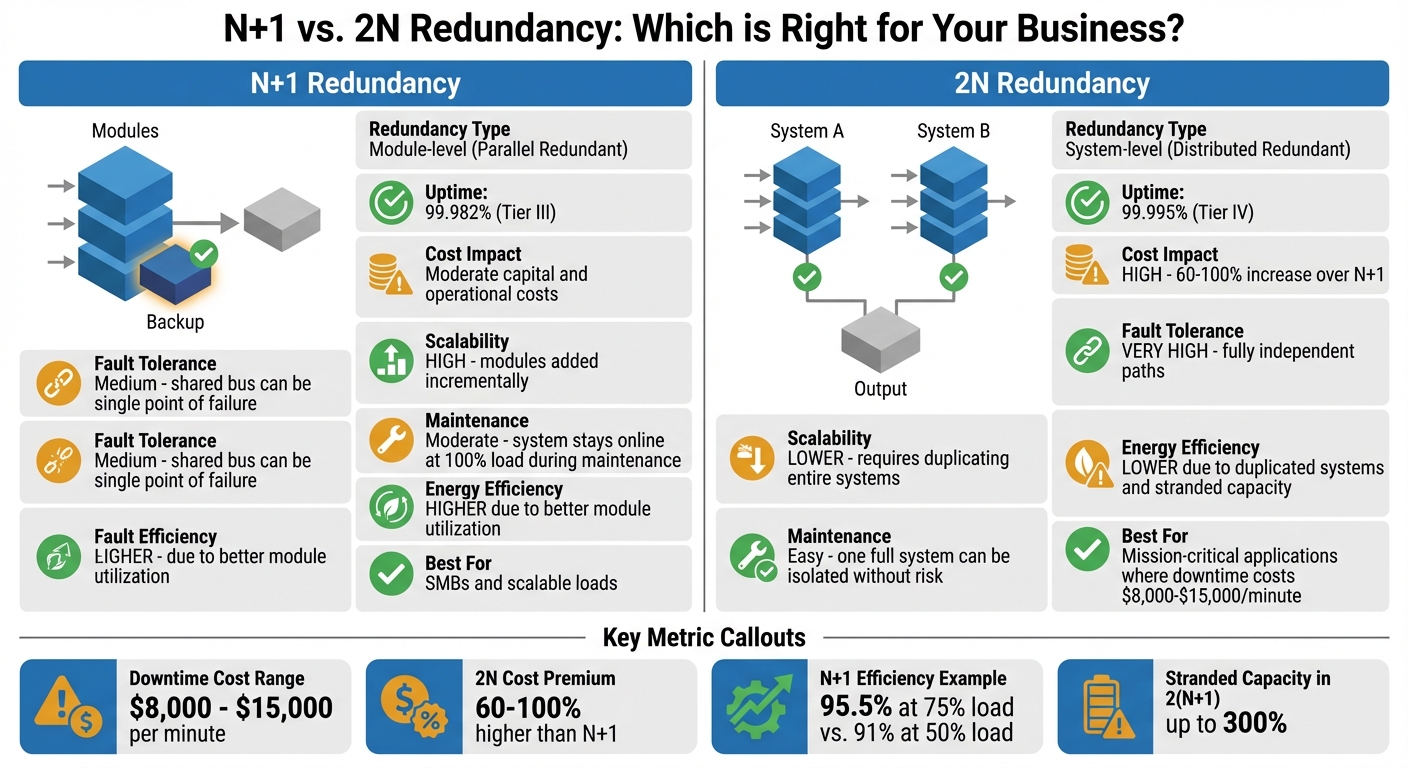
N+1 vs 2N UPS Redundancy Comparison: Cost, Uptime, and Efficiency
When designing critical infrastructure, choosing the right redundancy model is a cornerstone of ensuring uninterrupted power delivery. N+1 and 2N redundancy represent two distinct approaches to achieving this goal. N+1 focuses on "module redundancy", where additional components are integrated into a single system that shares a common output bus. On the other hand, 2N employs "system redundancy", using two completely independent UPS systems with separate input and output feeders. This fundamental difference shapes how these models handle fault isolation, maintenance, and operational costs.
Fault isolation is one of the standout features of 2N redundancy. Since the two UPS systems are entirely independent, a fault in one system won’t affect the other. In contrast, N+1 systems share infrastructure, such as a common bus or cooling system, which can act as a single point of failure. While N+1 is reliable for most applications, environments requiring extremely high availability - like those aiming for 99.9999% uptime - often lean toward 2N.
Maintenance requirements also vary. With 2N redundancy, one system can be completely taken offline for servicing, while the other handles the full load without interruption. In N+1 setups, however, taking a module offline means the remaining components must manage the entire load during maintenance, which can increase stress on the system.
Utilization and efficiency are areas where N+1 systems tend to excel. These systems usually achieve higher module utilization, which translates to better energy efficiency. UPS modules operate most efficiently at higher loads, but 2N systems typically run at about 50% load, leading to greater energy consumption and wasted capacity. For example, in a 2(N+1) configuration where N equals 1, stranded capacity can reach as high as 300%. These differences directly affect the cost and scalability of these systems, which we’ll explore next.
Cost and Efficiency Considerations
One of the most noticeable differences between these models is cost. Implementing 2N redundancy increases initial capital expenses by 60–100% compared to N+1 systems. This is due to the need for duplicate infrastructure, including separate UPS units, distribution pathways, and sometimes even cooling systems. As a result, 2N is typically reserved for situations where downtime is extremely costly.
N+1 systems also hold the advantage in energy efficiency. The duplication of components and pathways in 2N setups results in higher energy losses and ongoing operational expenses.
When it comes to scalability, N+1 offers more flexibility. Organizations can add modules incrementally as their needs grow. By contrast, scaling a 2N system involves duplicating entire infrastructures, which can be both complex and expensive. This makes N+1 particularly appealing to small and medium-sized businesses planning for future growth.
For return on investment (ROI), the choice often depends on the cost of downtime. Workshops involving finance, operations, and IT teams can help quantify potential losses and weigh them against implementation costs. For many mid-sized businesses, the marginal reliability gains of 2N don’t justify the steep expenses. However, for ultra-critical operations - like those in finance or healthcare, where downtime can cost $8,000 to $15,000 per minute - 2N becomes a practical necessity.
Comparison Table: N+1 vs. 2N Redundancy
| Feature | N+1 Redundancy | 2N Redundancy |
|---|---|---|
| Redundancy Level | Module-level (Parallel Redundant) | System-level (Distributed Redundant) |
| Typical Uptime | 99.982% (Tier III) | 99.995% (Tier IV) |
| Cost Impact | Moderate capital and operational costs | High costs – 60–100% increase over N+1 |
| Fault Tolerance | Medium; shared bus can be a single point of failure | Very high; fully independent paths |
| Scalability | High; modules can be added incrementally | Lower; requires duplicating entire systems |
| Maintenance | Moderate; system remains online but at 100% load during maintenance | Easy; one full system can be isolated without risk |
| Energy Efficiency | Higher due to better module utilization | Lower due to duplicated systems and stranded capacity |
| ROI | More favorable for SMBs and scalable loads | Lower initially; justified by uptime value in mission-critical applications |
This side-by-side comparison highlights the trade-offs organizations face when deciding between these redundancy models. Whichever option is chosen, it’s crucial to ensure that downstream components like Automatic Transfer Switches (ATS) and Power Distribution Units (PDUs) don’t introduce single points of failure. Even a robust 2N system can be compromised by weak links in the power distribution chain.
Implementing N+1 Redundancy: Practical Steps
Start by defining your "N" capacity - the minimum number of UPS modules required to support your load. For instance, if your system needs 120 kVA, you could use four 40 kVA modules, running each at about 75% load to achieve an efficiency of 95.5%. This step lays the groundwork for selecting components that ensure smooth redundancy.
It's important to use UPS modules that share the same model, capacity, and derated nameplate rating. This uniformity ensures balanced load sharing across all modules. Mixing different models or capacities can lead to imbalances that could jeopardize system performance.
Opt for a decentralized parallel architecture. In this setup, each module operates with its own static bypass and control logic. This design minimizes single points of failure and allows each module to function independently.
UPS Module Selection for N+1 Systems
Choosing the right UPS modules is essential for uninterrupted operation, especially during maintenance. Modular UPS systems are a strong option because they take up less space and allow for easier scalability with hot-swappable modules. This feature lets you replace a faulty module without disrupting power to critical systems, which significantly reduces Mean Time to Repair (MTTR).
Plan for both current needs and future growth by investing in modular frames with expansion slots. These systems are designed to maintain high efficiency, particularly at loads between 75% and 95%.
Sourcing Equipment from Electrical Trader

Once your UPS modules are selected, the next step is sourcing compatible peripheral equipment. Building an N+1 system requires more than just the UPS units. You'll also need items like circuit breakers, transformers, parallel bypass switches, and rack power distribution units (PDUs) to ensure a reliable power path. Electrical Trader provides a convenient marketplace for both new and used electrical components, making it easier to find everything you need in one place.
When sourcing from Electrical Trader, confirm that all peripheral equipment matches your UPS voltage and load requirements. The platform's categorized listings for breakers, transformers, and power generation equipment simplify the process of finding components that fit your N+1 setup. For facilities with budget constraints, their selection of quality used equipment can help lower initial costs while maintaining system reliability.
Double-check that all components - circuit breakers, transformers, bypass switches, and PDUs - align with your UPS specifications. Also, review warranty and support options for added peace of mind. Finally, ensure that your system supports concurrent maintenance, allowing individual modules to be serviced without interrupting the overall load protection.
Maintenance Strategies for N+1 UPS Systems
Keeping your N+1 UPS system in top shape requires consistent and thorough maintenance. This approach ensures the system is always ready to handle failures without compromising power to critical loads. One of the key benefits of N+1 redundancy is its ability to support concurrent maintenance - allowing individual modules to be serviced without causing downtime. By sticking to these maintenance strategies, you can ensure your system continues to operate reliably.
Preventive Maintenance for Backup Modules
Annual cleaning is essential to remove contaminants like dust, dirt, and metal filings from your UPS system. These particles can lead to short circuits if left unchecked. Use a vacuum with a non-conductive hose and attachments for this task - avoid compressed air or blowers, as they can push debris deeper into the system. For stubborn deposits, use lint-free rags with a nonflammable, fast-drying solvent, and handle delicate components with soft brushes.
"At least once a year, make sure your UPS gets cleaned including a good vacuuming with a non-conductive hose and attachments. Never use a blower or compressed air!" - Fuji Electric Corp. of America
Always clean de-energized equipment and wear appropriate PPE like goggles, gloves, and respirators for safety. When tightening connectors made of copper or lead, use a torque wrench to ensure proper contact, reducing the risk of overheating.
To maintain even wear across all components, rotate the backup module with active units periodically. This prevents the spare module from sitting idle for too long, which can degrade its performance over time. Facilities with high usage, such as manufacturing plants or hospitals, should schedule maintenance yearly, while standard office spaces might extend this to every 3–5 years.
Testing Redundant Systems for Fault Tolerance
Routine cleaning and component rotation are just part of the equation. Regular testing ensures the system functions correctly under simulated fault conditions. Testing, combined with 24/7/365 monitoring, can uncover silent failures in backup modules.
Before testing, verify that your IT load doesn’t exceed the system’s "N" capacity - the total capacity minus one module. If the load is too high, redundancy is already compromised, and the system could fail during testing.
To simulate a failure, remove one UPS module and observe how the load transfers to the remaining modules. Check that the load is evenly distributed and that the system correctly identifies the "failed" module through alerts. Pay attention to temporary issues like latency or packet loss during the transition to confirm your SLAs are being met. For modular systems, test whether you can replace or service a unit without disrupting power to critical loads.
If your load grows beyond the capacity of the remaining N modules, the redundancy provided by N+1 is compromised. Regular testing ensures your system is prepared to handle real-world failures, not just theoretical scenarios.
Conclusion
N+1 redundancy strikes a smart balance between uptime and cost for critical power systems. By including one spare module beyond the minimum required capacity, you safeguard against single-point failures without incurring the hefty expenses of full duplication models like 2N. This setup allows for concurrent maintainability - letting you service components without shutting down the entire system - while ensuring high availability for mission-critical operations.
Downtime can lead to significant financial losses, making reliable power protection a necessity. As Coase, a Data Center Specialist from caeled.com, aptly puts it: "Redundancy without maintenance is a false sense of security". Regular load testing, battery health checks, and continuous monitoring are critical to keeping your backup module ready when it matters most. This highlights the importance of consistent maintenance and proactive management.
Modular UPS systems further enhance the appeal of N+1 configurations. They allow for incremental capacity expansion, cutting down on upfront costs and simplifying future upgrades.
As mentioned earlier, sourcing dependable components is key. Electrical Trader offers a centralized marketplace for acquiring UPS modules, replacement batteries, and specialized power distribution units - everything you need to build and maintain a scalable N+1 system. With access to a wide range of manufacturers and modular components, this platform streamlines the process of creating a reliable and adaptable redundant architecture.
FAQs
How do I size an N+1 UPS system for future growth?
To properly size an N+1 UPS system with future growth in mind, start by determining your current load requirement, referred to as 'N' - this is the capacity needed to support your essential loads. Then, add an additional unit or capacity, the '+1', to provide redundancy and accommodate expansion. This setup ensures the system remains reliable during maintenance or unexpected failures, while also offering a cushion for anticipated growth. Be sure to factor in projected increases in load to avoid needing frequent upgrades down the line.
What can compromise N+1 redundancy besides a UPS module failure?
Failures in critical components like cooling units, power distribution units, or failover switches can undermine N+1 redundancy. These components play a key role in keeping the system redundant and ensuring operations continue without disruption.
How often should I test and rotate the “+1” UPS module?
To keep your “+1” UPS module running smoothly and ready to perform when needed, it's a good idea to test and rotate it on a regular schedule - every quarter is ideal. Regular testing helps confirm that the backup module is functioning properly and can step in seamlessly if the situation demands it.