

Substation Automation vs. Manual Systems: Cost Comparison
If I compare total cost instead of sticker price, automation usually wins at larger or outage-sensitive substations, while manual systems can still cost less at small, simple sites.
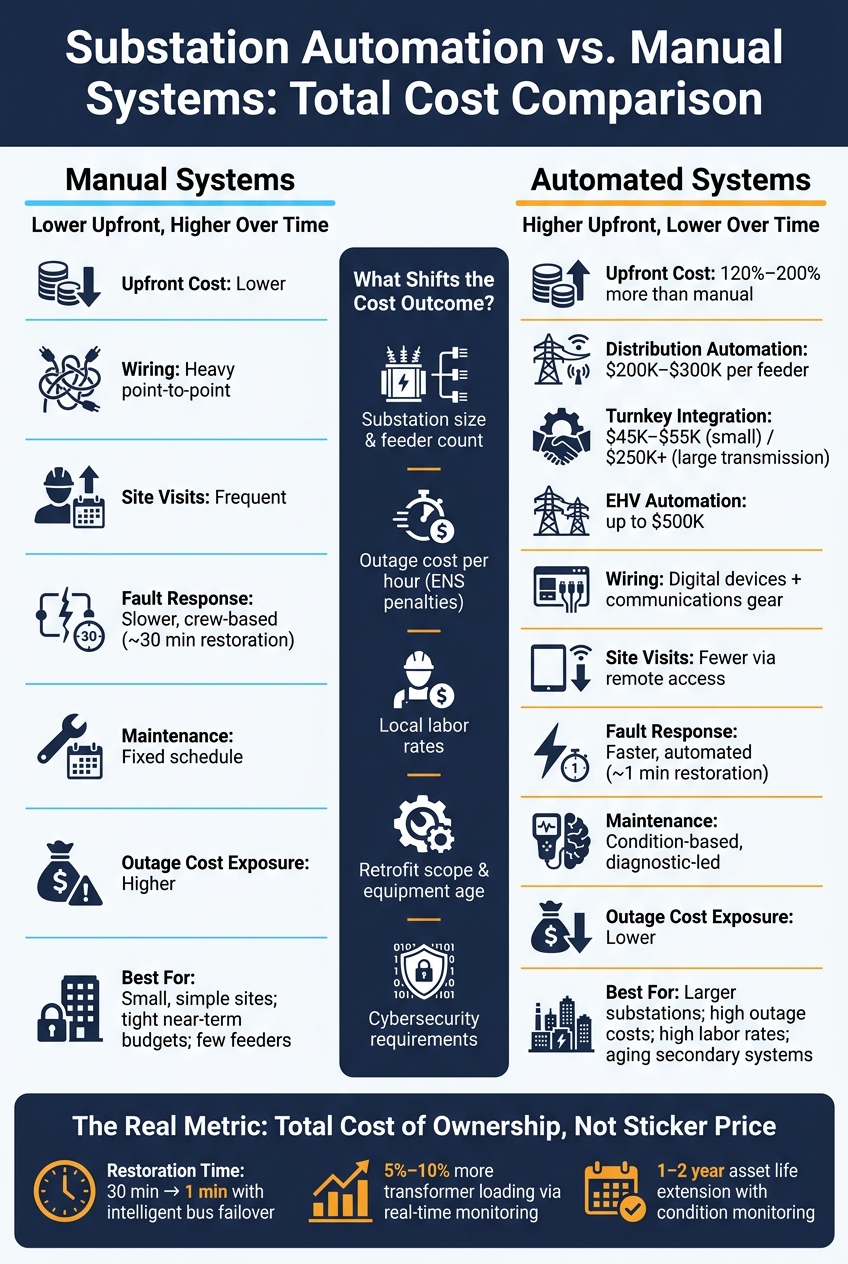
Here’s the short version: automated substations often cost 120% to 200% more upfront, and distribution automation can run about $200,000 to $300,000 per feeder. But that higher first cost can be offset by lower labor, fewer site visits, shorter outages, and delayed equipment spending. Manual systems start cheaper, but they often cost more over time in field work, troubleshooting, and outage exposure.
If you want the decision in plain English, I’d break it down like this:
- Manual systems: lower upfront cost, more hardwiring, more on-site work
- Automated systems: higher upfront cost, remote monitoring, remote switching, lower yearly labor
- Big cost drivers: CAPEX, labor, maintenance, outage penalties, retrofit scope, and replacement timing
- Best fit for automation: larger substations, high outage costs, high labor costs, or sites due for secondary-system replacement
- Best fit for manual: smaller substations, fewer feeders, simple duty, or tight near-term budgets
Substation Automation vs. Manual Systems: Total Cost Comparison
Quick Comparison
| Cost Area | Manual Systems | Automated Systems |
|---|---|---|
| Upfront cost | Lower | Higher |
| Wiring | Heavy point-to-point wiring | More digital devices and communications gear |
| Site visits | More frequent | Fewer due to remote access |
| Fault response | Slower and crew-based | Faster with remote or automatic switching |
| Maintenance style | Fixed schedule | Condition-based and diagnostic-led |
| Outage cost exposure | Higher | Lower |
| Best use case | Small, simple sites | Larger or outage-sensitive sites |
The main question is simple: Will the yearly savings and outage reduction pay back the higher upfront spend? That is what decides which setup costs less over the life of the substation.
sbb-itb-501186b
Upfront Cost Comparison: Where Automation Costs More
Automation comes with a much higher upfront CAPEX. At the start, IEC 61850-based automation solutions can cost 120% to 200% more than conventional wired systems. That extra spend comes from the mix of hardware, software, engineering, and testing needed to get a digital substation up and running.
Automation CAPEX: Hardware, Software, Integration, and Testing
The main cost drivers are Intelligent Electronic Devices (IEDs), SCADA-ready power equipment such as line switches, switched capacitor banks, and voltage regulators, plus specialized sensors, communications gear, and the engineering work needed to tie everything together. On top of that, the substation and feeder system need a dependable, low-latency communications network, which adds items like network switches and gateways.
Distribution automation usually costs $200,000 to $300,000 per feeder. Turnkey integration runs about $45,000 to $55,000 for a small substation and more than $250,000 for a large transmission substation. EHV automation can climb to $500,000.
Cybersecurity also needs to be budgeted from day one. In modern digital substations, it sits inside the communications and hardware cost base instead of showing up as a separate add-on.
Manual System CAPEX: Lower Initial Setup Cost
Manual systems skip most of those cost items. Conventional solid-state or electromagnetic relays, hardwired inputs from instrument transformers, and large amounts of control wiring between switchgear panels do not need a LAN, process bus, or cybersecurity layer. That keeps the starting price much lower.
But there’s a catch: physical complexity. Manual systems depend on extensive point-to-point wiring to connect multiple switchgear panels, and that pushes up installation labor.
"Troubleshooting in existing power substations is difficult and time-intensive due to the complicated wiring that interconnect several switchgear panels for control and protection equipment."
That wiring burden doesn’t just slow installation. It also makes troubleshooting more time-consuming and labor-heavy later on.
Lower CAPEX can look attractive at first glance, but labor needs and downtime start to shift the math.
Operating and Maintenance Costs: Labor, Downtime, and Field Service
Automation usually costs more at the start. But once a substation is up and running, that gap starts to narrow. Lower labor needs, fewer inspections, and less outage-related expense help automation earn back part of that early spend.
| O&M Factor | Manual Systems | Automated Systems (SAS) |
|---|---|---|
| Maintenance Labor | High; based on fixed periodic schedules and manual testing | Lower; based on actual equipment condition and automated diagnostics |
| Site Visits | Frequent; required for manual readings, inspections, and switching | Reduced; many tasks handled via remote control and monitoring |
| Restoration Time | Slower; requires manual fault tracing and physical switching | Faster; utilizes sequential switching and automated switching |
How Automation Cuts Routine Labor and Site Visits
Remote control and monitoring take a lot of routine work off the field crew's plate. Teams don't need to drive out as often for basic readings, visual checks, or switching tasks. Many of those jobs can be handled from a distance.
Maintenance changes too. Instead of servicing equipment on a fixed calendar, utilities can act based on actual condition data and automated diagnostics. That means less wasted labor and fewer truck rolls for work that may not be needed yet.
Where Manual Systems Add Recurring Cost
Manual substations keep more work tied to the site itself. Crews have to be there for readings, inspections, and switching operations, which adds labor hours and more field dispatches. Over time, that turns into a steady drain on O&M budgets.
Fault tracing also tends to take longer. With heavy hardwiring, troubleshooting is more labor-intensive and slower to work through. When something goes wrong, finding the issue isn't always simple.
Longer interruptions add another layer of cost, especially for utilities that face outage penalties. That's why these repeating labor and downtime costs matter so much. They play a big part in how fast automation starts paying back its higher upfront price.
These recurring savings set up the payback question.
Long-Term Savings, Payback, and When Each Option Makes Sense
The recurring O&M savings covered above are only part of the story. The main issue is simple: how fast do those savings make up for the higher upfront cost? Payback comes down to timing. If the savings show up soon enough, automation starts to look a lot more attractive. If not, manual setups can still win on cost.
Where Automation Pays Off Over Time
Lower field labor, faster fault isolation, and condition-based maintenance can trim operating costs year after year. That steady drop in day-to-day expense is what builds the case for automation.
Outage duration is one of the biggest cost drivers. Intelligent bus failover schemes can cut restoration time from about 30 minutes to just 1 minute. For utilities that face penalties for energy not supplied, that gap can justify a large share of the automation spend on its own.
Real-time monitoring can also open up 5% to 10% more transformer loading and push back new equipment purchases. Equipment Condition Monitoring may extend the life of primary assets by 1 to 2 years. Those gains matter because they reduce pressure to spend money right away on added capacity or replacement equipment.
Payback timelines still vary a lot by site. A small distribution substation may need about $95,000 to $305,000 for integration and equipment. That usually means a longer road to payback than a larger transmission substation, where outage penalties can be steep and labor costs are often higher. Site size, outage sensitivity, and local labor rates all shape how fast automation earns back its cost.
When those gains are limited, manual systems remain tough to beat.
When Manual Systems Still Make Financial Sense
Manual systems still make sense for smaller substations with few feeders, simpler operations, or tight near-term capital budgets. In that kind of setting, the savings may not build fast enough to support a full automation upgrade.
LCCA studies show that automation can lose its cost case when annual value is too low to offset the higher CAPEX. Put plainly, if the site does not save enough each year, the extra upfront spend is hard to defend.
Older installations add another layer. In brownfield projects, utilities may go with phased component replacement instead of a full automation overhaul. That approach can keep spending under control while fixing the most urgent reliability gaps first.
The break-even point shifts based on site size, outage exposure, labor rates, and retrofit scope.
Key Variables That Change the Cost Outcome
No two substations are the same. A few inputs can swing the cost comparison in either direction.
| Variable | Why It Matters |
|---|---|
| Substation size and feeder count | Larger sites with more feeders create more room for automation savings to offset higher CAPEX |
| Outage cost per hour | High ENS penalties make faster automated restoration much more valuable |
| Local labor rates | Higher staffing costs shorten payback from fewer site visits |
| Retrofit scope | Brownfield projects need to weigh remaining primary equipment life against secondary system upgrade costs |
| Cybersecurity requirements | Automated systems add digital risk and require continued spending on security protocols |
| Equipment age | Older secondary systems may already be due for replacement, which makes automation a better fit at the same time |
Those site-level factors are what decide the final cost outcome.
Conclusion: Picking the Right Cost Model for Your Substation
The choice comes down to one thing: payback. A higher CAPEX only makes sense if the savings in day-to-day operation can earn that money back over time. There isn't one winner in every case.
That's why the better lens is total cost of ownership, not just the upfront price tag. If a site faces high outage costs, heavy labor demands, or penalty risk, automation is more likely to make financial sense. On the other hand, a smaller substation with low power demand may never hit that break-even point.
A smart time to make the change is during the next secondary-system replacement cycle. Aging protection and control hardware will need to be replaced anyway. At that point, the real decision is whether to move to a system that can lower future operating costs. Automation pays off most when it trims those costs over the long haul.
FAQs
How do I calculate substation automation payback?
Calculate substation automation payback with a benefit-cost analysis that compares implementation costs against the added monetary and business gains.
This usually means identifying candidate automation functions, estimating “hard” benefits such as direct dollar savings, and using metrics like NPV to assess CAPEX and OPEX across the system life cycle.
When does a manual substation make more sense?
A manual substation often makes more sense when the high upfront cost of automation doesn't pencil out. That's often the case with smaller, lower-voltage sites, such as 132 kV-class substations, where the cost of automation can take up too much of the budget.
If the expected gains in reliability or long-term operating savings don't clearly outweigh that spend, a manual setup is still a practical choice.
What hidden costs should I include in a total cost comparison?
Include both upfront and long-term costs beyond procurement. That means looking past the purchase price and factoring in software licensing, system updates, and ongoing maintenance, which can run 3% to 5% of the total investment each year.
It also helps to account for energy not delivered, power consumption, preventive or corrective maintenance for intelligent electronic devices, commissioning strategies, staff training, and future upgrades for components with shorter service lives.