

EMS Leadership: Skills for Energy Optimization
Strong leadership is the backbone of effective energy management systems (EMS). While technology like sensors and AI plays a role, it’s leadership that ensures energy goals translate into measurable results. Without it, most EMS projects fail to meet expectations due to organizational barriers and lack of executive support.
Key takeaways:
- 60% of EMS projects fail, often due to resistance to change or absent leadership.
- Assigning a dedicated energy manager can reduce energy use by 6.4% without major investments.
- Predictive insights from EMS data can prevent 78% of equipment failures when acted upon.
EMS leaders need three core skills:
- Strategic thinking to align energy goals with broader objectives.
- Data-driven decision-making to identify inefficiencies early.
- Communication to engage teams and overcome resistance.
Understanding The Energy Management System (EMS) Under ISO 50001
sbb-itb-501186b
Key Leadership Skills for EMS Managers
Managing an Energy Management System (EMS) effectively goes beyond technical know-how - it demands strong leadership. Three essential skills distinguish successful EMS managers from those who struggle: strategic thinking, data-driven decision-making, and communication. These skills connect technical expertise with the ability to drive meaningful energy improvements.
Strategic Thinking and Goal Alignment
Great EMS leaders don’t just focus on energy management tasks - they align these tasks with broader organizational goals. For instance, they translate high-level sustainability targets, like achieving net-zero emissions by 2030, into actionable steps such as reducing kilowatt-hour (kWh) consumption or cutting carbon dioxide emissions. This alignment ensures that daily operations contribute to long-term objectives.
One challenge is bridging the gap between corporate-level sustainability goals and the operational priorities of plant managers, who are often focused on maintaining production efficiency. Effective leaders integrate these perspectives, ensuring that sustainability commitments become part of everyday activities. A study of 83 manufacturing facilities over 12 years showed that facilities implementing ISO 50001 - a standard emphasizing structured leadership and goal alignment - achieved an average annual energy performance improvement of 3.4%. The standard didn’t require new equipment; it changed how leaders approached energy management.
Data-Driven Decision-Making
Successful EMS managers rely on real-time data to identify and address inefficiencies before they escalate. Instead of waiting for monthly utility bills, they use tools like sub-metering to monitor energy use at the department or equipment level. This approach often reveals "phantom loads" - equipment consuming energy while idle - which can account for 15%–30% of total energy use.
By focusing on the 20% of equipment that typically drives 80% of energy consumption, managers can identify the areas with the greatest potential for savings. Real-time energy data also acts as an early warning system, flagging unusual consumption patterns that might indicate equipment wear or impending failure. Advances in machine learning have made these insights even more powerful, with predictive models achieving 85%–95% accuracy in forecasting equipment failures based solely on energy usage data.
"If a dashboard cannot help your team decide what to inspect on Tuesday morning, it is not finished." - Facility Management Insights
Communication and Team Collaboration
Even the most sophisticated data is useless if teams don’t understand or trust it. A common challenge in energy management is overcoming resistance from staff who may be skeptical of new processes or tools. To address this, EMS managers must engage teams early and tailor their communication to different audiences.
For executives, energy savings can be framed as "avoided costs" tied to competitive advantage. For maintenance teams, the emphasis might be on how energy data reduces emergency repairs and downtime. For building occupants, making goals visible and celebrating successes can foster a sense of shared responsibility.
One example of this approach comes from a Utah school district that adopted Brightly's Energy Manager software. By creating a culture of energy awareness, the district not only optimized energy use but also earned the 2024 Utah Energy Champion Award. The key wasn’t just the software - it was leadership’s ability to make energy management a shared mission.
"Energy efficiency in industry is as much a management challenge as it is a technical one, where the lack of leadership and senior management commitment can hinder the implementation of even well-established basic energy-saving practices." - Kalie Miera et al., Oak Ridge National Laboratory
Making Decisions with EMS Data
Turning data into actionable steps is at the heart of effective decision-making. For EMS managers, this means transforming raw energy data into practical improvements. The process bridges technical data analysis and strategic project execution.
A Step-by-Step Decision-Making Process
Start by setting a clear, measurable objective. Instead of a general goal like "reduce energy costs", aim for something specific, such as "reduce compressed air consumption by 20% within 3 months." To establish a reliable baseline, review 12–24 months of utility bills. This helps account for seasonal variations and peak demand charges.
Once you have a baseline, connect energy data to production metrics. For example, linking kWh consumption to units produced or pounds of output allows you to calculate an Energy Use Intensity (EUI) metric. This metric highlights efficiency gains while accounting for production changes. The table below illustrates how goals align with performance indicators and responsibilities:
| Goal | Key Indicator | Responsible Party |
|---|---|---|
| Lower product cost | kWh per unit | Production / Controlling |
| Control power peaks | Maximum demand (kW) | Energy Manager |
| Reduce equipment waste | After-hours consumption | Maintenance |
| Benchmark facilities | Energy Use Intensity (EUI) | Facility Manager |
This data-driven approach enables EMS leaders to align daily tasks with long-term sustainability goals. Once metrics are established, they guide decisions on which projects to prioritize.
Before applying changes across the entire facility, test them on a smaller scale - such as a single production line or compressor room. This allows you to confirm data accuracy and build team confidence. On average, companies see energy savings of 11% during the first few years of implementation.
How to Prioritize Energy Optimization Projects
When prioritizing projects, consider factors like urgency, payback period, operational impact, and compliance needs. For example, a project that prevents equipment downtime and pays for itself in under six months should take precedence over one with a longer-term benefit, like improving occupant comfort over two years.
EMS data often reveals savings opportunities in three major areas: eliminating waste (15%), peak demand shaving (15%), and predictive maintenance (10%). Together, these strategies can reduce total energy costs by up to 40%. Metering level also plays a role in prioritization. Circuit-level sub-metering, which costs $50–$200 per point, typically pays back in 3–6 months. Department-level metering, costing $500–$1,500 per point, may take 12–24 months. Focus on sub-metering the 20% of equipment responsible for 80% of total consumption.
Peak demand charges can make up as much as 37.5% of a facility’s monthly energy bill. Strategies like automated load shedding or shifting deferrable loads by 15–60 minutes can significantly reduce these costs.
"Energy monitoring is the most cost-effective predictive maintenance sensor." - Energy Solutions
Investing in Energy-Saving Equipment
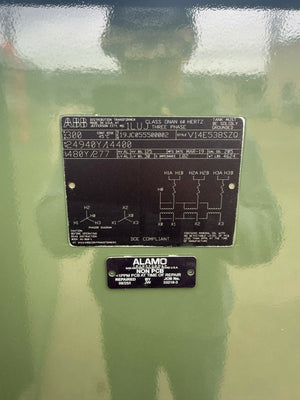
Once you've prioritized projects based on their impact and payback period, use EMS data to guide investments in energy-efficient equipment. For instance, if data shows a transformer running hotter than usual or a motor consuming 30% more energy than its baseline, it’s a clear signal to act. Research indicates that 78% of equipment failures are preceded by a 10%–40% energy spike within 30–90 days. Addressing these signals early can prevent costly emergency replacements, turning them into planned upgrades that fit your budget.
When sourcing new or replacement equipment - whether it’s a transformer, smart panel, or power distribution component - platforms like Electrical Trader simplify procurement. They offer a centralized marketplace for both new and used electrical equipment, helping you act quickly without straining your capital budget. By pairing EMS data with reliable sourcing options, you can streamline upgrade cycles and minimize downtime.
Building and Training a High-Performance EMS Team
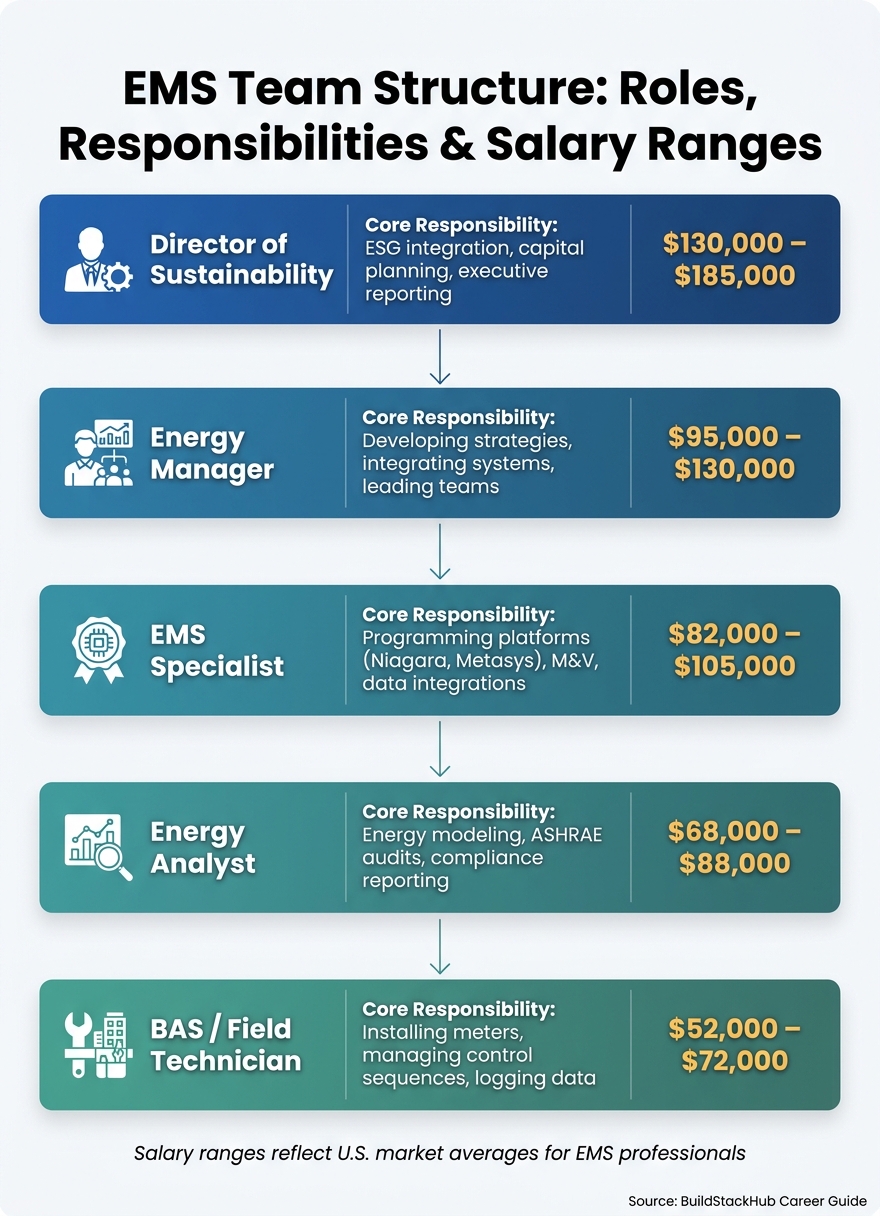
EMS Team Roles, Responsibilities & Salary Ranges
Defining Roles and Responsibilities
A well-rounded EMS team includes professionals handling Significant Energy Uses (SEUs), maintenance, purchasing, and data collection. Here's a breakdown of key roles, their primary responsibilities, and typical salary ranges:
| Role | Core Responsibility | Typical Salary Range |
|---|---|---|
| BAS / Field Technician | Installing meters, managing control sequences, and logging data | $52,000 – $72,000 |
| Energy Analyst | Conducting energy modeling, ASHRAE audits, and compliance reporting | $68,000 – $88,000 |
| EMS Specialist | Programming platforms (e.g., Niagara, Metasys), M&V, and data integrations | $82,000 – $105,000 |
| Energy Manager | Developing strategies, integrating systems, and leading teams | $95,000 – $130,000 |
| Director of Sustainability | Overseeing ESG integration, capital planning, and executive reporting | $130,000 – $185,000 |
(Source: BuildStackHub Career Guide)
At the top of the structure is the Energy Management Representative (or Energy Coordinator). This role is primarily organizational, focusing on securing resources, reporting to senior management, and ensuring energy goals are prioritized across departments. The Department of Energy's AMO eGuide emphasizes:
"Technical energy knowledge and skills are helpful for the energy management representative to have, but are not necessary; other energy team members could have these skills." - Department of Energy AMO eGuide
To ensure this role is effective, top management must formally document the appointment, giving the coordinator recognized authority across the organization. Clearly defined roles are essential for building the right skills and competencies within the team.
Developing Team Skills and Competencies
Start by conducting a competency gap analysis to compare team members' skills with role requirements. Foundational skills like HVAC basics, BAS fundamentals, and ASHRAE Level 1 and 2 audits are critical for entry-level team members. As they progress, the focus shifts to financial metrics like Net Present Value (NPV), Internal Rate of Return (IRR), and life-cycle costing. This shift reflects the growing overlap between energy management, corporate finance, and ESG reporting.
"The energy management career path is no longer just about saving kilowatt-hours; it's about leading the transition to a more efficient, resilient, and profitable future." - Mary Grace Galan
To address skill gaps, review existing HR or EHS records and adapt training documentation accordingly. A structured training plan will help ensure continuous development and improvement within the team.
Training and Continuous Learning
High-performing EMS teams often follow a credential stack approach, starting with broad certifications and advancing to specialized ones. Here's a look at some essential certifications:
| Certification | Issuing Body | Focus Area |
|---|---|---|
| Certified Energy Manager (CEM) | AEE | Energy auditing, financial analysis, and systems integration |
| Certified Measurement & Verification Professional (CMVP) | AEE / EVO | Verifying energy savings using IPMVP protocols |
| Building Energy Assessment Professional (BEAP) | ASHRAE | Audits and building system analysis (ASHRAE Level I–II) |
| BAS Certifications | OEMs (e.g., Niagara, Metasys) | Configuring control sequences and integrating utility metering |
(Source: BuildStackHub, AEE Center)
Since its introduction in 1981, over 40,000 professionals worldwide have earned the CEM certification, which requires periodic renewal to maintain standards. For those not yet eligible for full certification, the Energy Manager In-Training (EMIT) designation offers a structured path over a six-year period.
Training shouldn't be limited to technical roles. Non-technical staff - like purchasing agents, housekeeping supervisors, and contractors - play a part in energy outcomes too. For example, a purchasing agent unfamiliar with efficiency criteria could inadvertently derail an upgrade project. Always conduct a competency review when new equipment or systems are introduced, and maintain records like resumes and certifications to meet ISO 50001 requirements.
Conclusion: Moving Forward with EMS Leadership
EMS leadership isn’t just about installing software or managing staff - it’s about fostering a long-term commitment across every level of the organization. As researchers from Oak Ridge National Laboratory explain:
"Energy efficiency in industry is as much a management challenge as it is a technical one, where the lack of leadership and senior management commitment can hinder the implementation of even well-established basic energy-saving practices." - Kalie Miera et al., Oak Ridge National Laboratory
The numbers speak for themselves: facilities with dedicated energy managers see consistent reductions in energy use. Industrial sites that adopt structured EnMS frameworks often report energy savings of 5% to 20% annually, with payback periods ranging from just 1 to 3 years. To put this into perspective, in May 2017, the U.S. Department of Energy highlighted 30 sites across companies like 3M, Cummins, Nissan, and Schneider Electric that collectively saved $18.9 million by implementing ISO 50001 and Superior Energy Performance (SEP) frameworks.
These results highlight the power of strategic leadership and informed decision-making. By focusing on strategic planning, relying on data-driven insights, and building a skilled cross-functional team, organizations can translate energy-management frameworks into tangible outcomes. Moving from basic utility bill reviews to leveraging interval data and aligning plant-level operations with broader corporate energy goals are practical steps that yield cumulative benefits over time.
Of course, even the best strategies depend on reliable equipment to support them. The performance of your EMS ultimately hinges on the quality of the hardware feeding it data. Whether you’re upgrading, retrofitting, or starting fresh with components like circuit breakers, transformers, or power distribution systems, sourcing dependable equipment is key. Platforms like Electrical Trader offer access to high-quality products that enhance the operational integrity of your EMS.
FAQs
What should I measure first in an EMS?
Before diving into new hardware installation, it’s crucial to outline your goals clearly. Are you aiming to cut down on energy bills, pinpoint peak power usage, or ensure compliance with regulations? Start by analyzing your historical utility data from the past 12–24 months. This helps you create an energy baseline and spot patterns, such as seasonal spikes or unexpected after-hours usage.
Once you’ve done that, turn your attention to your Significant Energy Uses (SEUs). These are the equipment or areas consuming the most energy or offering the greatest opportunity for cost savings. Identifying these will guide your next steps effectively.
How do I get executives to support an EMS program?
Securing executive backing for an Energy Management System (EMS) program starts with building a strong business case grounded in clear, data-driven objectives. Here's how to make it happen:
- Start with CEO Endorsement: Get the CEO to publicly back a formal energy policy. This step establishes credibility and sets the tone for the program's importance within the organization.
- Highlight Financial Impacts: Use stakeholder meetings to identify inefficiencies and their associated costs. Present this data alongside a roadmap for achieving measurable ROI within a specific timeframe. This approach ties energy management directly to financial performance, making it harder to ignore.
- Keep the Momentum Going: Once the program is in motion, maintain executive support by sharing regular updates. Semi-annual check-ins are a great way to showcase ongoing cost savings and reinforce the program's value.
By following these steps, you'll create a compelling case that aligns energy management with business priorities, ensuring sustained leadership support.
How can EMS data predict equipment failures?
Energy Management Systems (EMS) rely on real-time data to anticipate equipment failures by spotting patterns that indicate wear and tear. Here’s how they do it:
- Energy signature analysis: Shifts in power usage or harmonics can highlight signs of equipment deterioration.
- Anomaly detection: AI tools identify irregular patterns, such as electrical stutters that might stem from mechanical issues.
- Trend monitoring: By observing metrics like insulation resistance over time, EMS can predict remaining equipment life and plan maintenance ahead of failures.