Smarter Robots for Power Plant Inspections
Robots are reshaping power plant inspections, making them safer, faster, and more thorough. Traditional manual methods cover just 5–15% of assets, leaving critical risks undetected. Robots now inspect up to 100% of surfaces, collecting thousands of data points and reducing unplanned outages by 63%.
Key improvements include:
- Safety: Robots operate in extreme heat, high-voltage zones, and confined spaces, eliminating human risks.
- Efficiency: Inspections are faster, with drones cutting inspection times by 85%.
- Cost Savings: Plants report millions saved annually and fewer outages.
- AI Integration: Predictive systems catch failures weeks earlier, reducing downtime.
From quadruped robots to drones and tracked crawlers, these technologies deliver full asset coverage and actionable insights, transforming maintenance strategies.
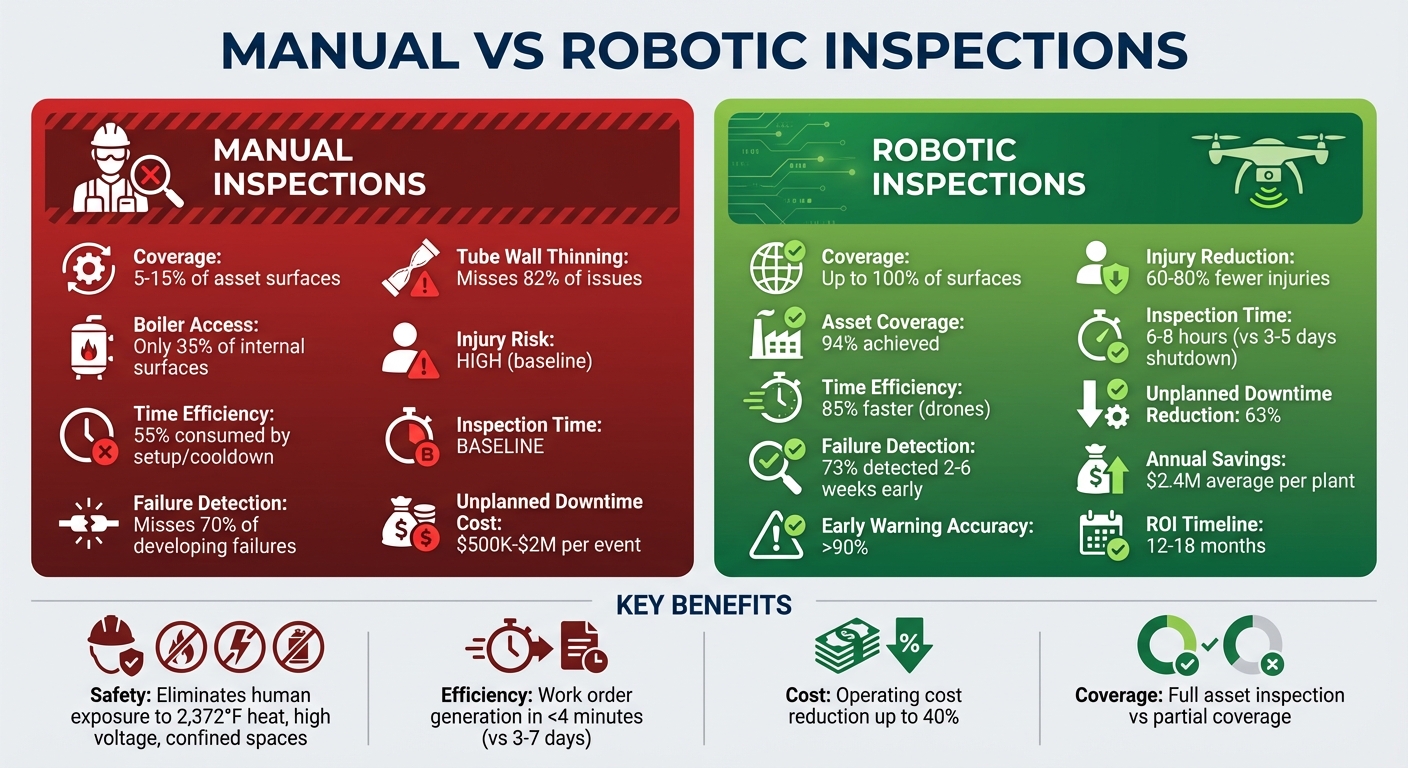
Manual vs Robotic Power Plant Inspections: Key Performance Metrics
Problems with Manual Power Plant Inspections
Safety Hazards and Dangerous Conditions
Manual inspections in power plants often put workers in harm's way. For example, boiler furnace interiors can reach temperatures over 2,372°F, limiting safe inspection times to just 30–60 minutes. Similarly, gas turbine enclosures often exceed 1,112°F, requiring technicians to wear bulky protective gear that restricts movement and reduces visibility. High-voltage switchyards present risks of lethal arc flashes, while confined spaces like cooling towers, pressure vessels, and underground tunnels pose dangers such as oxygen deficiency, exposure to toxic gases, and potential structural collapses. Inspecting cooling towers as tall as 98 feet often requires scaffolding or rope-access techniques, significantly increasing the risk of falls.
In a notable example, Shell Energy Park Rheinland introduced autonomous robots and drones in early 2026 to handle inspections in ATEX Zone 1 explosive environments. Under the guidance of Digital Innovation Lead Thomas Klein, this system removed the need for human entry into hazardous zones and enabled continuous 24/7 monitoring.
Inefficiencies and High Costs
Manual inspections aren’t just risky - they’re also inefficient. These inspections typically cover only 5–15% of an asset’s surface, with up to 55% of the time consumed by setup and cooldown processes. For instance, human crews can only access about 35% of a boiler's internal surface without extensive scaffolding, leaving 65% of potential issues undetected.
The financial stakes are high. Unplanned downtime in power plants can cost as much as $2.48 million per hour, with facilities dedicating 20% to 60% of their budgets to maintenance and repairs. Manual methods often miss up to 82% of boiler tube wall thinning and fail to detect 70% of developing equipment failures until alarms or shutdowns occur. Furthermore, 58% of issues identified during inspections never lead to formal work orders, leaving many problems unresolved.
A success story from 2018 highlights the benefits of automation. Granite Falls Energy automated maintenance for nearly 5,600 assets using the LLumin CMMS+ platform. By eliminating manual recordkeeping for 300 preventive maintenance tasks each month, the facility cut unplanned downtime by 30% and achieved significant cost reductions over five years.
Worker Shortages and Outdated Equipment
The challenges of manual inspections are compounded by workforce shortages and aging infrastructure. Many experienced boiler inspectors, turbine specialists, and high-voltage technicians are retiring, leaving a skills gap that hasn’t been filled by enough trained replacements.
Adding to the strain, over 60% of thermal power plants in operation were built before 2000. These older facilities require more frequent and intensive maintenance, but manual inspection teams are increasingly unable to keep up. This lack of resources often results in a "finding gap", where critical issues are identified but not addressed in time, leading to unplanned outages that can cost between $500,000 and $2 million per event.
"The power generation workforce is aging faster than it is being replaced. Experienced boiler inspectors, turbine specialists, and high-voltage technicians are retiring without enough trained replacements." - Oxmaint
sbb-itb-501186b
High Voltage Spot Inspections at National Grid | Boston Dynamics
Robotic Technologies for Power Plant Inspections
Specialized robots are transforming power plant inspections by addressing safety risks and inefficiencies. These robots are designed to navigate areas that are too dangerous or inaccessible for human crews, offering safer and more thorough inspections. Today, power plants rely on three main types of robots, each tailored to specific tasks and terrains - from ground-level equipment to towering structures.
Four-Legged Robots for Hazardous Zones
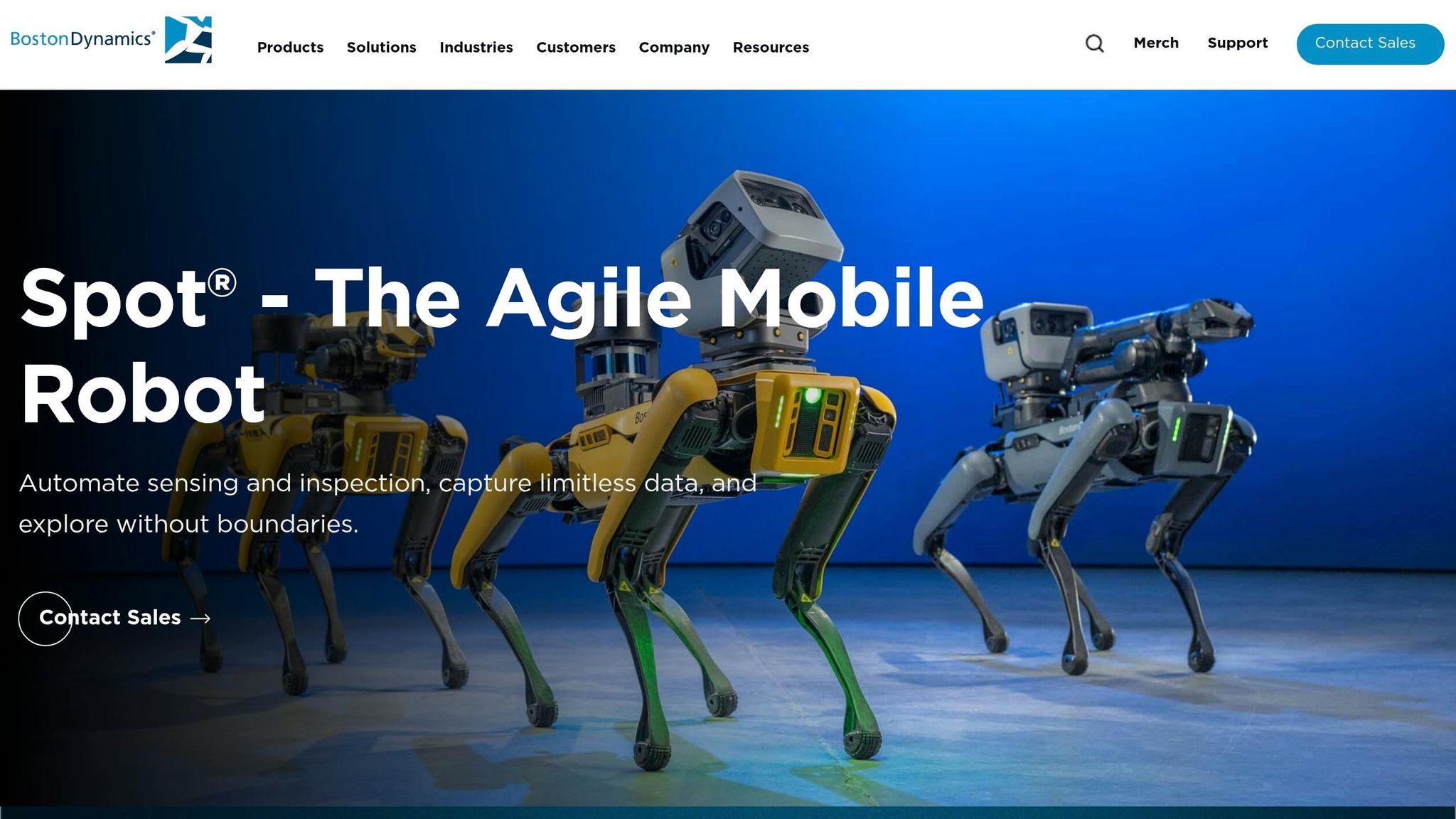
Quadruped robots, like Boston Dynamics' Spot, are built to handle challenging environments such as turbine halls, switchyards, and boiler houses. These areas often expose workers to high voltage, extreme noise, and other dangers. Equipped with tools like thermal cameras, acoustic sensors, and gas detectors, these robots can climb stairs, cross grated floors, and operate in hazardous zones.
For example, in 2022, J-POWER deployed Spot at the Onikobe Geothermal Power Plant for six missions covering 188 measurement points. The robot handled tasks such as digitizing gauge readings, measuring hydrogen sulfide levels, and spotting oil leaks - jobs that previously required human entry into risky areas.
"In terms of ROI, by having robots perform the patrols currently carried out by humans, personnel can focus on more critical tasks that only humans can do", said Takashi Fuchi, Spot Lead at J-POWER's Thermal Energy Department.
Deploying quadruped robots has reduced human exposure to high-risk zones by 78%. These robots also excel in ATEX-rated explosive environments, performing continuous patrols in areas with flammable gases or combustible dust. While these robots handle ground-level hazards, aerial drones take on inspections in hard-to-reach vertical spaces.
Drones for High-Altitude Inspections
Aerial drones are ideal for inspecting cooling towers, chimneys, and rooftops without requiring scaffolding or plant shutdowns. Equipped with SLAM (Simultaneous Localization and Mapping) technology, indoor drones can even navigate GPS-denied areas like boiler chambers and cooling tower interiors.
A manager at a 1,200 MW facility shared the impact of drone use:
"We used to shut the tower down for three days just to get inspectors up on scaffolds. Now the drone covers every surface in an afternoon while the tower stays online".
By eliminating the need for scaffolding and lengthy setup, drones cut inspection times by 85% compared to traditional methods. This not only reduces risks for workers but also ensures more reliable data collection.
Tracked Crawlers for Confined Spaces
Tracked crawlers complement aerial and quadruped robots, ensuring thorough inspections in confined and extreme environments. These heat-resistant robots are designed for tasks like inspecting boiler tube walls and other tight spaces where human access is nearly impossible. Using magnetic grips or treads, they can climb vertical surfaces and carry tools like ultrasonic thickness gauges and laser profilometers, which measure wall thickness with an accuracy of 0.1mm.
In October 2022, Korean company enesG used Eddyfi Technologies' custom crawler for nuclear reactor head inspections. The 19-pound robot, just 4.8 inches tall, navigated a complex array of penetration piping in a humid boric acid environment. Its HD camera and laser measurement system provided real-time data from areas that humans could not reach.
Gecko Robotics' Toka crawler system also stands out, completing furnace shell inspections in 6–8 hours without requiring downtime - a process that traditionally took 3–5 days of shutdowns. These crawlers achieve full coverage, far surpassing the 5–30% coverage typical of manual spot checks.
Multi-Robot Systems with Predictive Maintenance
Complete Coverage Systems
Power plants are increasingly turning to teams of coordinated robots to address areas that single-robot solutions can't effectively cover. For instance, a quadruped robot might excel at navigating complex, multi-level structures, but it won’t be able to inspect high-altitude cooling towers. Meanwhile, drones, which are perfect for high-altitude tasks, struggle in confined spaces like boiler tunnels. By combining multiple robot types on a unified platform, facilities can ensure thorough coverage of all critical zones.
In March 2026, DEEP Robotics and CHDER introduced an intelligent inspection system designed specifically for thermal power operations. This system utilized multiple robots to provide fully automated coverage of essential areas, achieving an early-warning accuracy rate of over 90%. The result? Annual operation and maintenance savings of more than $140,000.
The backbone of this success lies in a unified platform that integrates data from robots made by different manufacturers into a single dashboard. This approach eliminates redundant alerts and prevents the formation of data silos. Shell Energy Park Rheinland, for example, reported a potential 40% reduction in operating costs after adopting a unified system to manage its robotic fleet.
"The ability to operate different robot types under a single platform was the critical enabler."
- Thomas Klein, Digital Innovation Lead, Shell Energy and Chemicals Park Rheinland
By consolidating operations and data, this unified system not only improves coverage but also ensures that data flows seamlessly into predictive maintenance systems.
AI-Powered Predictive Maintenance
With complete coverage in place, the next step is leveraging integrated data streams for predictive maintenance. AI technology processes sensor data from robotic fleets and turns it into actionable maintenance insights. By analyzing vibration, thermal, and acoustic data, AI systems can identify specific fault types - like bearing defects or misalignments - and predict how long a component will last before failure.
Plants using AI-driven vibration analysis have reported detecting 73% of mechanical failures 2–6 weeks before they occur. This is a significant improvement compared to the 18% detection rate achieved through traditional manual inspections. These early warnings translate to average annual savings of $2.4 million per plant.
One of the most impactful advancements is the integration of AI with Computerized Maintenance Management Systems (CMMS). When a robot identifies an issue, the system can automatically create a prioritized work order in less than 4 minutes - down from the typical 3–7 days. The CMMS assigns these tasks to technicians with the right expertise for the specific asset, ensuring faster and more effective repairs.
Additionally, when technicians mark an alert as a false positive, that feedback helps train the AI model to improve its accuracy for similar scenarios in the future. This continuous learning process ensures the system becomes more reliable over time, further enhancing maintenance efficiency.
Case Study: Spider Robots for Nuclear Weld Inspections
Robotics is transforming how nuclear weld inspections are conducted, setting new standards for efficiency and safety.
In October 2025, Atommash, a division of Rosatom, unveiled a spider robot specifically designed for nuclear weld inspections. This robot performs ultrasonic testing on welds up to 11.8 inches thick - delivering results three times faster than traditional manual methods. The time savings are massive, potentially reducing labor by an estimated 500,000 work hours every year as part of a broader digital plant strategy.
The robot's design allows it to maneuver through challenging environments, including angled surfaces and tight reactor vessel interiors. It eliminates the need for human workers to enter high-risk zones, such as areas with high radiation, confined spaces, or extreme temperatures. These are environments where human exposure must remain below 12 millisieverts annually.
"By implementing robotics, we not only improve production efficiency but also create the work environment of the future... The spider robot is a clear example of how technology serves the safety of the nuclear energy industry."
- Oleg Shubin, Quality Director, Atommash
Europe has also seen similar advancements. Framatome Intercontrôle's PRIMUS platform, developed under the European RIMA project in 2021, leverages industrial robots and fuzzy logic software to automate ultrasonic weld testing. By 2025, this system reduced the inspection time for a single nuclear weld from two weeks to just one day. Using 3D scanning, it calculates precise robotic paths that can adapt in real time to actual conditions on-site.
These robotic systems are not just about speed; they are also boosting safety and data accuracy. Injuries during inspections have decreased by 60–80%, while the data collected during inspections has increased by 5 to 15 times, offering a much more comprehensive analysis.
Conclusion
Robotic inspection systems are transforming how facilities manage safety, costs, and equipment reliability. By automating inspections, these systems drastically reduce human exposure to dangerous environments while cutting costs and identifying potential failures before they escalate. Facilities adopting these technologies report 60–80% fewer inspection-related injuries and achieve up to 94% asset coverage, a stark contrast to the 5–28% typically achieved with manual methods. Multi-robot fleets, in particular, bring notable cost savings and operational efficiencies, with early defect detection helping to avoid expensive failures.
The move from reactive maintenance to AI-driven predictive systems has been a game-changer. Defects that once took weeks to discover are now identified 3–8 weeks earlier. When paired with CMMS platforms, robots can process sensor data and generate work orders in under 4 minutes, compared to the 3–7 days this task takes manually. This efficiency slashes unplanned downtime by 20–35% and often delivers a return on investment within 12–18 months.
"Successful robotic inspection will limit or eliminate the need to send inspectors to assess difficult-to-access or hazardous areas." - Anthony Zinn, Project Manager, NETL
A phased approach is the smartest way to implement these systems. Starting in high-risk areas like switchyards or boilers allows operators to gather results and build a strong case for broader adoption. The critical factor? Ensuring robotic data seamlessly integrates with maintenance systems, so essential findings don't get lost in the shuffle.
FAQs
Which plant areas should be automated first?
When considering automation in a power plant, the boiler tubes, transformers, and high-voltage switchyards are key areas to start with. These parts of the plant are not only dangerous but also difficult to reach and highly susceptible to critical failures. By using robotic inspections, potential problems can be identified early, reducing the risk of expensive downtime and enhancing worker safety.
What data do inspection robots collect?
Inspection robots collect visual, thermal, and ultrasonic data to spot problems such as defects or irregularities. The gathered information - like thermal images and detection results - is seamlessly fed into maintenance work orders. This integration ensures inspections are not only accurate but also proactive.
How do robots connect to a plant’s CMMS?
Robots work hand-in-hand with a plant's CMMS by sending inspection data directly, including details like defect locations and their severity. This data is then translated into prioritized work orders, streamlining the process between robotic inspections and maintenance tasks. The result? A smoother, more efficient approach to managing plant operations with improved accuracy.