




5 Signs of Transformer Failure and What to Do
Transformers don’t fail suddenly - they show warning signs that, if ignored, can lead to costly breakdowns. Here’s what to watch for:
- Abnormal sounds or vibrations: Buzzing or crackling often signals internal issues, like loose components or partial discharge.
- Excessive heat: Overheating cuts insulation life in half for every 10°C rise above rated temperature.
- Unstable voltage: Flickering lights or erratic equipment performance may point to winding damage or load imbalances.
- Visible damage or rust: Oil leaks, rust, or bulging panels hint at structural or internal problems.
- Repeated breaker trips: Frequent trips could mean insulation breakdown, overloading, or internal faults.
Ignoring these signs can lead to failures costing $150,000 or more, plus downtime losses of up to $1.6 million per hour. Regular maintenance, like oil testing, thermal imaging, and load checks, helps catch issues early. If problems persist, consult a professional for advanced diagnostics like Dissolved Gas Analysis (DGA) or insulation testing. Acting quickly can prevent catastrophic failures and extend your transformer’s lifespan.
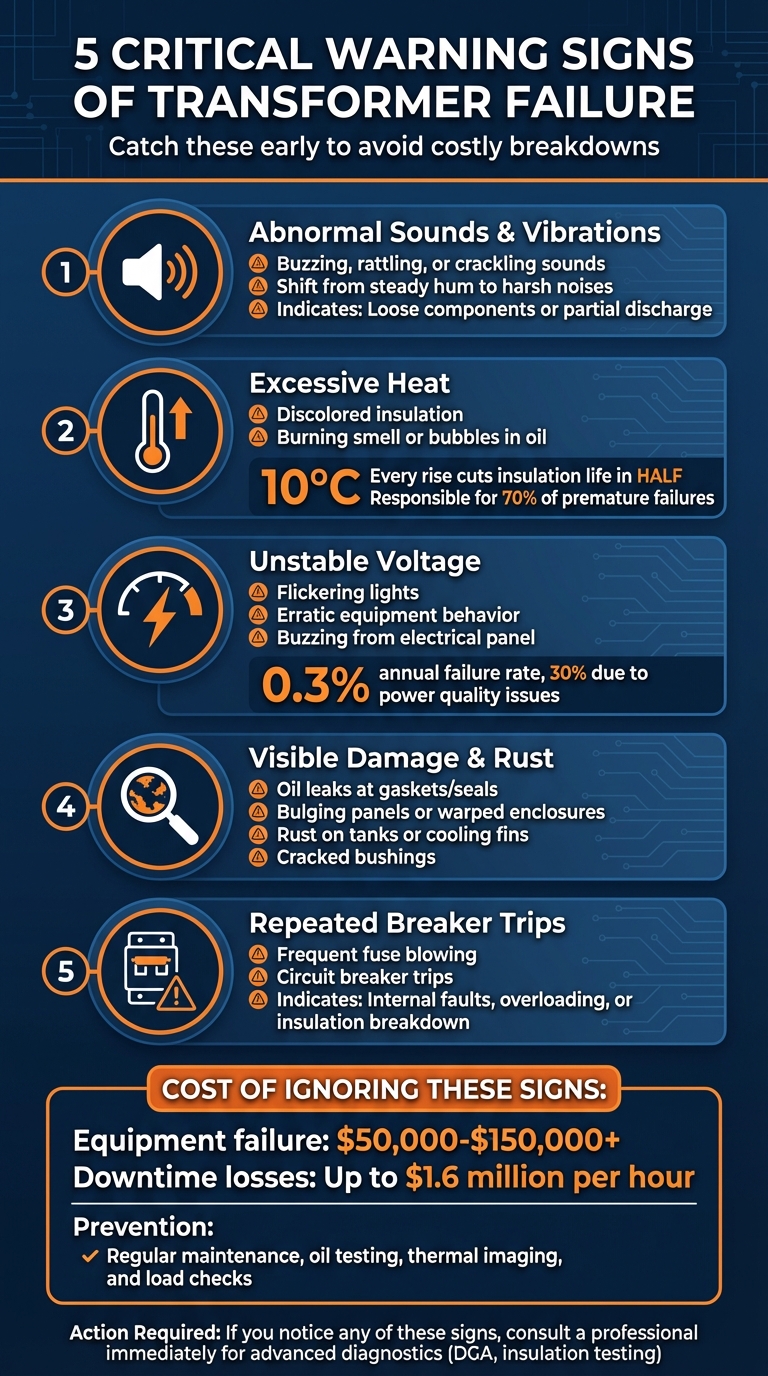
5 Warning Signs of Transformer Failure: Quick Reference Guide
Common Transformer Problems and Troubleshooting Tips
1. Abnormal Sounds and Vibrations
Transformers naturally emit a low hum during normal operation, caused by the expansion and contraction of their components. But when that hum shifts into something harsher - like buzzing, rattling, or crackling - it’s a red flag that something inside might be failing or coming loose.
As ElectPower explains:
A shift from steady hum to buzz, rattle, or intermittent crackle, the sound of loosening laminations or discharge activity.
That crackling sound often points to partial discharge, where electricity escapes into unintended areas. Left unchecked, this can lead to insulation failure.
What Causes These Noises
Several factors can contribute to unusual sounds in a transformer:
-
Vibration and Loose Components: Over time, vibrations can loosen electrical connections and mounting bolts. Fluke highlights the risk:
Once connections loosen, additional vibrations worsen the issue, creating a cycle of deterioration.Long term vibration can loosen connections in electrical transformers. Going unchecked results in excessive buzzing and overheating.
- Harmonic Distortion: Nonlinear loads, like variable frequency drives (VFDs) or switching power supplies, can inject harmonics into the system. According to IEEE 519, systems operating below 69 kV should maintain total harmonic distortion (THD) for voltage below 5%. Exceeding this threshold can cause excessive buzzing and vibration.
- Core Saturation: Overloading or sustained inrush currents can saturate the transformer core, leading to a harsher buzz.
- Physical Damage: Shocks from shipping, seismic activity, or prolonged vibration can distort windings and loosen laminations, further contributing to abnormal noises.
Understanding these causes is crucial for effective troubleshooting.
What to Do About It
To address these issues, follow these steps:
- Inspect for Changes: Conduct both visual and audible inspections to identify abnormal sound patterns. Use a power quality analyzer to monitor voltage, current, and harmonic data over time, especially for intermittent problems.
- Check Load Conditions: Compare the transformer's actual kVA, voltage, and current readings with its nameplate ratings. If the unit is overloaded or experiencing a voltage imbalance (anything over 2% between phases), it may be under significant stress.
- Tighten Connections: Shut off the power and inspect all connections. Tighten any loose mounting hardware or electrical terminations. Use thermal imaging to locate hotspots that might indicate failing connections.
- Address Persistent Issues: If crackling noises persist, consult professionals for a Dissolved Gas Analysis (DGA) on oil-filled transformers. This test can detect gases like acetylene and hydrogen, which signal arcing or thermal faults, helping to prevent catastrophic failures.
2. Excessive Heat and Temperature Problems
Excess heat can wreak havoc on transformers, breaking down insulation and drastically shortening their lifespan. One clear sign of overheating is discolored insulation, particularly at the tops of coils. Other warning signs include a burning or chemical smell, bubbles in the insulating oil, bulging panels, or cracked bushings.
Overheating is a major issue, responsible for 70% of premature transformer failures. Here’s a key fact: for every 10°C rise above the rated temperature, the insulation’s lifespan is cut in half. As Delta Wye Electric explains:
"The relationship between loading and insulation life follows a simple but unforgiving rule: every 10°C rise in operating temperature cuts insulation life in half".
Infrared thermography is a highly effective tool for spotting overheating issues. Thermal imaging can uncover hot spots at terminal connections and bus bars that aren’t visible to the naked eye. Additionally, consistently high temperature readings from built-in sensors or continuously running cooling fans are red flags that the transformer is struggling to stay within safe temperature limits.
Why Transformers Overheat
The biggest cause of overheating is overloading, which accounts for about 40% of transformer failures. Running a transformer at 10–15% above its nameplate kVA for extended periods puts significant strain on the system. On top of that, poor ventilation and cooling system failures can push temperatures even higher.
Ventilation problems often create thermal traps. Blocked air intakes, dust-covered cooling fins, or insufficient clearances around the transformer can all prevent proper heat dissipation. Most transformers are built to handle ambient temperatures up to 40°C (104°F). If temperatures exceed this, the unit may need to be derated to avoid damage. Cooling system failures - like malfunctioning fans in dry-type transformers or low oil levels in liquid-filled ones - can also cause temperatures to spike dangerously.
Another factor is non-linear loads, such as those from variable frequency drives (VFDs) or LED lighting. These loads generate harmonic distortion, which increases heat. If total harmonic distortion exceeds 5% for voltage or 15% for current, the resulting harmonic heating can be substantial. High-resistance connections, caused by loose bolts or corroded lugs, are another common source of heat buildup. Addressing these issues requires proactive cooling and load management.
How to Prevent Overheating
Once you know the causes, the next step is prevention. Start by comparing the measured load to the transformer’s nameplate rating. If the load exceeds 80%, it’s a warning sign. For liquid-filled transformers, check the sight glass regularly to ensure oil levels are adequate for both cooling and insulation.
Routine maintenance is essential. Clean cooling fins and ventilation grilles every quarter to prevent dust buildup. Verify that the transformer meets National Electrical Code clearance requirements - typically 12 inches of clearance for units under 112.5 kVA and 18 to 36 inches for larger ones. Annual infrared inspections can identify high-resistance connections or unbalanced phases early, and re-torquing terminal connections every 3–5 years helps counteract thermal cycling effects.
For systems with high harmonic content, consider upgrading to a K-factor rated transformer (e.g., K-4, K-13, or K-20), which is designed to handle non-linear loads. You can also reduce heat by implementing staggered startups for heavy machinery, which minimizes peak demand and inrush current. Power factor correction capacitors are another option - they lower the apparent kVA load on the transformer, giving it more thermal breathing room.
3. Unstable Voltage and Power Delivery Problems
Unstable voltage is often a sign of internal component issues. Symptoms like flickering lights, erratic equipment behavior, or buzzing noises from the electrical panel are common indicators of this problem. Diagnosing these issues typically requires precise testing methods to quickly identify the root cause.
The causes of voltage instability can vary. Internal factors include winding deformation, loose connections caused by vibrations, issues with On-Load Tap Changers (OLTCs), non-linear load harmonics, and load imbalances exceeding a 2% phase deviation. OLTCs, in particular, are prone to vulnerabilities that further destabilize voltage. Additionally, failing capacitors or poor filtering can introduce ripple voltage and high-frequency noise, signaling component wear and tear. External factors, like lightning strikes or switching surges, can overwhelm transformer insulation and result in transient overvoltages.
The risks are serious. Research covering over 425,000 unit-years shows an annual transformer failure rate of about 0.3%. Power quality issues are responsible for up to 30% of equipment failures in industrial environments. Even short-term voltage instability can have cascading effects, such as motor stalling, which can occur within 3 to 15 seconds of a fault. As GAMBICA, a UK trade association for industrial automation, points out:
"Power quality issues account for up to 30% of all equipment failures in industrial settings. Common culprits include voltage sags, harmonics, and poor grounding".
How to Test for Voltage Problems
Diagnosing voltage instability requires a systematic approach. Start by using a power quality analyzer or an advanced power logger to monitor fluctuations over time, as these issues are often intermittent. For three-phase systems, compare voltage and current across all phases.
Evaluate harmonic distortion using IEEE 519 standards (THD < 5% for systems below 69 kV). High levels of harmonics, especially 3rd or 5th order, often point to interference from electronic devices like variable frequency drives or switching power supplies. An oscilloscope can help detect ripple voltage or high-frequency noise, which may indicate failing capacitors or inadequate filtering.
Thermal imaging is another valuable tool. Use an infrared camera to identify temperature differences in terminations and coils. A noticeably higher temperature on one phase compared to others often signals voltage unbalance or a loose, high-resistance connection. Elevated heat at neutral terminations could also indicate excessive harmonics.
For internal issues, transformer turns ratio (TTR) and winding resistance tests can detect short circuits or winding degradation. As ElectPower explains:
"A bad transformer rarely fails without a tell... Output issues: sagging or erratic secondary voltage, asymmetry across phases, or poor regulation under normal load".
Before testing, record the transformer's kVA, voltage, and current ratings from the nameplate to establish a baseline for comparison.
Fixing Voltage Issues
After identifying the problem, take targeted steps to stabilize voltage. For load imbalances, map out the equipment distribution system and redistribute loads to ensure an even draw across phases. Persistent imbalances can often be traced to loose or high-resistance connections, which thermal imaging can help locate.
Tighten all terminations immediately to prevent voltage drops and eliminate buzzing noises. If harmonic distortion is above acceptable limits, implement filtering solutions to reduce interference and overheating.
Reactive power compensation can also help stabilize voltage. Tools like shunt capacitors, Static Var Compensators (SVCs), or synchronous condensers provide dynamic vars to regulate voltage. In some cases, it may be necessary to block OLTCs or set them to specific taps to avoid worsening voltage drops.
For internal issues, professional assessment is crucial. Conduct Dissolved Gas Analysis (DGA) on transformer oil to detect arcing or thermal faults before they escalate. Regularly test for gases like hydrogen, acetylene, and methane to catch early signs of trouble. Installing surge arresters at transformer terminals and ensuring the Basic Insulation Level (BIL) can handle transient voltages will help protect the system.
In extreme cases, load shedding may be required to prevent voltage collapse. Compare actual power usage to the transformer's nameplate ratings to identify chronic overloading. If the transformer consistently operates beyond its capacity or shows irreversible damage, replacing it might be more cost-effective than repairs. Addressing these issues promptly can prevent further disruptions, as highlighted in earlier sections.
sbb-itb-501186b
4. Visible Damage and Rust
Visible damage often serves as an early warning for internal problems. Catching these signs can help prevent complete system failure. For example, oil leaks might show up as damp gaskets, wet stains running down the tank, or oil lines under flanges. These leaks usually indicate failing seals or gaskets, which can allow moisture to seep in and degrade insulation. Bulging panels or warped enclosures might point to dangerous pressure buildup or severe overheating.
Rust and corrosion are also major red flags. Corrosion on tanks, enclosures, or cooling fins can weaken the structure. Inside the tank, rust can form sludge, polluting the oil. Cracked bushings or damaged porcelain components might lead to insulation problems, oil leaks, or even complete failure.
External factors like salty air near coasts or industrial pollutants can speed up corrosion. Dust and debris on dry-type coils can block airflow, increasing the risk of overheating. As Giga Energy puts it:
"The difference between a transformer that lasts 40 years and one that fails in 10 often comes down to the quality of seals and gaskets".
Spotting these visible issues helps focus inspections on potential damage areas.
How to Inspect for Physical Damage
A detailed walk-around inspection should target paint condition, leaks, and gauge readings. Look for signs like caulking paint, cracks from temperature changes, peeling that traps moisture, or rust pinholes.
Pay special attention to common leak areas, such as welded seams, bushings, gauges, tap changer handles, and gasketed parts. If a pressure/vacuum gauge shows "0", check it at different times during the day as load changes. A gauge stuck at "0" might mean a leak that needs a pressure test with dry air or nitrogen.
Check cooling fins and radiators for blockages or plant growth that could trap heat. Inspect hinges and locks for corrosion to ensure the enclosure stays sealed. When the system is off, examine high and low voltage bushings for cracks and check the seals on all gasketed parts. Use thermal imaging to spot hidden hot spots on casings or tap chambers.
| Inspection Frequency | Recommended Actions |
|---|---|
| Weekly | Inspect exterior condition and cooling systems |
| Monthly | Perform a visual inspection, check oil levels and gauges, ensure cooling systems are working, and listen for unusual noises |
| Quarterly | Clean and inspect bushings, check connection tightness, test alarms, and inspect surge arrestors |
| Annual | Conduct a full inspection, including oil sampling (DGA), insulation resistance tests, and infrared scans |
Maintenance to Prevent Damage
Once damage is spotted, immediate maintenance is key to avoid further problems. Address rust or peeling paint right away to stop metal deterioration and potential oil leaks. Replace gaskets and seals at the first sign of dampness to keep moisture out of the oil. For dry-type transformers, regularly vacuum or blow out dust from vents to prevent arc tracking. Keep cooling fins and radiator airways clean to ensure proper heat dissipation.
If the unit vibrates excessively, install vibration-dampening pads to protect internal connections. For transformers in tough environments with salty air, high humidity, or heavy dust, increase the frequency of cleaning and seal inspections. Record readings from liquid level, pressure/vacuum, and oil temperature gauges annually to track trends. For critical units like generator step-up transformers or furnace transformers, perform visual inspections and oil tests up to four times a year.
5. Repeated Fuse and Breaker Trips
When fuses blow or circuit breakers trip over and over, it's a clear sign that something isn’t right. These devices are built to protect your system by cutting power when they detect dangerous conditions like short circuits, overcurrent, or internal faults. Ignoring these warning signs can lead to serious problems - think fires, system shutdowns, or even complete equipment failure.
The issue might stem from inside the transformer, such as winding-to-winding shorts caused by insulation breakdown or internal arcing that triggers Buchholz relays. Overloading the transformer - running it beyond its rated capacity - can also lead to overheating and cause overcurrent relays to trip. External factors, like short circuits in the connected load, lightning strikes, or power surges, can also be culprits.
The fault could be in the transformer itself, the connected load, or the input circuitry. Other contributors include moisture in the system, oil contamination, aging insulation, or mechanical stress from vibrations or earthquakes. These factors weaken the transformer's dielectric strength, making it prone to internal flashovers or intermittent shorts. The next step is to systematically test and narrow down the problem.
Finding the Source of the Problem
Start by identifying which relay tripped. Differential relays (87T) usually indicate internal winding faults, while overcurrent relays (50/51) suggest external overloads or downstream issues. If a Buchholz relay activates, it often points to gas formation caused by internal arcing or severe insulation failure.
To isolate the fault, disconnect the transformer from the input circuit. If the input power stabilizes after disconnection, the transformer’s primary side is likely the issue. If not, the problem might lie in the input circuitry. Compare the transformer's actual power consumption (measured in kVA, voltage, and current) with its nameplate ratings. If the load exceeds its capacity, it’s likely an external overload rather than an internal fault.
Use a digital multimeter (DMM) to measure the primary and secondary circuits. Voltage drops or current surges can often explain the trips. If the primary voltage reads less than 80% of the expected value, investigate the input circuitry before blaming the transformer. Infrared thermography can also be helpful, identifying hot spots on terminals that might cause nuisance trips even when the transformer itself is functioning properly.
For oil-filled transformers, perform Dissolved Gas Analysis (DGA) after a trip to check for signs of arcing (acetylene) or partial discharge (hydrogen). Insulation resistance tests using a megohmmeter can detect moisture issues, and a Polarization Index (PI) ratio below 2.0 suggests serious insulation problems.
Don’t rely on a single measurement. Continuous logging of power quality data can help catch intermittent issues. Also, keep an eye on total harmonic distortion - voltage distortion above 5% in systems under 69 kV can lead to overheating and further complications.
Repair vs. Replacement Decision
Once the issue is diagnosed, weigh your options for repair or replacement. Persistent problems or high repair costs often point to replacement as the better long-term solution.
Repairs make sense for localized issues like leaking gaskets, faulty bushings, cooling fan problems, or loose connections. If moisture is found in dry-type windings, the unit should be thoroughly dried before re-energizing to prevent permanent damage.
On the other hand, replacement is usually the smarter choice if DGA reveals active arcing, or if tests show advanced aging of paper insulation or significant mechanical distortion in the windings. For older transformers - those in service for 10 to 20 years or more - replacement is often preferred because newer models are more efficient and reliable.
Transformer costs vary widely depending on size and type. Small distribution units typically cost between $1,000 and $5,000, while large substation transformers can exceed $100,000. For options, you can check out Electrical Trader.
Generally, well-maintained transformers have low failure rates - less than 1% per year - and are built to last 20 to 40 years, with some exceeding 50 years. However, if repair costs start approaching the replacement value or the transformer has a history of frequent failures, replacing it is often the better financial and operational decision.
Testing Methods and When to Call Professionals
Identifying transformer issues early depends on using the right diagnostic tools. One of the most effective methods for oil-filled transformers is Dissolved Gas Analysis (DGA). This test detects gases generated when oil or paper insulation deteriorates due to heat or electrical stress. For instance, if hydrogen levels exceed 700 ppm or acetylene surpasses 10 ppm, it signals critical faults that demand immediate action. To avoid costly breakdowns, annual DGA testing is strongly advised for essential transformers.
Another powerful diagnostic tool is infrared thermography, a non-invasive method that can be performed while the transformer is operational. This scan identifies external hot spots caused by loose connections, cooling system blockages, or bushing issues. A notable example comes from 2012, when Saira Dar of 3i Condition Monitoring found a 212°F hot spot on a 3,000 kVA transformer using thermal imaging. Despite the unit's internal alarm failing to trigger at its 176°F setpoint, the thermal scan prompted a shutdown. Upon inspection, arcing contacts in the tap chamber were discovered. The repair cost $91,000, but it averted a potential failure estimated at $327,000.
"Thermography should always be used in conjunction with other testing methods." - Saira Dar, Level III Thermographer, 3i Condition Monitoring Consultancy
For assessing insulation health, insulation resistance testing is key. A Polarization Index (PI) ratio under 2.0 often indicates moisture or contamination. To evaluate mechanical integrity, Sweep Frequency Response Analysis (SFRA) is invaluable. This test detects physical shifts in the transformer’s core or coils, which are common after significant electrical faults or physical movement.
If any test uncovers critical issues, it’s time to call in the experts. Immediate professional assistance is essential if you notice sudden noise changes (like buzzing or crackling), thermal scans reveal hot spots above 212°F, or DGA results show a spike in combustible gases. Similarly, professional intervention is required after events like lightning strikes, earthquakes, or when protective relays trip during energization. While in-house teams can handle basic diagnostics with tools like handheld infrared cameras or multimeters, specialists are needed for advanced testing. These professionals use tools such as UHF sensors for partial discharge detection and lab-grade gas chromatography for precise DGA analysis.
Conclusion
Spotting early warning signs like unusual sounds, overheating, voltage instability, visible damage, or frequent breaker trips can significantly extend a transformer's lifespan - from 10 years to as long as 40–50 years. Achieving this requires consistent care, including annual oil testing, thermal scans, and visual inspections.
Ignoring maintenance comes at a hefty price. Transformer failures can lead to losses ranging from $50,000 to $150,000 or more, factoring in equipment damage and unplanned downtime. Regular monitoring and proactive upkeep not only prolong the life of your equipment but also help avoid these costly emergencies. These potential financial risks highlight the importance of acting quickly when issues arise.
Certain test results, like hydrogen levels exceeding 300 ppm, thermal hot spots over 221°F, or evidence of core distortion, indicate it's safer to replace the transformer. When these red flags appear, swift action is essential - delays can turn manageable problems into catastrophic failures. Acting promptly helps reduce downtime and ensures smoother operations.
If you're in need of replacement transformers or power distribution equipment, check out Electrical Trader. They offer a variety of new and used units, including 3-phase transformers, substation transformers, and emergency standby generators, with suppliers who can deliver quickly to keep your operations on track.
FAQs
What are the main reasons transformers overheat?
Transformers can sometimes overheat, and there are a couple of usual suspects behind this. One big one is loose electrical connections. When connections aren’t tight, resistance goes up, and that extra resistance generates unwanted heat. Another common issue is excessive harmonics. This happens when non-linear loads mess with the electrical current, creating distortions that force the transformer to work overtime, leading to overheating.
The good news? Regular maintenance and inspections can catch these problems early. Fixing them quickly not only helps prevent failures but also keeps the transformer running safely and efficiently.
Why is regular maintenance important for preventing transformer failures?
Regular maintenance plays a key role in spotting and resolving potential transformer problems before they escalate into expensive failures. Routine inspections - like keeping an eye on temperature, listening for unusual sounds, and evaluating overall performance - can reveal early warning signs, such as overheating, strange noises, or insulation issues.
Tasks like scheduled cleaning and ensuring adequate ventilation are equally important. These steps prevent overheating caused by dust accumulation or blocked airflow. Additionally, condition-based testing, such as checking moisture levels and assessing insulation, helps you plan maintenance more effectively, minimizing the chance of sudden breakdowns. Consistent upkeep not only extends your transformer's lifespan but also boosts reliability and reduces the risk of unexpected downtime.
How do I know if I should replace a transformer instead of repairing it?
Transformers should be replaced instead of repaired when they've reached the end of their usual lifespan - typically 20 to 30 years - or when the damage is too severe for repairs to make financial sense. In such cases, replacement ensures better safety, reliability, and overall value compared to costly fixes.
Other signs that replacement might be the smarter move include frequent failures, consistent overheating, or noticeable wear like insulation breakdown or oil contamination. These issues can compromise performance and safety, making a new transformer the more practical long-term solution.