

Short Circuits vs. Overloads: Key Differences
Short circuits and overloads are both electrical faults but differ in cause, impact, and behavior. A short circuit occurs when electricity flows through an unintended low-resistance path, leading to an immediate and dangerous surge in current - 10 to 100 times the normal level. In contrast, an overload happens when a circuit carries more current than it’s designed for, typically 10% to 50% above capacity, causing gradual heat buildup.
Key Points:
- Short Circuits: Instant, severe current spikes due to wiring faults, damaged insulation, or moisture. Immediate risks include fire, explosions, and equipment damage.
- Overloads: Gradual overheating from excessive load (e.g., too many devices on one circuit). Prolonged risks include insulation damage and potential fires.
Quick Comparison:
| Feature | Short Circuit | Overload |
|---|---|---|
| Cause | Faulty wiring, exposed conductors, moisture | Excessive devices on one circuit |
| Current Level | 10–100× normal | 10%–50% above capacity |
| Onset Speed | Instant | Gradual |
| Symptoms | Sparks, breaker trips immediately | Dimming lights, warm outlets |
| Primary Hazard | Fires, explosions, electrocution | Gradual heat damage, potential fire |
| Protection | Magnetic breakers, fast-acting fuses | Thermal breakers, slow-blow fuses |
Understanding these differences helps prevent electrical failures, ensuring safety and system reliability.
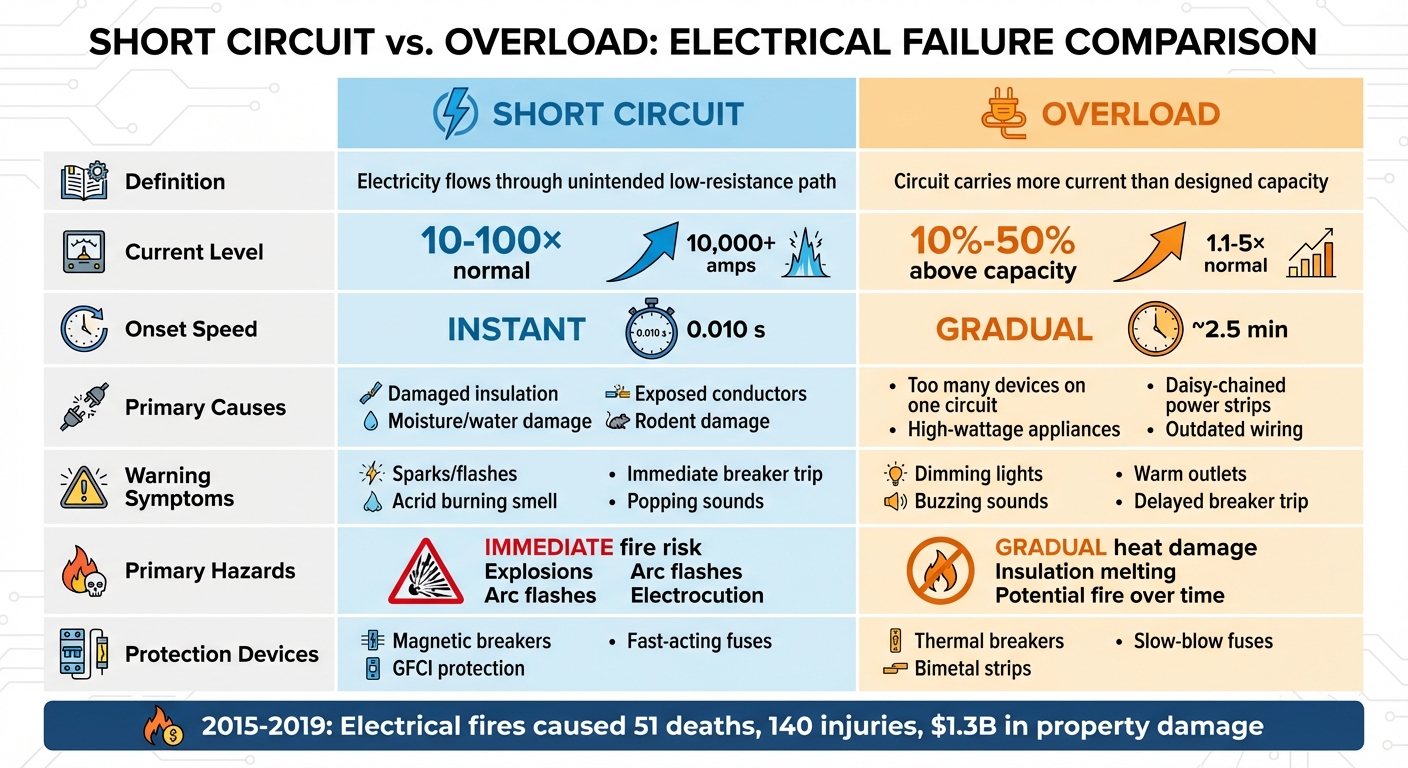
Short Circuits vs Overloads: Side-by-Side Comparison Chart
Short Circuits vs. Overloads: Side-by-Side Comparison
Categories for Comparison
Short circuits and overloads differ in their causes, behavior, and the way they impact electrical systems. By examining key aspects - like their definitions, voltage and current behavior, causes, onset speed, symptoms, and protective measures - professionals can identify and address these issues effectively.
Comparison Table
| Category | Overload | Short Circuit |
|---|---|---|
| Definition | Occurs when the current exceeds the circuit's designed capacity | Happens when current flows through an unintended, low-resistance path |
| Voltage Behavior | Can cause a noticeable voltage drop | Results in voltage dropping to nearly zero at the fault point |
| Current Level | 10%–50% above the circuit rating; protective devices typically trip at 120%–160% of capacity | Can reach 10–100× the normal rating, often thousands of amperes |
| Onset Speed | Develops gradually over time | Occurs instantly |
| Primary Causes | Excessive load from too many devices, high-wattage appliances, or motor inrush currents | Damaged insulation, loose connections, moisture, or rodent damage |
| Symptoms | Warm outlets, dimming lights, buzzing sounds, or a burning smell | Sparks, flashes, immediate breaker trips, and an acrid odor |
| Primary Hazard | Gradual heat buildup leading to fire or insulation damage | Immediate risks like fire, explosions, arc flashes, and electrocution |
| Protective Device | Thermal breakers or slow-blow fuses | Magnetic breakers, fast-acting fuses, or GFCI protection |
Overloads occur when the demand on a circuit exceeds its safe capacity, such as when too many devices are plugged in or high-wattage appliances are used simultaneously. For instance, a 15-amp circuit can handle up to 1,800 watts safely; exceeding this limit can cause overheating and potential hazards.
Short circuits, on the other hand, are caused by wiring faults or physical damage, leading to massive current surges - sometimes tens of thousands of amperes. These events require fast-acting protection like magnetic breakers to prevent severe damage. Understanding these differences is essential for diagnosing and preventing electrical failures, as explored in upcoming sections.
What Is a Short Circuit?
Definition and Characteristics
A short circuit happens when electricity takes an unintended shortcut, bypassing its designated path through a device or appliance and flowing directly back to the power source. This low-resistance fault disrupts the normal flow of current.
"A short circuit is an overcurrent which greatly exceeds the normal full load current of the circuit. Also, as the name infers, a short circuit leaves the normal current carrying path of the circuit and takes a shortcut around the load and back to the power source." - Eaton
When this happens, the current surges dramatically, often reaching levels 10 to 100 times higher than usual. For instance, in a standard 10-amp residential circuit, a short circuit can cause the current to spike up to 10,000 amps. At the same time, the voltage at the fault point drops to nearly zero, allowing an enormous amount of current to flow. Depending on the system's impedance, short circuit currents can range from fractions of an amp to over 200,000 amps (200 kA). These extreme conditions often lead to physical damage, triggering the short circuit in the first place.
Common Causes
Short circuits are usually caused by physical issues within the electrical system. Damaged or deteriorating insulation on wires is a frequent culprit - when the protective coating cracks, melts, or wears away, it can expose the conductors, allowing them to touch each other or grounded surfaces. Loose electrical connections can also create unintended contact points. Moisture from leaks or flooding provides another path for current to flow improperly, while rodents chewing through insulation can expose live wires. Faulty equipment, such as damaged power cords, or improper installation - like nails or screws accidentally piercing live wiring - are also common triggers. These issues can quickly escalate into dangerous situations.
Immediate Effects
The consequences of a short circuit are both immediate and severe. The sudden surge of energy generates intense heat, which can melt conductors and insulation. This often leads to arc flashes - explosive events that produce sparks, flames, and localized explosions. These incidents not only pose a fire hazard but can also cause serious injuries. For example, in 2021, electrical malfunctions, including short circuits, were responsible for 24,200 fires, 295 deaths, 900 injuries, and approximately $1.2 billion in property damage in the U.S. alone.
Beyond the fire risk, short circuits can cause significant damage to electrical equipment. Contacts may become pitted, carbon deposits may form, and circuit breakers may fail catastrophically if they are pushed beyond their interrupting capacity.
"Interrupting a short circuit that is limited by the resistance of the wiring is a very severe test of a circuit breaker, and if the interrupting capacity of the breaker is not adequate, the device can literally explode." - E-T-A Circuit Breakers
What Is an Overload?
Definition and Characteristics
An overload happens when the electrical current drawn by devices exceeds the safe capacity of a circuit's wiring or protective devices. Unlike a short circuit, which causes an immediate and intense surge of current, an overload is a steady, excessive demand on the circuit. In this situation, electricity flows along its intended path, but the current level surpasses what the circuit was designed to handle.
"An overload condition exists when the normal circuit current is exceeded, and a short circuit is not present. An overload - if allowed to persist - could cause damage to wiring or equipment."
- Jack Smith, Columnist
For example, a 20-amp circuit carrying 24 amps may not seem like a massive excess, but if sustained, it becomes hazardous. Similarly, a standard 15-amp residential circuit can safely supply up to 1,800 watts, but for added safety, experts recommend keeping the load at 80% of its capacity - around 1,440 watts.
Common Causes
Overloads often stem from everyday activities that push circuits past their limits. Using multiple high-wattage devices on the same circuit is a frequent culprit. For instance, running a 1,200-watt microwave alongside a 1,700-watt air fryer on a single 15-amp circuit can easily exceed its capacity. Faulty mechanical equipment, such as motors with jammed parts or worn-out bearings, can also draw excessive current. Overusing extension cords or daisy-chaining power strips further stresses circuits, and older homes with outdated wiring or panels may struggle to handle modern electrical demands. This constant overuse doesn’t just strain the system - it also causes wear and tear over time.
Gradual Effects
Unlike the immediate destruction caused by a short circuit, overloads cause damage over time. The extra current produces heat, which slowly deteriorates the insulation on wires. Prolonged exposure can cause the insulation to dry out, crack, or even melt.
"Overload protection specifically handles excess current that if sustained over time could cause overheating of the conductors and equipment."
This heat buildup doesn’t just affect wiring - it can also damage motors, transformers, and sensitive electronics. Signs like dimming lights or voltage drops are often early indicators of trouble brewing beneath the surface.
Electrical Characteristics: How They Differ
Voltage Behavior
The key distinction between these two scenarios lies in how they affect voltage. In a short circuit, electricity takes an unplanned route with minimal resistance. As a result, the voltage collapses because the current bypasses the usual load entirely. On the other hand, during an overload, the voltage remains present but at a reduced level. Here, the current continues to flow through the intended path - appliances and wiring - but at levels exceeding what the circuit is designed to handle. These contrasting voltage behaviors naturally lead to dramatic differences in current levels, which we’ll explore next.
Current Magnitude
The disparity in current levels between these two conditions is striking. Short circuits can produce 10 to 100 times the normal operating current, with fault currents often reaching 5,000 to 10,000 amps in standard residential or commercial systems. By contrast, overloads are much less severe, typically ranging from 1.1 to 5 times the circuit's normal rating. For example, a 15-amp circuit pulling 20 amps is experiencing an overload, whereas the same circuit carrying 10,000 amps is dealing with a short circuit.
"Short circuits and ground faults generate thousands and thousands of amps. Overcurrent protection must shut down the circuit immediately when these situations occur."
- Ally Childress, Licensed Electrician
Duration of Fault
Another clear difference lies in how long these faults last. Short circuits happen in an instant, with circuit breakers responding within milliseconds to cut off the current. In contrast, overloads persist for a longer period - typically around 2.5 minutes on a 15-amp circuit drawing close to 20 amps - before the breaker trips. This intentional delay allows breakers to ignore harmless "inrush currents" caused by motor startups while still protecting against prolonged overload conditions.
"Overload conditions are usually not as time-critical as short circuits and ground faults. Electrical equipment can usually withstand some level of load current over its rating for a length of time."
- Steven Eich, Vice President and Electrical Technical Director, Environmental Systems Design
How to Identify Short Circuits and Overloads
Causes: Short Circuits vs. Overloads
Short circuits and overloads happen for different reasons, but both can cause trouble if not addressed. Short circuits usually occur when insulation fails, wires are exposed, or connections become loose. These issues can be caused by things like water damage or even rodents chewing through wires. When the exposed copper from hot and neutral wires touches, a short circuit is the result. On the other hand, overloads happen when a circuit is asked to handle more electricity than it's rated for. High-wattage devices like space heaters (often 1,500 watts), hair dryers, window air conditioners, and vacuum cleaners are common culprits. Spotting the signs early can help avoid bigger problems.
Symptoms Checklist
You can often figure out what's going wrong by paying attention to the symptoms. Short circuits make themselves known in dramatic ways - sparks or "zaps", loud popping or sizzling sounds, scorch marks near outlets, and a sharp, burning smell are telltale signs. When this happens, the breaker trips immediately and won’t reset until the issue is resolved. Overloads, on the other hand, tend to show up more gradually. You might notice lights dimming or flickering when you turn on more appliances, buzzing outlets, electronics that seem to struggle, or wall plates that feel warm to the touch. Typically, an overload trips the breaker after a high-wattage device is used or when there’s sustained high demand.
Here’s a quick comparison to help you differentiate the two:
| Sign | Short Circuit | Overload |
|---|---|---|
| Breaker Behavior | Trips immediately upon reset | Trips after a delay or when a device is used |
| Visual Cues | Sparks, arcing, scorch marks | Dimming or flickering lights, discolored plates |
| Sounds | Loud popping or "zap" | Faint buzzing or crackling |
| Physical Feel | Dangerous to touch | Warm outlets or switches |
| Odor | Sharp, acrid burning smell | Gradual burning odor |
A simple test can help narrow down the problem. Unplug everything, reset the breaker, and see what happens. If the breaker trips right away, it’s likely a short circuit. If it stays on until devices are plugged back in, you’re probably dealing with an overload.
sbb-itb-501186b
Dangers and Damage from Each Issue
Immediate Risks of Short Circuits
Short circuits are among the most dangerous electrical problems. When electrical current suddenly veers off its intended path, it creates a massive surge - often spiking between 5,000 and 50,000 amperes or even higher in branch circuits. This surge generates intense arcing, releasing extreme heat that can ignite fires instantly and cause severe burns.
The destruction happens in the blink of an eye. Devices connected to the circuit fail immediately, with internal components melting, connections charring, and contacts suffering severe pitting due to the heat. On top of that, the risk to personal safety is immense. Accidental contact with a short circuit can lead to electrocution, potentially causing cardiac arrest, internal injuries, or even death. These effects happen almost instantly, making short circuits starkly different from the slower damage caused by overloads.
Gradual Risks of Overloads
Unlike short circuits, overloads cause damage over time. When a circuit carries more current than it's designed for - often 2 to 5 times its normal capacity - the wires gradually heat up. This sustained heat weakens the insulation, making it brittle and prone to melting, which exposes live conductors.
Overloaded circuits are a leading cause of electrical fires. The prolonged heat buildup can ignite nearby flammable materials, leading to catastrophic outcomes. Beyond fire risks, overloads also take a toll on connected devices. Motors and electronics operating beyond their rated capacity experience excessive heat and voltage drops, which accelerate wear and drastically shorten their lifespan. Over time, the wiring itself becomes compromised, increasing the chances of arcing faults or short circuits. While overloads might not have the explosive immediacy of a short circuit, their gradual nature makes them equally dangerous, especially when left unchecked.
Understanding both the instant devastation of short circuits and the creeping dangers of overloads is essential for detecting and preventing faults in power distribution systems.
How to Detect and Prevent These Problems
Inspection Techniques
Spotting electrical faults starts with observing how the breaker reacts. For instance, short circuits cause an immediate trip due to a sudden surge in current. On the other hand, overloads trip after a delay since they rely on a bi-metallic strip heating up over time.
Short circuits often leave behind scorch marks, while overloads might show up as flickering or dimming lights. To diagnose an overload, turn off the breaker and note which devices lose power. Then, add up their wattage to see if the circuit is carrying too much. Tools like clamping ammeters can measure real-time current flow, while multimeters are handy for checking voltage, continuity, and resistance to track down wiring issues. Pinpointing the problem accurately is key to preventing future damage.
Prevention Methods
Once you've identified the issue, taking swift action can protect your system. Start by balancing loads and using the right equipment. A good rule of thumb is the 80% rule: a 15-amp circuit should handle no more than 1,440 watts continuously (80% of its 1,800-watt capacity), while a 20-amp circuit should stay under 1,920 watts. Spread high-wattage devices - like toasters, space heaters, and microwaves - across different circuits instead of overloading one. For appliances that demand more power, such as refrigerators, dishwashers, or EV chargers, consider installing dedicated circuits.
Switching from incandescent bulbs to LEDs can reduce amperage draw significantly. Avoid upgrading a 15-amp breaker to 20 amps unless you've confirmed the wiring is 12-gauge, as thinner 14-gauge wire can't safely handle the increased load. Regularly inspect appliance cords for signs of wear, cracks, or even rodent damage. For reliable circuit breakers, transformers, and power distribution components, Electrical Trader offers a variety of new and used options to help keep your system running smoothly.
Protective Devices for Short Circuits and Overloads
Fuses and Thermal Breakers for Overloads
Thermal breakers and fuses are designed to address overload scenarios by responding to gradual heat buildup. Thermal breakers rely on a bimetal strip or disk that bends as it heats up due to excessive current. If the overload continues, the heat causes the strip to trip after a slight delay, preventing unnecessary interruptions from brief motor inrush currents.
Fuses, on the other hand, use a metal element that melts when exposed to excessive current, breaking the circuit. Both fuses and thermal breakers share an inverse time-current characteristic: the higher the current, the quicker they act. For instance, a 1,000-amp overload might take between 70 and 300 seconds to trip a 400-amp thermal breaker, allowing enough time to handle temporary surges without cutting power.
However, thermal devices are not suited for the nearly instantaneous surges caused by short circuits. As Tim Crnko, Training and Technical Services Manager at Cooper Bussmann, explains:
"If a fuse tries to interrupt a fault current greater than its interrupting rating, the fuse can violently rupture".
This limitation highlights the need for a different solution - magnetic breakers - for handling short circuits.
Magnetic Breakers for Short Circuits
Magnetic breakers are specifically designed to tackle the sudden and intense electrical surges caused by short circuits. These devices use a solenoid that reacts almost instantly to the strong magnetic fields generated by a short circuit. When current exceeds a set threshold, the solenoid trips the breaker immediately, ensuring rapid protection. This quick response is critical, as short-circuit currents can range from 50,000 to over 200,000 amperes, creating magnetic forces between bus bars that can exert hundreds of pounds per linear foot.
Many modern molded-case circuit breakers (MCCBs) combine both thermal and magnetic technologies in one unit, known as a thermal-magnetic breaker. In these devices, the bimetal strip handles long-term overloads, while the magnetic solenoid provides instant protection against short circuits. For those seeking reliable circuit breakers and power distribution components with this dual protection, Electrical Trader offers a variety of new and used options to meet diverse system needs.
Overload vs Short circuit Explained
Conclusion
Understanding the difference between short circuits and overloads is key to maintaining electrical system safety. Short circuits result in sudden surges of current - sometimes 10 to 100 times higher than normal - that demand immediate shutdowns to prevent fires, explosions, or dangerous arc flashes. On the other hand, overloads happen more gradually, as circuits carry 10% to 50% more current than they’re designed for. This excess current generates heat, which can melt insulation and ignite nearby materials over time.
From 2015 to 2019, fires caused by overloads led to 51 deaths, 140 injuries, and $1.3 billion in property damage. To mitigate these risks, thermal breakers are designed to handle overloads, while magnetic breakers are specifically built to respond to short circuits.
Adhering to the 80% rule for continuous loads and following NEC standards are crucial steps in preventing electrical hazards. Regular inspections - checking for warm outlets, burning odors, or flickering lights - can help identify and address problems before they escalate. These proactive measures play a vital role in protecting your electrical systems and reducing risks.
For power distribution professionals, having access to dependable circuit breakers, transformers, and protective devices is non-negotiable. Electrical Trader offers a trusted platform for sourcing both new and used electrical components. Whether you’re upgrading old panels or in need of emergency replacement breakers, the platform connects you with the tools necessary to keep electrical systems safe and running smoothly.
FAQs
How can you tell the difference between a short circuit and an overload?
A short circuit often announces itself in a sudden and dramatic way. You might see the breaker trip instantly, notice sparks, or hear popping or crackling sounds. Sometimes, there’s even a burning smell from overheated wiring. Devices connected to the affected circuit may shut off without warning, and a quick look might reveal damaged or exposed wires.
An overload tends to creep up more slowly. This happens when a circuit is burdened with too many devices or high-power appliances. Signs include outlets or switches feeling warm to the touch, lights dimming when large appliances are turned on, and the breaker tripping during periods of heavy use.
Both situations are serious and come with safety risks. To protect your home and avoid damage, consider using protective devices like circuit breakers, which are available from Electrical Trader.
What can I do to prevent short circuits and overloaded circuits in my home?
To keep your home safe from electrical hazards like short circuits or overloaded circuits, it’s important to stay proactive with maintenance and inspections. Start by checking your wiring and devices for any signs of wear, such as frayed cords or exposed wires, and replace damaged components immediately. Be cautious about overloading circuits - avoid plugging multiple high-wattage appliances into the same outlet, and make sure heavy-duty equipment like HVAC systems or water heaters are connected to dedicated circuits.
Double-check that your circuit breakers are properly matched to your wiring’s capacity. If you notice a breaker tripping frequently, it’s a sign to call a licensed electrician to investigate. Consider upgrading older wiring and adding safety features like GFCI outlets in wet areas (bathrooms, kitchens, etc.) and AFCI breakers in living spaces to reduce risks. When purchasing new or replacement electrical components, always opt for high-quality, certified products from reputable suppliers such as Electrical Trader.
Lastly, schedule regular professional inspections to uncover any hidden problems and ensure your electrical system remains safe and dependable. These simple steps can go a long way in protecting your home from potential electrical dangers.
What devices can protect against both short circuits and overloads?
The most effective way to protect a circuit from both short circuits and overloads is by using circuit breakers that are appropriately rated for the specific application.
- Short Circuits: A molded-case circuit breaker rated under UL 489 is an excellent choice. These breakers are designed to handle fault currents ranging from 5,000 to 50,000 amps or more, making them ideal for high-demand systems, such as 480 V branch circuits, where fault currents can be exceptionally high.
- Overloads: To manage overloads, opt for a breaker with a time-delay (inverse-time) feature. This type allows for temporary current surges (2–5 times its rated capacity) without tripping immediately. If the breaker is housed within equipment, a UL 1077-compliant supplementary protector can be used to handle overload protection, while the equipment itself absorbs the stress from short circuits.
Choosing a single breaker that meets the appropriate UL standards and has the correct interrupting capacity ensures dependable protection against both short circuits and overloads, minimizing unnecessary trips.