

Checklist for Buying Servo Voltage Stabilizers
Servo voltage stabilizers protect sensitive equipment like CNC machines, medical devices, and servers from voltage fluctuations. Choosing the right stabilizer involves understanding your load, voltage conditions, and required features. Here's what you need to know:
- Identify Critical Loads: Focus on voltage-sensitive devices. Decide between facility-wide or device-specific stabilizers.
- Calculate Load in kVA: Sum up equipment power needs and add a 20–25% safety buffer.
- Phase Type: Single-phase for smaller setups; three-phase for industrial use.
- Input Voltage Range: Match the stabilizer's range to your grid's fluctuations.
- Cooling and Enclosure: Air-cooled for indoors; oil-cooled for high-capacity or outdoor use.
- Safety Features: Over/under-voltage cutoff, surge protection, and phase imbalance protection.
- Vendor Reliability: Choose brands with strong support and certified products.
For a quick comparison of models and prices, visit Electrical Trader. Proper selection ensures stable power, protects equipment, and minimizes operational disruptions.
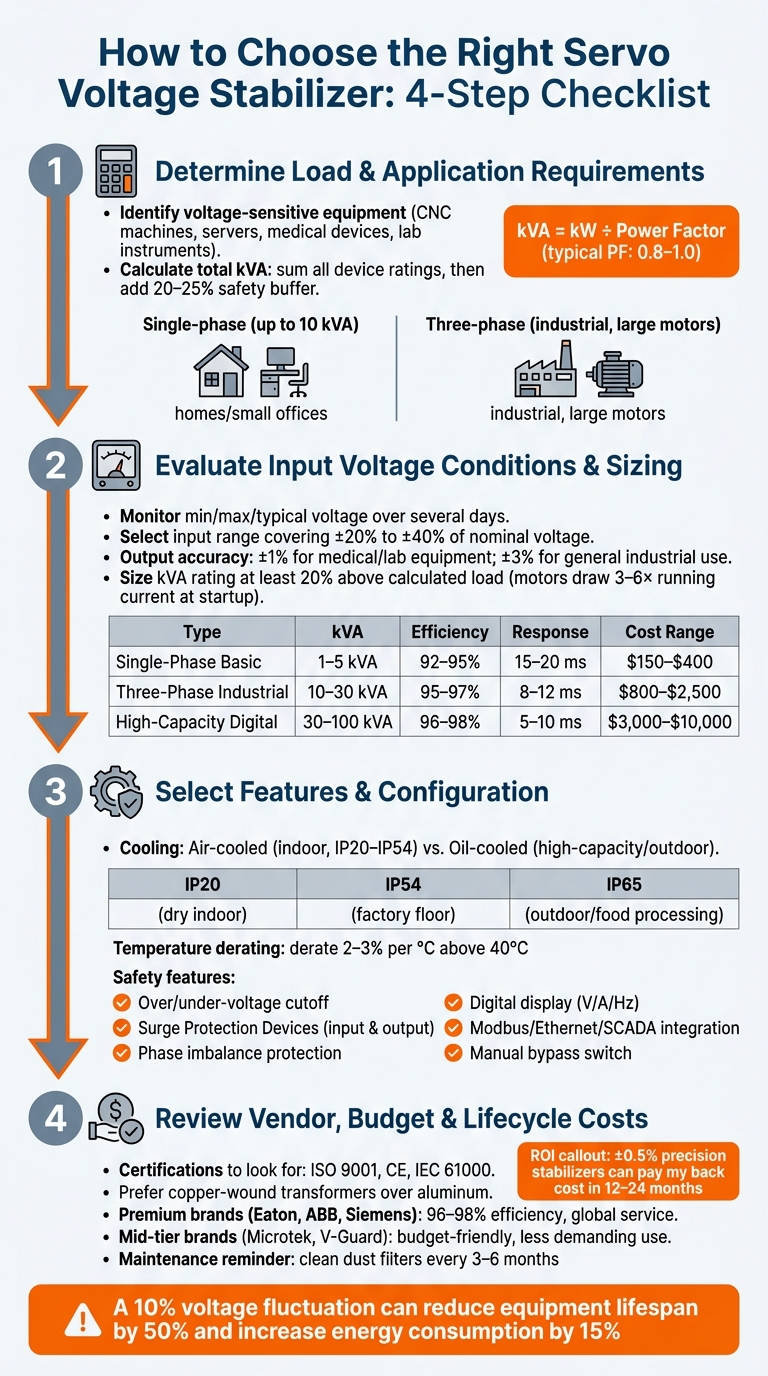
How to Choose the Right Servo Voltage Stabilizer: 4-Step Checklist
9 Things You Should Know Before #Buying Right #Servo #Stabilizer (English).
sbb-itb-501186b
Determine Load and Application Requirements
Choosing the right servo voltage stabilizer starts with a clear understanding of your load and application needs. Defining these requirements upfront will help you compare models effectively.
Identify Critical Loads and Applications
Not all equipment needs servo stabilization - focus on voltage-sensitive devices. Examples include CNC machines, medical imaging equipment, servers, laboratory instruments, and telecom infrastructure. In industrial environments like manufacturing plants or data centers, even brief voltage fluctuations can disrupt operations or damage equipment. Similarly, in areas prone to brownouts, appliances like HVAC systems, refrigerators, and home theater setups benefit from consistent voltage.
At this stage, decide whether you need stabilization for the entire facility or dedicated protection for specific devices. For example, stabilizing an entire floor or building requires a high-capacity centralized unit. On the other hand, protecting a single CNC machine or server rack might only need a smaller, dedicated stabilizer. Making the right choice here avoids unnecessary expenses while ensuring adequate protection.
Calculate Total Connected Load in kVA
Once you've identified critical equipment, calculate the total power demand. Start by checking the nameplate ratings on your devices, which typically list power consumption in watts (W), kilowatts (kW), or amps (A). If the rating is in kW, convert it to kVA using this formula:
kVA = kW ÷ Power Factor
Most devices operate with a power factor between 0.8 and 1.0. After calculating the kVA for each device, sum them up. Add a 20–25% safety buffer to the total to account for inrush currents. Skipping this step could lead to nuisance tripping or premature equipment failure.
Define Supply Type and Phase Configuration
Your power supply setup determines the type of stabilizer required. For loads up to 10 kVA, a single-phase unit is suitable for homes, small offices, or light commercial use. For larger industrial settings, three-phase units are essential. These are especially important for large motors or setups where unbalanced power can cause overheating or damage. To confirm your supply type, check your electrical panel or consult an electrician.
Evaluate Input Voltage Conditions and Sizing
Once you've determined your load requirements, the next step is analyzing the voltage conditions at your facility. This step ensures you choose a stabilizer that can handle your grid's fluctuations, avoiding issues like tripping or performance drops.
Measure Actual Voltage Fluctuations
Taking a single voltage reading won't give you the full picture. Instead, monitor and record the minimum, maximum, and typical voltages over several days. This data helps you understand the actual range of fluctuations and is critical for selecting a stabilizer that matches your needs.
Select Input Voltage Range and Correction Capability
Based on the voltage extremes you recorded, choose a stabilizer model with an input range that fully covers these variations. In the U.S., stabilizers typically handle fluctuations between ±20% and ±40% of the nominal voltage (120V for single-phase or 208/240V for three-phase systems). Additionally, consider the output accuracy your equipment requires. For example, high-precision devices like medical imaging systems or laboratory instruments often need ±1% accuracy, while most industrial equipment can operate within ±3% accuracy.
Choose kVA Rating and Safety Headroom
When selecting a kVA rating, aim for at least 20% above your calculated load. This extra capacity accounts for startup surges, which are common with inductive loads like motors, compressors, and HVAC systems. These devices can draw 3–6 times their running current during startup, and the safety margin helps protect sensitive equipment from potential damage.
Here’s a quick look at typical kVA ranges and costs:
| Model Type | kVA Range | Efficiency | Response Time | Approx. Price (USD) |
|---|---|---|---|---|
| Single-Phase Basic | 1–5 | 92–95% | 15–20 ms | $150–$400 |
| Three-Phase Industrial | 10–30 | 95–97% | 8–12 ms | $800–$2,500 |
| High-Capacity Digital | 30–100 | 96–98% | 5–10 ms | $3,000–$10,000 |
For loads exceeding 30 kVA, consider a professional electrical assessment. This ensures proper phase balancing and accurate system sizing.
Select Servo Stabilizer Features and Configurations
Once you've established your power requirements, it's time to focus on the features and configurations that will safeguard your equipment effectively.
Choose Phase Type and Configuration
Your choice of phase type depends entirely on the equipment you're powering. Single-phase stabilizers are designed to correct voltage on one 120V or 240V leg, making them ideal for smaller, isolated setups like office workstations, bench tools, or small appliances. On the other hand, three-phase stabilizers regulate all three lines, which is critical for industrial loads such as CNC spindles and conveyor drives. Without proper three-phase regulation, you risk neutral-point drift, which can lead to insulation failure and motor damage.
After determining the phase type, consider the cooling method and enclosure safety to match your operational environment.
Check Cooling Type and Enclosure Rating
For most indoor industrial applications, air-cooled stabilizers are the go-to option. They are lighter, easier to maintain, and typically paired with IP20 to IP54 enclosures. However, if you're dealing with high-capacity or outdoor applications where heat dissipation is more challenging, oil-cooled stabilizers are a better fit. Keep in mind that oil-cooled units require periodic oil checks, while air-cooled models need regular maintenance of fans and filters.
The enclosure rating is another critical factor, often overlooked by buyers. Here's a quick reference guide:
| IP Rating | Protection Level | Typical Use Case |
|---|---|---|
| IP20 | Indoor, dry | Control rooms, clean factory floors |
| IP54 | Dust-protected, water spray | Factory floors with washdown |
| IP65 | Dust-tight, water jets | Outdoor installations, food processing |
If your production floor operates at temperatures exceeding 104°F (40°C), forced-air convection cooling becomes essential. Standard stabilizers are typically rated for temperatures between -10°C and 45°C (14°F to 113°F). However, for every degree above 40°C, you should derate the stabilizer's capacity by 2–3%.
Finally, make sure to evaluate the protection and monitoring features to ensure the system's overall safety and reliability.
Review Protection and Monitoring Features
The reliability of your servo stabilizer heavily depends on its safety features. Look for models with an over/under-voltage cutoff, which continuously monitors phase voltage at millisecond intervals to shut down the system before damage occurs. Include Surge Protection Devices (SPDs) on both the input and output sides to protect against fast transients, such as those caused by lightning strikes. For three-phase systems, phase imbalance protection is critical to prevent hazardous neutral-point drift in unbalanced factory setups.
For added functionality, prioritize stabilizers with a digital display that provides real-time data on voltage, current, and frequency. Advanced models may also offer Modbus or Ethernet interfaces, allowing integration with SCADA systems - a valuable feature for managing multiple machines or accessing predictive maintenance data. Additionally, a manual bypass switch is indispensable, enabling you to take the stabilizer offline for servicing without interrupting power to your production line.
"A voltage fluctuation of just 10% can reduce equipment lifespan by 50% and increase energy consumption by 15%." - YIY Engineering Team
Review Vendor, Budget, and Lifecycle Costs
Once you've identified the features you need, the next step is finding a reliable vendor, securing the right price, and understanding the total cost of ownership over the unit's lifetime.
Check Vendor Reliability and Support
Servo stabilizers rely on components like servo motors, carbon brushes, and linkages - all of which require dependable vendor support. It's crucial to verify that the vendor stocks essential spare parts and provides quick technical assistance when needed.
Look for products with certifications such as ISO 9001, CE, and IEC 61000, and ask for factory test reports to confirm performance claims. Be cautious of unbranded units or vague claims like "zero delay" that lack supporting documentation. Prioritize units with copper-wound transformers instead of aluminum, as copper offers better heat dissipation and durability. Also, ensure the unit includes a manual bypass circuit for added reliability.
Premium brands like Eaton, ABB, and Siemens might have a higher upfront cost, but they often come with global service networks and efficiency ratings between 96% and 98%. For more budget-friendly options, mid-tier brands like Microtek and V-Guard are widely available and ideal for less demanding applications.
Once you've confirmed the vendor's reliability, it's time to evaluate both upfront costs and long-term expenses.
Compare Upfront Costs and Long-Term Expenses
The purchase price is just the beginning. Additional costs like installation, inspections, and periodic carbon brush replacements should also be factored in. Units with efficiency ratings above 95% can significantly reduce energy loss, saving money in the long run. While copper windings may cost more initially, they offer better durability and lower maintenance costs compared to aluminum. To maintain optimal performance, clean dust filters and vents every 3 to 6 months to prevent overheating and wear.
Balancing technical performance with cost ensures you get a stabilizer that delivers reliable power management over time.
Source Options on Electrical Trader
For a convenient way to compare models and balance specifications with your budget, visit Electrical Trader. This platform acts as a centralized marketplace for both new and used servo stabilizers, transformers, breakers, and other power distribution equipment. With clear pricing details, you can find a unit that meets your kVA requirements without breaking the bank.
Conclusion
A thoughtful process is key when choosing the right servo voltage stabilizer. This involves four essential steps: calculating your load, assessing voltage conditions, aligning stabilizer features with your specific needs, and evaluating vendor support.
Skipping any of these steps can lead to costly consequences. For instance, a mere 10% voltage fluctuation might slash equipment lifespan by half and increase energy usage by 15%. Proper sizing and configuration not only safeguard your equipment but also help control expenses.
Investing in a stabilizer with ±0.5% precision can pay off quickly, often covering its cost within 12–24 months in industrial environments.
When it comes to purchasing, Electrical Trader offers a wide range of options. You’ll find everything from basic single-phase models priced at $150–$500 to high-capacity three-phase systems exceeding $6,000 - all while ensuring seller reliability.
FAQs
How do I know if I need a facility-wide stabilizer or one per machine?
When deciding, take a close look at your equipment. If your facility uses machines with different voltage sensitivities or power requirements, it might make sense to go with individual stabilizers for each machine. On the other hand, if your facility operates under consistent voltage conditions and has uniform loads, a single stabilizer for the entire facility could simplify maintenance and cut down on costs. Ultimately, the choice hinges on the load characteristics and how sensitive your equipment is to voltage fluctuations.
What should I measure to pick the right input voltage range?
To determine the appropriate input voltage range, monitor the voltage levels at your location over several days, covering both peak and off-peak hours. Use a single-phase voltage recorder to log the minimum and maximum readings. This information will help you understand the range of voltage fluctuations. In the U.S., these fluctuations generally fall between ±5% and ±13% of the nominal voltage. Choosing a stabilizer that can accommodate these variations ensures reliable performance.
When should I choose an oil-cooled stabilizer instead of air-cooled?
For high-temperature environments or industrial settings with heavy power needs, an oil-cooled stabilizer is the way to go. These stabilizers can operate in ambient temperatures as high as +60°C, making them perfect for places like foundries, boiler rooms, or metal processing facilities. On the other hand, air-cooled stabilizers are a better fit for residential or light commercial applications, where temperatures stay moderate and cooling demands are lower.