

Why RCD Testing Matters for Workplace Safety
If an RCD or GFCI is not tested, I should not assume it will protect anyone. These devices can fail with no visible warning, and that can leave workers exposed to shock even when the device looks fine.
Here’s the short version:
- RCDs/GFCIs cut power during a ground fault
- Breakers do not do the same job
- Push-button checks help, but they are not enough
- Meter-based testing confirms trip speed and trip level
- High-risk job sites need more frequent testing
- Failed devices should be tagged out and removed from service
The reason this matters is simple. In the U.S., 1,474 workers died from exposure to electricity from 2014 to 2023. Older data also showed 2,267 electrical fatalities and 33,848 nonfatal injuries during a study period. That is why testing should be treated as a workplace safety control, not just a maintenance task.
What I take from this article is clear: the goal is not just to install protection, but to prove it still works. That means setting a schedule, testing based on risk, keeping records, and replacing failed units before they hurt someone.
What is RCD Testing + Why Is It Important? | The Local Guys Test & Tag
sbb-itb-501186b
The Problem: RCDs Can Fail Without Any Warning
A GFCI or RCD can look fine and still fail inside. That leaves workers exposed until a fault happens. The main issue isn't appearance. It's whether the device will still trip under fault conditions.
Failure Modes You Cannot See
A seized trip mechanism, welded contacts, or trip-threshold drift can keep the device from opening the circuit. Aging internal electronics and worn mechanical parts can lead to the same result over time.
Dust, vibration, moisture, and frequent handling speed up wear, especially on portable tools, extension cords, and temporary power setups.
A visual check can spot cracked housings or heat damage. But it can't tell you if the device will trip when it needs to. Only a functional trip test - and, where required, instrumented trip-time and trip-current testing - can confirm that the protection still works.
What Incident Data and Safety Guidance Show
Incident reviews point to the same pattern again and again: protection was missing, bypassed, defective, or never tested. In many cases, the failure isn't found until after something goes wrong unless testing catches it first.
Regulators and safety frameworks treat testing as part of electrical risk control, not as an extra maintenance task. A protective device only does its job if it has been checked and shown to operate within the required trip threshold and response time. Some frameworks also require a failed RCD to be removed from service once a defect is found.
That leads straight to the next step: a test program that checks trip function, records results, and removes failed units from service.
The Solution: How RCD Testing Works and What to Check
The gap between installation and actual protection is closed with routine checks and proper instrument testing. In practice, RCD testing has two parts: quick push-button checks and instrument testing done by a qualified electrician or test technician.
Push-Button Tests for Routine Functional Checks
The built-in TEST button on an RCD/GFCI creates an internal imbalance that acts like a ground fault. If the device is working, it should trip, cut power, and then allow power to be restored after the RESET button is pressed.
This is a fast function check that trained workers or facility staff can do on a set schedule. In higher-risk workplaces like construction sites, industrial facilities, and wet locations, monthly push-button tests are a solid baseline. In rough-use settings or where portable equipment is involved, daily or pre-shift checks may make more sense. In lower-risk places like offices, testing every 3 to 6 months is usually acceptable.
Here’s the key point: push-button tests show that the device operates. They do not confirm trip time or sensitivity. To know how the device is performing, that routine check needs to be backed up with instrument testing.
Trip-Time and Sensitivity Testing with a Calibrated Tester
Instrument-based testing uses a calibrated RCD/GFCI tester to apply a set residual current - often 10 mA or 30 mA, depending on the device rating - and then measure trip time in milliseconds. For a standard 30 mA personal-protection device, a common benchmark is tripping within 300 ms at rated residual current and within 40 ms at five times that current.
This kind of testing checks how the device holds up after years of wear, exposure to moisture, power surges, or mechanical damage. That matters because a device can look fine from the outside and still miss the mark when it counts.
Instrument testing should be done by a qualified electrician or test technician who can work safely on energized equipment, read the results correctly, and decide whether the device can stay in service or needs to be removed from service.
Once the testing is done, the next step is just as important: recording the results.
What Good Test Records Should Include
Documentation turns one-off test results into something you can actually use. A practical log entry should include:
- The unique device ID
- The location
- The device type and rating
- The test date
- The tester's name
- The result
- Any corrective action taken
- The next scheduled test date
A log with next-due dates helps move testing from reactive to planned, so devices don’t quietly slip past their testing window. It also helps to track repeated trip-time results over time. That way, you can spot gradual decline and replace devices before they fail. Records should be kept for several years for audits, inspections, and investigations.
Matching Testing Intervals to Your Work Environment
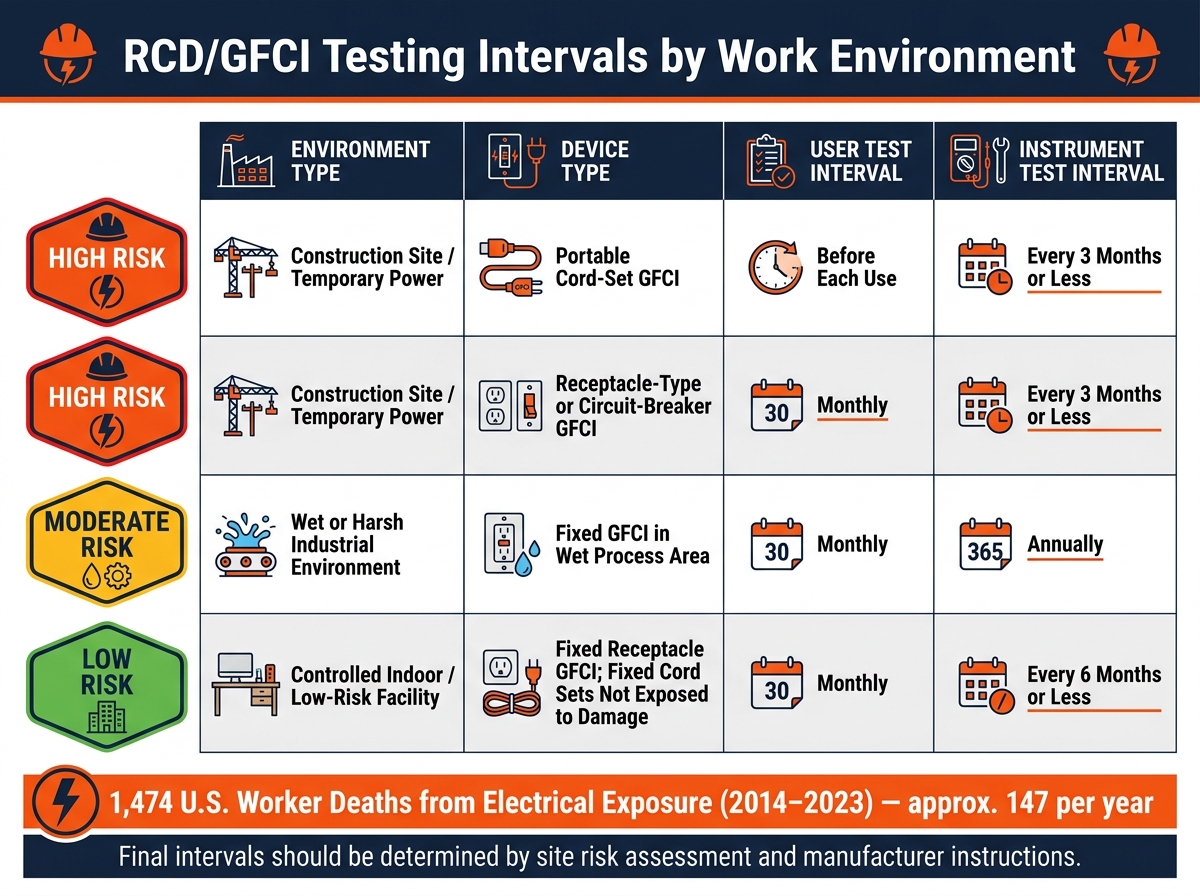
RCD/GFCI Testing Intervals by Work Environment
Testing intervals should get shorter as exposure goes up. That’s the core idea. Most failures don’t show obvious warning signs, so sticking to the schedule is what helps keep protection working when it’s needed.
Higher-Risk Environments Need Shorter Testing Cycles
Construction sites, manufacturing floors, outdoor power distribution setups, and temporary installations put GFCIs and RCDs through a lot. Cords get run over. Plugs loosen and wear down. Devices get wet. Equipment gets moved again and again. Over time, that kind of stress can hurt performance long before anything looks wrong.
For portable cord-set GFCIs used on job sites, OSHA construction guidance calls for testing before each use. For receptacle-type GFCIs and circuit-breaker GFCIs in these settings, monthly functional tests are the standard expectation. And under an assured equipment grounding conductor program, cord sets and receptacles that are not fixed and are exposed to damage must be tested at intervals not exceeding 3 months - with records kept on site.
This isn’t just box-checking. NIOSH FACE reports have linked fatalities to inoperative or untested GFCIs.
Office and Low-Risk Facilities Still Need Scheduled Testing
Lower-risk spaces don’t get a free pass. In offices, retail spaces, and controlled commercial areas, fixed GFCI receptacles should still get a monthly push-button test as a sound baseline. Instrument-based testing should also follow a written schedule, with someone clearly assigned to do it and documented results kept on file.
Testing Intervals by Environment: A Comparison
Use this table as a starting point. The final interval should come from the site risk assessment and the manufacturer’s instructions.
| Environment | Device Type | User Test Interval | Instrument Test Interval |
|---|---|---|---|
| Construction site / temporary power | Portable cord-set GFCI | Before each use | ≤ 3 months |
| Construction site / temporary power | Receptacle-type or circuit-breaker GFCI | Monthly | ≤ 3 months |
| Wet or harsh industrial environment | Fixed GFCI in a wet process area | Monthly | Annual instrument test with calibrated equipment |
| Controlled indoor / low-risk facility | Fixed receptacle GFCI; fixed cord sets and receptacles not exposed to damage | Monthly | ≤ 6 months |
Where no fixed schedule exists, use the documented site risk assessment. After that, the focus shifts to who owns missed tests and what happens when a device fails.
Building a Testing Program That Closes the Gap
Once testing intervals are set, the next step is simple: someone has to own the program, checks need to happen on schedule, and everyone needs to know what happens when a device fails. Without that, even a well-written plan can fall apart in day-to-day work.
Roles, Corrective Action, and Replacement Planning
Start with clear roles. Operators and nearby workers should handle push-button checks based on the site schedule. Qualified personnel should handle calibrated trip-time and sensitivity tests. A maintenance or safety coordinator should manage the records, track failures, and work with procurement when replacements are needed.
If a device fails a test - doesn't trip, trips too slowly, or shows too much leakage - the response can't be vague or delayed. Tag it out, remove it from service, and keep it out until it has been repaired or replaced and then retested. That process should be written down ahead of time and understood by everyone involved. No one should be making it up on the spot.
That plan also needs the basics in place: test tools on hand and replacement parts available when needed.
Where to Source Testers and Replacement Equipment
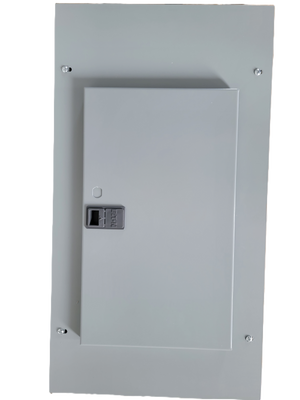
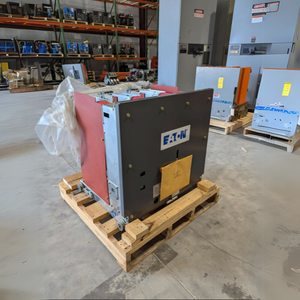
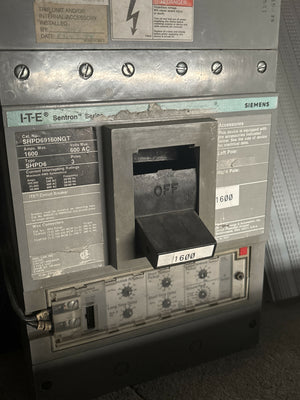
Keeping a testing program running means having the right gear ready when you need it. For most organizations, that includes handheld GFCI testers for routine functional checks, plus trip-time or trip-current instruments for deeper performance verification. And when devices fail - or when circuits are upgraded - you may also need replacement breakers, transformers, enclosures, and related equipment.
Electrical Trader offers new and used breakers, transformers, and power distribution equipment for maintenance and replacement planning.
Key Takeaways for Workplace Safety
The data below shows why this kind of discipline matters.
The main issue is that GFCIs and RCDs can fail with no visible warning. A device may look normal and even pass a push-button test, yet still disconnect too slowly to stay within safe shock exposure limits. That’s why instrument testing is needed to confirm actual protective performance.
From 2014 to 2023, 1,474 workers died from exposure to electricity in the U.S. - about 147 fatalities per year. A large share of those workers were in non-electrical occupations. A documented testing program based on the work setting turns the device from an assumed safeguard into a checked one.
FAQs
How do I know if an RCD needs instrument testing?
The built-in test button checks the RCD’s internal mechanical operation. But it does not measure the actual trip current or the response time.
To confirm that the device works to safety standards, instrument testing is required.
If the RCD does not trip during a routine button check, or if you need proof of performance for compliance, contact a licensed electrician for formal instrument testing.
Who is qualified to perform RCD testing at work?
In the United States, a licensed electrician should handle RCD or GFCI testing, especially if a device fails its routine test.
Facility operators or occupants can use the built-in test button every three to six months. But if there’s a problem, a qualified professional needs to step in to inspect the circuits, check grounding, deal with nuisance tripping, and confirm the system meets local electrical codes and safety standards.
What should we do right away if an RCD fails a test?
If an RCD fails to trip during a test, contact a licensed electrician right away to inspect the device and the electrical system. Don’t keep relying on a device that fails its safety check. It may not protect against electric shock or fire.
If you’re dealing with repeated nuisance tripping, that also calls for a professional inspection of the circuit and grounding system.