Impact of Poor Wiring on Circuit Breaker Performance
If a breaker keeps tripping, the wiring may be the problem - not the breaker. I’d sum it up this way: loose terminals, bad neutrals, wrong wire size, and GFCI/AFCI miswiring can cause false trips, missed trips, overheating, and early breaker damage.
Here’s the short version:
- Loose connections create heat. Research cited in the article shows terminal temperatures can go above 212°F even when load stays under the breaker rating.
- Bad wiring can fool you. A breaker may look “bad” when the fault is actually at the lug, neutral, grounding path, or conductor.
-
Different breakers react in different ways.
- AFCIs often trip on arc patterns from loose or damaged conductors.
- GFCIs can lose downstream protection if line and load are reversed.
- Standard thermal-magnetic breakers may not trip until heat or fault current gets high enough.
- Loose neutrals are a big risk. In an MWBC, a lost neutral can leave the breaker in place while connected equipment sees harmful voltage swings.
- Wrong wire size changes protection. A breaker that is too large for the conductor can let the wire overheat before it trips.
- Heat damage is not always inside the breaker. Charring, melted insulation, soot, or warped plastic near the terminal often points to a wiring fault.
- Testing should come first. I’d check thermal images, torque, voltage drop, visual damage, and insulation resistance before replacing the breaker.
A few numbers make the point clear:
- 84% of AFCI-related service calls in one 2025 ESFI survey were tied to actual arc-faults, not breaker failure.
- 32% of issues in a 2022 ESFI survey involved poor GFCI protection.
- A neutral fault with 2 ohms of resistance at 30 amps can produce 1,800 watts of heat at one connection point.
- The article also cites 23,700 electrical fault-related fires in 2023.
If I had to reduce the whole article to one takeaway, it would be this: don’t replace the breaker until the wiring has been checked first. That is the main step that helps separate a failed device from a bad connection, a sizing error, or a wiring defect that is still sitting in the circuit.
How to Troubleshoot Electrical Wiring Problems When Your Circuit Breaker Trips
sbb-itb-501186b
Wiring Defects Most Often Linked to Breaker Problems
Field reports keep pointing to the same trouble spots: loose terminations, mismatched hardware, and older conductors that drive up resistance and heat. Poor connections are identified as a leading cause of electrical fires in the United States. That matters because these faults don’t just make things run hot. They also affect contact pressure and can change how a breaker trips.
Loose Connections, Arcing, and Overheating at Breaker Terminals
A loose lug increases contact resistance, which creates heat that may not trip a standard breaker. As resistance goes up, the extra heat speeds oxidation and can damage the lug, insulation, and nearby plastic parts.
The installation mistakes behind this are usually pretty simple:
- Under-torquing the connection
- Landing conductors with strands outside the lug
- Cross-threading set screws
Hardware mismatches can also shrink the contact area, create hot spots, and lead to terminal damage or even phase-to-phase faults.
When checking the area, look for charring, discoloration, warped plastic, soot, and burned insulation near the terminal. Those signs usually point to terminal damage, not an internal breaker failure.
Aging Conductors That Raise Failure Rates
Older aluminum conductors can relax during thermal cycling, which reduces clamp force and increases resistance. Once clamp force drops, resistance rises with it, and that can lead to nuisance trips or breakers that won’t reset.
These wiring defects also affect the way breakers trip, especially AFCIs, GFCIs, and thermal-magnetic units.
How Miswiring Affects Trip Behavior by Breaker Type
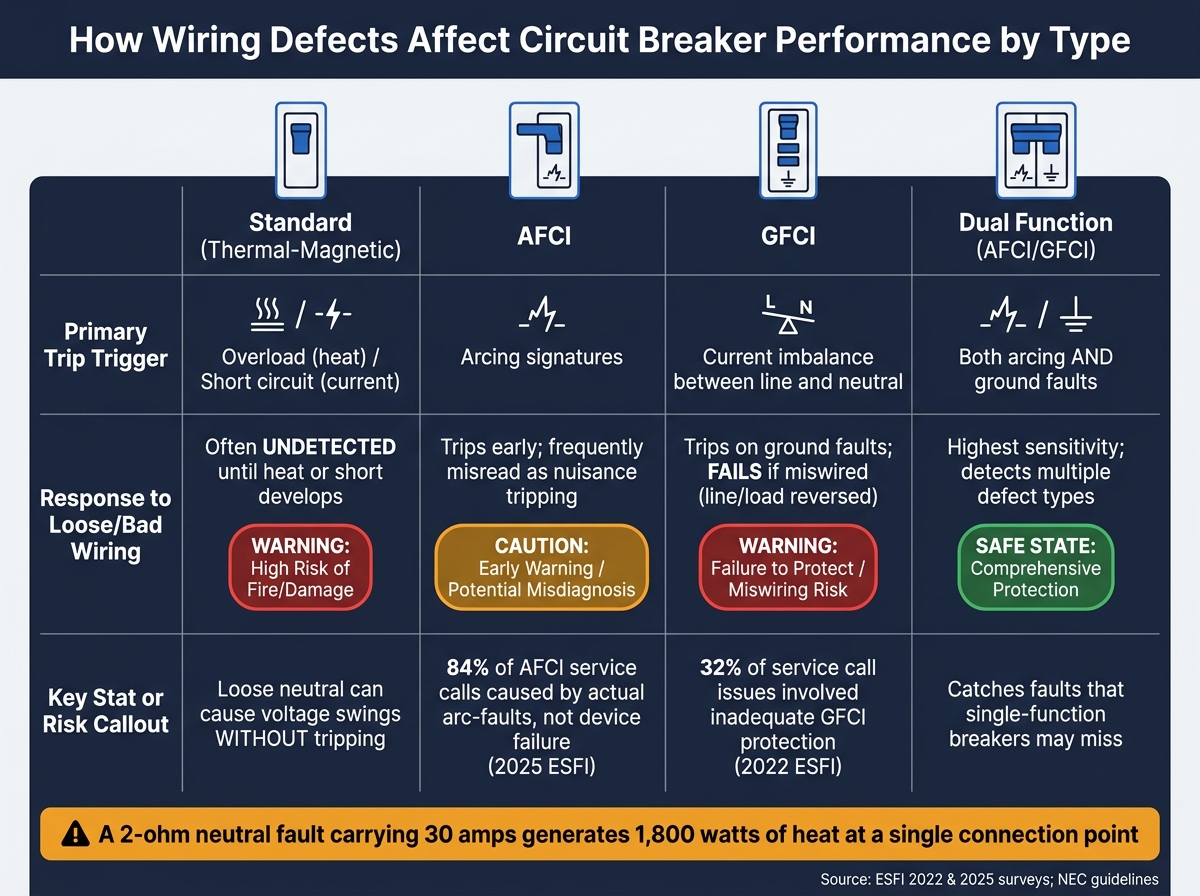
How Wiring Defects Affect Circuit Breaker Performance by Type
Different breakers reveal wiring faults in different ways. AFCIs tend to trip when they detect arcing. GFCIs can lose downstream protection if line and load are reversed. And thermal-magnetic breakers may not react until a fault creates enough heat or current to trip them.
So the same wiring mistake can look like a bad breaker in one panel, yet stay hidden in another.
AFCI Trips Caused by Loose or Damaged Conductors
AFCIs are built to detect arcing patterns. That means loose terminations, worn conductors, or damaged connectors can set them off. In some cases, those faults cause trips that people brush off as “nuisance” trips. In other cases, the bad connection can hide a more serious arc fault.
In a 2025 ESFI survey of electrical contractors in Georgia and South Carolina, 84% of AFCI-related service calls were caused by actual arc-faults, not device failure.
GFCI Line-Load Miswiring and Lost Protection
A line-load reversal can be sneaky. The GFCI may still look normal and even seem to work at first glance, but downstream receptacles can lose protection.
A 2022 ESFI survey found that inadequate GFCI protection accounted for 32% of the issues identified during service calls. That’s why checking the wiring layout matters so much. A face-button test by itself doesn’t always tell the whole story.
Thermal-Magnetic Breakers Under Loose Neutrals and Undersized Conductors
Standard breakers trip in two main ways:
- The thermal part reacts to heat from an overload
- The magnetic part reacts to a sudden surge of current from a short circuit
Because of that, loose neutrals may cause voltage swings without causing an immediate trip. Undersized conductors can also run hotter than they should, which may lead to earlier trips than expected.
| Breaker Type | Primary Trip Trigger | Response to a Loose Connection |
|---|---|---|
| Standard (Thermal-Magnetic) | Overload (heat) / Short circuit (current) | Often undetected until heat or short develops |
| AFCI | Arcing signatures | Trips early; frequently misread as nuisance tripping |
| GFCI | Current imbalance between line and neutral | Trips on ground faults; fails if miswired |
| Dual Function (AFCI/GFCI) | Both arcing and ground faults | Highest sensitivity; detects multiple defect types |
These differences matter when an inspection points back to the wiring rather than the breaker itself. The next step is sorting out whether the fault comes from grounding, bonding, or conductor sizing.
Grounding, Bonding, and Conductor Sizing Errors That Change Breaker Response
Loose terminations are only part of the story. Grounding, bonding, and conductor sizing also decide whether a breaker clears a fault the way it should. When grounding or bonding is wrong, the fault-current path changes. That can lead to slow clearing, nuisance trips, or no trip at all.
Loose Neutrals, Double-Lugged Neutrals, and Voltage Instability
A loose neutral can be just as dangerous as a loose hot conductor. It carries the same heat risk, and a bad neutral connection adds impedance to the circuit. That extra impedance can slow down overcurrent protection during a fault - or stop it from operating when it should.
Double-lugging is another common problem. That means putting two neutral wires under one lug. NEC 408.41 has banned this since 2002, and UL 67 never allowed it in the first place. Over time, thermal cycling reduces clamp force, the connection loosens, and the result can be arcing plus loss of the grounded conductor.
In multi-wire branch circuits (MWBCs), a loose or lost neutral creates a different kind of danger. Connected equipment can see hazardous overvoltage even while the breaker looks fine and stays in place. So the breaker can seem normal while electronics and appliances take the hit.
The heat buildup can get ugly fast. A defective neutral connection with only 2 ohms of resistance carrying 30 amps produces 1,800 watts of heat right at the connection point. That is space-heater-level heat concentrated in one small spot.
Improper neutral-to-ground bonding adds another failure path. Neutral current can end up on the equipment-grounding conductor, which may trigger nuisance ground-fault trips. In other cases, fault current returns through the neutral and bypasses the breaker trip mechanism, which can lead to a missed trip.
Sizing mistakes create a different problem altogether: the breaker stays closed while the conductor gets too hot.
Undersized Conductors, Trip Curves, and Coordination Problems
If a breaker is rated above the conductor's ampacity, the wire can heat past its insulation limit before the breaker trips. NEC 240.4(D) sets firm maximums for small copper conductors:
- 15 amps for 14 AWG
- 20 amps for 12 AWG
- 30 amps for 10 AWG
When undersized conductors overheat again and again, they don't just damage insulation. They also shorten the life of the breaker and its terminals.
Temperature makes this even tougher. Ampacity drops as ambient temperature goes up. For example, 14 AWG NM-B cable rated at 15 amps under normal conditions falls to about 12 amps in an attic at 122°F (50°C). In that case, a standard 15-amp breaker may not give enough protection.
Trip-curve mismatch can also cause trouble. Put a fast-trip breaker on a motor feeder, and startup inrush may trip it for no good reason. Put a time-delay curve on a lighting circuit, and an actual fault may clear too slowly - or not soon enough to limit damage. And if selectivity is poor, a branch-circuit fault can trip the main breaker and shut down the whole panel.
These errors tend to show up in predictable ways:
| Wiring/Sizing Error | Typical Breaker Symptom | Safety/Reliability Consequence |
|---|---|---|
| Oversized breaker | Fails to trip during overload | Cable insulation melts; high fire risk |
| Undersized conductor | Breaker stays closed while wire overheats | Insulation fire inside walls; melted terminals |
| High-impedance grounding | Delayed trip clearing time | Increased shock hazard and equipment damage |
| 90°C wire on 75°C lugs | No trip until terminal failure | Terminal overheating and connection failure |
| Mismatched trip curve | Nuisance trip or delayed trip | Unsafe fault duration or operational downtime |
| Poor coordination | Main breaker trips on branch fault | Total building blackout; loss of critical systems |
What the Research Means for Inspection, Testing, and Replacement Decisions
When a breaker keeps tripping and the pattern points to wiring, test the circuit before you swap the breaker. Start by checking the load, the ambient temperature, and the terminations. A hot enclosure, a loose connection, or an overloaded conductor can make a properly rated breaker trip sooner than it should.
Tests That Help Separate Wiring Faults from Breaker Failure
Start with thermal imaging, then verify what you find with torque and voltage-drop testing.
Infrared thermography is one of the best ways to spot loose or corroded terminations while the circuit is energized. It works best when the circuit is under load, ideally at 40% or more of rated capacity. A hotspot centered at a lug usually signals a connection issue. By contrast, more even heating across the breaker body lines up more with overload-related heating.
If the heat is centered at the lug, fix the connection. If the breaker body shows damage, replace the breaker. When thermal imaging points to a terminal, follow up with a torque check after de-energizing. Use a calibrated torque tool and tighten to the manufacturer's specs.
A millivolt drop test can also help sort out whether the issue is internal breaker resistance or a loose external lug. Run it energized and under load. Poor connections may also show voltage drops in the range of 3 V to 25 V.
| Test Method | What It Finds | When to Run It |
|---|---|---|
| IR Thermography | Loose or corroded terminations | Energized, ideally ≥40% load |
| Millivolt Drop | Internal contact resistance | Energized, under load |
| Torque Check | Loose mechanical connections | De-energized |
| Megger (Insulation Resistance) | Insulation or dielectric damage | De-energized |
| Visual Inspection | Charring, pitting, carbon tracking, "bull's eye" burn patterns | De-energized |
If an inspection shows visible charring, pitting, melted polymer, or carbon tracking on the breaker body, replace the whole unit. Heat can damage the breaker's dielectric properties and clearances even when the trip mechanism still seems to work. And if a terminal has been overheated for a long time, simply tightening it may not fix the problem. Long-term heat can weaken the terminal enough that replacement is the safer move.
After any repair or replacement, run an insulation resistance test before re-energizing. That extra check helps confirm that both the wiring and the breaker are safe to put back into service.
Conclusion: Poor Wiring Reduces Reliability, Safety, and Breaker Life
Loose terminations, miswiring, and overheating can all look like breaker failure. Poor contact can create glowing connections that exceed 2,192°F (1,200°C), and the U.S. Fire Administration reported 23,700 electrical fault-related fires in 2023. In many cases, the breaker is just the last line of protection. If the wiring issue stays in place, the next breaker will likely end up in the same situation.
Inspection, torque checks, thermal scanning, and post-repair testing are what separate a bad termination from a true breaker failure. They also form the basis of safer, more dependable electrical systems.
FAQs
Why would a good breaker keep tripping?
A good circuit breaker can keep tripping for a simple reason: it’s doing its job.
In many cases, the breaker itself isn’t bad. It’s reacting to a problem somewhere else in the circuit.
Common causes include circuit overloads, high ambient temperatures, and wiring issues like loose connections, damaged insulation, or wires that are too small for the load. In some cases, an AFCI breaker may trip because it detects an arc fault or a neutral imbalance. Older breakers can also drift out of calibration over time.
Can bad wiring damage a breaker over time?
Yes. Bad wiring can wear out a circuit breaker over time.
Loose connections add resistance, and resistance makes heat. That heat can melt insulation, char terminals, and put extra strain on the breaker’s internal parts.
Wiring that’s the wrong size or insulation that’s breaking down can also keep the breaker under thermal stress. Over time, that can lead to nuisance trips or weak fault response.
If you notice heat damage, discoloration, or repeated trips under normal loads, replace the breaker and have the connections professionally torqued.
What should be tested before replacing a breaker?
Before replacing a breaker, make sure the breaker is the problem, not the wiring or something plugged into the circuit. A simple first step is to unplug the devices on that circuit and see if the breaker still trips.
Also check the panel for loose connections, discoloration, or signs of overheating. Pros may go a step further and test voltage at the line and load terminals, verify torque, and use infrared thermal imaging to find hotspots.