

Troubleshooting Circuit Breaker Failures
When a circuit breaker trips, it’s protecting your home from unsafe electrical conditions. Frequent tripping, overheating, or a breaker that won’t reset are signs of potential issues like circuit overloads, short circuits, or internal damage. Addressing these problems quickly can prevent fires and costly repairs. Here’s what you need to know:
- Safety First: Always turn off power, use insulated tools, and verify circuits are de-energized before working.
-
Common Issues:
- Frequent Tripping: Often caused by overloads or short circuits. Look for burn marks, smells, or buzzing sounds.
- Overheating: Check for loose connections or excessive loads. Breakers should not exceed 140°F.
- Reset Failures: Persistent tripping may indicate a short circuit, ground fault, or a faulty breaker.
- When to Replace: Signs include scorch marks, loose handles, or breakers older than 30–40 years.
- Call a Professional: If you notice burning smells, buzzing, or persistent faults, hire an electrician.
Tip: Avoid overloading circuits and schedule regular inspections to ensure your electrical system is safe. For replacements, match the breaker’s brand, model, and rating.
How To Troubleshoot Circuit Breaker Tripping & Testing
sbb-itb-501186b
Safety Steps Before Starting
Handling circuit breakers without proper precautions can lead to serious injuries. Before working on your electrical panel, follow these crucial safety steps to protect yourself and your home.
Turn Off Power and Isolate the Circuit
Begin by turning off all lights and unplugging devices connected to the circuit you're working on. This helps prevent power surges when resetting the breaker. Locate your main electrical panel, often found in a garage, basement, or utility room, and open the panel door.
Look for the tripped breaker - it will either be in the center (intermediate) position or fully in the OFF position. Some modern breakers have a red or orange indicator flag to show they’ve tripped. To isolate the circuit, flip its breaker to OFF. If you need to cut power to the entire house, turn off the main breaker instead.
"Stand to the side of the panel and, if possible, use one hand only (not touching the panel with your other hand or leaning on something grounded) as you flip the switch back. This stance is a precaution electricians use, if there's a spark or flash, you minimize the risk of injury."
When operating switches, avoid standing directly in front of the panel. Position yourself to the side and use only one hand to flip the breaker, reducing the risk of completing an electrical circuit with your body. Once the breaker is off, take additional precautions by using proper safety gear.
Wear Proper Safety Gear
The right protective gear can make all the difference. Insulated gloves, safety goggles, and rubber-soled shoes help protect against electric shocks and flying debris. Use tools with insulated handles when working near wires or electrical components.
"To prevent shock, wear safety glasses, make sure your hands are dry, stand to the side, and stand on a dry surface when resetting a circuit breaker."
Moisture increases the risk of shock, so ensure your hands are dry and the area is free of dampness. If conditions are wet, pause and wait for everything to dry before proceeding. Always double-check that the circuit is de-energized before touching anything.
Confirm No Electricity is Present
Never assume the power is off - verify it. Use a non-contact voltage tester (NCVT) or a multimeter to confirm no electricity is flowing. An NCVT is a quick and convenient tool that detects voltage through insulation without direct contact.
For a more thorough check, set your multimeter to AC voltage and test the outlet or breaker terminals. A reading of zero volts confirms the circuit is de-energized. Always test your voltage tester on a live circuit before and after use to confirm it's working properly.
If you notice signs like burn marks, a burning plastic smell, buzzing or hissing sounds, or if the breaker trips immediately after being reset, stop what you're doing and call a licensed electrician. These are signs of serious electrical faults that require professional expertise. By completing these safety steps, you’re ready to safely address circuit breaker issues.
Common Circuit Breaker Problems
Once you've ensured safety precautions are in place, it’s important to recognize common circuit breaker issues to guide your troubleshooting. Circuit breakers often trip due to three main reasons: an overload, a short circuit (including ground faults), or an arc fault. Identifying the specific problem can help you resolve it more efficiently and safely.
Frequent Tripping
Frequent tripping is often tied to a circuit overload. This happens when the electrical demand exceeds the circuit's capacity, which is typically 15–20 amps. For example, running multiple high-powered appliances at once can easily overload the circuit and trip the breaker. Short circuits are another common cause, occurring when hot and neutral wires come into contact, leading to an immediate surge that trips the breaker. Signs of a short circuit include burn marks, discolored outlets, or a noticeable burning smell.
"If you find that your breaker keeps tripping right when you turn it on, you have a short circuit causing the problem."
Ground faults are a specific type of short circuit that occur when a hot wire touches a ground wire or a grounded metal box, often in areas with higher moisture levels like kitchens or bathrooms. Another potential issue is an arc fault, which happens when electricity sparks between damaged or corroded wires. Arc faults are particularly dangerous because they increase the risk of electrical fires. Each year, electrical fires are responsible for over $1.3 billion in damages, underscoring the importance of identifying and addressing these faults. In addition to tripping, circuit breakers under continuous strain may begin to overheat.
Breaker Overheating
An overheating breaker can be identified by its excessive heat, a burning plastic smell, or a buzzing noise. Loose connections at the terminals or an improperly seated breaker are common culprits. These issues increase electrical resistance and, in turn, generate heat. In some cases, simply reseating the breaker securely can fix the problem.
Continuous overload is another cause of overheating. Running a circuit near its maximum capacity for extended periods puts undue strain on the breaker. According to the National Electrical Code, continuous loads should not exceed 80% of the breaker's rating. For instance, a 15-amp circuit should ideally handle no more than 12 amps on a regular basis.
Circuit breakers are generally designed to operate in ambient temperatures up to 90°F, though internal components can reach up to 185°F during normal use. If the surface temperature of the breaker exceeds 140°F, it’s a clear sign of overheating.
"A breaker that is carrying a significant load but is failing to 'trip' or shut off may make a loud sound and should be repaired or replaced in order to prevent an overheated circuit."
- Relectric
Over time, arcing within the breaker can degrade its internal components, increasing resistance and heat. While most breakers are built to last 30 to 40 years under optimal conditions, visible damage or wear may indicate it’s time for a replacement . Identifying these overheating symptoms can help you decide whether reseating or replacing the breaker is necessary. Another common issue to watch for is a breaker that refuses to reset.
Failure to Reset
If a breaker won’t stay in the "ON" position, the issue could be mechanical or electrical. Sometimes, the breaker trips into a middle position and requires a hard reset. To do this, push the handle firmly to the "OFF" position until you hear a click, then switch it back to "ON" . A loose or unresponsive handle could indicate internal spring or contact damage .
Persistent overloads or faults are another reason a breaker might not reset. Unplug all appliances connected to the circuit. If the breaker stays on with no load, an overload was likely the cause. However, if it trips immediately after being reset, a short circuit or ground fault is probably to blame .
"If a breaker trips instantly when flipped on, there is likely a short somewhere. If, however, the breaker takes time to trip (a few seconds to a minute or more), then there is excess heat being built up, and the breaker is 'thermal tripping.'"
- Dustin Stelzer, Licensed Electrician, Dodec Electric
Internal failure could also be the root of the problem. Look for white, chalky corrosion around the screw terminals or signs of rodent damage to the wiring . To determine if the breaker itself is faulty, disconnect its wire (with the power off), cap it safely, and attempt to reset it. If the breaker still won’t stay on, it likely needs replacement. Mechanical or internal issues often require replacing the breaker, making accurate diagnosis a key step in effective troubleshooting.
How to Troubleshoot Circuit Breakers
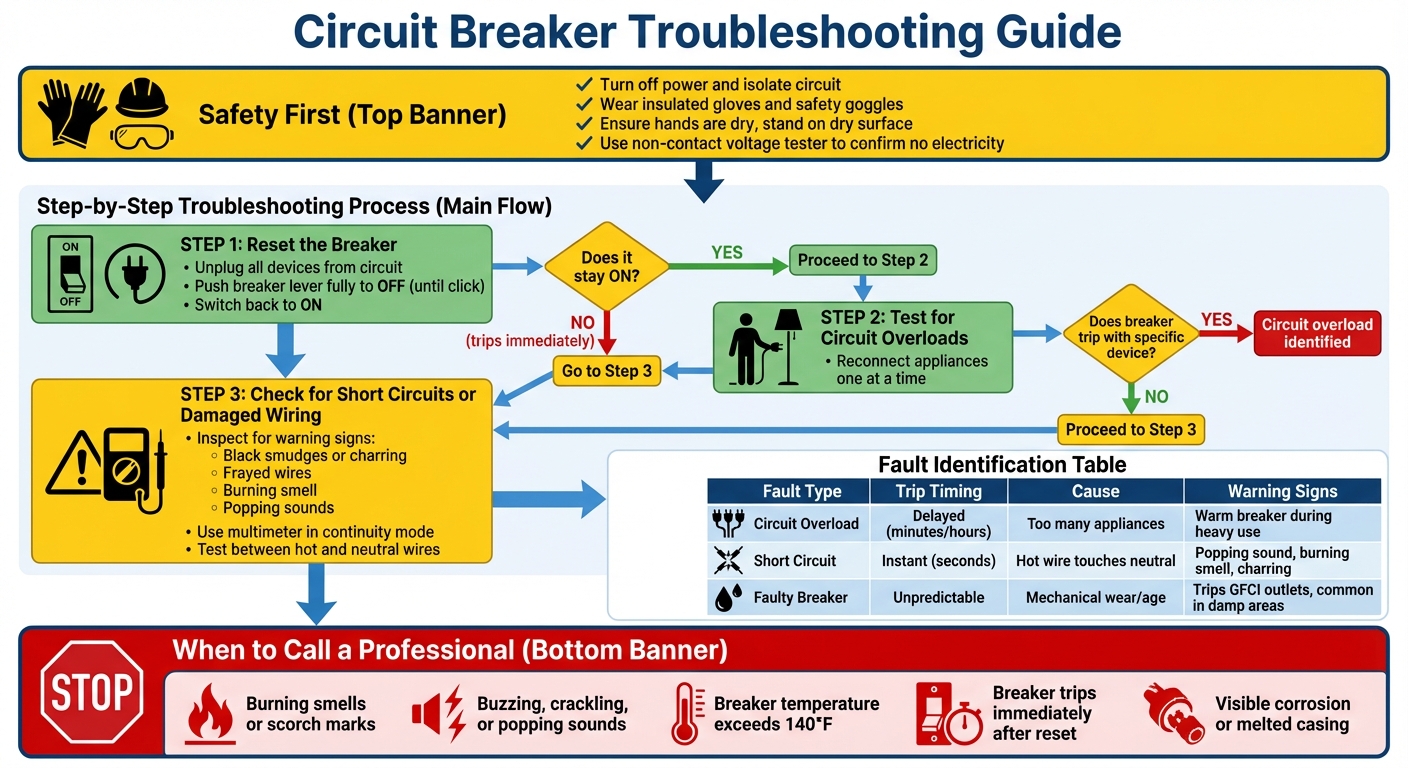
Circuit Breaker Troubleshooting Safety Steps and Common Problems Guide
When dealing with issues like tripping, overheating, or reset failures in circuit breakers, a step-by-step troubleshooting method can help determine if the root cause is an overload, a short circuit, or a faulty breaker.
Reset the Breaker
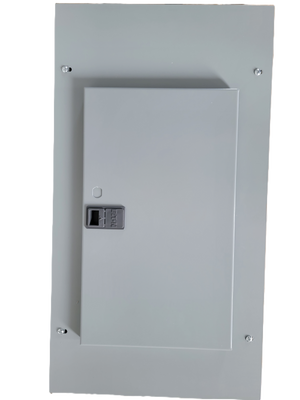
Begin by unplugging all devices connected to the affected circuit to avoid immediate re-tripping or a power surge. Locate your electrical service panel - usually a gray metal box found in basements, garages, or utility rooms - and identify the tripped breaker. It may be in the "OFF" position, a neutral middle position, or show a red or orange indicator.
To reset, push the lever fully to the "OFF" position until you hear a click, then switch it back to "ON." A properly reset breaker will stay in place with a clear click. If it immediately trips back to "OFF", there’s likely a persistent fault, such as a short circuit.
"Never force a breaker to stay on. It's trying to protect you - listen to it."
Always ensure your hands are dry and the surface is not damp when performing this task.
Test for Circuit Overloads
If the breaker resets successfully, check for circuit overloads. Reconnect appliances one at a time to determine if any specific device causes the breaker to trip. If the breaker trips only when certain appliances are plugged in, an overload is the likely culprit.
High-wattage devices like space heaters, microwaves, or hair dryers are common triggers, especially when used at the same time. While a breaker may feel warm under heavy use, it should not become hot. If you hear buzzing or sizzling sounds after resetting, this could indicate an overload or arcing. Turn off the breaker immediately and contact a professional.
Check for Short Circuits or Damaged Wiring
If no overload is found, the issue might be a short circuit or faulty wiring. If the breaker trips instantly with no devices connected, inspect for signs like black smudges, charring on outlets, frayed wires, flickering lights, or a burning smell. A short circuit often produces a popping sound.
Use a multimeter in continuity mode to test between the hot and neutral wires. A near-zero resistance reading points to a short circuit. Ground faults - caused when a hot wire touches a ground wire or metal box - are especially common in damp areas like kitchens or bathrooms and can trip GFCI outlets. If you notice damaged wiring, scorch marks, or if the breaker feels unusually hot or emits a burnt plastic smell, stop troubleshooting and call a licensed electrician. These are signs of serious issues that require professional attention.
| Fault Type | Timing | Cause | Common Signs |
|---|---|---|---|
| Circuit Overload | Delayed (minutes/hours) | Too many appliances | Warm breaker during heavy use |
| Short Circuit | Instant (seconds) | Hot wire touches neutral | Popping sound, burning smell, charring |
| Ground Fault | Instant (seconds) | Hot wire touches ground | Trips GFCI outlets, common in damp areas |
| Faulty Breaker | Unpredictable | Mechanical wear/age | Breaker feels loose or won’t stay "ON" |
When to Replace a Circuit Breaker
If resetting a circuit breaker doesn’t solve the problem, it might be time to replace it.
Signs of a Faulty Breaker
A breaker that won’t stay on after being reset is a clear sign of trouble. If the handle feels loose or doesn’t click into place, it’s likely that the internal parts are worn out. Typically, standard breakers last about 30–40 years, while GFCI and AFCI breakers have a shorter lifespan of 15–20 years.
Physical damage is another warning sign. Scorch marks, melted casings, discoloration, or corrosion on the contacts are all red flags. If the breaker feels excessively hot - over 140°F - or emits a burning smell, it’s likely failing internally. According to the Electrical Safety Foundation International (ESFI), electrical malfunctions lead to around 51,000 structure fires annually in the U.S., causing over $1.3 billion in property damage.
Other symptoms include flickering lights on a particular circuit, appliances shutting off unexpectedly, or buzzing and crackling noises coming from the panel. Older panels, especially those that haven’t been serviced in 10 to 15 years, are more prone to issues. Panels from legacy brands like Federal Pacific Electric, Zinsco, or Challenger are particularly risky, with documented failure rates exceeding 25%.
If these signs are present, replace the breaker with one that matches the original specifications.
Where to Buy Replacement Breakers
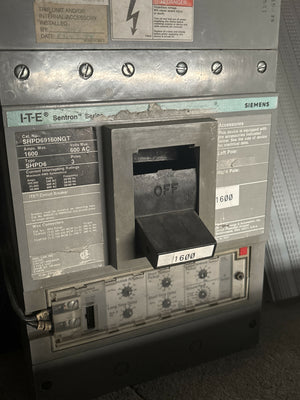
When replacing a breaker, it’s crucial to match the brand, model, and amperage rating of the original unit to ensure safety and compatibility. Most residential circuits use 15-amp or 20-amp breakers, but always verify the label on your existing breaker for specifics, including the voltage rating and type of fault protection (Standard, GFCI, or AFCI).
For replacements, Electrical Trader (https://electricaltrader.com) is a reliable source. They offer a wide range of new and used circuit breakers from major brands like Eaton/Cutler-Hammer, Square D, Siemens, and General Electric. The platform also stocks options for obsolete models. If your manufacturer is no longer supported, consider UL-listed "Classified Breakers" from brands like Eaton. These breakers are designed to be compatible with over 750 different load centers from various manufacturers.
When to Call a Professional Electrician
There are times when electrical issues go beyond the scope of DIY fixes, and that's when calling a professional becomes essential.
If a circuit breaker trips immediately after being reset, it could point to a serious short circuit or wiring issue that requires expert attention. Repeatedly resetting a tripping breaker isn't just ineffective - it can be dangerous. As Oohmage explains:
"Repeatedly resetting a tripping breaker increases risk every single time you do it. It may restore power for a moment, but it also allows stress, heat, and fault energy back into a system that has already signaled something is wrong."
- Oohmage
Complex or Persistent Problems
Certain signs should immediately prompt you to call a licensed electrician. These include burning smells, scorch marks, buzzing sounds, or a breaker that's hot to the touch or making crackling or popping noises. Continuing to use circuits with these issues can be extremely hazardous.
Homes equipped with older electrical panels from brands like Federal Pacific Electric, Zinsco, Pushmatic, or Challenger should also be inspected by a professional. These panels are notorious for failing to trip during power surges, posing a fire risk. Similarly, if your home was built before 1960 or has aluminum wiring, an inspection is a smart move to ensure everything meets modern safety standards.
Professional electricians bring specialized tools to the table, such as infrared scanners to detect hidden heat behind walls and insulation testers for spotting corroded wires - equipment most homeowners don’t have. A diagnostic visit typically costs between $75 and $150, though this fee is often credited toward repairs. For reference, replacing a single breaker costs between $150 and $300, while installing a dedicated circuit for high-demand appliances can range from $250 to $900.
Staying Code-Compliant
Beyond fixing problems, a professional ensures that all electrical work complies with current safety codes.
Major projects like panel replacements, dedicated circuit installations, or whole-house rewiring must adhere to National Electrical Code (NEC) standards and local regulations. Licensed electricians ensure proper grounding, secure connections, and balanced electrical loads - all of which are vital for maintaining your homeowners' insurance coverage. Data suggests that 65.7% of electrical upgrades involve improving existing systems rather than simple repairs.
If you're planning to add an EV charger, install a hot tub, or upgrade from 100-amp to 200-amp service, a licensed electrician can handle the permits and inspections required for the job. On average, panel replacements cost around $1,230, while rewiring an entire house can range from $1,500 to $10,000.
Conclusion
Before diving into troubleshooting, make sure to follow all safety measures: work in dry conditions, unplug appliances before resetting, and always switch the breaker fully to "OFF" before turning it back to "ON". If the breaker trips immediately after resetting, it could point to a short circuit or ground fault that needs professional attention. On the other hand, if it trips after some time, the issue is likely an overloaded circuit. These steps provide a solid foundation for diagnosing the problem.
Pay close attention to warning signs like buzzing sounds, burning smells, scorch marks, or overheating (above 140°F/60°C). These are serious indicators of potential electrical failure that should be addressed immediately.
For ongoing safety and efficiency, managing your electrical usage wisely is key. Avoid overloading a single circuit by distributing high-wattage appliances - such as space heaters or hair dryers - across multiple circuits. Installing dedicated circuits for energy-intensive devices like HVAC systems or EV chargers can also help. This typically costs between $250 and $900. Additionally, scheduling a professional inspection every 3 to 5 years can catch aging components or loose connections before they become serious problems.
If you need to replace a breaker, consider using Electrical Trader to find reliable, compatible components and the right tools for a safe installation.
Taking care of breaker issues promptly is more than just a matter of convenience - it’s about ensuring the safety of your home and loved ones. Routine maintenance and professional checkups are your strongest safeguards against electrical hazards.
FAQs
How can I tell if it’s an overload or a short?
An overload happens when the breaker trips after running for a while, usually because too many devices are drawing power at the same time. On the other hand, a short circuit causes an immediate trip. This often occurs if a hot wire comes into contact with a neutral wire or if the wiring is damaged. Pay attention to these patterns to pinpoint the problem.
Why does my breaker feel hot but not trip?
A breaker can feel hot without tripping for a couple of reasons. Poor connections might be causing electrical resistance, which generates heat. Alternatively, the breaker could be operating within its designed temperature range without being overloaded. However, a hot breaker might also signal a fault that requires replacement. If this problem continues, it's best to consult a licensed electrician to ensure your electrical system is safe and working correctly.
How do I pick the exact replacement breaker?
To find the right replacement breaker, start by identifying the type and specifications of your existing one. Look inside your electrical panel for any labels or diagrams that outline the breaker's type, amperage, and voltage.
Next, carefully remove the old breaker and check for markings on it. These markings will usually indicate the model, brand, and ratings. It's crucial to match these specifications exactly to ensure both compatibility and safety.
When you're ready to buy, stick with a trusted supplier, such as Electrical Trader, to guarantee quality and reliability.