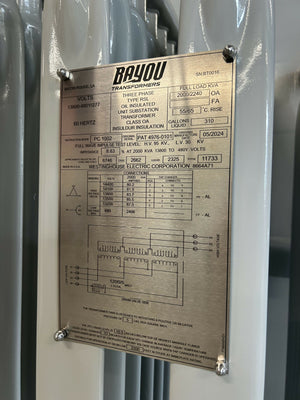
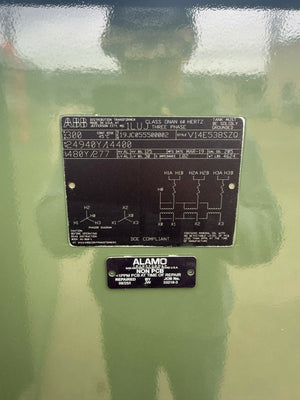
PCB Testing for Old Transformers: Guide
If an old oil-filled transformer does not have clear PCB records, I would test it before I move it, sell it, repair it, or scrap it. In the U.S., the lab result puts the unit into one of 3 groups: under 50 ppm, 50 to 499 ppm, or 500 ppm and up. That single number affects service, storage, shipping, sale paperwork, and disposal rules.
Here’s the short version:
- Made before 07/02/1979 with no records? I would treat it as a PCB risk and test it.
- Nameplate missing or unreadable? I would assume a high-risk status until lab results say otherwise.
- Under 50 ppm: keep, store, or sell it as non-PCB.
- 50 to 499 ppm: manage it as PCB-contaminated and use tighter controls.
- 500 ppm or more: mark it, store it under TSCA PCB rules, and plan for approved disposal.
- Screening kits can help, but I would use an accredited lab for any final call, near-cutoff result, sale, or disposal decision.
A few numbers stand out. Field kits often use action levels at 20 ppm, 50 ppm, and 500 ppm. Testing may cost about $500 to $5,000 for many distribution units and $5,000 to $30,000 for larger power transformers. That cost is small next to a bad classification.
What I like about this guide is its simple path:
- Decide if testing is needed
- Take a clean oil sample
- Read the lab report the right way
- Act based on the ppm result
If you just want the answer: test first, keep the paperwork, then let the ppm result tell you what to do next.
Step 1: Decide Whether the Transformer Needs Testing
Situations That Call for PCB Testing
Use the thresholds and risk factors above to decide if the transformer needs PCB lab testing. If the PCB status isn't documented, test it first. That applies to any unit being taken out of service, moved to a new location, or getting ready for sale or disposal.
Some situations carry more risk. If a unit is going to oil reprocessing, retrofill, or repairs that involve shared oil-handling equipment, test it before any work starts. That helps prevent cross-contamination. And if the transformer is headed for disposal, the PCB result decides which disposal path applies.
The good news: testing costs are usually manageable. Oil testing for a distribution transformer often costs $500 to $5,000. Full testing and evaluation for larger power transformers usually falls between $5,000 and $30,000. By comparison, getting the classification wrong and handling a PCB transformer the wrong way can cost a lot more.
Field Screening Kits vs. Accredited Lab Analysis
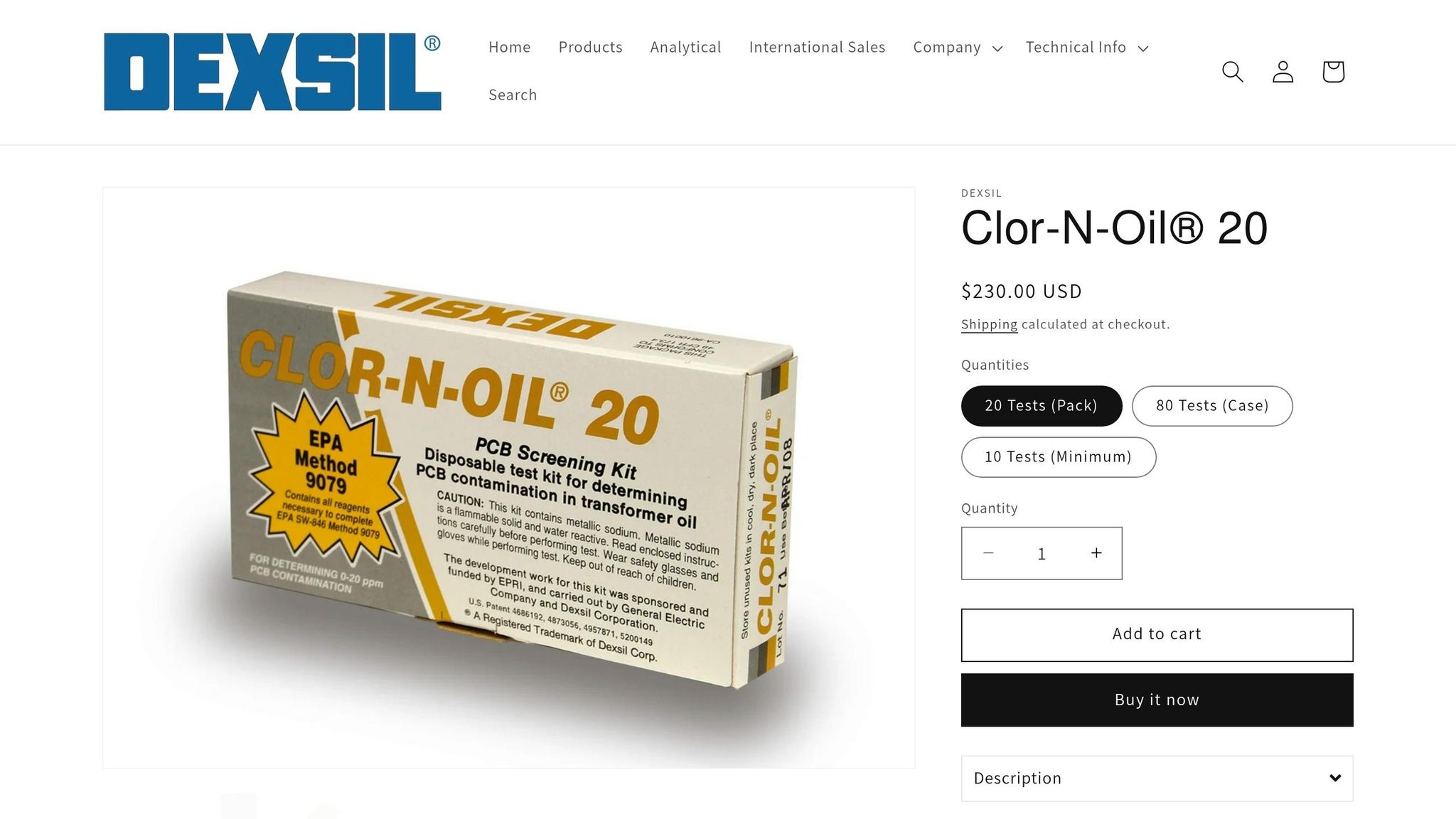
Field screening kits can give you a fast read on-site. For example, Clor-N-Oil uses action levels of 20, 50, and 500 ppm. That makes these kits useful for quick triage.
But speed isn't the same as a final answer. If the result lands near the 50 ppm cutoff, or if you get any positive result, confirm it with an accredited laboratory. Lab analysis using methods such as EPA SW-846 Method 8082A, ASTM D4059, or IEC 61619 gives you a documented ppm concentration you can use for regulatory and commercial decisions.
Why PCB Test Records Matter Before a Sale
A lab report takes a unit from "suspected" to documented. That's a big deal in a sale. Buyers looking at an older oil-filled transformer need to know its PCB status before they move forward, because that classification affects how the unit can be handled, shipped, stored, and installed after purchase.
For Electrical Trader listings, a current lab report can cut down on buyer questions and help the sale move with less friction. A result below 50 ppm gives many buyers the paperwork they want and makes the unit easier to assess.
Keep these records in the equipment file:
- The lab report
- The chain-of-custody form
- Sampling notes
If testing is required, the next step is collecting a representative oil sample without contaminating it.
sbb-itb-501186b
Step 2: Collect and Handle Transformer Oil Samples Safely
PPE, Lockout/Tagout, and Pre-Sampling Preparation
De-energize the transformer before you take a sample. Apply lockout/tagout at every isolation point, then verify zero voltage with a properly rated meter. Ground the equipment and follow grounding procedures for medium- and high-voltage units.
Wear oil-resistant gloves, safety glasses or a face shield, non-melting long sleeves and pants, and safety footwear. Add arc-flash PPE based on the incident energy analysis.
Before you touch the valve, set out everything you need:
- Clean, PCB-free sample bottles
- Disposable tubing or a glass sampler
- Labels
- Absorbent pads
- A waste container for purge oil and oily rags
Having the setup ready cuts down time at the equipment and lowers the risk of spills or contamination.
How to Draw a Representative Oil Sample
Once the site is secured, collect a sample that reflects the oil in the unit. Start by identifying the transformer by nameplate, asset ID, or tag number, and match it to the work order and lab form. Record the location, date, time, time zone, and sampler name or initials. Note whether the unit was energized, its approximate load, and any faults, leaks, or recent maintenance.
Clean the valve area, then purge stagnant oil into a waste container before taking the sample. Collect the oil only after flow is steady and bubble-free. Keep the bottle upright, avoid touching the bottle neck to metal, and use clean tubing or a clean sampler. Record the oil temperature, operating condition, and approximate load.
Sample Storage, Shipping, and Chain of Custody
Cap the bottle right away, check it for leaks, and place it in a sealed secondary container. Keep samples separate, and don't reuse tubing or contact surfaces between transformers.
Store samples upright in a cool, dry, shaded place. Ship them promptly to an ISO/IEC 17025-accredited laboratory using tracked overnight or two-day shipping.
Document every custody transfer. List the sample ID, transformer ID, collection date and time, sampler name, and requested PCB analysis. Each handoff, whether during packaging, with the courier, or at lab receipt, should include names, dates, and times. That record supports use of the result for service, storage, sale, or disposal decisions.
Once the lab receives the sample, use the report to confirm the PCB concentration and decide the next step.
Introduction of the Clor-N-Oil Test Kits
Step 3: Read the Lab Report and Determine the Right Action
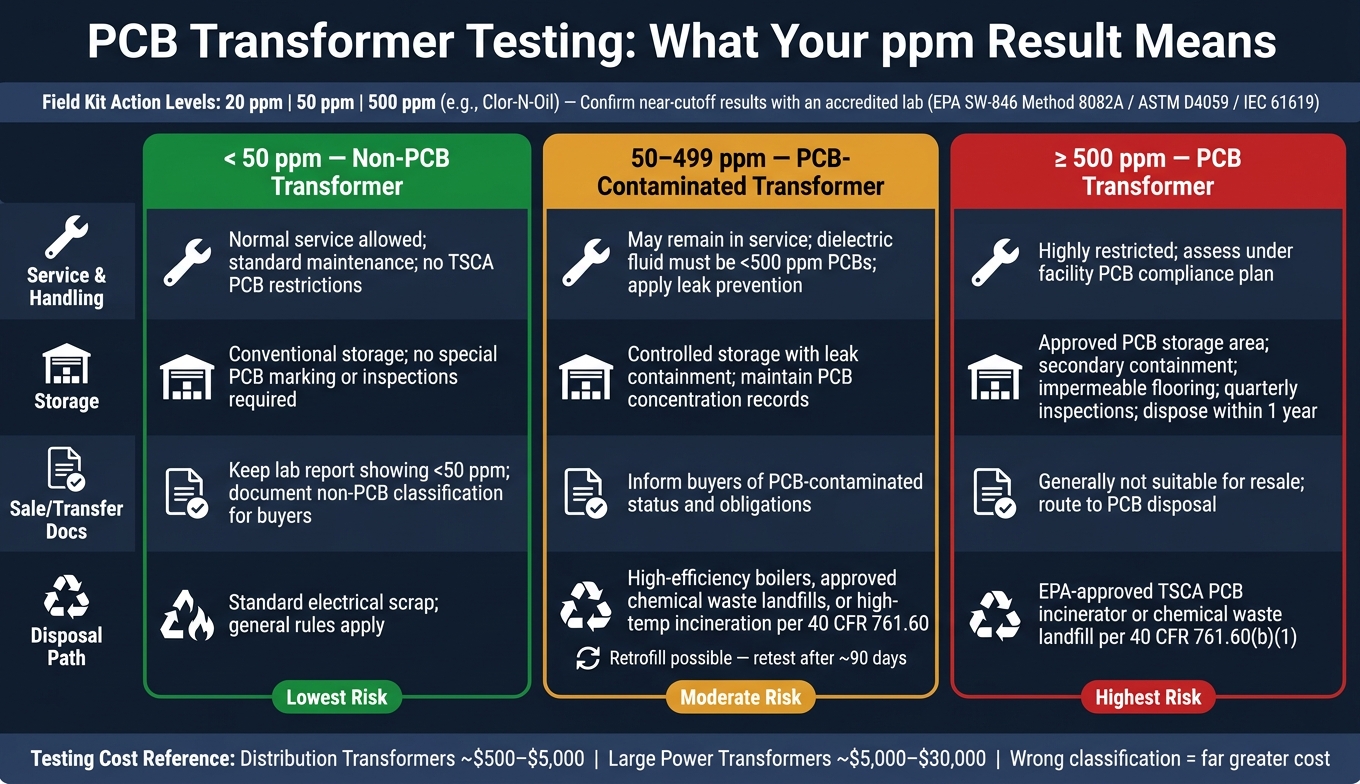
PCB Transformer Testing: 3-Tier Action Guide by ppm Level
Key Fields to Check on a PCB Lab Report
Once sampling is done, the lab report is what turns field notes into a compliance call. Before you focus on the ppm result, make sure the sample details and test method check out.
Start with the sample ID and transformer ID. They should match the chain-of-custody form exactly. If those details are off, the result may not belong to the unit you think it does.
Next, look at the fluid type. The report should make it clear whether the sample came from mineral oil or another dielectric fluid. That matters because fluid type helps you apply the right PCB assumptions and category.
Then check the analytical method and reporting limit. GC-ECD is a standard PCB method. And here's the part that trips people up: a non-detect does not mean the transformer is below 50 ppm unless the reporting limit is well under that cutoff. Use a lab that reports below 50 ppm.
You should also review calibration and QC flags. Estimated values, matrix interference, or similar flags can add uncertainty to the result. That becomes a bigger issue when the number lands close to 50 ppm or 500 ppm. If anything looks inconsistent, retest before making a service or disposal call.
How ppm Results Affect Service, Storage, and Disposal Decisions
Under TSCA, transformer status depends on PCB concentration. The result isn't just a number on paper. It affects whether the unit can stay in service, how it must be stored, what you need to tell a buyer, and how it must be disposed of.
PCB Action Table by Concentration Range
| PCB Concentration | Transformer Category | Service & Handling | Storage | Sale/Transfer Documentation | Disposal Path |
|---|---|---|---|---|---|
| < 50 ppm | Non-PCB Transformer | Normal service; standard maintenance; not subject to TSCA PCB use or storage restrictions | Store as conventional equipment; no special PCB marking or inspections required | Keep the lab report showing < 50 ppm and document non-PCB classification for buyers | Standard electrical scrap; general rules apply |
| 50–499 ppm | PCB-Contaminated Transformer | May remain in service; use only dielectric fluid < 500 ppm PCBs; apply controlled handling and leak prevention | Controlled storage areas with leak containment; maintain PCB concentration records | Inform buyers of PCB-contaminated status and obligations | Fluids via high-efficiency boilers, approved chemical waste landfills, or high-temperature incineration per 40 CFR 761.60 |
| ≥ 500 ppm | PCB Transformer | Highly restricted; assess continued operation under the facility's PCB compliance plan | Approved PCB storage area with secondary containment, impermeable flooring, and quarterly inspections | Generally not suitable for resale; route to PCB disposal | EPA-approved TSCA PCB incinerator or chemical waste landfill per 40 CFR 761.60(b)(1) |
After the result is confirmed, the concentration range drives the next step. A transformer can be reclassified as non-PCB only if compliant retesting shows less than 50 ppm and the lab reporting limit is also below 50 ppm.
Next Steps After Testing: Service, Storage, Sale, or Disposal
Once the lab confirms the ppm level, the path is pretty clear: keep the unit, control it, or take it out of service.
If the Transformer Tests Below 50 ppm
If the result is below 50 ppm, treat the transformer as non-PCB. That means it can stay in service, sit in storage for reuse, or be sold as used equipment. PCB storage-for-disposal rules do not apply.
Keep the original lab report and chain-of-custody record with the transformer's asset file. That way, if the unit is moved, transferred, or sold later, its PCB status is easy to prove. It also helps to add a durable label and a CMMS note like "Non-PCB (<50 ppm)" along with the test date and lab name.
If you're selling the transformer, include the PCB result, sampling date, and lab name in the listing. On Electrical Trader, that paperwork gives buyers a clear record for compliance and for their own files.
If the Transformer Tests at 50 to 499 ppm or 500 ppm and Above
If the transformer tests at 50 to 499 ppm, it is considered PCB-contaminated. In many cases, it can still remain in use, but the rules get tighter. Label the unit as PCB-contaminated, add it to a PCB equipment register, and inspect it on a regular basis for leaks. Any servicing fluid used must contain less than 500 ppm PCBs.
One common option is retrofill. That means draining the unit, refilling it with a compatible fluid, running it, and then retesting after about 90 days. Done right, this can bring PCB levels down by a large margin.
At that point, the ppm number starts to matter a lot more. Higher readings leave you with fewer options.
If the transformer tests at 500 ppm or above, use becomes highly restricted, and the unit should move into a removal plan. If disposal can't happen right away, store it in a TSCA-compliant PCB storage area with labeling, secondary containment, and 30-day inspections. Disposal must then be finished within one year using an approved incinerator, chemical waste landfill, or another EPA-approved method.
The test result doesn't just sit on paper. It tells you what happens next.
Conclusion: Test First, Document Results, Then Act
For older oil-filled transformers, the order is simple: test first, document the result, then act. Keep below-50 ppm units in service or sell them with the report. Manage 50 to 499 ppm units under PCB controls or as part of a retrofill plan. Remove units at 500 ppm and above through compliant disposal. If you're creating a resale listing on Electrical Trader, attach the test report.
FAQs
Do dry-type transformers need PCB testing?
No. Dry-type transformers do not need PCB testing.
PCB testing applies to oil-filled units because PCBs were once used in transformer dielectric fluids. Dry-type transformers use solid or resin-based insulation instead of liquid cooling media, so they do not contain the oil linked to PCB contamination.
Can a transformer test above 50 ppm after a retrofill?
Yes. A transformer can still test above 50 ppm after a retrofill.
Retrofilling is meant to lower PCB levels, but a result above 50 ppm still calls for specialized handling. At that level, the unit does not meet the usual regulatory threshold for non-PCB status, so PCB-specific management or disposal rules still apply.
How often should older transformers be retested?
Retesting depends on the transformer’s condition and the environment it runs in. In most cases, utilities and plant teams test units every 3 to 5 years as part of routine maintenance. Older transformers usually need checks more often, since wear can build up slowly and stay hidden until it turns into a bigger issue.
For oil-related testing, dielectric strength is usually checked once a year. DGA is also often done annually for stable units. But for older transformers, or units under stress, testing may move to every 3 to 6 months. The right schedule comes down to a few practical factors: the transformer’s age, the conditions around it, and its maintenance history.