Overcurrent Protection: Role of Fuses
A fuse helps stop wire damage and fire by opening the circuit when current gets too high. In this article, I explain the main job of a fuse, how it handles overloads, short circuits, and ground faults, and why correct sizing matters under U.S. code.
If I had to boil the whole piece down, it would be this:
- Too much current means too much heat
- A fuse cuts power before that heat damages wires or equipment
- Fuse type matters: fast-acting and time-delay fuses do different jobs
- Ratings matter: amp, voltage, and interrupting rating all have to fit the circuit
- Code matters: NEC Article 240 sets basic rules for conductor protection
- Maintenance matters: the wrong replacement fuse can create a fire risk
A few hard numbers stand out:
- Small branch-circuit conductor limits include 14 AWG copper at 15 A, 12 AWG copper at 20 A, and 10 AWG copper at 30 A
- Motor inrush can reach 6 to 8 times full-load current
- Some current-limiting fuses are rated for 200 kA or 300 kA interrupting capacity, while a common NEC minimum benchmark is 10,000 A
What I like about this topic is how direct it is. A fuse is simple in concept, but the details decide whether it protects the circuit or leaves it exposed. Pick the wrong class, oversize it, or replace it with the wrong part, and the protection can fail when you need it most.
So this article is not just about what a fuse is. It is about how fuses cut fault energy, how code rules affect selection, and how inspection and replacement keep that protection in place.
How Fuses Work and Why They Are Effective
Melting, Arcing, and Circuit Interruption
A fuse stops dangerous heat by melting its internal element fast. Inside the insulated body, a fusible element sits in place and stays isolated from the rest of the circuit. That element is shaped so it melts at a predictable current level. The terminals and body help with a low-resistance connection, physical support, and resistance to heat.
When overcurrent hits, the fusible element heats up and melts, which opens the circuit. As the element pulls apart, an electrical arc can form. That’s why the fuse body has to contain the arc and clear the maximum available fault current safely. If the arc weren’t contained, the fault could keep acting like a steady heat source.
After the fuse operates, you have to replace it.
Inverse Time Action and Motor Inrush
This same setup also helps fuses tell the difference between normal startup current and an actual fault. Put simply, fuses open faster when current goes higher. Time-delay fuses can handle normal motor inrush, but they still clear a fault that lasts too long.
sbb-itb-501186b
How does overcurrent protection work?
Main Fuse Types and Where They Are Used
Fuse Types Compared: Class, Response, Use & Fire-Safety Role
Common U.S. Fuse Classes for Branch, Motor, and Transformer Protection
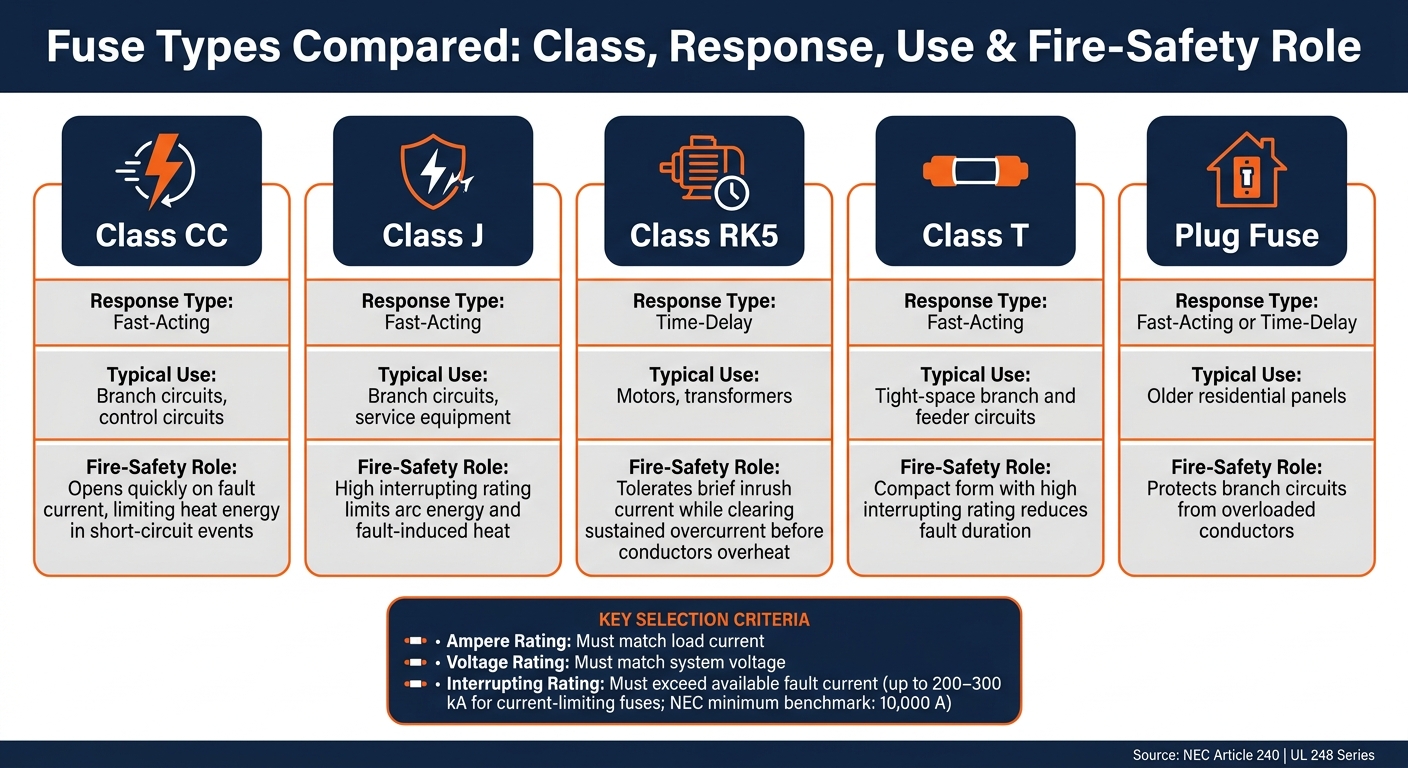
Now that we’ve covered how a fuse works, the next step is picking the right fuse class for the job. In U.S. installations, that usually means plug fuses in older residential panels or cartridge fuses such as CC, J, RK5, and T for branch, motor, and transformer protection.
The big difference comes down to fast-acting versus time-delay response. Fast-acting fuses are used for sensitive electronics and other loads that need immediate interruption. Time-delay fuses are a better fit for motors and transformers because they can ride through normal startup current without opening. That split begins with the fuse class and its response curve.
In homes, branch fuses protect outlet, lighting, and appliance circuits, which helps cut fire risk from overloaded branch circuits. For motors and transformers, the fuse has to do two things at once: allow normal starting current and still open before long-lasting overcurrent can overheat cables or damage insulation. That’s the balancing act. The right class clears faults fast enough to limit heat, without making the protection too large for the circuit.
When choosing a fuse, the main checks are simple:
- Ampere rating: must match the load current
- Voltage rating: must match the system voltage
- Interrupting rating: must be high enough for the available fault current
Fuse Type Comparison: Ratings, Response, and Fire-Safety Role
| Fuse class / characteristic | Response type | Typical use | Fire-safety role |
|---|---|---|---|
| Class CC | Fast-acting | Branch circuits, control circuits | Opens quickly on fault current, limiting heat energy in short-circuit events |
| Class J | Fast-acting | Branch circuits, service equipment | High interrupting rating limits arc energy and fault-induced heat |
| Class RK5 | Time-delay | Motors, transformers | Tolerates brief inrush current while clearing sustained overcurrent before conductors overheat |
| Class T | Fast-acting | Tight-space branch and feeder circuits | Compact form with high interrupting rating reduces fault duration |
| Plug fuse | Fast-acting or time-delay | Older residential panels | Protects branch circuits from overloaded conductors |
Those ratings are the starting point for code-compliant sizing and coordination.
Code Requirements, Selection, and Coordination
NEC Article 240 and UL Requirements That Affect Fuse Selection
Once you've picked the right fuse class, the next job is making sure the fuse fits the code limits, the conductor, and the fault current available at that point in the system.
Fuse selection starts with conductor ampacity, load type, and available fault current under NEC Article 240. After temperature and bundling adjustments, the fuse rating generally can't be higher than the corrected conductor ampacity.
Some branch-circuit conductor limits are fixed and leave no room to go up a size:
- 14 AWG copper: 15 A
- 12 AWG copper: 20 A
- 10 AWG copper: 30 A
For larger conductors rated 800 A or less, NEC allows the next higher standard rating in limited cases. Above 800 A, the overcurrent device has to match conductor ampacity directly. NEC also requires overcurrent protection in each ungrounded conductor, usually where the conductors get their supply, with only limited tap-rule exceptions.
UL marking matters too. Fuses should be UL-listed, usually under the UL 248 series for low-voltage use, and marked with their voltage rating, interrupting rating, and time-delay traits. That listing shows the fuse was tested to interrupt its rated fault current safely.
Still, a marking on the label doesn't solve the whole problem. The fuse also has to match the load and the conductor it protects.
| NEC / UL Topic | Key Rule | Design Implication |
|---|---|---|
| Conductor protection | Fuse rating must align with conductor ampacity after corrections | Helps prevent overheating and fire |
| Small conductors | 14 AWG Cu 15 A, 12 AWG Cu 20 A, 10 AWG Cu 30 A | No next-size-up option |
| Standard ratings and 800 A rule | Use standard fuse ratings; next higher permitted only in limited cases at 800 A or less | Large feeders require direct ampacity matching |
| Ungrounded conductors | Protection is required in each ungrounded conductor near the supply point | Affects fuse placement and enclosure selection |
| Interrupting rating and UL listing | Fuse interrupting rating must cover available fault current | Verify fault level and fuse markings before energizing |
Sizing Fuses for Conductors, Motors, and Transformers
For continuous loads, NEC uses 125% of load current when selecting the overcurrent device. That means the fuse has to carry the adjusted load without nuisance opening while still protecting the conductor from sustained overload heating.
Motor circuits are a different animal. Startup inrush can hit 6–8 times full-load current, so NEC permits higher fuse ratings for short-circuit and ground-fault protection than you'd use for many other loads. In plain terms, the fuse has to ride through startup without opening every time the motor kicks on. That's why time-delay fuses are commonly used for motor inrush, with separate overload protection handling running overloads.
Transformer protection follows NEC Article 450 and Table 450.3(B). Primary and secondary fuse limits are set there, and the fuse should be sized to tolerate transformer energization while still clearing sustained faults.
Interrupting rating is non-negotiable. If the fuse's interrupting rating is below the available fault current at the installation point, the fuse can fail catastrophically during a fault and create both fire and personnel hazards. Check the interrupting rating against the available fault current before energizing.
Correct sizing is only one piece of the job. After that, you need the right device to open first when something goes wrong.
Selective Coordination With Upstream Breakers and Downstream Devices
Selective coordination means the protective device closest to the fault clears first, so the rest of the system stays energized. Without it, a fault on one branch can open a larger upstream device and shut down more of the system than needed. That matters a lot in life-safety and standby systems, where NEC requires coordination. It also helps keep fault heat and downtime confined to the smallest part of the system.
Fuses often have an edge here because many fuse families come with manufacturer selectivity tables. In some cases, a 2:1 ampere ratio between upstream and downstream fuses of the same class can achieve coordination. Current-limiting fuses also reduce let-through energy, which can make coordination easier.
| Coordination Scenario | Typical Approach | Safety Impact |
|---|---|---|
| Fuse-to-fuse (same class) | Use manufacturer selectivity tables and an appropriate ampere ratio | Limits fault energy to the affected branch |
| Fuse upstream of breaker | Compare time-current characteristics for the available fault current | Helps keep the upstream device from opening first |
| Emergency / healthcare systems | Review coordination across the full circuit path | Reduces unnecessary outages in life-safety loads |
The review shouldn't stop at two devices sitting next to each other on a one-line. It should cover the full circuit path, from the utility service entrance down to the last branch-circuit fuse. Manufacturer selectivity tables can speed up the check, but more involved systems and life-safety loads still call for a formal short-circuit and coordination study.
Fuse Maintenance and Procurement for Fire-Safe Installations
Inspection, Replacement, and Common Errors to Avoid
Once you've picked and coordinated the right fuse, maintenance is what keeps that protection working. A fuse can't do its job if inspections are skipped or replacements get sloppy. Use an NFPA 70B-based inspection program, with annual visual checks as the starting point and more frequent checks in harsh environments.
During each inspection, look for:
- Discoloration
- Cracks
- Corrosion
- Contamination
- Loose clips
- Heat damage
Also check that terminations are tight and free of corrosion. Infrared thermography can help spot overheating at fuse terminals before it turns into a bigger issue. Hot spots at fuse clips are a strong sign of loose connections and a higher fire risk.
If a fuse blows, replace it with the same:
- Voltage rating
- Current rating
- Interrupting rating
- Time-delay characteristic
- Class
Rejection fuseholders help stop mix-ups, but they don't replace label checks.
A few mistakes can create problems fast. Don't oversize a fuse just to stop nuisance trips. Don't swap a current-limiting fuse for a non-current-limiting fuse without engineering review. And don't use a fuse with a voltage rating that's too low.
Label each fuse enclosure with the correct type and rating. Then log every replacement with the date, the reason the fuse opened, and the exact part number installed. It also helps to keep spare fuses for critical circuits on hand, so technicians aren't pushed into using the wrong rating during an outage.
Finding Compatible Electrical Components for Safer Installations
When replacement gear is needed, match the fuse to the equipment's nameplate data and short-circuit rating. Electrical Trader offers breakers, transformers, and other power distribution equipment for repairs, upgrades, and expansions.
Conclusion: Key Points on the Role of Fuses
That same day-to-day discipline is what turns fuse selection into fire protection that lasts. Fuses help prevent fire when selection, interrupting rating, coordination, and maintenance all fit the installation.
FAQs
How do I know if a fuse is sized correctly?
Make sure the fuse’s current rating and interrupting rating fit your system.
For a continuous load - that means 3 hours or more - multiply the load by 1.25. For noncontinuous loads, size the fuse at 100%.
You also need to match the fuse to the wire’s ampacity and check the equipment nameplates. And the interrupting rating must be equal to or higher than the available short-circuit current.
When should I use a time-delay fuse?
Use a time-delay or slow-blow fuse when a circuit has short, harmless current spikes that might otherwise cause nuisance trips. It’s made to handle temporary startup inrush without shutting off power.
That makes it a good fit for equipment like motors or transformers, which pull more current at startup, while still guarding against longer overloads.
What happens if I replace a fuse with the wrong type?
Using the wrong fuse can slow down overcurrent protection and sharply increase the risk of overheating and fire. If the fuse rating is higher than the conductors it’s supposed to protect, the circuit may get too hot before the fuse opens the fault.
It can also throw off selective coordination. That can lead to needless outages or keep faults from being isolated the way they should be. For safety and code compliance, replacement fuses should match the original specifications.