Selective Coordination: Fire Safety Guide
Selective coordination is a critical approach in electrical systems to ensure safety and reliability during faults. It isolates power loss to the specific circuit experiencing an issue, keeping essential systems like emergency lighting, fire alarms, and elevators operational. Without this, even minor faults could cause widespread outages, jeopardizing life safety during emergencies.
Key points:
- Purpose: Prevent system-wide power loss by isolating faults to specific circuits.
- Fire Safety Impact: Maintains power for essential systems during emergencies, aiding evacuations and first responders.
- Real-Life Example: A 2025 high-rise incident showed how poor coordination led to total emergency system failure during a storm-induced fault.
- Code Requirements: NEC Articles 700, 701, 517, and others mandate selective coordination for emergency, standby, and critical systems.
- Implementation: Requires detailed system analysis, proper device selection, and compliance with NEC and NFPA standards.
Selective coordination isn't just a regulatory requirement - it’s a life-saving measure that ensures power reliability in critical situations.
Selective Coordination Requirements, Solutions, Tips and Tricks
sbb-itb-501186b
Codes and Standards Requirements
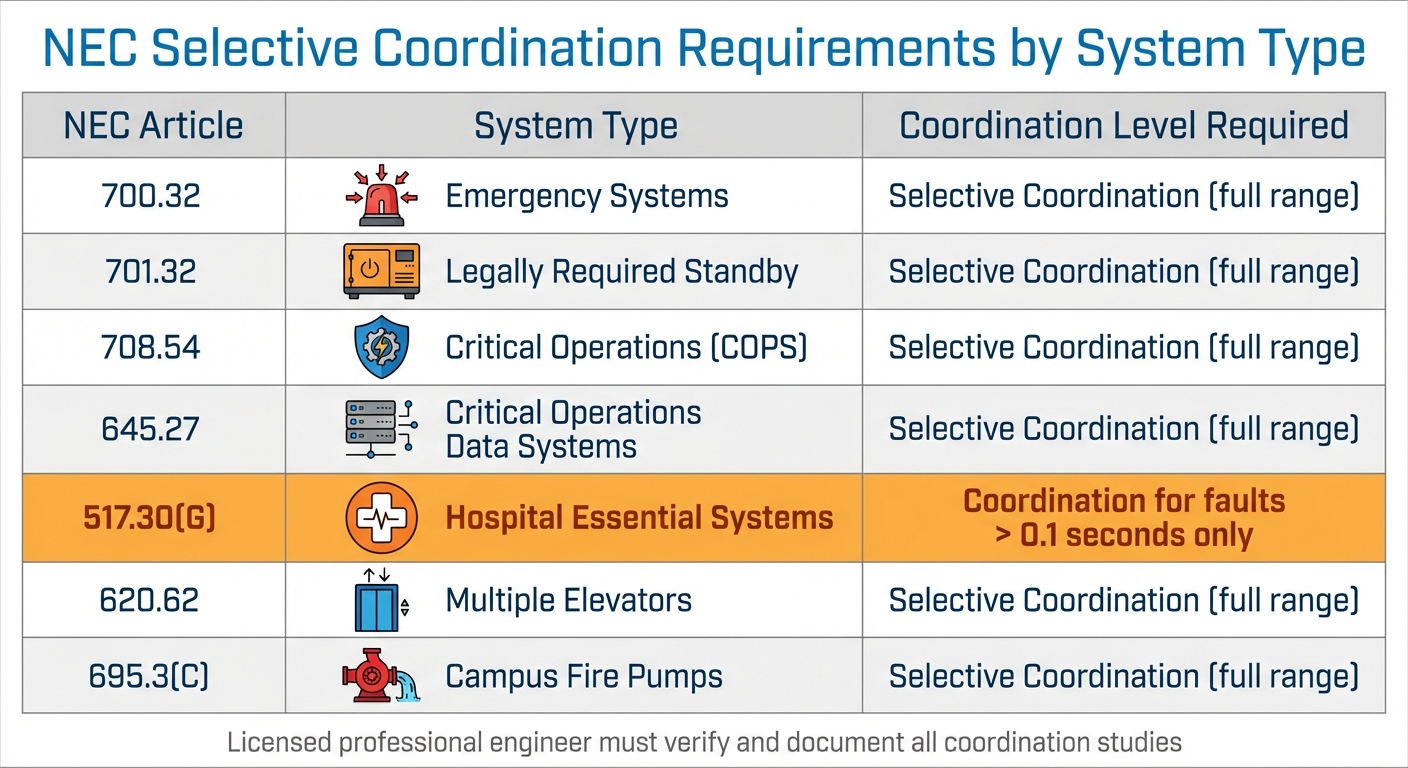
NEC Selective Coordination Requirements by System Type
The NEC mandates selective coordination for life-safety and critical power systems to ensure emergency functions remain operational during faults. This strict compliance supports essential fire prevention and safety measures by keeping critical systems running when they’re needed most.
NEC Articles on Selective Coordination

Article 700.32 (formerly 700.28) requires complete selective coordination for emergency systems across all overcurrent levels. The 2023 NEC broadened this to include both supply-side and load-side overcurrent protective devices (OCPDs), ensuring a thorough review of coordination both upstream and downstream. As the NEC Code Panel explains:
"The panel agrees that selective coordination of emergency system overcurrent devices with the supply side overcurrent devices will provide for a more reliable emergency system".
Article 701.32 (formerly 701.27) applies the same coordination requirements to legally required standby systems, which power critical functions like exit signs and elevators during outages. Similarly, Article 708.54 extends these rules to Critical Operations Power Systems (COPS), which support essential infrastructure like police and fire stations, as well as emergency management centers where power reliability is crucial for public safety.
Selective coordination is also required in other specific circumstances. Article 620.62 mandates it for multiple elevators sharing a single feeder, preventing a fault in one elevator from disabling the entire system - a rule in place since 1993. Article 695.3(C) addresses fire pumps in campus-style complexes, while Article 645.27 applies to critical operations data systems.
Healthcare facilities have slightly different requirements. Article 517.26 ensures the life safety branch in hospitals adheres to Article 700, but Article 517.30(G) allows a less stringent standard for other hospital systems, requiring coordination only for faults lasting longer than 0.1 seconds. This "defend in place" approach reflects the unique needs of hospitals, though many designers choose higher reliability standards.
| NEC Article | System Type | Coordination Level Required |
|---|---|---|
| 700.32 | Emergency Systems | Selective Coordination (full range) |
| 701.32 | Legally Required Standby | Selective Coordination (full range) |
| 708.54 | Critical Operations (COPS) | Selective Coordination (full range) |
| 645.27 | Critical Operations Data Systems | Selective Coordination (full range) |
| 517.30(G) | Hospital Essential Systems | Coordination for faults > 0.1 seconds only |
| 620.62 | Multiple Elevators | Selective Coordination (full range) |
| 695.3(C) | Campus Fire Pumps | Selective Coordination (full range) |
A licensed professional engineer must verify and document selective coordination, including OCPD types, ratings, and settings, to ensure compliance throughout the system’s lifecycle. Under the 2023 NEC, coordination studies should be updated whenever OCPDs are replaced or emergency systems are modified.
Additional Fire Safety Standards
In addition to the NEC, NFPA standards reinforce selective coordination requirements. NFPA 70 defines selective coordination in Article 100 as:
"Localization of an overcurrent condition to restrict outages to the circuit or equipment affected, accomplished by the selection and installation of overcurrent protective devices and their ratings or settings for the full range of available overcurrents".
NFPA 99 (Health Care Facilities Code) aligns with NEC Articles 517.26 and 517.30(G), detailing coordination guidelines for hospital life-safety systems.
Together, these standards create a robust framework for electrical safety. By ensuring that only the device nearest to a fault operates, critical systems - such as fire pumps, emergency lighting, and elevator controls - can remain functional, supporting safe evacuation and effective emergency response.
How to Achieve Selective Coordination
Achieving selective coordination requires a detailed analysis of your electrical system and careful selection of equipment. This process ensures compliance with NEC and NFPA standards. The first step is to create a one-line diagram that outlines your entire electrical system, identifying every overcurrent protective device (OCPD) from the utility source down to the final branch loads. You’ll also need to gather critical equipment data, such as utility fault-duty availability, transformer capacity and impedance, generator subtransient reactance, motor specifications, and cable types and lengths.
Next, calculate the maximum available short-circuit current at the line-side terminals of each OCPD. This calculation should account for momentary (first-cycle), interrupting duty, 30-cycle, and ground-fault currents. A load-flow study is also essential to confirm that continuous current requirements are met and that the OCPD ratings align with normal operating conditions [2, 14]. Eduard Pacuku, Electrical Project Engineer at Jacobs, emphasizes the importance of proper device selection:
"The electrical engineer must carefully consider OCPDs so that the protective device closest to the fault opens first and quickly enough to prevent the upstream devices from tripping".
Below, we explore coordination strategies for both circuit breakers and fuses.
Circuit Breaker Coordination
Coordinating circuit breakers involves using time-current curves (TCCs) and manufacturer-specific coordination tables. These tools help ensure that the curve for the device closest to the fault does not overlap with those upstream when plotted on a single graph [2, 14]. Generally, TCCs are divided into three regions: instantaneous (for high-level faults), short-time (3–30 cycles), and long-time (30 seconds to 8 minutes).
Electronic trip units (ETUs) provide adjustable settings for long-delay, short-time, instantaneous, and ground fault protection, allowing for finer tuning and better separation between curves [16, 17]. For static relays, a time interval of 0.2–0.3 seconds is recommended, while electromechanical relays typically require 0.3–0.4 seconds.
For clearing times under 0.01 seconds, manufacturer selectivity tables are useful, as they account for dynamic impedance. A quick manual check involves multiplying the instantaneous trip setting by 0.8 to account for the -20% manufacturing tolerance permitted under UL 489. A practical guideline is to ensure that the upstream breaker has at least twice the ampacity of the downstream breaker. For critical upstream devices, such as main service breakers, power air circuit breakers with a short-time delay (instead of an instantaneous trip) can enhance coordination by ensuring downstream devices clear faults first.
Fuse Coordination
Fuse coordination tends to be simpler and is based on published selectivity ampere rating ratios. For example, Class J fuses typically coordinate at a 2:1 ratio, while Class L (KRP-C) fuses used with Class RK5 (FRS-R) devices require a 4:1 ratio. These ratios hold up to an interrupting rating of 200,000 A (200 kA), which is standard for most modern current-limiting branch-circuit fuses [17, 14].
Tim Crnko, Training and Technical Services Manager at Cooper Bussmann, explains:
"If the CB time-current curves cross, the available short-circuit current at the point of intersection is interpreted as the maximum short-circuit current to which selective coordination can be achieved".
Dual-element (time-delay) fuses are particularly effective for protecting against overloads while still clearing short circuits quickly. These fuses are often used in fire prevention applications. When working with mixed systems that include both fuses and circuit breakers, it’s crucial to consult specific testing data or manufacturer tables to ensure proper coordination. This ensures the fuse clears the fault before the breaker unlatches [2, 14].
For selecting equipment suited to selective coordination, platforms like Electrical Trader provide a variety of circuit breakers, fuses, and power distribution components, complete with the coordination tables and technical documentation needed for NEC compliance.
Where Selective Coordination Applies
Based on established NEC and NFPA standards, selective coordination is required for systems critical to life safety and mission continuity. Since its inclusion for elevator circuits in 1993, NEC requirements have gradually expanded to cover additional applications.
Required Applications
Selective coordination is mandated for seven key system types, as outlined in NEC Articles 700, 701, 517, 620, 708, 695, and 645.
- Emergency systems (Article 700): These systems must maintain full coordination to ensure egress lighting, exit signs, and fire alarm systems remain functional during evacuations.
- Legally required standby systems (Article 701): These systems protect equipment like pressurization fans, smoke control systems, and communication tools essential for rescue and fire-fighting operations. Full coordination is necessary to keep these systems operational.
- Health care facilities (Article 517): The Life Safety Branch of essential electrical systems must achieve full selective coordination. However, other branches only need coordination for faults lasting longer than 0.1 seconds.
- Elevator systems (Article 620): Coordination is required for multiple elevators sharing a single feeder, ensuring a fault doesn’t disable all elevators simultaneously.
- Critical Operations Power Systems (COPS) (Article 708): These systems apply to facilities critical to public safety, such as emergency response centers.
- Fire pump systems (Article 695): In multi-building campus complexes, coordination ensures a reliable water supply remains available during fires.
- Information technology equipment (Article 645): Critical data center infrastructure, especially for public safety or national security, requires selective coordination.
Additionally, the International Building Code (Chapter 27) and NFPA 110-2016 emphasize these coordination requirements for high-risk environments. These standards guide engineers in configuring overcurrent protective devices to isolate faults and prevent system-wide failures. By limiting the impact of faults to specific circuits, selective coordination plays a key role in reducing fire risks and maintaining operational reliability in critical systems.
Implementation Guidelines
Meeting selective coordination requirements involves meticulous planning, thorough documentation, and the right equipment. This process begins with an engineering analysis and continues through installation and ongoing maintenance.
Engineering and Documentation
The first step is conducting a short-circuit current study, which calculates the available fault current at the line-side terminals of every overcurrent protective device in the system. Without these values, verifying proper coordination under fault conditions isn't possible.
A licensed professional engineer must oversee, document, and update all selective coordination details. This includes analyzing the full range of overcurrents - from minor overloads to the system's maximum fault current - and documenting every device's specifications. These details should include the manufacturer, type, frame size, ampere rating, and precise settings (long-time, short-time, and instantaneous) for each device.
"Selective coordination shall be selected by a licensed professional engineer or other qualified person... The selection shall be documented and made available to those authorized to design, install, inspect, maintain, and operate the system." - National Electrical Code (NEC) 2014
Engineers generally rely on one of three methods: fuse manufacturer selectivity ratio tables (the simplest), time-current characteristic (TCC) curves, or manufacturer-specific circuit breaker coordination tables. If using ratio or coordination tables, it’s essential to stick with a single manufacturer, as no data exists for combining brands. For circuit breakers, manufacturer-specific tables often outperform TCC curves, especially for clearing times below 0.01 seconds, where curve overlaps can occur.
Installers must verify and adjust circuit breaker settings upon delivery, as factory defaults often differ from the coordination study. Accurate documentation ensures that installation aligns with the engineering analysis, enhancing system safety. Daniel R. Neeser, Senior Field Application Engineer at Eaton's Bussmann Division, highlights the importance of documentation, stating it "provides the detail on the selection of each overcurrent protective device and substantiates that all the overcurrent protective devices are selectively coordinated". This documentation must remain accessible to inspectors, contractors, and system owners throughout the building's lifespan.
These documented parameters are essential for the next step: selecting and sourcing the exact equipment specified.
Equipment Selection and Sourcing
Once the documentation is complete, selecting equipment that matches the specifications becomes critical. Devices listed in the coordination study must align precisely with what gets installed. Circuit breakers with electronic trip units - offering adjustable long, short, and instantaneous settings - make coordination easier compared to thermal-magnetic molded-case types. When documenting coordination parameters, account for UL 489's -20% to +30% tolerance.
Source equipment from reliable suppliers. If your study specifies a particular breaker with specific ratings and adjustable trip settings, ensure your supplier can provide that exact model. Platforms like Electrical Trader specialize in new and used electrical components, including breakers, fuses, and other protection equipment required for selective coordination. They offer code-compliant devices from multiple manufacturers, making it easier to meet the documented requirements.
When coordinating fuses and circuit breakers, maintaining at least a 2:1 ampacity ratio between upstream and downstream devices simplifies the process. Most current-limiting, branch-circuit fuses have interrupting ratings of at least 200,000 amperes (200 kA), which is sufficient for the fault current levels in most commercial and industrial setups.
Ensure coordination across all supply-side devices, including those connected to both grid and generator sources. This requires accounting for the different fault current characteristics of each power source. Starting the design at the utility or substation level and working downstream helps avoid conflicts later, as utility companies often impose fixed restrictions on main protective devices. This comprehensive approach - from analysis to equipment sourcing - ensures selective coordination across all power sources.
Conclusion
Incorporating selective coordination into electrical system design is essential for protecting both lives and property. This approach ensures that only the protective device nearest to a fault activates, isolating problems to the smallest area possible while keeping critical systems - such as emergency lighting, fire alarms, and smoke control - operational.
The risks of poor coordination are immense. Kyle Krueger, Executive Director of Codes and Standards at NECA, highlights the stakes:
"The failure to implement selective coordination in emergency electrical systems can lead to life-threatening consequences, regulatory penalties and financial burdens".
It's crucial to address coordination during the design phase, as retrofitting after installation can be extremely costly. A licensed professional engineer must perform a detailed short-circuit study, documenting every device's specifications. Whether you’re working with fuses or circuit breakers, precision is key. The coordination study must account for all types of overcurrents - from minor overloads to maximum fault conditions - not just those lasting longer than 0.1 seconds.
When sourcing equipment, ensure it aligns perfectly with the documented specifications. This includes circuit breakers with electronic trip units, current-limiting fuses rated for 200,000 amperes, and manufacturer-tested combinations. Platforms like Electrical Trader offer a range of code-compliant breakers, fuses, and protective devices from various manufacturers, simplifying the process of finding the exact components your study specifies.
Selective coordination doesn’t just meet code requirements - it saves lives, supports compliance, and maintains operational continuity. As the NEMA Fuse Section puts it:
"A reliable system is not only important for life safety, it's important from a business perspective as nothing will stop all activity, paralyze production, inconvenience and disconcert people more than a major power failure".
Invest in precise planning, high-quality equipment, and thorough documentation. The safety and reliability of your system depend on it.
FAQs
What is selective coordination in simple terms?
Selective coordination is all about making sure that when a fault or overload happens in an electrical system, only the protective device nearest to the problem kicks in. This way, the rest of the system keeps running smoothly. By limiting unnecessary power outages, it helps maintain reliability and ensures critical operations stay up and running.
This process involves carefully arranging and setting up devices like circuit breakers or fuses to quickly isolate faults. The result? Improved safety and less disruption - especially crucial in places like hospitals or high-rise buildings where continuous power is non-negotiable.
Which NEC systems must be selectively coordinated?
The NEC requires selective coordination for several critical systems, such as elevator OCPDs, fire pump OCPDs, emergency systems, legally required standby systems, critical operation power systems, and critical operation data systems. These guidelines play a key role in maintaining the safety and reliability of electrical systems.
What documents do inspectors expect for selective coordination?
Inspectors usually ask for documentation to confirm that overcurrent protective devices are selectively coordinated under all conditions - whether it's overloads, ground faults, or short circuits. These records need to demonstrate that the devices are correctly chosen and installed to maintain system reliability and reduce fire risks.