

NFPA 70E vs OSHA: Who Issues Fines?
OSHA can fine you. NFPA 70E cannot.
If I had to sum this up in one line, that’s it. OSHA is the federal agency that issues citations and civil penalties. NFPA 70E is a safety standard that helps show what safe electrical work should look like, but it has no power to fine anyone.
Here’s the short version:
- OSHA enforces law
- NFPA 70E gives guidance for electrical safety
- OSHA can cite under 29 CFR rules and the General Duty Clause
- NFPA 70E can support OSHA’s case, but it is not the citation itself
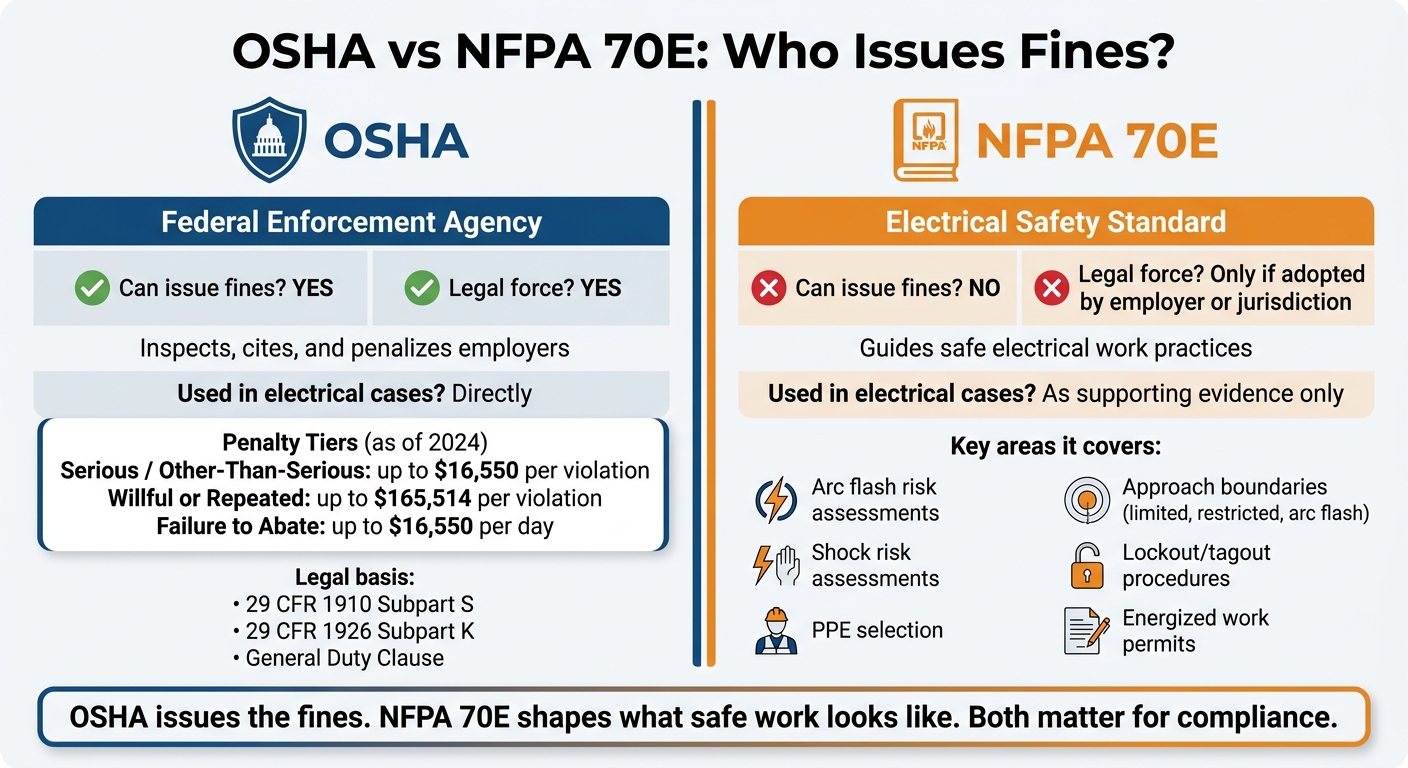
- As of 2026, OSHA penalties can reach $16,550 for serious or other-than-serious violations, $165,514 for willful or repeated violations, and $16,550 per day for failure to abate
If you run a shop, manage a site, or hire electrical contractors, the main point is simple: your legal risk comes from OSHA, but your day-to-day safety program will often be judged against practices found in NFPA 70E.
Quick Comparison
| Item | OSHA | NFPA 70E |
|---|---|---|
| What it is | Federal enforcement agency | Electrical safety standard |
| Can it issue fines? | Yes | No |
| Legal force | Yes | Only if adopted by an employer or jurisdiction |
| Main role | Inspects, cites, penalizes | Guides safe work practices |
| Used in electrical cases? | Directly | Often used as support |
So when people ask, “Who issues fines?” the answer is clear: OSHA does. NFPA 70E still matters because it can shape what OSHA expects to see in training, PPE, risk assessments, energized work rules, and written records.
OSHA vs NFPA 70E: Who Can Fine You?
OSHA's Enforcement Authority
OSHA can inspect workplaces and issue civil penalties. It is the federal agency with legal authority to set and enforce workplace safety rules, send inspectors into facilities, and cite employers when they violate OSHA requirements. NFPA cannot issue fines.
If OSHA finds a violation, it sends a citation and penalty notice. That citation spells out the rule that was violated, the hazard involved, the penalty amount, and the deadline to fix the problem. Employers usually have 15 working days to do one of three things:
- correct the hazard
- pay the penalty
- contest the citation
What OSHA Looks at During Electrical Safety Inspections
OSHA compliance officers inspect under OSHA's electrical standards for general industry and construction. In practice, they often focus on lockout/tagout procedures, whether circuits are de-energized before work starts, how energized work is justified, PPE availability and condition, guarding of live parts, and whether qualified workers have documented training for the equipment they use.
What inspectors see on the floor is only part of the picture. The paperwork matters too. Officers often ask for written safety programs, training records, job hazard analyses, and maintenance logs to check whether day-to-day work matches the written record. When those documents are missing or don't line up, OSHA has a stronger case that the hazard was recognized. That ties straight to the General Duty Clause - Section 5(a)(1) of the OSH Act - which OSHA can use when no specific standard fits the exact situation.
That’s where NFPA 70E comes in. It helps show what OSHA may view as recognized safe practice.
How OSHA Penalties and Abatement Work
Penalty size also depends on how the employer responds after OSHA identifies the hazard. OSHA sets penalty amounts based on how it classifies the violation. Serious violations - where there is a substantial probability of death or serious physical harm - bring higher penalties, and OSHA updates its maximums each year for inflation. In 2024, serious and other-than-serious violations were about $16,131 per violation. Willful or repeated violations were about $161,323 per violation. Failure-to-abate penalties were about $16,131 per day until the hazard was fixed.
OSHA may lower proposed penalties based on employer size, prior inspection history, and documented safety efforts. On the flip side, high-risk electrical hazards can lead to steeper penalties.
sbb-itb-501186b
NFPA 70E's Role in Electrical Safety
OSHA enforces the law. NFPA 70E provides the safety framework OSHA expects employers to use. The standard does not carry its own fine authority, but OSHA often treats it as the yardstick for safe electrical work.
OSHA asked for NFPA 70E to help employers comply with 29 CFR 1910 Subpart S and 29 CFR 1926 Subpart K. So in day-to-day use, NFPA 70E works as a practical guide for hazard assessments, PPE choices, and controls for energized work.
What NFPA 70E Helps Employers Do
NFPA 70E gives employers a clear way to deal with the electrical hazards behind the worst injuries: arc flash, shock, and arc blast. It links PPE selection and work controls to the level of hazard in front of the worker.
In practice, that means it supports shock risk assessments, arc flash risk assessments, and energized work permits. It sets limited approach boundaries and restricted approach boundaries for shock risk, along with the arc flash boundary - the distance at which an unprotected worker can suffer a second-degree burn.
It also guides lockout/tagout procedures. And it helps employers decide when energized work is justified, plus what records that decision needs.
For PPE, NFPA 70E helps employers choose task-specific gear that matches the hazard instead of leaning on a one-size-fits-all checklist. If OSHA later shows up on-site, those same controls can serve as proof of what the employer did.
Why NFPA 70E Still Matters Without Fine Authority
A lack of fine authority doesn't make NFPA 70E any less useful. It still matters because it helps employers build a documented compliance record - hazard assessments, approach boundaries, PPE selection, and training. That's exactly the kind of evidence OSHA looks for during an inspection.
How OSHA Uses NFPA 70E in Citations
OSHA cites its own rules, such as 29 CFR 1910.335 or the General Duty Clause. NFPA 70E can back up the citation, but it is not the legal basis for the penalty.
OSHA Cites Its Own Standards, Not NFPA 70E
OSHA has said it does not enforce NFPA 70E, but it may use the standard to support PPE and hazard-recognition findings. In plain English, NFPA 70E helps show what safe work should look like. But the citation itself still rests on OSHA's own standard or the General Duty Clause.
Where NFPA 70E Supports OSHA's Position
OSHA uses NFPA 70E to support citations tied to missing arc-rated PPE, lack of an arc flash risk assessment, weak training, and unsafe energized work practices. That gives OSHA a way to show what a reasonable employer should have done.
For example, OSHA has used missing arc-flash controls to support a General Duty Clause citation.
That support can make OSHA's case stronger, but the penalty still comes from OSHA's rule. That's the key line to remember: NFPA 70E may support the argument, while OSHA's own rules carry the legal penalties.
Which Rules Carry Legal Penalties and What Employers Should Know
When OSHA shows up after an inspection, the legal risk comes from OSHA rules, not from NFPA 70E. OSHA standards can lead to citations and civil penalties. NFPA 70E, by itself, does not carry legal penalties.
More specifically, violations of 29 CFR 1910 Subpart S, 1926 Subpart K, or the General Duty Clause can bring federal citations and civil penalties. Those penalty amounts also go up each January to match inflation.
That said, NFPA 70E still matters a lot. It lays out methods that OSHA often views as reasonable electrical safety practice. So even though it isn't the source of the penalty, it often shapes what OSHA expects to see in the field.
This is where paperwork can make or break your case. When OSHA decides citation severity and penalty amounts, it looks closely at records like:
- training records
- risk assessments
- corrective action logs
Key Points for Contractors, Facilities, and Procurement Teams
On multi-employer jobs, OSHA can cite more than one party for the same hazard. That means a contractor, site owner, or another employer on the job could all face exposure from the same issue.
Clear documentation helps sort out who is responsible for each safety task. That includes things like arc-flash labels, energized work approvals, and PPE selection. If ownership is vague, trouble can spread fast across every party involved.
Procurement teams also need to do their part on the front end. Before buying, they should check equipment ratings, certifications, and condition. A bad purchase can turn into a jobsite problem later, and by then the paper trail matters just as much as the gear itself.
FAQs
Can OSHA cite me for not following NFPA 70E?
OSHA can't directly cite you for failing to follow NFPA 70E because it's a consensus standard, not a federal regulation.
That said, OSHA often looks to NFPA 70E as a yardstick when deciding whether an employer took reasonable steps to protect workers. During an inspection, the agency may point to NFPA 70E to show that a hazard was recognized or to back up its own electrical safety rules.
What happens after an OSHA electrical inspection?
An OSHA electrical inspection usually starts with credential presentation and an opening conference. From there, the inspector moves into a walkaround, may hold private employee interviews, reviews documents, and wraps up with a closing summary.
During that process, inspectors look closely at energy control procedures, training records, and maintenance logs. They may also check whether your safety program, including arc flash hazard assessments and lockout/tagout procedures, lines up with NFPA 70E.
If records are missing or incomplete, the inspection can slow down. That can also lead to citations, fines, or corrective actions.
When does NFPA 70E become legally enforceable?
NFPA 70E is a voluntary consensus standard. By itself, it does not carry the force of law.
It becomes enforceable only when a federal, state, or local agency or code formally adopts it.
Once that happens, the local Authority Having Jurisdiction can require compliance, inspect, and issue penalties. At the federal level, OSHA may still reference NFPA 70E during inspections under the General Duty Clause.