




New vs Used Electrical Equipment: Reliability in Harsh Conditions
When deciding between new and used electrical equipment for harsh conditions, here’s what you need to know:
- New equipment offers factory-tested reliability, pristine components, and warranties. It's designed to handle extreme temperatures, moisture, and chemical exposure without prior wear or damage.
- Used equipment can save 30-60% on costs but comes with risks. Its performance depends on prior use, maintenance history, and refurbishment quality. Hidden damage from previous exposure to harsh conditions can lead to failures.
Key Factors to Consider:
- Extreme Temperatures: New equipment has modern materials for better insulation and fault clearing. Used equipment may have brittle insulation and slower fault response.
- Moisture Resistance: New units are factory-sealed, while used ones may have compromised seals or internal corrosion.
- Chemical Exposure: New equipment uses high-grade sealants, while used equipment might have makeshift replacements that reduce durability.
Quick Tip: Always review testing reports and service records for used equipment to assess reliability. For harsh environments, the upfront cost of new equipment often pays off in long-term performance and safety.
What makes a harsh connector? Harsh environments explored. Connectivity in harsh environments
sbb-itb-501186b
What Are Harsh Conditions for Electrical Equipment?
Harsh conditions refer to environments that put electrical equipment under extreme stress, accelerating wear and reducing its lifespan. According to NFPA 70B, such equipment demands rigorous maintenance to ensure reliability and safety. Recognizing these stressors is critical when deciding between new and used equipment, as prior exposure to harsh conditions can leave hidden damage behind.
Three major environmental factors - extreme temperatures, high humidity, and chemical contamination - pose significant risks to electrical equipment. Each one affects components differently. For example, extreme heat can degrade insulation and cause physical expansion, while moisture promotes corrosion and electrical malfunctions. Chemicals, on the other hand, can erode protective coatings and create unintended conductive pathways. Let’s break down how these factors uniquely impact equipment.
Extreme Temperatures
High temperatures can wreak havoc on insulation materials, causing them to break down and lose mechanical integrity. For instance, in transformers, thermal aging accelerates rapidly with rising temperatures. A mere 11°F to 13°F increase above the design hot spot temperature (6°C to 7°C) can double the aging rate. Power transformers operating continuously at their design hot spot temperatures of 203°F–230°F see their insulation lifespan shrink to just 7.2 years, while distribution transformers under similar conditions last around 20 years.
"The rate of breakdown increases exponentially with temperature, allowing the expected life of insulation to be expressed by the Arrhenius theory of electrolytic dissociation." – Edvard Csanyi, Electrical Engineer, EEP
Temperature extremes also impact physical components. Overhead conductors exposed to excessive heat elongate and sag, which reduces clearance and raises the risk of faults. On the flip side, cold temperatures can make materials brittle. Ceramic components like porcelain bushings may crack under such conditions, leading to potential failures.
High Humidity and Moisture
Moisture is one of the leading causes of corrosion in electrical systems. In underground cables, moisture combined with an electric field can trigger "water treeing", a process that weakens the dielectric strength of insulation and increases the likelihood of breakdowns during voltage transients.
Older silicon carbide surge arresters are particularly vulnerable to moisture. If water enters their air gaps, it can cause corrosion and mechanical stress, potentially leading to catastrophic failure during overvoltage events. For equipment to maintain a "Condition 1" rating - indicating like-new status - its enclosures must be completely moisture-free and secure. Even trace amounts of moisture can lead to short circuits and accelerate contact failures.
Chemical Exposure and Contaminants
In addition to temperature and moisture, chemical exposure presents another major challenge. Substances like sea salt, fertilizers, industrial pollutants, and road salt degrade insulation strength. In wet conditions, highly contaminated insulators are prone to flashovers, which are unintended electrical discharges across their surfaces. Dust and sand, especially in desert or urban areas, can form a conductive layer on equipment. When this layer becomes wet, it significantly reduces the voltage withstand capacity.
Contaminants like grime and carbon deposits can also interfere with mechanical components. Circuit breakers and switches may experience operational issues due to buildup on internal parts, which increases resistance and disrupts electrical pathways. In high-contamination areas, such as coastal or industrial regions, regular cleaning of insulators is essential to maintain their dielectric strength and prevent flashovers.
How New Electrical Equipment Performs in Harsh Conditions
When it comes to handling extreme environments, new electrical equipment offers a distinct advantage. With untouched, factory-fresh components, these units are designed to deliver optimal performance right out of the box. The insulation, contacts, and protective coatings are all in pristine condition, free from the wear and vulnerabilities often found in used equipment.
Material Condition and Insulation Quality
New equipment is built with carefully selected, high-grade components that meet strict performance benchmarks. One critical factor is insulation quality. Before leaving the factory, these units undergo rigorous insulation resistance testing to ensure they can endure electrical stress without breaking down. Unlike used equipment, which may accumulate dirt, corrosion, or residues that compromise its dielectric strength, new units present a clean and reliable foundation. This is especially important in environments prone to chemical exposure or high moisture levels. The robust material quality of new equipment is further validated through extensive factory testing.
Factory Testing and Compliance
Before reaching customers, new electrical equipment is subjected to a battery of tests designed to weed out any subpar designs. For instance, factory testing has revealed failure rates as high as 10%–50% for cable components, 25% for power transformers during short-circuit testing, and 32% for high-voltage circuit breakers during IEC test series. These stringent tests ensure that only the most reliable products make it to market, contributing to impressively low in-service failure rates of around 0.30%.
"In order to maintain the low service failure rate, type‑testing and independent certification remains a key de‑risking instrument to distinguish the well‑designed, well‑manufactured products from the inferior ones." – René Smeets and Bas Verhoeven, ELECTRA
Additionally, new equipment comes with original UL certifications, such as UL 489 for molded-case breakers, confirming their compliance with industry-standard safety and performance requirements. These rigorous factory checks ensure that each unit is ready to handle the demanding conditions it may face. To back this up, manufacturers provide warranties and technical support to further guarantee reliability.
Manufacturer Warranties and Technical Support
New equipment typically includes at least a one-year warranty, offering protection against defects that could be exacerbated by harsh operating conditions. This level of coverage provides peace of mind that reconditioned equipment often cannot match. Beyond warranties, manufacturers also supply technical support and training resources to help operators maintain peak performance over time. For utilities and industries managing critical infrastructure, this combination of warranty protection and expert assistance reduces uncertainty about the equipment's history and quality.
While new circuit breakers may cost 100% of the manufacturer's list price compared to 30–60% for reconditioned alternatives, many organizations see this as a worthwhile investment. The added reliability and support significantly lower the risks associated with operating in challenging environments.
How Used Electrical Equipment Performs in Harsh Conditions
Used electrical equipment can be an economical choice, but its reliability in extreme environments depends on several factors. Prior use, age, and refurbishment practices all play a role in determining how well it will perform under tough conditions. Here's a closer look at how these elements impact reliability.
Effects of Age and Previous Use
The environment where equipment was previously used can significantly affect its performance. In fact, environmental factors alone account for up to 60% of an electronic component's lifespan. For example, equipment housed in climate-controlled settings tends to last much longer than equipment exposed to fluctuating or extreme conditions.
"Equipment installed in climate-controlled rooms will extend equipment useful life whereas equipment in non-climate-controlled rooms will age faster." – New Spring Engineering
Different components wear out at different rates. For instance:
- Electrolytic capacitors in VFDs and UPS systems typically last 8–11 years.
- Silver solder joints in power electronics may fail after 12–15 years.
- Vacuum interrupters in medium voltage breakers can hold up for about 20 years.
When you buy used equipment, you're inheriting whatever remains of its lifespan - along with any additional wear caused by harsh conditions. Chemical exposure, for instance, can be particularly damaging. In environments containing hydrogen sulfide, VFDs that might last over 20 years in ideal conditions may fail in just three years. Corrosive atmospheres can also weaken plastic components, making them brittle or causing them to disintegrate entirely.
Refurbishment and Service Records
Maintenance and refurbishment history are also key to understanding how used equipment will perform in challenging environments. While refurbishment can address some issues, it has its limits. Testing and repairs can uncover hidden failures, but electronics often fail unpredictably rather than following a clear wear-and-tear pattern. The effectiveness of refurbishment depends heavily on which components are replaced and whether maintenance has been documented thoroughly.
"Testing and repairs to detect hidden failures becomes your best option... aging is a definite factor too." – paulengr, Senior Member, Mike Holt Forum
Service records are critical for assessing whether equipment was operated within manufacturer specifications. Preventive maintenance can extend the life of most production equipment to 20–25 years, and medium voltage breakers with annual servicing can last up to 50 years. Without these records, however, it's difficult to gauge how much life the equipment has left.
Parts availability is another challenge when dealing with older equipment. Once a product becomes obsolete, replacement parts may be just as old as the equipment itself. For example, finding components for 30-year-old GE AK breakers often means using parts that have been sitting unused for decades.
"When equipment goes obsolete, parts availability is a huge problem... Reliability of 'new' is just as bad as the parts in service." – paulengr, Senior Member, Mike Holt Forum
Price Savings vs. Performance Risks
Used electrical equipment is often significantly cheaper than new alternatives, which can make it appealing for applications in controlled environments with moderate demands. However, the equation changes when harsh conditions are involved.
Equipment that has already endured environmental stress is more likely to fail prematurely when redeployed in demanding settings. While major electrical distribution equipment typically lasts 20–40 years under normal conditions, exposure to heat, humidity, or corrosive chemicals can drastically shorten its lifespan. This means that the money saved upfront could be quickly outweighed by unexpected failures, downtime, or emergency replacements.
For buyers, understanding the equipment's history is essential. For example, a transformer from a climate-controlled substation may perform well in a similar setting, but it might struggle in a coastal facility with high humidity and salt air. Matching the equipment's past conditions with its intended environment is critical to ensuring reliable performance.
New vs Used Equipment: Performance Comparison in Harsh Conditions
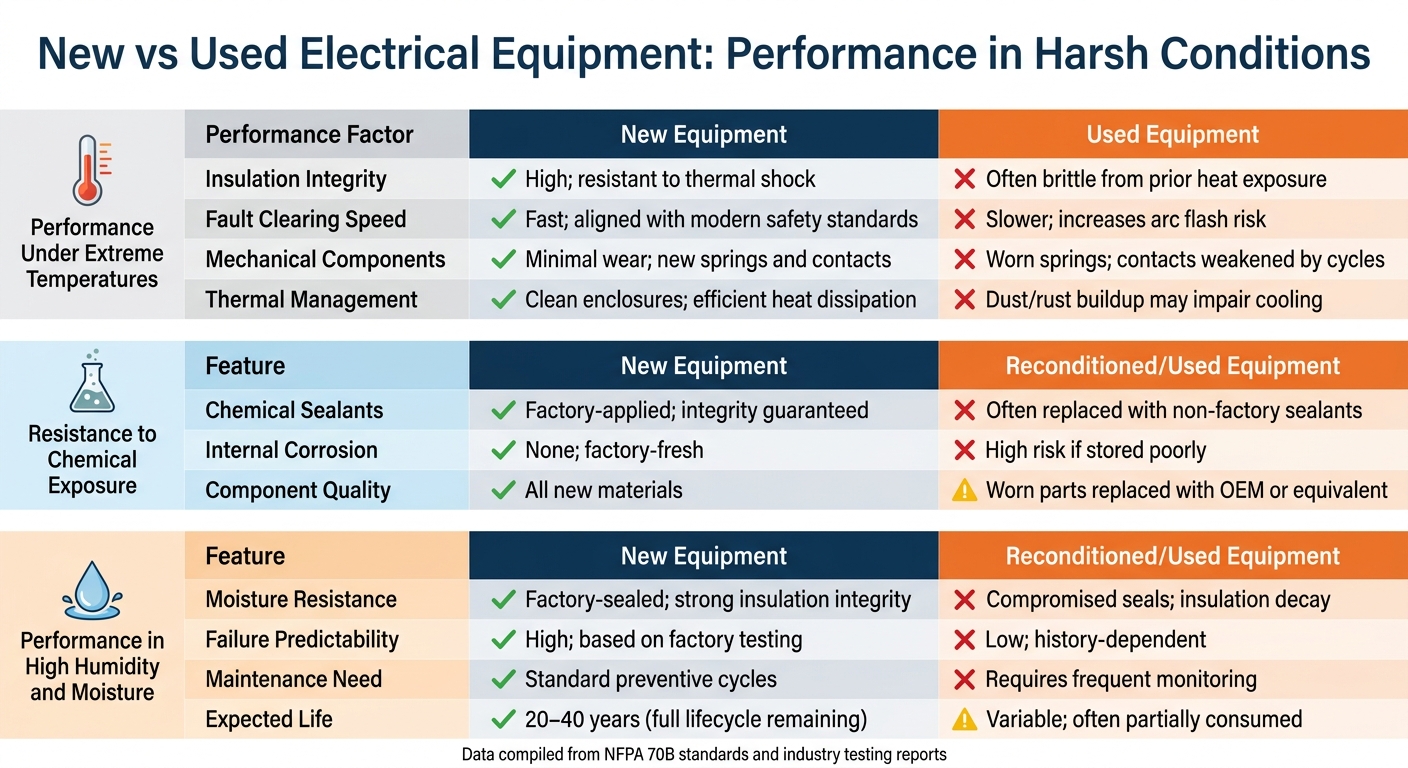
New vs Used Electrical Equipment Performance Comparison in Harsh Conditions
When deciding between new and used electrical equipment for harsh environments, it’s important to understand how each holds up under stress. The differences go beyond theory - they directly affect reliability, safety, and costs over time. Here’s a closer look at how new and used equipment compare in challenging conditions.
Performance Under Extreme Temperatures
Temperature swings can take a toll on electrical equipment. Daily cycles of heating and cooling cause mechanical wear on circuit breaker contacts, weaken springs, and make insulation brittle over time. New equipment is built with modern insulation materials that are better equipped to handle these stresses. On the other hand, used equipment often has insulation that’s already been weakened by years of exposure, increasing the risk of cracking or failure in extreme conditions.
"Electrical equipment deterioration may be due to daily temperature cycles, collection of dust, condensation, mechanical wear of circuit breaker contacts and contactors, weakening of operating springs, deterioration of insulating materials, and rusting enclosures." – Consulting-Specifying Engineer
The safety implications are significant. Older equipment tends to take longer to clear fault conditions, which can heighten arc flash risks during temperature-induced stress. Newer units, designed to meet current NFPA 70E standards, clear faults faster, reducing hazards. In contrast, older equipment may require operators to use higher-rated protective gear due to slower response times.
| Performance Factor | New Equipment | Used Equipment |
|---|---|---|
| Insulation Integrity | High; resistant to thermal shock | Often brittle from prior heat exposure |
| Fault Clearing Speed | Fast; aligned with modern safety standards | Slower; increases arc flash risk |
| Mechanical Components | Minimal wear; new springs and contacts | Worn springs; contacts weakened by cycles |
| Thermal Management | Clean enclosures; efficient heat dissipation | Dust/rust buildup may impair cooling |
These differences are critical for ensuring safety and cost-effectiveness in high-stress environments.
Resistance to Chemical Exposure
Chemical exposure highlights another key difference between new and used equipment. New units come with factory-applied sealants that meet strict safety standards and protect against chemical ingress. In contrast, used equipment often has seals replaced with makeshift alternatives, which can compromise chemical resistance.
"Reconditioned breakers... may be damaged on the inside due to corrosion and water. On top of that, the sealant on these reconditioned breakers has most likely been removed and replaced with other sealants that aren't professionally applied in a factory." – Connecticut Electric
Internal corrosion is a hidden but serious risk. Used equipment, especially items stored improperly or for long periods, often suffers from internal damage that isn’t visible externally. Some sellers may clean the surface to improve appearance, but this doesn’t address chemical damage to critical components like contacts or trip units. These issues directly affect how long the equipment will last and how reliably it will operate.
| Feature | New Equipment | Reconditioned/Used Equipment |
|---|---|---|
| Chemical Sealants | Factory-applied; integrity guaranteed | Often replaced with non-factory sealants |
| Internal Corrosion | None; factory-fresh | High risk if stored poorly |
| Component Quality | All new materials | Worn parts replaced with OEM or equivalent |
The choice between new and used becomes even more critical when moisture is added to the equation.
Performance in High Humidity and Moisture
Moisture and humidity accelerate wear and tear on electrical systems, breaking down insulation and causing rust. New equipment is factory-sealed to protect against condensation and features robust insulation. In contrast, used equipment may have compromised seals, allowing moisture to seep in and speed up corrosion.
High humidity can also lead to sudden failures in used equipment, as aging components are more prone to unpredictable breakdowns. These failures can result in dangerous situations like arcing or fires. New equipment, tested in controlled environments, offers consistent and predictable performance, whereas used equipment’s reliability depends on its maintenance history and prior exposure to harsh conditions.
| Feature | New Equipment | Used Equipment |
|---|---|---|
| Moisture Resistance | Factory-sealed; strong insulation integrity | Compromised seals; insulation decay |
| Failure Predictability | High; based on factory testing | Low; history-dependent |
| Maintenance Need | Standard preventive cycles | Requires frequent monitoring |
| Expected Life | 20–40 years (full lifecycle remaining) | Variable; often partially consumed |
For those sourcing equipment on platforms like Electrical Trader, understanding these performance differences is key. While used equipment from controlled environments may still perform adequately, harsh conditions demand a closer evaluation of whether the equipment can meet your reliability and safety needs.
Testing Methods for Equipment in Harsh Conditions
Testing ensures that both new and used equipment can perform reliably in extreme environments. This is especially important for electrical equipment, where failure in harsh conditions can lead to costly consequences. Whether you're working with new or reconditioned units, understanding the right testing methods is crucial to avoid unnecessary risks.
Visual Inspections and Diagnostic Testing
The approach to visual inspections depends on whether you're dealing with new or used equipment. For new units, the focus is on ensuring the equipment is in pristine condition - clean, dry, and free of any system alerts. Used equipment, however, requires a deeper dive. According to NFPA 70B, used equipment is categorized based on its maintenance history.
Surface-level checks can sometimes be misleading. Internal issues like corrosion, carbon buildup, or worn-out contacts may not be visible. It's important to inspect the internal components thoroughly. Look for cracks, contamination on porcelain bushings, and evidence of chemical or thermal stress, as these could classify the equipment as high-risk.
"Used or improperly refurbished breakers have 'questionable pasts that are impossible to track' and could be hiding internal damage." – Connecticut Electric
When purchasing from platforms like Electrical Trader, confirm that reconditioned equipment includes formal testing reports. These reports should detail tests conducted under simulated fault conditions. Equipment refurbished by PEARL or NETA-certified technicians tends to offer greater reliability. Per NEC guidelines, the original UL label should be replaced with one identifying the reconditioning firm and the service date. Additionally, thermal imaging can uncover hot spots, which are often early indicators of potential failures under load.
Once visual and diagnostic checks are complete, performance benchmarking can provide a more quantitative assessment of the equipment's condition.
Performance Benchmarking
Performance benchmarking goes beyond visual inspections to verify whether equipment meets essential standards. For transformers and high-voltage equipment, tests like Insulation Resistance (IR), Polarization Index (PI), and Power Factor tests are essential for evaluating how well the equipment handles electrical stress. For oil-immersed equipment, Dissolved Gas Analysis (DGA) and Breakdown Voltage (BDV) tests are critical to uncover hidden faults caused by thermal or electrical issues.
| Test Type | Purpose | Acceptable Range (Used/Refurbished) |
|---|---|---|
| Insulation Resistance (IR) | Evaluates dielectric health | ≥ 1,000 MΩ (for HV winding) |
| Polarization Index (PI) | Checks insulation dryness | ≥ 1.5 |
| Power Factor (Tan δ) | Assesses insulation aging | ≤ 1.0% |
| Breakdown Voltage (BDV) | Tests oil dielectric strength | > 40 kV |
Always request oil analysis and electrical test reports dated within the last six months. For equipment previously exposed to extreme environments - like high humidity, severe temperatures, or chemical exposure - ensure it underwent processes like dehydration, oil drying, and cooling system upgrades. Equipment refurbished in line with IEC 60076-18 guidelines is more likely to perform close to its original specifications.
When shopping for used units on platforms such as Electrical Trader, check that load loss remains within 110% of the baseline and no-load loss stays below 115%. These benchmarks help you weigh the initial savings against potential long-term reliability issues.
Summary for Electrical Trader Buyers
When deciding between new and used electrical equipment for challenging environments, it’s all about weighing upfront costs, reliability, and compatibility with your systems. New equipment offers pristine insulation, adherence to industry standards, and strong manufacturer warranties - advantages that are especially critical in extreme conditions like high humidity, chemical exposure, or fluctuating temperatures.
On the other hand, properly refurbished equipment can deliver comparable performance if certified technicians have rigorously tested it. As Rishi Sudan of RS Electrical Supply explains:
"Many utilities believe that reconditioned equipment is not as safe or reliable as newly manufactured equipment. However, a closer look at the facts reveals a different story."
Ultimately, it comes down to evaluating the equipment’s performance record. If you’re considering used options, make sure to review detailed testing reports and look for NEC-compliant markings that identify the reconditioning firm and service date. Used equipment can be a great fit if its history matches your operational needs.
With verified information and a clear service history, you can make a confident choice. When browsing on Electrical Trader, prioritize sellers who provide thorough service records and up-to-date testing documentation. Whether you're in the market for 15-kilovolt circuit breakers, transformers, or switchgear, assessing refurbishment quality and the supplier’s reputation is key to selecting reliable equipment for demanding environments.
Check out Electrical Trader's product range to find both new and reconditioned equipment tailored to your requirements.
FAQs
When is used equipment a safe choice in harsh environments?
Used electrical equipment can perform reliably in harsh environments if it’s properly maintained, rigorously tested, and comes with a clear operating history. This type of equipment works well for older systems, temporary projects, or emergency repairs. However, for critical safety systems, it’s best to avoid using it unless it has been thoroughly verified to withstand extreme conditions. Adhering to standards such as NFPA 70B and conducting a detailed condition assessment are key steps to ensure the equipment remains dependable under challenging environmental factors.
What documents should I ask for before buying used gear?
Before buying used electrical equipment, it's essential to request proper documentation to confirm its condition and history. Key details to look for include the model number, serial number, manufacturing date, and whether the equipment has been refurbished to OEM specifications or is being sold "as is."
It's also wise to ask for maintenance records, calibration reports, and testing documentation. These can help ensure the equipment is reliable and safe, particularly if it will be used in demanding or sensitive environments.
Which tests best predict failure in heat, moisture, or chemicals?
Tests designed to mimic long-term stress conditions, such as voltage aging and insulation breakdown tests, are highly effective. Voltage aging involves subjecting insulation and cables to elevated voltage and temperature over an extended period to identify potential weaknesses. Insulation breakdown tests, guided by standards like IEEE 1043 and 1553, evaluate the durability of materials under aging-related stress. These approaches are useful for predicting failures caused by factors like heat, moisture, and chemical exposure.





