NEC Code Updates for Residential Breakers 2026
If you pick breakers the same way you did under older NEC cycles, you can miss code in 2026. I’d check six things first: AFCI, GFCI, SPD, outdoor emergency disconnect rules, service layout, and load calculation.
Here’s the short version:
- More branch circuits need AFCI protection, including many 120 V, 10 A to 20 A dwelling-unit circuits.
- GFCI coverage is broader around sinks and in wet or utility areas, so one circuit may need both AFCI and GFCI.
- A dual-function breaker is often the simplest answer when both rules apply.
- Dwelling-unit services need an SPD, and feeder-fed equipment may also need SPD planning, panel space, and listed connections.
- One- and two-family homes need a readily accessible outdoor emergency disconnect, which can push the main disconnect outside and turn the indoor panel into a subpanel.
- Load calculations still set main and feeder breaker size, while wire size, equipment nameplate, and circuit load set branch-breaker size.
- Interrupting rating still matters: many residential breakers are 10 kAIC, but some locations may need more.
- Local adoption controls everything. The 2026 NEC is a model code, so I’d confirm the edition with the AHJ before buying or installing anything.
What this means in plain English: breaker choice is no longer just about 15 A vs. 20 A or 100 A vs. 200 A. You also have to match the protection type, panel listing, fault-current rating, and equipment layout.
NEC 2026 Analysis of changes - Chapter 2 Part 2
sbb-itb-501186b
Quick comparison
| Area | What changed | What I’d check |
|---|---|---|
| AFCI | More dwelling circuits covered | Whether the circuit now needs an AFCI or dual-function breaker |
| GFCI | More sink and utility-area coverage | Whether AFCI and GFCI apply at the same time |
| SPD | Service SPD rules affect panel setup | Space, listing, breaker connection, and panel rating |
| Emergency disconnect | Outdoor disconnect rules shape layout | Whether an exterior main or meter-main is needed |
| Load calc | Main and feeder sizing still starts here | Whether demand factors point to 100 A, 125 A, 150 A, 200 A, or 225 A |
| Interrupting rating | Fault-current check stays separate from load | Whether 10 kAIC is enough at that location |
So if I were summarizing the full article in one line, it would be this: in 2026, residential breaker selection depends on code coverage, panel listing, service layout, and fault-current limits - not just amp rating.
NEC Sections That Drive Residential Breaker Decisions in 2026
Articles 210, 215, 220, and 230 shape most residential breaker calls: protection type, feeder rules, load sizing, and service layout.
| Code Article | What It Controls | Practical Breaker Decision |
|---|---|---|
| 210 | Branch-circuit protection, AFCI/GFCI requirements | Standard, AFCI, GFCI, or dual-function breaker |
| 215 | Feeder construction and SPD requirements | Feeder protection and SPD compatibility |
| 220 | Dwelling load calculations | Minimum amp rating for service and feeder breakers |
| 230 | Service disconnect rules | Outdoor placement, labeling, and emergency disconnect |
Start with Article 210. That’s where circuit-level protection gets sorted out.
Articles 210 and 215: Branch Circuits, Feeders, AFCI, GFCI, and SPD Requirements
Article 210 covers branch-circuit protection. In 2026, Article 210.12 extends AFCI protection to nearly all 120 V, 15 A and 20 A dwelling-unit branch circuits, including bathrooms and garages. Article 210.8(A) also expands GFCI coverage near indoor sinks, including laundry and utility sinks.
That has a direct effect on breaker choice. A dual-function AFCI/GFCI breaker is often the cleanest fix because one circuit can fall under both rules. A 20 A kitchen circuit is a good example. It can trigger both AFCI and GFCI requirements, so a dual-function breaker is often the simplest pick.
Then there’s the feeder side. Article 215 deals with feeder-level protection and SPD placement. In 2026, it requires a Type 1 or Type 2 SPD in or next to distribution equipment on the load side of feeders, with a 10 kA minimum nominal discharge current rating. In plain English, the panel and breaker setup has to leave room for the SPD and still meet listing, short-circuit, and clearance rules.
Articles 220 and 230: Load Calculations, Service Disconnects, and Emergency Disconnects
Article 220 sets breaker size, not breaker type. Before you choose a main or feeder breaker, you need a load calculation. Demand factors can lower the calculated load enough to change the breaker you need. That’s what decides whether a 100 A, 125 A, 200 A, or 225 A breaker makes sense.
After the load calculation, Article 230 takes over. This section controls where the service disconnect goes and how it must be marked. For one- and two-family dwellings, the 2026 NEC requires the disconnect to be in a readily accessible outdoor location on or within sight of the dwelling. The enclosure also has to be permanently labeled EMERGENCY DISCONNECT with letters at least 1/2 inch high, using white text on a red background.
In retrofit work, this can change the whole layout. You may need to add an outdoor main and turn the indoor panel into a subpanel. Once that happens, feeder sizing under Article 220 and SPD placement under Article 215 both come back into play.
The next section breaks down the 2026 changes for AFCI, GFCI, SPDs, and disconnect layout.
Key 2026 NEC Changes That Affect Residential Breaker Selection
AFCI and GFCI Coverage Changes in Dwelling-Unit Circuits
AFCI now applies to most 120 V, 10 A to 20 A branch circuits in dwelling units, which means a lot of home circuits now need more than a standard breaker. GFCI rules still cover wet and utility spaces, so many kitchen, laundry, basement, and outdoor circuits now fall under both sets of rules.
When both protections are required, use a dual-function AFCI/GFCI breaker listed to UL 1699 and UL 943. That single breaker can protect the full branch circuit under both requirements.
This is where breaker selection gets very practical. If a panel won’t accept the needed breaker type, the lower price on a different model doesn’t help much. Fit and listing come first.
SPD Requirements at Services and Feeders
NEC 230.67 requires all services supplying dwelling units to have a surge-protective device (SPD). On feeder-fed equipment, the main issue is making sure the SPD matches the panel, the available breaker space, and the listing rules.
Before ordering breakers for a residential job with SPD support, check a few basics:
- The panelboard accepts the SPD form factor
- A compatible breaker position or dedicated connection is open
- The panel's short-circuit current rating supports the device
SPD placement now affects more than surge protection. It also affects panel space, breaker connections, and equipment listing.
Emergency Disconnect and Service Disconnect Layout Changes
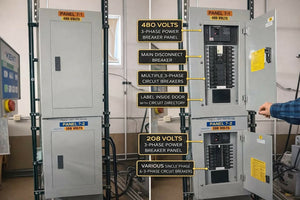
For one- and two-family dwellings, disconnect location rules can change the whole equipment layout, often pushing the main disconnect outdoors.
That can mean using a main breaker, a grouped disconnect, or an exterior-rated disconnect assembly. In plain terms, you may end up choosing a meter-main or outdoor disconnect assembly instead of a standard indoor main panel.
Those layout shifts flow straight into breaker sizing, enclosure choice, and feeder planning under Article 220.
How the 2026 Code Changes Affect Breaker Sizing, Compatibility, and Sourcing
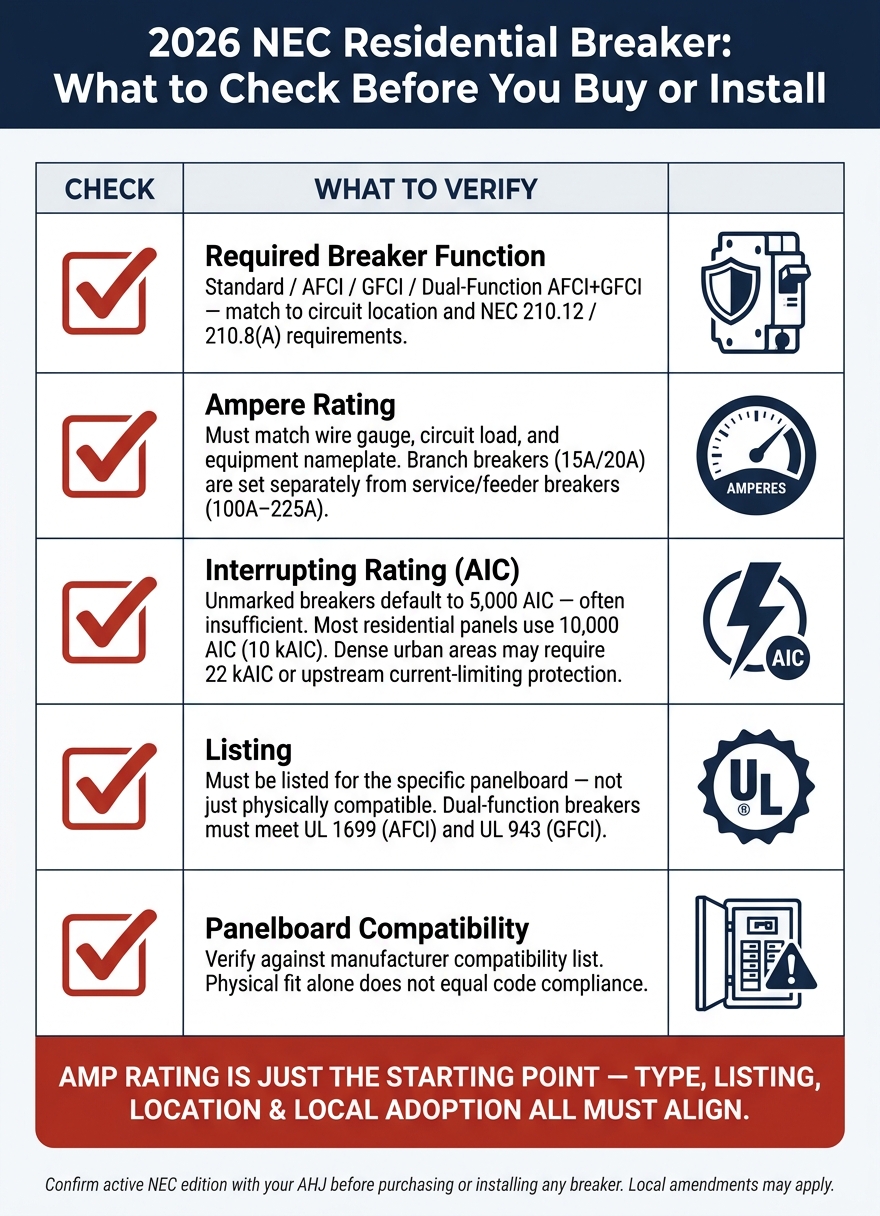
2026 NEC Residential Breaker Selection: 5-Point Compliance Checklist
Load Calculations and Breaker Sizing Under Article 220
Dwelling-unit load calculations still include general lighting, the required small-appliance circuits, and the laundry circuit.
That calculation is used to size the feeder and main breaker. It does not set the branch-circuit breaker size. A 15 A or 20 A branch breaker still has to match the wire gauge and the actual circuit load. A dryer breaker still follows the appliance nameplate. So when you total the loads and apply the demand factors, the dwelling-unit calculation helps you decide whether the service can use a 150 A or 200 A main breaker.
After you’ve set the load, there’s another step people sometimes blur together: checking the breaker’s listing, interrupting rating, and panel fit. Those are separate checks.
The optional single-family method can lower the calculated service load. It uses 100% of the first 10,000 VA and 40% of the remainder. But there’s a catch. If you add an EV charger, that load is added back at 100% with no demand factor, which can drive the total up again.
Protection type is only one piece of the puzzle. AFCI, GFCI, and SPD rules do not change available fault current. That has to be checked on its own. Load calculation tells you one thing; interrupting rating tells you another. They’re related to the same job, but they answer different questions.
What to Check Before Buying or Installing a Breaker
Getting the amp rating right is only part of the job. A breaker also has to be the right type, rated for the fault current, and listed for the panel it’s going into.
| Check | What to Verify |
|---|---|
| Required breaker function | Standard, AFCI, GFCI, or dual-function AFCI/GFCI |
| Ampere rating | Matches wire gauge, circuit load, and equipment nameplate |
| Interrupting rating (AIC) | At or above available fault current at that panel location |
| Listing | Listed for the specific panelboard, not just physically compatible |
| Panelboard compatibility | Fits the panel and appears on the manufacturer's compatibility list |
The interrupting rating point gets missed a lot on residential work. An unmarked breaker defaults to a 5,000 A interrupting rating under NEC 110.9 and 240.83(C), and that often isn’t enough. Most residential panels use breakers marked 10,000 A (10 kAIC). But in dense urban areas, where services may be fed by large utility transformers, available fault current can go past that mark. When that happens, you may need 22 kAIC devices or upstream current-limiting protection.
Listing and compatibility are not the same thing. A breaker can slide onto the bus and still fail the code test if it isn’t listed for that panel. Physical fit alone doesn’t make it acceptable. The safe move is to check the manufacturer’s compatibility list, not just the slot size.
Conclusion: Main NEC 2026 Takeaways for Residential Breakers
Put it all together, and the 2026 updates shrink your breaker options pretty fast. For residential work, breaker selection now turns on AFCI/GFCI coverage, required SPDs, and revised disconnect-location rules.
For work in the field, the main point is straightforward: code compliance starts with the load calculation and the fault-current check. These rules deal with a major residential fire risk. Before you buy or install any breaker, confirm which NEC edition your jurisdiction enforces and whether there are local amendments in play.
Then size service and feeder breakers using Article 220 load calculations. After that, verify the available fault current and the breaker’s interrupting rating. GFCI coverage now brings more outdoor and damp-location circuits into the picture.
Before ordering or installing breakers, make sure the device matches both the panel and the application. An AFCI or GFCI breaker that isn’t listed for the specific panelboard can still fail inspection, even if the amp rating and protection function look right. SPDs also need to be listed for the application and installed according to manufacturer instructions. If you’re sourcing through Electrical Trader, check listing marks, condition, and panel compatibility before installation.
Amp rating is just the starting point. Type, listing, location, and local adoption all have to line up.
FAQs
Do all home circuits need AFCI in 2026?
No. The National Electrical Code does not require AFCI protection on every home circuit.
It is required in many residential settings to detect hazardous arcing and help prevent fires. But the code applies this protection to specific areas and circuit types, not every circuit.
If you want to confirm which circuits in your home need AFCI protection, talk to a licensed electrician.
When do I need a dual-function breaker?
You need a dual-function breaker when the same circuit requires both GFCI and AFCI protection.
A standard breaker protects against overloads and short circuits. But it doesn't detect ground-fault leakage current or hazardous arcing conditions. A dual-function breaker handles both on a single circuit.
How do I know if 10 kAIC is enough?
A 10 kAIC rating is enough only when the breaker's interrupting rating is equal to or higher than the available fault current at that spot in the panel.
That matters because fault current changes based on your utility service, transformer impedance, and conductor length. Have a licensed electrician check your system's available fault current and make sure the components are matched the right way.