




Natural Gas vs Diesel Generators: Key Differences
When choosing between natural gas and diesel generators, the decision depends on your priorities like cost, performance, maintenance, and usage environment. Here's a quick summary:
- Diesel Generators: Known for reliability and quick power delivery (5–10 seconds to full load). They are fuel-efficient and perform well under heavy loads. However, they require on-site fuel storage and higher maintenance. Diesel is ideal for remote locations and emergency applications but produces more emissions and noise.
- Natural Gas Generators: Cleaner, quieter, and better suited for urban areas with pipeline access. They cost less to fuel but are less efficient and depend on utility infrastructure, which may fail during emergencies. Maintenance involves spark plug and ignition system upkeep.
Quick Comparison
| Feature | Diesel Generators | Natural Gas Generators |
|---|---|---|
| Fuel Efficiency | 20–40% more efficient | Less efficient |
| Environmental Impact | Higher emissions | Lower emissions (30% less CO₂) |
| Noise Levels | 75–90 dB(A) | 58–69 dB(A) |
| Initial Cost | Lower for large units | 50–100% higher for large units |
| Maintenance | Requires fuel upkeep | Spark plug and ignition maintenance |
| Reliability | Independent with on-site fuel | Depends on pipelines |
| Lifespan | 20,000–30,000 hours | 15,000–20,000 hours |
Diesel generators are best for critical, remote, or emergency applications. Natural gas generators work well in urban, regulated environments. Your choice should align with your specific needs and location.
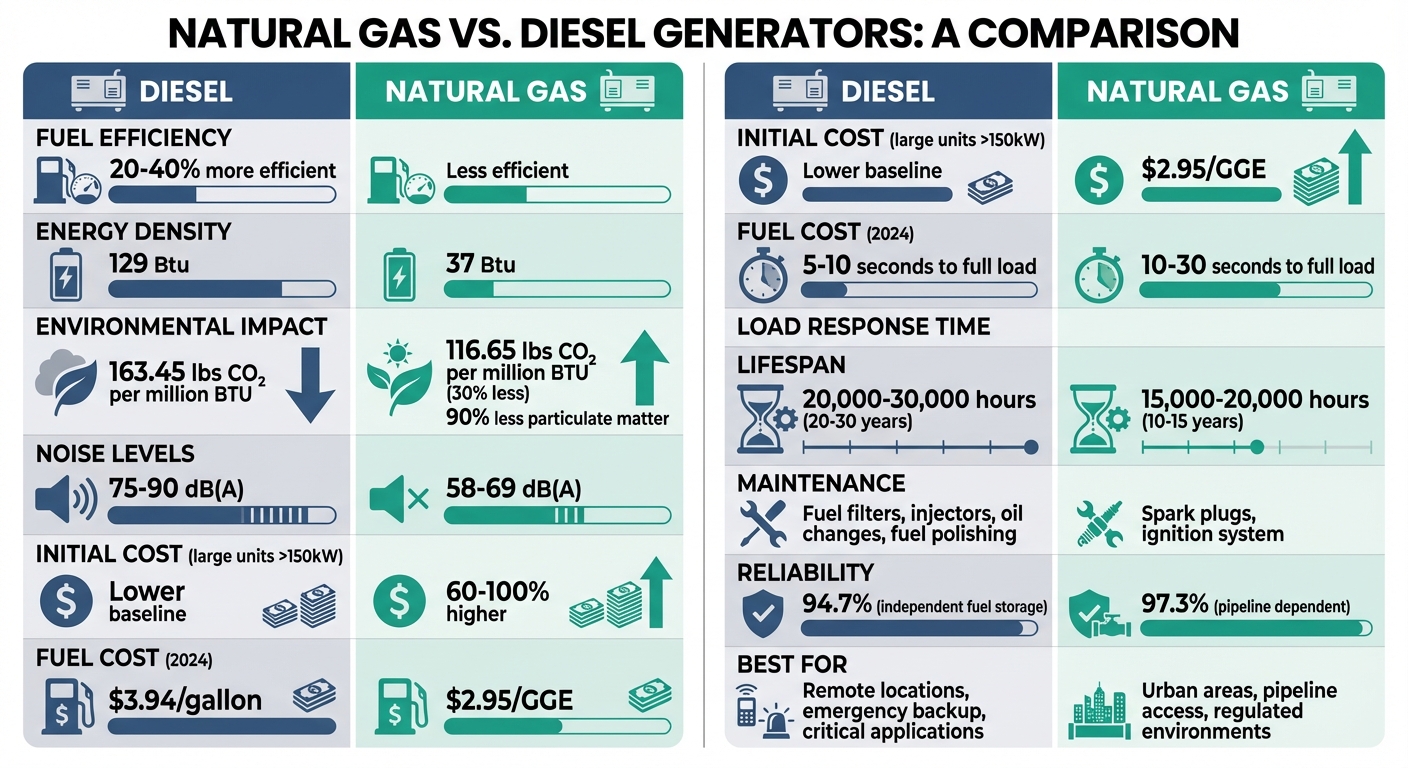
Natural Gas vs Diesel Generators: Side-by-Side Comparison Chart
Efficiency and Power Output
Energy Density and Fuel Efficiency
Diesel and natural gas differ significantly in energy density. Diesel delivers approximately 129 Btu, while natural gas offers only about 37 Btu. This disparity directly affects how much fuel is needed to produce the same amount of power.
Diesel generators are known for their higher thermal efficiency, thanks to compression ignition. Typically, diesel generators operate at about 40% thermal efficiency when running within their optimal range (up to 80% of total load capacity). This efficient combustion process enables diesel engines to extract more energy per gallon, making them 20% to 40% more fuel-efficient than natural gas engines.
For example, the 500 kW natural gas HIPOWER HNI-500 measures 19 feet in length, while a comparable diesel IGSA Volvo is slightly smaller at 17.5 feet. This size difference highlights the larger footprint required for natural gas units due to their lower energy density.
Load Performance and Power Consistency
Fuel efficiency isn't the only factor - performance under varying load conditions is equally important. Diesel generators excel in meeting sudden power demands, reaching full load within 5–10 seconds, whereas natural gas units typically take 10–30 seconds. Diesel engines also manage rapid load changes better, often running at 1,800 RPM. This speed not only conserves fuel but also reduces wear on internal components.
However, diesel generators can struggle at light loads. Operating below 50–70% of capacity may lead to "wet stacking", where unburned fuel and soot accumulate in the exhaust system. On the other hand, natural gas generators handle lighter loads more efficiently. They burn hotter and cleaner, making them a better choice for applications with variable power demands.
sbb-itb-501186b
Cost Analysis: Initial and Lifetime Ownership Costs
Upfront Costs and Installation
The initial expense of a generator depends heavily on its size. For units under 150 kW, natural gas generators often cost about the same or slightly less than diesel models. However, for industrial-sized units over 150 kW, natural gas generators can be 60% to 100% more expensive than comparable diesel options. For smaller units, the price difference is closer to 50% higher.
Installation costs add another layer to the upfront investment. Natural gas generators require a dedicated utility hookup and gas line infrastructure. If these systems aren't already in place, the installation can become significantly more expensive. As Depco Power Systems highlights:
If your facility doesn't already have a sufficient gas service line, installation can be costly.
Diesel generators, on the other hand, need on-site fuel storage, such as sub-base "belly tanks" or larger above-ground or underground day tanks. These storage solutions increase the initial equipment costs and the physical footprint of the setup. Beyond these upfront considerations, fuel costs play a major role in determining the long-term economic feasibility of each generator type.
Fuel Costs Over Time
Diesel generators are generally 20% to 40% more fuel-efficient than their natural gas counterparts due to their compression ignition systems and higher energy density. However, natural gas is typically cheaper per unit. For example, in 2024, the national average price for natural gas was $2.95 per GGE (Gasoline Gallon Equivalent), compared to $3.94 per gallon for diesel. This price gap has been even wider in the past, such as in 2022, when natural gas cost $2.76 per GGE while diesel was $5.02 per gallon.
That said, fuel efficiency can tip the scales. Diesel’s higher energy density - around 129 Btu compared to 37 Btu for natural gas - means diesel generators consume less fuel to produce the same power. For instance, a 500 kW diesel generator uses roughly 35 gallons of fuel per hour at full load. In contrast, natural gas's lower energy content requires a higher volume of fuel to match diesel's output, which can diminish its lower price advantage. These differences in fuel efficiency and consumption directly affect the overall cost of operating each generator over time.
Total Cost of Ownership
When factoring in both initial costs and ongoing fuel expenses, the total cost of ownership can differ significantly. A 10-year analysis of a 50-kW unit shows that diesel generators cost approximately $28,000, while natural gas models come in at $32,000. Diesel units typically break even within 2.5 years, whereas natural gas units take about 3.5 years to reach the same point.
Real-world examples illustrate these dynamics. In 2024, a Brazilian manufacturing plant chose diesel generators over natural gas, cutting annual fuel costs by about $20,000. Similarly, an Indian small business achieved a break-even point on their diesel generator investment in just 24 months - 15 months faster than the break-even period for a natural gas unit.
The U.S. Department of Energy offers this perspective:
Natural gas generators' lower fuel costs per kilowatt-hour of energy generated allows grid-connected natural gas backup generators to economically produce more revenue than diesel generators. However... lower capital costs make diesel generators more economic options than natural gas generators on a net present value (NPV) basis.
Other considerations, like emissions fees - which can reach $61.73 per ton in areas like Texas as of September 2023 - and differences in lifespan (diesel generators typically last 20,000 to 30,000 hours compared to natural gas's 15,000 hours), further shape the total ownership costs over time.
Maintenance and Durability
Maintenance Requirements
Diesel and natural gas generators have distinct maintenance needs. Diesel generators are known for their simpler compression ignition systems, which don’t include spark plugs or high-voltage ignition components. On the other hand, natural gas generators require regular servicing of parts like spark plugs, ignition coils, and carburetors. Maintaining diesel fuel involves using stabilizers, periodic fuel polishing, and replacing filters and water separators. In contrast, natural gas, delivered through pipelines, eliminates on-site fuel maintenance and burns cleaner. As Depco points out:
Natural gas engines do have spark plugs and ignition components that need periodic replacement (unlike diesels).
Natural gas’s cleaner burn results in less soot and carbon buildup, helping to keep engine oil cleaner for longer periods. Additionally, industrial diesel generators typically run at 1,800 RPM, compared to smaller units that operate at 3,600 RPM, reducing overall wear and tear. These differences in maintenance directly affect the durability and lifespan of both types of generators.
Generator Lifespan
Diesel generators stand out for their longer lifespan, which is closely tied to their lower maintenance demands. They typically last 20 to 30 years, even under heavy use, compared to the 10 to 15 years expected from natural gas generators. This durability stems from their solid construction and lower operating speeds, which minimize stress on components. Diesel generators also have prime power overhaul intervals ranging from 15,000 to 25,000 hours, while natural gas units generally fall between 12,000 and 30,000 hours. Industry expert Patrick Paden highlights this reliability:
Diesel generators generally offer superior efficiency, longer lifespan, and better reliability for critical business applications.
For critical settings like hospitals or data centers, where reliability and a 20+ year lifespan are essential, diesel generators remain the go-to option.
Environmental Impact and Noise Levels
Emissions and Air Quality
When it comes to emissions, natural gas generators offer clear environmental benefits. They release 90% less particulate matter and produce 116.65 pounds of CO₂ per million Btus, compared to diesel's 163.45 pounds. Additionally, natural gas units emit about 30% less nitrogen oxide (NOₓ) and sulfur oxide (SOₓ) than their diesel counterparts. As Mike McGlothlin from Big Bear Engine Company puts it:
Natural gas generators produce approximately 30-percent less nitrogen oxide (NOₓ), carbon dioxide (CO₂), and sulfur oxide (SOₓ) pollutants.
Diesel generators, however, have made significant strides in reducing emissions. Thanks to advancements like Tier 4 engines and Selective Catalytic Reduction (SCR) technology, particulate matter and nitrous oxide emissions from off-highway diesel engines have dropped by 99% since 1996. That said, diesel engines running at light loads can experience "wet stacking", a condition where unburned fuel and soot accumulate in the exhaust. Cleaner emissions not only benefit air quality but also help minimize disruptions in communities, especially when paired with quieter operations.
Noise Levels and Urban Use
Noise is another crucial factor, particularly in urban environments. Natural gas generators operate at noise levels of 58–69 dB(A) at 23 feet, significantly quieter than diesel units, which range from 75–90 dB(A). This reduced noise output makes natural gas generators a better fit for noise-sensitive locations like hospitals, schools, and residential areas. Their quieter operation is largely due to lower compression ratios and fewer moving parts.
Another advantage of natural gas generators is the absence of the strong diesel odor, which makes them more suitable for densely populated areas. While modern diesel units can be equipped with sound-attenuating enclosures, such as those using rock wool insulation, natural gas generators are still the preferred choice in areas with strict noise regulations. Urban zones often impose fewer permitting challenges and operational restrictions on natural gas units, unlike diesel generators that require complex exhaust treatment systems to comply with regulations.
Fuel Supply and Reliability
Fuel Storage and Accessibility
One major distinction between diesel and natural gas generators lies in how they receive fuel. Diesel generators store fuel directly on-site, with capacities ranging from a few hundred gallons to over 10,000 gallons. In contrast, natural gas generators connect directly to underground pipelines, relying on steady municipal gas pressure for operation.
This difference becomes especially important during emergencies. According to Generator Source:
Diesel generators are the undisputed champions of reliability for life-safety and emergency standby applications. The primary reason is their on-site fuel storage.
Natural gas pipelines, while convenient, can be vulnerable. Earthquakes, floods, or other disasters can rupture underground lines, and many pipeline systems depend on grid-powered pumps. A widespread outage could disrupt the gas supply. While natural gas generators can theoretically run indefinitely as long as the pipeline remains functional, diesel generators are limited by the size of their fuel tanks and the availability of refueling services during a crisis.
Reliability statistics show that natural gas systems average a 97.3% reliability rate, compared to 94.7% for diesel. Regional data highlights these differences: in Texas, natural gas systems achieve 98.3% reliability versus 97.3% for diesel, while in Florida, natural gas stands at 95.5% compared to diesel's 90.1%.
Fuel maintenance also influences reliability. Diesel requires stabilizers and periodic "polishing" to remove water and contaminants, while natural gas, delivered continuously through pipelines, avoids these maintenance needs.
These considerations are critical when assessing generator performance in emergency or remote scenarios.
Emergency and Remote Applications
In remote or off-grid locations, having a reliable, independent fuel source is essential. For sites like construction areas, mining operations, or oil platforms, diesel is often the go-to choice. These locations typically lack access to natural gas infrastructure, and transporting pressurized gas over long distances is neither practical nor cost-effective. For instance, in California, diesel powers 90% of backup generators.
Practical examples highlight diesel's reliability in remote settings. In 2024, a mining operation in Indonesia ran its generators continuously for 30 days using 2,000 liters of diesel stored in barrels. Similarly, during a five-day snowstorm-induced blackout in 2023, a rural U.S. household maintained refrigeration and heating with just 50 liters of stored diesel.
Bi-fuel systems offer another layer of reliability. These systems operate on natural gas during normal conditions but can switch to diesel if the gas supply is interrupted. This dual capability makes them popular in mission-critical facilities like hospitals, data centers, and emergency services, where uninterrupted power is non-negotiable.
Despite the extensive network of natural gas pipelines in the U.S. - totaling about 305,000 miles - diesel remains the preferred choice for emergency standby power when guaranteed fuel access is a priority.
Understanding these fuel supply factors is key to selecting the right generator for your specific needs and environment.
Diesel vs Natural Gas In 60 Seconds
Choosing the Right Generator
When selecting a generator, the decision largely depends on how and where it will be used, as well as your performance needs. Diesel generators are often the go-to choice for remote locations like construction sites or mining operations because they can store fuel on-site, offering independence from external fuel sources. This makes diesel particularly advantageous in isolated areas. On the other hand, natural gas generators are ideal for urban, stationary setups where pipeline infrastructure is already in place and stricter environmental regulations apply.
One of diesel's standout features is its quick load response - it can reach full load in just 5–10 seconds, compared to the 10–30 seconds typically required by natural gas generators. This rapid response makes diesel generators better suited for handling sudden power demands, especially for heavy equipment like pumps and compressors. In mission-critical environments such as hospitals, data centers, or emergency services, this speed can be a deciding factor. Additionally, diesel's ability to store fuel on-site ensures reliability during regional disasters, further solidifying its role in high-stakes applications.
However, natural gas has its own advantages, particularly in urban settings. It produces lower carbon dioxide emissions - 116.65 lbs per million BTU compared to diesel's 163.45 lbs - and operates more quietly, with noise levels ranging from 58–69 dB(A) versus diesel's 75–90 dB(A). This makes natural gas a better fit for noise-sensitive areas like residential neighborhoods or hospitals, often eliminating the need for costly soundproofing measures.
Maintenance needs also play a role in choosing the right generator. Diesel generators require more frequent upkeep, including tasks like fuel filter replacements, injector servicing, oil changes, and periodic fuel polishing. In contrast, natural gas generators primarily need spark plug and ignition system maintenance. These differences can significantly influence long-term costs, depending on how often the generator runs and the conditions it operates under. Fuel costs are another factor - natural gas averaged $2.95 per GGE in early 2024, while diesel was higher at $3.94 per gallon.
For facilities with existing gas lines and moderate runtime requirements, natural gas offers lower fuel costs and easier compliance with regulations. Meanwhile, for remote locations, emergency standby applications, or any scenario where fuel independence is critical, diesel remains the preferred option. Some operations even opt for bi-fuel systems, which primarily run on natural gas but automatically switch to diesel if the gas supply is interrupted. This hybrid approach combines the reliability of diesel with the cost benefits of natural gas, offering a balanced solution for diverse needs. Ultimately, the choice comes down to weighing performance, operational costs, and environmental considerations.
FAQs
Which generator is cheaper to own over 10 years?
Natural gas generators often prove to be a more cost-effective option over a 10-year period compared to diesel generators. This is largely due to lower fuel costs and reduced maintenance requirements. Natural gas tends to have more stable and predictable pricing, which helps with budgeting. Plus, its cleaner combustion process results in less engine wear, cutting down on repair needs. While the initial purchase price of a natural gas generator may be higher, the long-term savings on fuel and maintenance can make it the smarter financial choice for those planning for extended use.
How do I size a generator to avoid wet stacking?
To avoid wet stacking, it's crucial to select a generator that aligns with your load needs and run it at 70-80% of its maximum capacity. Wet stacking occurs when a generator operates under too light a load, leading to unburned fuel accumulating in the engine.
Start by calculating your total load in watts or kilowatts. Be sure to account for both the starting and running wattages of all your appliances. Then, choose a generator with an additional 20-30% capacity to ensure it operates efficiently and safely.
Is natural gas reliable during major power outages?
Natural gas stands out as a dependable energy source, especially during major power outages. Thanks to its robust pipeline network, disruptions are rare. Research highlights minimal outages and ongoing advancements in supply reliability, solidifying its role as a consistent choice for power generation.