

Low-Emission Power: SOFC Generators Explained
Solid Oxide Fuel Cell (SOFC) generators are a cleaner, more efficient way to produce electricity compared to traditional combustion-based systems. They use an electrochemical process to convert fuels like hydrogen, natural gas, or biogas into electricity, achieving efficiencies of up to 60% and even 80% in combined heat and power (CHP) setups. This means less fuel use and fewer emissions.
Key Highlights:
- High Efficiency: SOFCs outperform conventional generators with electrical efficiencies up to 60%.
- Fuel Flexibility: Can operate on hydrogen, natural gas, biogas, and more.
- Low Emissions: Minimal NOx, SOx, and particulate emissions.
- Quiet Operation: No moving parts mean silent and vibration-free performance.
- Challenges: High operating temperatures (600–1,000°C) can strain materials, and startup times are longer than conventional systems.
Recent advancements, like a 2025 innovation allowing SOFCs to operate at just 300°C, could make these systems more practical and accessible. Despite challenges, SOFCs are shaping the future of low-emission power generation for industries, commercial use, and hybrid energy systems.
Are solid oxide fuel cells the future of efficient green energy?
sbb-itb-501186b
How SOFC Generators Work
Solid Oxide Fuel Cell (SOFC) generators operate using a three-layer design that transforms fuel into electricity. Unlike traditional combustion engines that burn fuel, SOFCs rely on an electrochemical process, making them cleaner and more efficient.
Main Components of SOFC Generators
SOFC generators consist of several key parts that work together to produce electricity:
- Anode (fuel electrode): This porous layer, typically made from nickel-YSZ (yttria-stabilized zirconia), is where fuel oxidation occurs. Nickel acts as a catalyst, speeding up the reaction between fuel and oxygen ions while promoting effective gas flow.
- Cathode (air electrode): Situated on the opposite side of the anode, the cathode is often made from lanthanum manganite or similar materials. It reduces oxygen from the air into oxygen ions (O²⁻) and features a porous structure to facilitate gas movement.
- Electrolyte: Positioned between the anode and cathode, this dense ceramic layer - commonly made of YSZ - conducts oxygen ions from the cathode to the anode. It also blocks electrons, forcing them to travel through an external circuit, which generates electricity.
- Interconnect: This component links individual cells in series, increasing the voltage from under 1 V per cell to levels suitable for practical use.
These components work together in a sequence of electrochemical reactions to produce power.
Operating Process
The process begins at the cathode, where oxygen molecules interact with electrons from the external circuit:
O₂ + 4e⁻ → 2O²⁻
The resulting oxygen ions travel through the electrolyte to the anode, where they react with hydrogen fuel:
H₂ + O²⁻ → H₂O + 2e⁻
This reaction releases electrons, which return to the external circuit to sustain the process. If carbon monoxide is present, it undergoes a similar reaction:
CO + O²⁻ → CO₂ + 2e⁻
SOFCs operate at high temperatures, ranging from 600°C to 1,000°C (1,112°F–1,832°F). These temperatures enable ionic conductivity and allow for internal fuel reforming. According to FuelCellsWorks:
"The high operating temperature means that fuels can be reformed within the fuel cell itself, eliminating the need for external reforming and allowing the units to be used with a variety of hydrocarbon fuels."
When natural gas (methane) enters the anode, the heat drives its conversion into hydrogen and carbon monoxide through an endothermic steam reforming reaction. This reaction not only generates hydrogen for the fuel cell but also helps cool the stack as the electrochemical processes generate heat. A single cell can deliver around 1 W/cm² of power.
To achieve usable power outputs, multiple cells are stacked together. For instance, Delphi Corporation developed a 5-kW auxiliary power unit using anode-supported planar SOFCs capable of running on reformed gasoline or diesel, making it suitable for heavy-duty trucks and luxury vehicles.
This combination of internal reforming and efficient ion transport is what drives the strong performance and reduced emissions of SOFC generators.
Benefits of SOFC Technology
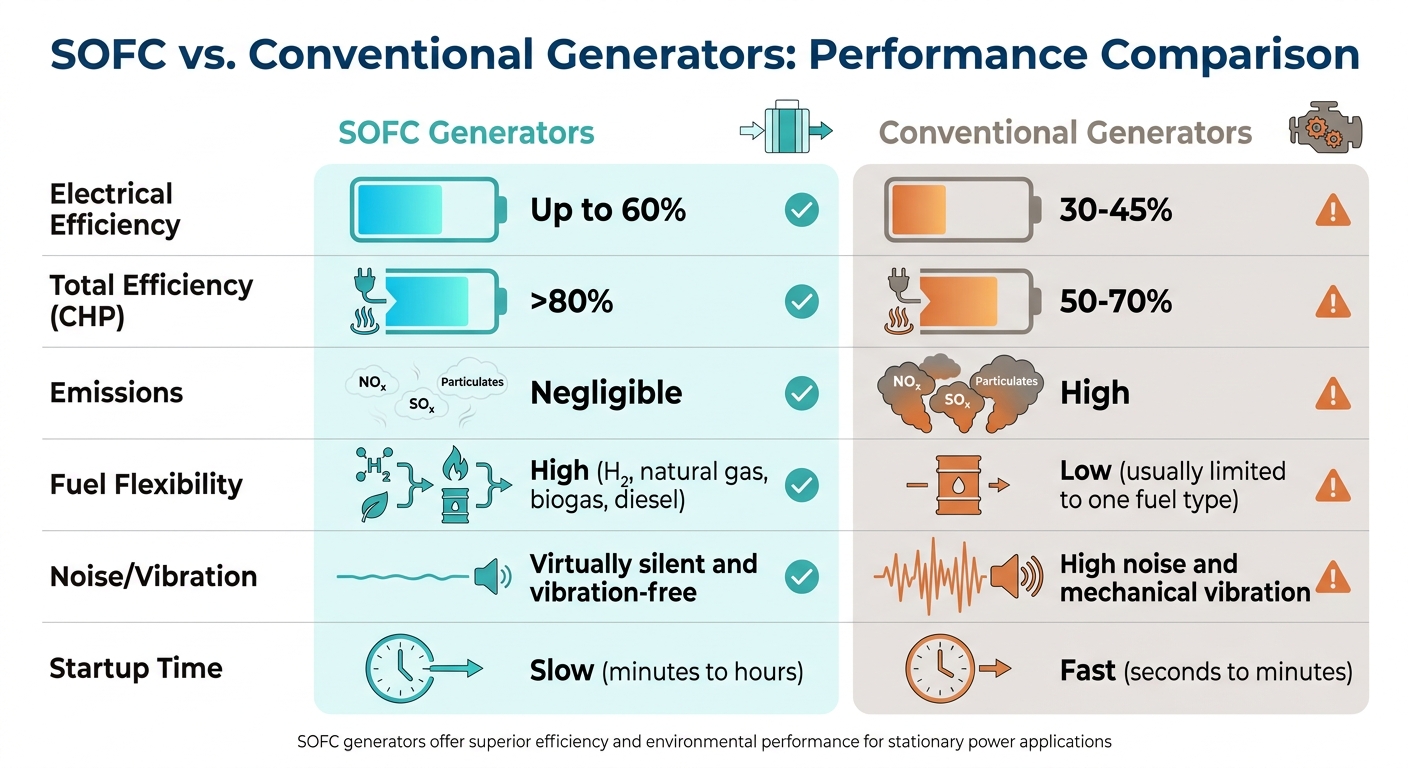
SOFC vs Conventional Generators: Efficiency and Emissions Comparison
Solid Oxide Fuel Cell (SOFC) generators bring a range of performance and environmental perks, thanks to their unique design and operational approach.
High Efficiency and Fuel Flexibility
SOFC generators stand out by converting chemical energy directly into electricity, bypassing the inefficiencies of combustion. This direct approach allows them to achieve electrical efficiencies of up to 60%, far surpassing the 30%–45% efficiency range of traditional generators. When paired with Combined Heat and Power (CHP) systems, their efficiency can climb past 80%, as they capture and repurpose exhaust heat for heating or even driving gas turbines.
Their high operating temperatures enable internal reforming, a process where light hydrocarbons like methane are converted into hydrogen directly at the anode. This built-in capability eliminates the need for an external reformer, reducing costs. According to the IEA Advanced Fuel Cells:
"The fuel processing-related costs for SOFC systems were much lower because of their higher temperatures and fuel flexibility. They also benefited from the internal reforming process that occurs naturally in SOFCs".
SOFCs are compatible with a wide range of fuels, including hydrogen, natural gas, biogas, diesel, and carbon monoxide. This adaptability makes them suitable for diverse energy sources, including renewable options like green hydrogen and biogas, which support carbon-neutral operations. They also maintain high efficiency even during part-load operations, making them ideal for balancing energy loads.
The combination of efficiency and fuel versatility not only enhances performance but also lays the groundwork for significant environmental benefits.
Low Emissions and Environmental Impact
SOFCs operate without combustion, which means they produce almost no NOx, SOx, or particulate emissions. Subhash C. Singhal, Director of Fuel Cells at Pacific Northwest National Laboratory, highlights this advantage:
"Solid oxide fuel cells (SOFCs) offer a clean, low-pollution technology to electrochemically generate electricity at high efficiencies; since their efficiencies are not limited the way conventional heat engine's is".
Their fuel flexibility also makes them a strong candidate for net-zero emissions when used with renewable fuels. A notable example is a Siemens/Westinghouse 100-kW atmospheric SOFC power system, which operated in the Netherlands for two years. It delivered 108 kW of AC electricity at 46% efficiency to the grid and provided 85 kW of hot water for district heating, all without any detectable performance decline. The system was later relocated to Essen, Germany, where it successfully ran for another 4,000 hours.
Comparison Table: SOFC vs. Conventional Generators
| Feature | SOFC Generators | Conventional Generators |
|---|---|---|
| Electrical Efficiency | Up to 60% | 30%–45% |
| Total Efficiency (CHP) | >80% | 50%–70% |
| Emissions | Negligible NOx, SOx, and particulates | High NOx, SOx, and particulates |
| Fuel Flexibility | High (H₂, natural gas, biogas, diesel) | Low (usually limited to one fuel type) |
| Noise/Vibration | Virtually silent and vibration-free | High noise and mechanical vibration |
| Startup Time | Slow (minutes to hours) | Fast (seconds to minutes) |
With their efficiency, adaptability, and minimal environmental footprint, SOFC generators are well-positioned to play a key role in the shift toward cleaner, carbon-neutral energy systems.
Challenges and Limitations of SOFC Generators
SOFC generators come with their share of technical hurdles, which complicate their path to widespread commercial use. These challenges stem largely from the extreme conditions required for their operation.
Material Durability and Compatibility
Operating temperatures for SOFCs are incredibly high - ranging from 1,112°F to 1,832°F (600°C to 1,000°C). This heat puts a lot of strain on the materials used. For instance, the commonly used anode material, nickel-yttria stabilized zirconia (Ni-YSZ), struggles with nickel coarsening, which reduces its catalytic efficiency. It also faces issues like sulfur poisoning from fuel impurities and carbon buildup (coking) when hydrocarbon fuels are used, both of which can damage the anode over time.
The cathode isn’t spared from problems either. It can develop higher electrical resistance due to chromium deposits from metallic interconnects, as well as airborne contaminants like silicon and sulfur. Additionally, oxide scale formation on interconnects at high temperatures further complicates matters. Another significant issue is the thermal expansion mismatch between ceramic and metallic layers. When these materials expand or contract at different rates during heating and cooling, it can lead to cracking, delamination, or even complete failure. As noted by Zarabi Golkhatmi in a research review:
"The commercial breakthrough of solid oxide fuel cells (SOFCs) is still hampered by degradation related issues."
- Zarabi Golkhatmi, Renewable and Sustainable Energy Reviews
To become commercially viable, SOFC systems need to limit their degradation rate to 0.2% per 1,000 hours of operation. For context, the SECA program set a much higher interim target of 4.0% per 1,000 hours back in 2008.
These material limitations also lead to operational difficulties, such as long startup times.
Startup Time and Operating Challenges
The high temperatures required for SOFCs mean they take a long time to start up. For example, planar SOFC stacks typically need about an hour to gradually reach their optimal temperature to avoid thermal shock. Subhash C. Singhal from Pacific Northwest National Laboratory highlights the benefits of reducing these temperatures:
"Reduction of the SOFC operating temperature by 200°C (392°F) or more allows use of a broader set of materials... simplifies thermal management, aids in faster start up and cool down, and results in less degradation of cell and stack components."
This lengthy startup process makes SOFCs less practical for applications where power needs to be available instantly - like emergency backup systems or passenger vehicles. The U.S. Department of Energy has set ambitious durability targets: 40,000 hours for stationary systems and over 5,000 hours for transportation uses. Despite these challenges, long-term stability is possible. For example, one SOFC stack demonstrated stable performance for an impressive 93,000 hours at 700°C (1,292°F), with a degradation rate of 0.5% per 1,000 hours.
Efforts to address these issues include innovations like micro-tubular designs and lower-temperature systems. Micro-tubular SOFCs, for instance, can start up in minutes instead of hours. Meanwhile, researchers are working on systems that operate at much lower temperatures, between 300°C and 600°C (572°F to 1,112°F). A breakthrough came in August 2025, when Kyushu University researchers published findings in Nature Materials about a scandium-doped electrolyte that enabled SOFC operation at just 300°C (572°F). These advancements are paving the way for broader applications and more practical use of SOFC technology.
Applications of SOFC Generators
Solid oxide fuel cell (SOFC) generators, despite facing technical hurdles, have proven their value in real-world applications, showcasing their potential in various sectors.
Industrial and Commercial Deployments
SOFC generators are increasingly used in facilities that need consistent and low-emission energy, including hospitals, industrial plants, research campuses, and commercial buildings. These systems help reduce carbon emissions and offer greater energy independence.
One standout example is SoCalGas, which installed Bloom Energy SOFC systems at its Pico Rivera and Monterey Park facilities in July 2020. According to Jawaad Malik, Vice President of Strategy and Sustainability, the initiative aimed to enhance energy resilience. By the end of 2021, these facilities had slashed their grid power consumption by 76%, dropping from a 2019 baseline of 9.6 million kWh. The SOFC systems not only maintained power during grid outages but also fed excess energy back to the grid.
Another example is the BlueGen 15 2.0 SOFC system at the National Energy Technology Laboratory (NETL) in Morgantown, West Virginia. Commissioned in November 2024, this 1.5 kW unit operated in "island mode" within a micro-grid setup. It achieved an overall efficiency of 89% and cut carbon emissions by 50% to 100%, depending on the fuel source.
These projects underscore the potential of SOFC systems to transform energy use in industrial and commercial settings.
Hybrid Systems and Emerging Technologies
Hybrid configurations are pushing SOFC technology to new heights. Integrating SOFCs with gas turbines or micro gas turbines (MGT) can achieve fuel-to-electricity conversion efficiencies above 70%, far outpacing the 20%–30% efficiency typical of standard recuperated microturbines.
In June 2022, Mitsubishi Power Europe and the Gas- und Wärme-Institut Essen e.V. (GWI) launched Europe’s first hybrid SOFC system at the GWI campus in Essen, Germany. This project, part of the "KWK.NRW 4.0" research initiative funded by the European Regional Development Fund, integrated the SOFC into the campus's power and heat systems. Professor Klaus Görner, GWI’s Scientific Director, emphasized the system’s adaptability:
"The flexibility of the plant, including ease of starting up and shutting down, its role in integrating renewable energy when the sun is not shining or the wind isn't blowing; and most of all the potential for sustainable power using hydrogen, are aspects we will be looking into."
Between 2020 and 2024, Nexceris, Czero, and Brayton Energy collaborated under the U.S. DOE ARPA-E INTEGRATE program to develop a 50 kWe SOFC/GT Hybrid Pilot System. This system used natural gas to generate power from both the SOFC and gas turbine, demonstrating effective management of transients and maintaining pressure balance between the anode and cathode.
These advancements highlight the growing role of hybrid systems in enhancing SOFC efficiency and expanding their applications.
SOFC Generators and Low-Emission Power Generation
Emission Reductions and Carbon Neutrality
SOFC generators are changing the way electricity is produced. Unlike traditional generators that rely on combustion, SOFCs generate electricity through electrochemical oxidation. This process eliminates the flame reactions responsible for producing NOx, SOx, and particulates.
One of the biggest advantages of SOFCs is their efficiency. With electrical efficiencies reaching up to 60%, they outperform conventional heat engines, which are limited by the Carnot cycle.
Their fuel flexibility is another standout feature. SOFCs can operate on hydrogen, natural gas, biogas, and ethanol. When fueled by biogas or green hydrogen, the carbon emissions are either part of a short-term cycle or eliminated altogether. Operating at high temperatures - between 1,112°F and 1,832°F (600–1,000°C) - SOFCs can internally reform light hydrocarbons like methane directly at the anode. This process uses the system’s own waste heat to power the endothermic reaction, further boosting efficiency.
These features make SOFCs a strong candidate for integration into advanced, low-emission power systems.
Integration with Power Generation Equipment
To fully benefit from the emission reductions and fuel flexibility of SOFCs, proper integration into power systems is essential. The Balance of Plant (BoP) components play a key role, transforming the raw electrical output into grid-ready power. This includes air preheaters, fuel reformers, water heat exchangers, and power electronics to convert DC power into AC for grid use.
For industrial setups, pairing SOFCs with heat recovery systems increases efficiency and maximizes returns. The exhaust heat can be repurposed to drive steam systems or provide hot water, pushing the total system efficiency well beyond the electrical output alone. When sourcing components for SOFC integration, it’s important to prioritize reliable heat exchangers and inverters to ensure stable grid synchronization. Platforms like Electrical Trader offer essential equipment such as transformers and power electronics for completing these systems.
In more advanced applications, pressurized SOFCs can be combined with gas turbines in hybrid configurations. In this setup, the SOFC serves as the primary generator, while its high-pressure exhaust powers a turbine to capture additional energy. This hybrid approach enhances efficiency and supports low-emission industrial energy solutions.
Conclusion
Solid oxide fuel cell (SOFC) generators stand out for their ability to provide high efficiency and low emissions in industrial and commercial power generation. By converting fuel into electricity through electrochemical reactions, they achieve electrical efficiencies over 60%, and when combined with heat recovery systems, total efficiencies can exceed 80%.
These systems are compatible with a range of fuels, including natural gas, biogas, hydrogen, and coal gas, offering flexibility for various operational needs. SOFCs also emit very low levels of NOx, SOx, and particulates, while operating almost silently. This makes them an appealing option for industries facing stricter emissions regulations and noise restrictions.
However, challenges remain. High operating temperatures can impact material durability, and longer startup times may not suit every application. Encouragingly, ongoing developments in lower-temperature SOFC designs are helping to address these issues, making the technology more accessible and reliable.
"Solid oxide fuel cells (SOFCs) offer a clean, low-pollution technology to electrochemically generate electricity at high efficiencies; since their efficiencies are not limited the way conventional heat engine's is".
For industries seeking cleaner power solutions, SOFCs provide a clear path forward. Whether used as standalone systems or combined with gas turbines in hybrid setups, they deliver tangible benefits in efficiency and emissions reduction. This positions SOFC technology as a critical tool for meeting emissions targets, complying with regulations, and advancing the transition toward carbon neutrality.
FAQs
What does an SOFC need in the balance of plant (BoP)?
To operate efficiently, a Solid Oxide Fuel Cell (SOFC) depends on several crucial components within the balance of plant (BoP). These include the anode system, cathode system, and cooling system. Together, these systems ensure the SOFC functions smoothly and maintains its performance.
How long do SOFC generators take to start and why?
SOFC generators require more time to start up because they operate at extremely high temperatures - usually between 800°C and 1,000°C. The system needs this additional time to fully heat up and stabilize before it can work effectively.
What fuel impurities can damage an SOFC over time?
Impurities, such as sulfur compounds, pose a serious threat to solid oxide fuel cells (SOFCs) by causing sulfur poisoning of the anodes. This issue can result in a steady decline in performance and a noticeable drop in efficiency over time. To protect the system and ensure it operates effectively for as long as possible, consistent fuel purification is a must.