




How Hydrogen Improves Fuel Efficiency
Hydrogen is transforming energy systems by improving fuel efficiency and reducing emissions. Here's why it matters:
- Higher Efficiency: Hydrogen fuel cells convert over 60% of chemical energy to electricity, reaching up to 90% efficiency in combined heat and power setups. This is nearly double the efficiency of traditional combustion engines.
- Clean Energy: Combustion of hydrogen produces no CO₂, making it a cleaner alternative to fossil fuels.
- Energy Density: With an energy density of 33.33 kWh/kg, hydrogen outperforms gasoline and natural gas by weight.
- Grid Reliability: Hydrogen can be stored in salt caverns, offering long-duration and seasonal energy storage, essential for periods of low wind or solar energy.
Hydrogen also integrates into existing infrastructure with modifications like retrofitting turbines or blending with natural gas. Projects like HYFLEXPOWER and Utah's Intermountain Power Project showcase its practical application.
In short, hydrogen is a powerful tool for boosting efficiency, cutting costs, and supporting cleaner energy solutions.
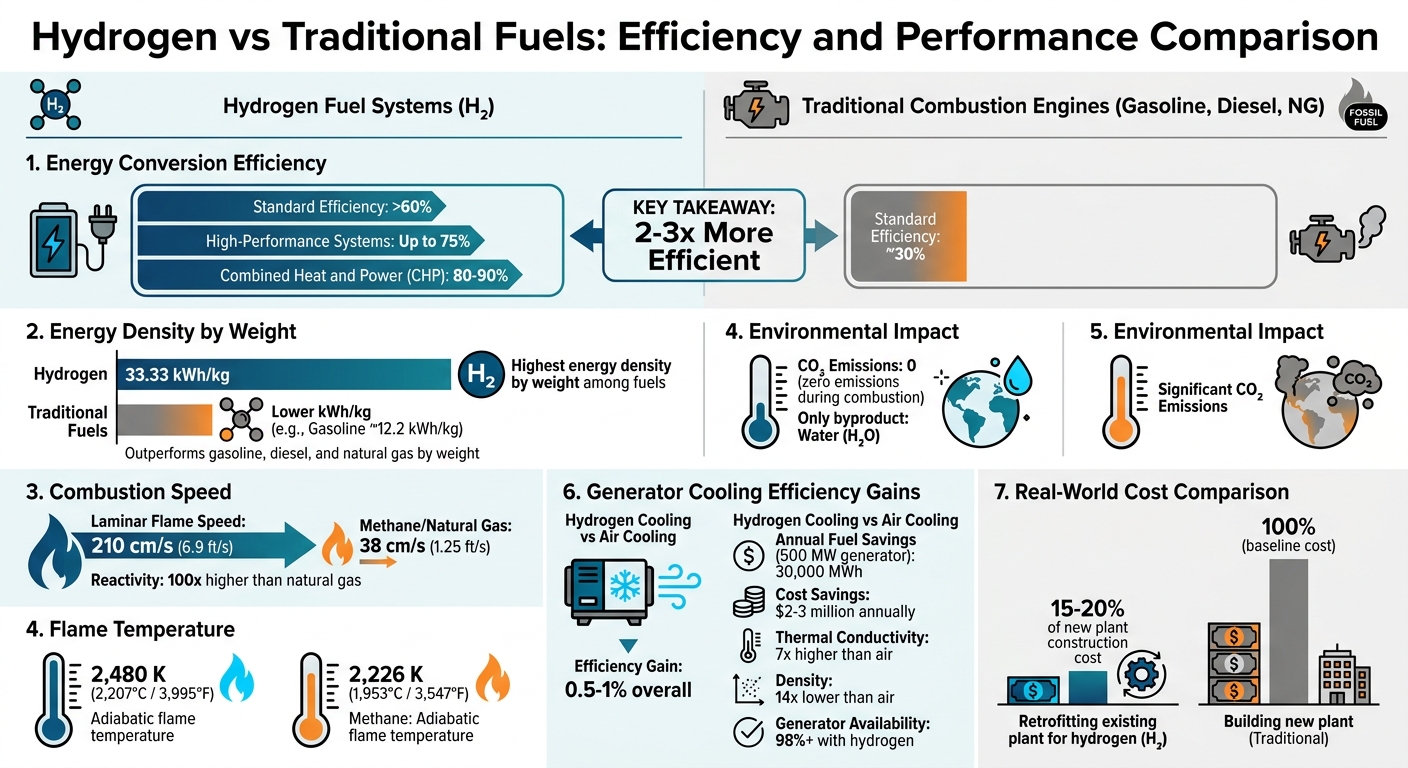
Hydrogen vs Traditional Fuels: Efficiency and Performance Comparison
The Green Hydrogen Efficiency - Odyssey From Electrolysis to End Use
sbb-itb-501186b
How Hydrogen Fuel Systems Work
Hydrogen fuel systems create electricity through fuel cells, which convert chemical energy directly into electrical power without burning the fuel. This approach, often referred to as "cold combustion", avoids many of the inefficiencies found in traditional engines.
The Hydrogen Fuel Cell Process
Fuel cells operate based on a straightforward electrochemical reaction. Hydrogen gas enters the anode (negative electrode), where a platinum catalyst breaks each hydrogen molecule into protons and electrons. While the protons pass through an electrolyte, the electrons are forced to travel through an external circuit, generating direct current (DC) electricity. At the cathode, the protons and electrons reunite with oxygen from the air, forming water and releasing heat. By stacking multiple fuel cells, the system can be scaled to produce power ranging from portable devices to large-scale installations.
Fuel cells boast impressive efficiency, converting chemical energy to electricity at rates above 60%, and some systems achieve up to 75%. When waste heat is utilized in combined heat and power (CHP) setups, total efficiency can rise to 80% to 90%. For context, fuel cells are about twice as efficient as internal combustion engines when comparing fuel-to-wheel performance.
Why Hydrogen Outperforms Conventional Fuels
Hydrogen stands out with an energy density of 33.33 kWh/kg, making it the most energy-dense fuel by weight. This means hydrogen delivers more energy per pound compared to gasoline, diesel, or natural gas. Unlike batteries that need recharging, fuel cells continuously generate electricity as long as hydrogen is available.
The direct conversion of chemical energy into electricity gives hydrogen fuel cells a distinct advantage over traditional fuels. Combustion engines lose substantial energy to heat and mechanical friction, whereas fuel cells skip combustion altogether, leading to minimal energy loss. They also operate quietly, thanks to their lack of moving parts, and produce zero carbon dioxide emissions during operation. Different types of fuel cells cater to various applications, from PEMFCs (operating between 140°F and 212°F) used in vehicles and backup power, to SOFCs (running at 1,832°F) designed for large-scale stationary power generation.
This combination of efficient energy conversion and high energy density positions hydrogen as a powerful option for cleaner and more effective power generation, setting the stage for future advancements in energy systems.
How Hydrogen Increases Power Generation Efficiency
Hydrogen enhances power generation efficiency by enabling rapid and complete combustion. Its reactivity is 100 times higher than natural gas, with a laminar flame speed of 210 cm/s (6.9 ft/s) compared to methane's 38 cm/s (1.25 ft/s). This high reactivity ensures fast combustion with minimal energy loss, making it a powerful option for improving system performance. Combined with hydrogen's high energy density, these characteristics make it an efficient fuel for power generation.
Hydrogen's high energy content also plays a key role. It allows less fuel to be used while still generating the same amount of power, reducing fuel weight and increasing overall efficiency.
Thermal Efficiency Gains with Hydrogen Blending
Hydrogen's rapid combustion properties can be leveraged even further when blended with natural gas. This approach improves thermal efficiency without requiring major equipment changes. The addition of hydrogen enhances the formation of OH and H radicals, ensuring complete combustion. Hydrogen also has a higher adiabatic flame temperature - about 2,480 K (approximately 2,207°C or 3,995°F) - compared to methane's 2,226 K (around 1,953°C or 3,547°F). When used in well-designed systems, this higher flame temperature contributes to better thermodynamic efficiency.
"Turbo-gas plants operating with hydrogen/methane mixtures represent an important solution for the decarbonisation of the thermo-electric generation sector."
- Donato Cecere, Researcher, ENEA
Blending hydrogen into fuel mixtures also allows systems to use leaner fuel-to-air ratios, which not only improves thermal efficiency but also helps reduce emissions. For instance, cutting CO₂ emissions by 50% in a gas turbine often requires a fuel mixture with about 75% hydrogen by volume. Additionally, hydrogen's faster reaction rates can lead to shorter combustor designs, reducing heat losses through liner walls and further boosting system performance. This streamlined approach makes retrofitting existing systems easier while paving the way for hydrogen integration into power generation.
Adding Hydrogen to Existing Power Systems
Adapting power systems to use hydrogen depends on the concentration of hydrogen in the fuel mix. For lower blends, such as 5–10%, a relatively simple modification - like adding a mixing station before the fuel delivery system - might be enough. However, when dealing with higher blends (50–100%), the process becomes more complex and typically involves replacing the combustion system and the fuel delivery skid entirely.
Selecting Hydrogen-Compatible Equipment
One of the first steps in retrofitting for hydrogen is identifying which components need to be upgraded. When hydrogen concentrations exceed 50%, existing combustors often need to be replaced with versions specifically designed to handle high hydrogen levels. These advanced combustors use fuel-injection micromixers, which ensure thorough mixing of hydrogen and air while maintaining high flow velocities. This design is critical for safety, as explained by Jeffrey Benoit, Vice President of Clean Energy Solutions at PSM:
"Hydrogen reacts very quickly, so micromixers not only allow uniformity in fuel-air distribution but can allow very high velocities of the reacting flow, preventing the hydrogen fuel-and-air mixture from burning inside the micromixer fuel injector, which would cause catastrophic damage".
Hydrogen's unique properties also demand a higher volumetric flow - over three times that of natural gas. This means the entire fuel system, including piping, valves, and manifolds, needs to be resized. Benoit elaborates:
"The reason for [replacing the fuel skid] is that hydrogen takes up significantly more volume to deliver the same amount of energy, so to keep the piping velocities within design conditions and the fuel system operating properly, all the piping and valves need to be sized for the maximum amount of hydrogen to be used".
Upgrading to autonomous control systems, such as AutoTune, is also recommended. These systems can optimize heating values and fine-tune injection parameters in real time. For hydrogen-cooled generators, sealing systems must be upgraded to maintain pressures of 15–30 psi above atmospheric levels, preventing hydrogen leaks at shaft exits.
For those sourcing components, Electrical Trader (https://electricaltrader.com) offers a broad selection of electrical and power distribution equipment tailored for hydrogen applications.
These upgrades lay the foundation for the retrofit strategies discussed below.
Retrofit Methods for Hydrogen Systems
Hydrogen retrofit strategies have been successfully applied in real-world projects. In 2023, PSM and Thomassen Energy retrofitted a Frame 7E gas turbine in Daesan, Korea. This involved replacing the combustion system with a FlameSheet combustor and upgrading the fuel delivery skid and manifolds to enable 100% hydrogen combustion. By February 2025, PSM had implemented its HyFlex FlameSheet combustion system in various commercial applications, including a 25-MW GE Frame 5, an 80-MW GE Frame 7E in Korea, and GE Frame 7F and Siemens Westinghouse 501F units in the U.S..
After equipment upgrades, safety becomes a top priority. Hydrogen is highly explosive when mixed with air in concentrations between 4% and 75% by volume. To mitigate risks, operators must follow strict purging procedures. For example, transitioning between air and hydrogen requires a "safety bridge" using CO2: the sequence is Air → CO2 → Hydrogen for startup, and Hydrogen → CO2 → Air for shutdown. Additional safety measures include installing gas detection systems at high elevations (since hydrogen rises) and ensuring proper ventilation. Daily monitoring of hydrogen purity, which should stay above 98%, is also essential for both efficiency and safety.
Many operators prefer a phased approach, starting with 10–20% hydrogen blends. This strategy spreads out costs and allows time to test performance before moving to higher concentrations. It also helps identify potential issues with materials like seals and gaskets, which may degrade due to hydrogen's small molecular size. Finally, ensuring compatibility with existing grid control systems through standards like IEC 61850 and DNP3 is crucial for seamless integration.
Operating and Maintaining Hydrogen Systems
Maintaining hydrogen systems after recent retrofits requires careful attention to ensure they run efficiently. Daily monitoring plays a key role in preserving these efficiency gains, with hydrogen purity being one of the most important factors to watch. Purity levels should stay at 98% or higher. Even a small drop, like from 99.2% to 98.5%, can lead to noticeable temperature increases in generators. For instance, in a 350 MW unit, a gradual rise in temperature was observed over three months when purity fell from 99.2% to 98.5%. The issue was traced to a sealing oil system operating at slightly low pressure, allowing air to infiltrate. Adjusting the oil pressure and performing a controlled purge brought the system back to optimal efficiency. This example highlights how even minor deviations can have a significant impact on performance.
Fast Refueling and Reduced Downtime
Hydrogen systems typically operate at pressures between 15 and 30 psi above atmospheric levels. This range increases gas density, improving heat capacity and thermal conductivity while also preventing air from entering the system. The sealing oil system must maintain a pressure higher than the hydrogen to create a reliable liquid barrier, which helps minimize leaks and reduces downtime. Around 98% of power plants use hydrogen instead of air for cooling generators because of its superior heat transfer properties and lower windage losses.
Maintenance schedules depend on how intensively the system is used. High-demand industrial environments often require quarterly inspections of seals, filters, and leak detection systems. In contrast, facilities with lighter usage can extend these checks to every six months. Thermal imaging is a key tool for identifying hot spots caused by blockages or damaged baffles, complementing the regular inspections of seals and filters.
"Small deviations from normal can have big consequences over time. Don't just look at whether readings are 'acceptable' - compare them to what's normal for your specific unit." - Rotormind, Engineer, Powerplant Manual
These proactive maintenance strategies are crucial for integrating advanced monitoring systems that help maintain overall efficiency.
Monitoring Systems for Maximum Efficiency
Efficient refueling is just one aspect; real-time monitoring is equally vital for catching issues early. Monitoring hydrogen purity, pressure, and temperature trends in real time allows operators to spot potential problems before they escalate. For example, in a 500 MW unit, hydrogen detection alarms only went off during load changes. Upon investigation, it was discovered that thermal expansion and contraction of the generator housing caused an intermittent mechanical seal leak. Replacing the seal during a planned outage resolved the issue.
Keeping detailed service logs is another important practice. These logs help operators track wear and pressure trends, making it easier to anticipate repairs. Regular updates to control software can prevent glitches and improve operational efficiency. Additionally, maintaining an inventory of high-quality spare parts ensures that downtime is minimized during unexpected repairs. For sourcing components like valves, manifolds, or control systems, Electrical Trader (https://electricaltrader.com) offers a wide range of equipment tailored for hydrogen applications.
Conclusion
Hydrogen offers a clear boost in power generation efficiency. For instance, fuel cells are two to three times more efficient than traditional gasoline-powered internal combustion engines. Additionally, using hydrogen to cool large generators can deliver a 0.5% to 1% overall efficiency gain compared to air cooling. In practical terms, for a 500 MW generator, this equates to about 30,000 MWh in annual fuel savings, valued at $2 to $3 million. Hydrogen's physical properties, like its seven times higher thermal conductivity and 14 times lower density compared to air, further reduce windage losses and stabilize operating temperatures. This combination helps push generator availability rates to an impressive 98% or higher.
Retrofitting existing infrastructure to accommodate hydrogen is both feasible and cost-effective. For example, upgrading a modern combined-cycle gas turbine to handle high-hydrogen fuel blends typically costs just 15% to 20% of building an entirely new plant. Real-world projects illustrate this potential: the HYFLEXPOWER demonstration in France successfully ran turbines on 100% green hydrogen, and the Long Ridge Energy Generation Project in Ohio is already operating on natural gas-hydrogen blends. These examples highlight how decarbonization is achievable without prematurely retiring valuable assets, provided the right equipment upgrades and planning are in place.
"Hydrogen enables the decarbonisation of gas turbines without the economic and operational disruption of early retirement." - Hydrogenera.eu
To fully realize hydrogen's potential, sourcing reliable, hydrogen-compatible equipment is critical. Materials must meet ASME B31.12 standards to prevent hydrogen embrittlement, and specialized components like burners, valves, and monitoring systems are essential to manage hydrogen's unique characteristics. Platforms such as Electrical Trader (https://electricaltrader.com) simplify the process by offering hydrogen-ready equipment, including fuel-injection systems and high-integrity seals, helping professionals secure the necessary components without delays.
FAQs
Is hydrogen fuel more efficient end-to-end than natural gas?
Hydrogen fuel, when considered from production to end use, tends to be less efficient than natural gas. The processes involved - producing, compressing, and transporting hydrogen, particularly when derived from natural gas - lead to considerable energy losses. For instance, hydrogen fuel cell vehicles require roughly three times more primary energy per mile compared to battery electric vehicles running on grid electricity. Although hydrogen performs well in certain areas, such as heavy-duty transportation, its overall efficiency falls short of natural gas in most cases.
What upgrades do turbines need to run on high hydrogen blends or 100% hydrogen?
Turbines need upgrades to their combustion technology, such as adjustments to burners and combustion systems. These updates help tackle issues like the risk of flashback, faster flame speeds, and managing NOx emissions. These improvements are essential for ensuring turbines operate safely and efficiently when using high hydrogen blends or even 100% hydrogen.
How is hydrogen stored safely for long-duration grid backup?
Hydrogen storage for grid backup prioritizes both safety and efficiency. The most common methods include:
- Compressed gas storage: High-pressure tanks are specially engineered to prevent leaks and ensure secure containment.
- Liquid hydrogen storage: Cryogenic tanks maintain extremely low temperatures, around -253°C, to keep hydrogen in its liquid state.
- Chemical storage: Hydrogen is immobilized in compounds like metal hydrides, providing a stable and controlled storage option.
Each system is built to meet rigorous safety standards, utilizing durable materials and thoughtful designs to address challenges like pressure, extreme temperatures, and chemical reactivity.





