Load Break vs Fault Interruption: Key Differences
When it comes to medium-voltage systems, load break switches (LBS) and fault interrupters serve distinct purposes. Here's the short answer:
- Load Break Switches: Handle normal load switching and isolation. They manage routine operations like sectionalizing feeders or isolating equipment for maintenance. However, they cannot interrupt fault currents and rely on upstream devices for protection.
- Fault Interrupters: Devices like circuit breakers and fuses are built to detect and clear high-energy faults. They protect the system by interrupting fault currents quickly, preventing damage and system failures.
Quick Comparison
| Feature | Load Break Switch (LBS) | Fault Interrupter (e.g., Circuit Breaker) |
|---|---|---|
| Primary Function | Normal load switching, isolation | Fault protection, high-energy interruption |
| Interrupting Capacity | Normal load currents only | High fault current capacity (25,000–63,000+ A) |
| Fault Sensing | None (relies on upstream devices) | Integrated (thermal, magnetic, or electronic) |
| Automation | Manual or remote-controlled | Automatic tripping during faults |
| Cost & Maintenance | Lower cost, simpler upkeep | Higher cost, more maintenance required |
Key takeaway: Use each device for its intended role. Load break switches are for routine operations, while fault interrupters handle fault protection. Misusing these devices can lead to safety risks or unnecessary costs.
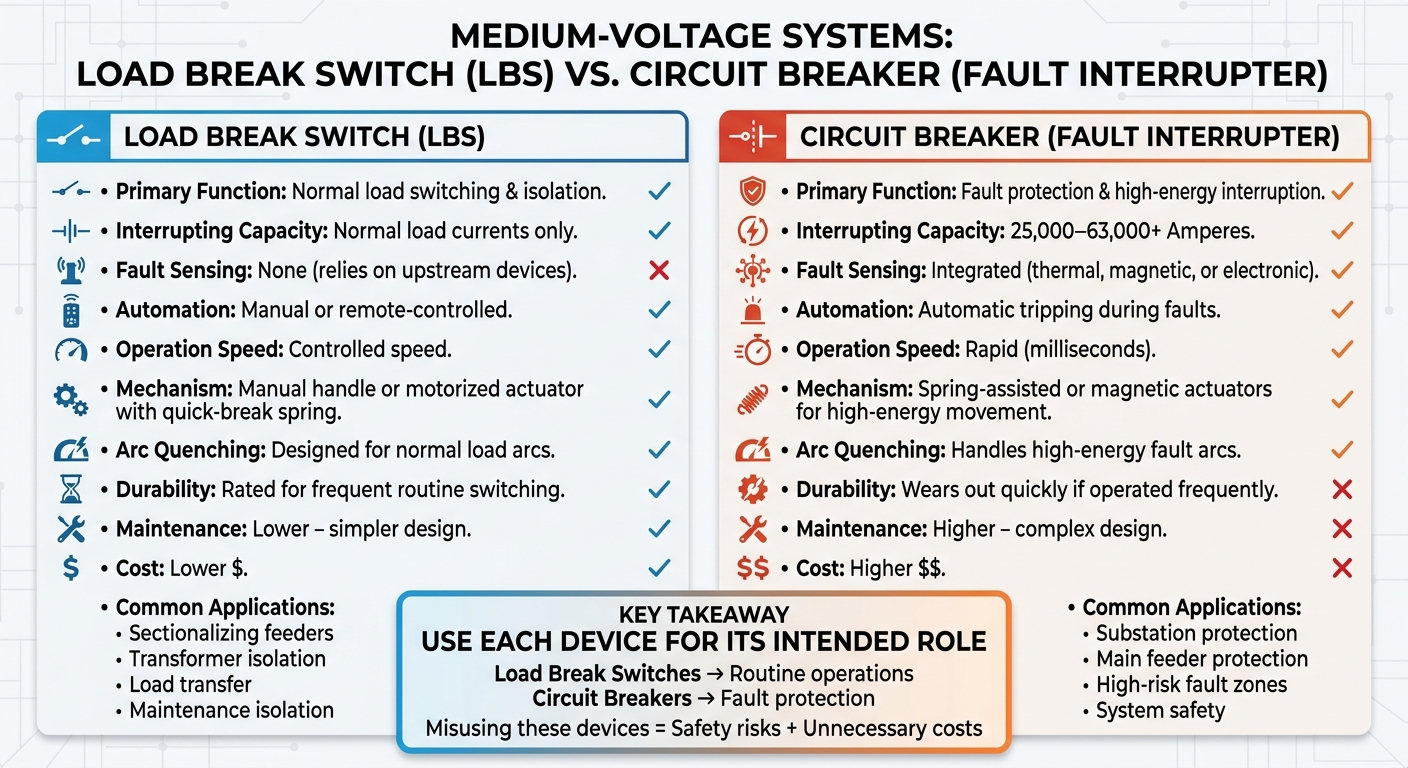
Load Break Switch vs Circuit Breaker Comparison Chart
Primary Functions and Operating Roles
Load Break Switches: Isolation and Load Switching
A load break switch is essential for everyday tasks like sectionalizing feeders, transferring loads, and isolating equipment for maintenance. It functions as an isolator, enabling circuits to open and close safely during normal operations. However, it depends on upstream protective devices to handle fault conditions.
These switches use air, gas, or vacuum methods to extinguish arcs, ensuring circuits can be opened and closed securely under standard conditions. Their real advantage lies in their flexibility. They allow utilities and facility managers to reconfigure networks, isolate transformers for servicing, or de-energize specific sections without disrupting the entire distribution system. The visible open point they provide is crucial for safety during maintenance and troubleshooting. Unlike fault interrupters, which are built for more severe conditions, load break switches focus on operational convenience and safety.
Fault Interruption: Protection Against Abnormal Conditions
When it comes to abnormal scenarios, circuit breakers step in as the system's protector. They are designed to detect and interrupt high-energy fault currents - like those from short circuits or overloads. For example, if a fault occurs due to a downed line, equipment failure, or insulation breakdown, the circuit breaker trips quickly to stop the issue from spreading through the network.
Circuit breakers differ from load break switches in their ability to handle the intense energy released during faults. With robust mechanical and electrical capacity, they work alongside protective relays to trip automatically within fractions of a second. This rapid response minimizes equipment damage, reduces fire risks, and prevents prolonged outages. Beyond opening the circuit, circuit breakers also extinguish the arc created by fault-level currents, providing a critical layer of protection.
sbb-itb-501186b
Decoding Differences: Disconnector x Load Break Switch x Circuit Breaker
Protection Capabilities and Electrical Ratings
This section dives into the specifics of protection capabilities and electrical ratings, highlighting the distinctions between load break switches and circuit breakers.
Load Break Switches: Handling Normal Load Currents
Load break switches are designed to manage normal load currents and specific voltage levels but are not built to handle short-circuit faults. To control arcs during normal load interruptions, they use arc-quenching techniques such as air, gas, or vacuum. However, they require coordination with upstream protection devices to ensure safe operation. Using a load break switch in fault conditions can result in severe damage to equipment due to its limitations in fault management.
Circuit Breakers: Built for Fault Conditions
Circuit breakers, on the other hand, are specifically designed to handle high-energy fault conditions. They can interrupt short-circuit currents, with interrupting capacities typically ranging from 25,000 to 63,000 amperes or even higher in medium-voltage systems. Circuit breakers come equipped with thermal, magnetic, or electronic trip units that detect abnormal conditions and automatically open the circuit. This feature enables them to safely extinguish high-energy fault arcs, making them a critical component in preventing equipment damage and large-scale system failures.
Comparison Table: Key Differences
The table below highlights the key differences between load break switches and circuit breakers:
| Feature | Load Break Switch (LBS) | Circuit Breaker (CB) |
|---|---|---|
| Interrupting Capacity | Limited to normal load currents | High fault current capacity (25,000–63,000+ A) |
| Fault Sensing | None (relies on upstream devices) | Integrated (thermal, magnetic, or electronic) |
| Arc Quenching | Designed for normal load interruptions | Handles high-energy fault arcs |
| System Dependency | Requires upstream protection devices | Operates independently |
| Design Complexity | Simple, with lower maintenance needs | More complex and requires more maintenance |
| Cost | Lower | Higher |
The next section will explore how these devices differ in terms of mechanical design and operational speed.
Mechanical Design and Operating Features
The mechanical designs of load break switches and circuit breakers reflect their distinct roles in medium-voltage systems. Load break switches rely on manual or motorized actuation to open and close contacts under normal operating conditions. They use a quick-break spring mechanism that ensures consistent contact separation, regardless of how quickly or slowly the operator acts. This controlled movement helps reduce arcing during routine switching tasks.
On the other hand, circuit breakers are equipped with heavy-duty spring or magnetic mechanisms designed for high-energy interruption. Power engineer Li-aung Yip explains that circuit breakers "generally have heavy, spring-driven mechanisms that operate very forcefully and wear out quickly. Not meant to be operated frequently". These mechanisms enable circuit breakers to interrupt fault currents within milliseconds, preventing severe damage. However, their complexity makes them more demanding in terms of maintenance.
The level of automation further highlights the difference between these devices. Load break switches require human intervention - whether through a manual handle or a motorized remote control. Circuit breakers, however, operate autonomously, tripping instantly when their built-in relays detect overcurrent or short-circuit conditions. This ability to act without human input not only speeds up response times but also limits how frequently circuit breakers can be used without causing significant wear.
These mechanical distinctions define the operational roles of both devices. Load break switches are ideal for frequent, routine switching tasks, such as sectionalizing feeders, transferring loads, and creating visible isolation points for maintenance. Circuit breakers, in contrast, are built to handle high-energy fault interruptions but are not suited for frequent use. William Conklin, Associate Editor at Electricity Forum, points out that "a load break switch offers a simpler alternative when protection is already handled, and the primary need is controlled switching".
The table below highlights the key mechanical differences between these two devices:
| Feature | Load Break Switch | Circuit Breaker |
|---|---|---|
| Mechanism Type | Manual handle or motorized actuator with quick-break spring | Spring-assisted or magnetic actuators for high-energy movement |
| Operation Speed | Controlled speed to minimize arcing during routine switching | Rapid tripping (milliseconds) to interrupt faults before damage |
| Automation | Manual or remote-controlled; no automatic fault response | Fully automatic tripping via integrated relays |
| Durability | Rated for frequent routine switching | Wears out quickly if operated frequently |
| Maintenance Needs | Simpler design, lower maintenance | Complex, maintenance-intensive |
Applications in Medium-Voltage Systems
Load Break Switches: Maintenance and Isolation
Load break switches play a crucial role in medium-voltage distribution networks, acting as control points to manage and isolate specific sections of the system. Strategically placed, these switches allow operators to sectionalize feeders, ensuring that only the targeted segment is de-energized while the rest of the network continues to operate. This feature is especially useful during scheduled maintenance or when shifting loads between power sources.
In substations, these switches help direct power flow between different zones and isolate transformers for servicing. A key safety feature of load break switches is their ability to provide a visible isolation point, enabling maintenance teams to confirm that the circuit is open before starting any work. Industrial facilities also depend on these switches to disconnect equipment safely under normal load conditions. This minimizes downtime, as fault protection is left to upstream circuit breakers. As William Conklin from Electricity Forum points out, "a load break switch is not selected because it can interrupt current. It is selected because of what it deliberately does not attempt to interrupt".
While load break switches are designed for safe isolation and maintenance tasks, circuit breakers take on the responsibility of fault protection.
Circuit Breakers: Fault Protection and System Safety
Circuit breakers are the backbone of fault protection in medium-voltage systems, stepping in during abnormal conditions to ensure system safety. Unlike load break switches, circuit breakers are engineered to respond automatically to faults, clearing them quickly before they can cause severe damage to transformers, cables, or other components.
In substations and distribution networks, circuit breakers work in tandem with protective relays to form a coordinated system. They are designed to handle the intense energy released during fault events - something load break switches are not equipped to manage. However, the complexity of circuit breakers comes with higher costs and maintenance requirements. Despite this, their placement at critical points in the network is essential for maintaining system reliability. Proper selection of circuit breakers relies on precise fault current analysis to ensure they can handle the maximum short-circuit current at their installation point.
Key Differences Summary Table
This table highlights the main distinctions between load break switches (LBS) and circuit breakers, focusing on their functions, protection levels, interrupting capacity, and typical applications.
| Feature | Load Break Switch (LBS) | Circuit Breaker (Fault Interruption) |
|---|---|---|
| Primary Function | Normal load switching and isolation | Fault protection and current interruption |
| Interrupting Capacity | Handles normal load currents | Manages high fault/short-circuit currents |
| Protection Capability | None (depends on upstream devices) | Provides full overcurrent and fault protection |
| Operating Role | Sectionalizing, load transfer, maintenance | Automatic fault clearing and system safety |
| Cost & Maintenance | Lower cost; easier upkeep | Higher cost; more complex maintenance |
| Arc Quenching | Designed for normal load arcs | Built for high-energy fault arcs |
| Operating Mechanism | Manual or motorized; controlled operation | Automatic, rapid tripping during faults |
| Common Applications | Sectionalizing feeders, transformer isolation, industrial load disconnection | Substation protection, main feeder protection, high-risk fault zones |
Load break switches are tailored for routine load switching and isolation tasks, while circuit breakers are built to handle faults and protect system integrity. Choosing the right device is crucial - using a load break switch without proper upstream protection can leave the system exposed during faults, while opting for a circuit breaker where a simpler switch would work increases costs unnecessarily. Proper selection ensures both safety and cost-effectiveness in medium-voltage systems.
Conclusion
Understanding where protection ends and control begins is crucial in medium-voltage systems. Load break switches are designed for routine operations - like sectionalizing feeders, transferring loads, and providing visible isolation for maintenance. On the other hand, circuit breakers act as the system's defense against high-energy faults.
To sum up their roles: Use each device for its intended purpose. Employing a circuit breaker for routine switching adds unnecessary costs and complexity. Similarly, relying on a load break switch for fault protection is inadequate and risky. The reliance of load break switches on upstream protection isn’t a flaw; it’s a deliberate design choice that keeps them efficient for controlled switching tasks.
In real-world applications, engineers need to base their choices on system requirements, including voltage levels and fault current ratings. This reinforces the importance of balancing cost and safety in medium-voltage systems. When upstream protection - like fuses or circuit breakers - is already in place, a load break switch can add operational flexibility without duplicating protective functions. However, this only works if upstream devices are properly engineered and coordination settings are accurate.
The difference between load break and fault interruption isn’t just technical - it’s also operational and financial. Choosing the right device ensures both safety and cost efficiency. Whether you’re purchasing new equipment or assessing existing systems, understanding these functional distinctions helps avoid coordination errors and supports smarter decisions for industrial and utility infrastructures.
FAQs
Can a load break switch trip on a fault?
A load break switch is a device used to safely open circuits during normal load conditions. However, it is not designed to handle or interrupt fault currents. Its main purpose is switching electrical loads, not providing fault protection. To deal with fault conditions, additional equipment like a circuit breaker or fault interrupter is necessary to isolate and trip the fault.
How can I confirm if upstream protection is properly coordinated with a Load Break Switch (LBS)?
To ensure everything works smoothly, it's important to examine the time-current characteristic curves of both the upstream protective devices and the load break switch (LBS). The goal is to make sure the upstream device only trips for faults that exceed a specific threshold, allowing the LBS to operate as intended. A well-planned system design, with carefully coordinated protection settings and thorough testing, helps avoid unnecessary tripping. This approach ensures faults are isolated effectively, keeping the system both reliable and safe.
When should I choose a circuit breaker instead of an LBS?
When selecting a circuit breaker, it's important to consider its ability to interrupt fault currents and safeguard the system during abnormal conditions. Circuit breakers are specifically built to handle overloads, short circuits, and high fault currents, providing essential protection for the system. On the other hand, load break switches (LBS) are designed for switching under normal operating conditions. While they are well-suited for maintenance or routine operations, they are not capable of interrupting fault currents and should not be used for fault protection.