Liquid Cooling vs. Air Cooling for Battery Systems
Liquid cooling and air cooling are the two primary methods used to manage battery temperatures. Each has its own strengths and weaknesses, making the right choice dependent on the application, system size, and operational conditions. Here's a quick breakdown:
- Air Cooling: Simple, cost-effective, and easy to maintain, but limited in efficiency. Best for residential systems or low-power setups.
- Liquid Cooling: Offers superior heat management and extends battery life but comes with higher upfront costs and added maintenance. Ideal for utility-scale systems or high-performance applications.
Key Points:
- Air Cooling: Relies on fans or natural convection. Affordable but struggles in high-power systems or hot climates.
- Liquid Cooling: Uses coolant for precise temperature control. More efficient but complex and expensive.
Quick Comparison
| Factor | Air Cooling | Liquid Cooling |
|---|---|---|
| Efficiency | Low | High |
| Temperature Uniformity | Poor (hot spots possible) | Excellent (<3°C difference) |
| Upfront Cost | Lower | 10–20% higher |
| Maintenance | Simple (clean fans/filters) | Technical (leak checks, pumps) |
| Noise Level | High (fans) | Moderate (pumps/small fans) |
| Best Use | Low-power systems | High-density or utility-scale |
If you're managing a small residential system, air cooling might suffice. For larger, high-density applications like electric vehicles or grid-scale storage, liquid cooling is often worth the investment. Both methods play a critical role in ensuring battery safety and performance.
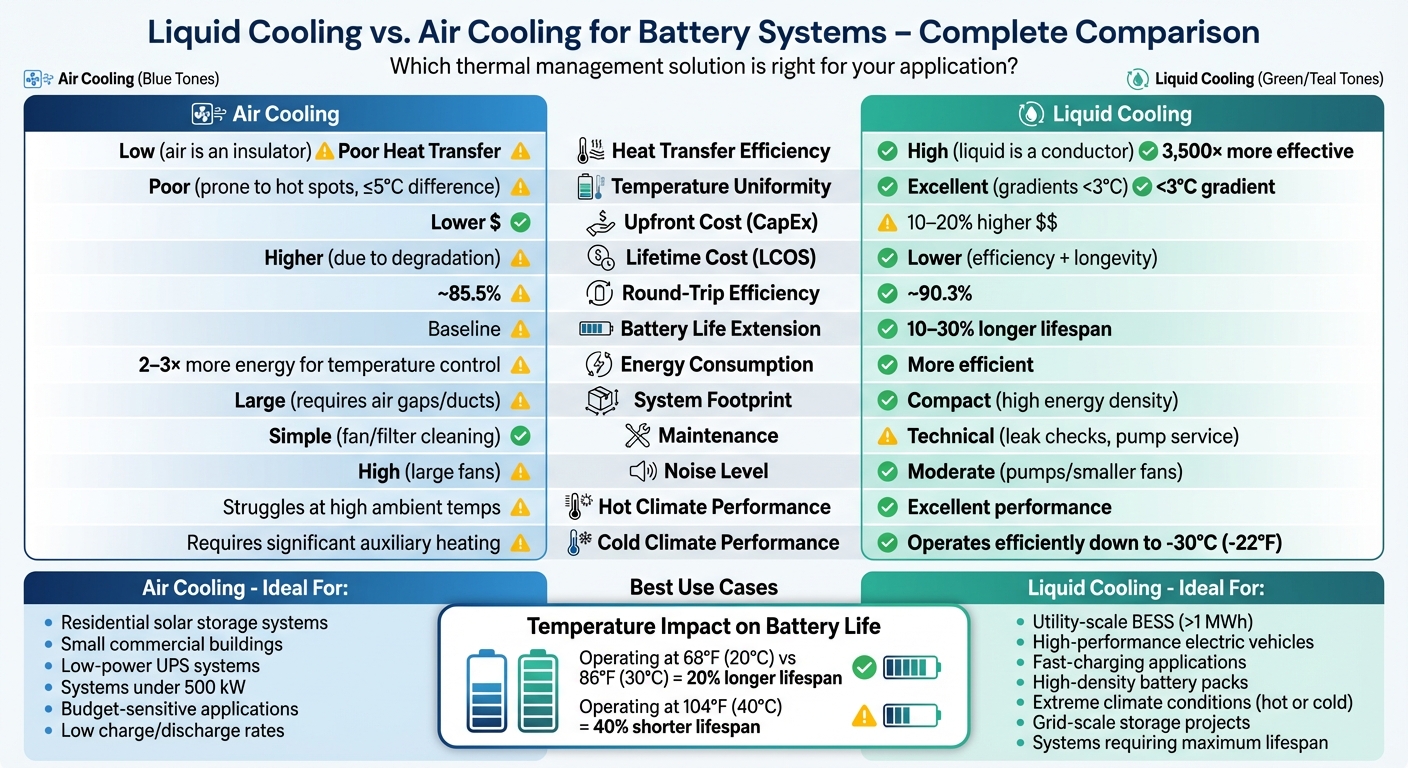
Air Cooling vs Liquid Cooling for Battery Systems: Complete Comparison Chart
An Overview of EV Lithium-ion Battery Heating and Cooling Technology: air/liquid/refrigerant cooling
sbb-itb-501186b
How Air Cooling Works
Air cooling manages battery heat by transferring it to the surrounding air. This process relies on three key mechanisms: conduction (heat moves from battery cells to surfaces or fins), convection (air carries the heat away), and radiation (heat is emitted from surfaces). Its simplicity makes air cooling one of the easiest thermal management solutions to implement.
Natural convection is the most straightforward method. It works passively, as warm air rises and pulls in cooler air to replace it. While nearly cost-free, this approach has limited cooling capacity, making it suitable only for low-power systems.
Forced air circulation steps things up by using fans or blowers to actively push air through ducts and across battery modules. The airflow absorbs heat from the cells and exits through vents. Engineers often improve this setup with fins, heat sinks, or vortex generators to direct airflow more efficiently. Common duct shapes, like U, Z, or T, help ensure even air distribution across the system.
However, air has a relatively low specific heat capacity - about one-fourth that of water. This means it removes heat much slower than liquid cooling systems. For instance, a forced-air system can keep cell temperatures around 89°F (32°C) during a 3C discharge in a 77°F (25°C) environment. Advanced designs using T-shaped ducts and vortex generators can further lower cell temperatures by up to 13°F (7°C) at a 2.5C discharge rate.
"The air-cooling type of battery thermal management system (BTMS) is becoming popular in the EVs and HEVs industry due to its simplicity, high reliability, and safety features." – Scientific Reports
Advantages of Air Cooling
Air cooling stands out for its affordability. The system requires only basic components like fans, ducts, and vents, keeping upfront costs low. Maintenance is equally simple - there are no pumps to service or coolant to replace, eliminating concerns about leaks or electrical shorts.
Its lightweight and straightforward design make installation easier. This is especially appealing for applications like electric scooters, backup UPS batteries, and small stationary storage systems.
Safety is another major plus. Without conductive liquids, there’s no risk of shorts due to leaks, and it avoids the environmental issues associated with toxic coolants. For systems with low charge and discharge rates, air cooling offers sufficient thermal management without unnecessary complexity.
Disadvantages of Air Cooling
That said, air cooling does have its drawbacks. Air's low thermal conductivity and heat capacity limit how quickly it can remove heat. This becomes a challenge in high-density battery packs or hot environments.
Temperature consistency is another issue. Air-cooled systems can develop hot spots in areas with insufficient airflow, making it difficult to maintain a temperature difference of less than 9°F (5°C) between cells. Additionally, high-speed fans can be noisy, and the system’s performance drops significantly in warm ambient conditions.
These limitations define air cooling’s role in thermal management, paving the way for a closer look at liquid cooling.
Air Cooling Pros and Cons Summary
| Advantages | Disadvantages |
|---|---|
| Low upfront cost and minimal maintenance | Limited cooling efficiency due to air's thermal properties |
| Lightweight, simple design with easy installation | Prone to hot spots and poor temperature uniformity |
| No risk of liquid leaks or electrical shorts | Noise from fans during operation |
| No toxic coolants, making it environmentally safer | Performance highly dependent on ambient conditions |
| Ideal for low-power and budget-sensitive applications |
Next, we’ll dive into how liquid cooling addresses these thermal challenges.
How Liquid Cooling Works
Liquid cooling operates through a closed-loop system that circulates a coolant - often a 50/50 mix of water and glycol or a dielectric fluid - across cold plates with microchannels that make direct contact with battery cells. This setup transfers heat away from the cells via conduction.
A pump drives the heated coolant through hoses to a heat exchanger, where the heat is dissipated. The heat exchanger may use air-cooled fins or connect to facility HVAC systems for cooling. The now-cooled fluid is then recirculated back to the cold plates. Throughout the process, sensors, valves, and a Thermal Control Unit (TCU) monitor and adjust temperatures and flow rates to ensure optimal performance.
This method of cooling is incredibly efficient - up to 3,500 times more effective than air cooling. It maintains battery packs at a steady temperature of around 86°F (30°C), with fluctuations kept to just 5°F (2.78°C). This level of precision is crucial because lithium-ion batteries last approximately 20% longer when kept at 68°F (20°C) compared to 86°F (30°C). In contrast, operating at higher temperatures, like 104°F (40°C), can cut their lifespan by roughly 40%.
Liquid cooling systems come in two main types. Indirect cooling relies on sealed cold plates to circulate coolant without direct contact with the battery cells. Alternatively, direct immersion cooling submerges the cells in a non-conductive dielectric fluid for even greater heat dissipation. Examples of these approaches include Tesla's Megapack, which uses an ethylene glycol–water mix in cooling loops for utility-scale storage, and CATL's "Qilin" design. CATL's system places cooling plates between cells, increasing the heat-transfer area fourfold and enabling ultra-fast 10-minute charging.
"Liquid-based cooling for EV batteries is the technology of choice, which is rapidly taking over from forced-air cooling, as energy and power densities increase." – Junaid Shah, Saur Energy
This foundation lays the groundwork for a detailed comparison with air cooling systems.
Liquid Cooling vs. Air Cooling: Side-by-Side Comparison
When it comes to cooling systems, the choice between liquid and air cooling impacts upfront costs, long-term expenses, and overall system performance in significant ways.
Liquid cooling stands out for its efficiency, thanks to water's high specific heat capacity (4.18 kJ/kg·K) and 24× better thermal conductivity compared to air. This allows it to remove heat more quickly and maintain a temperature difference of less than 3°C across modules. In contrast, air-cooled systems often face challenges like hot spots and uneven cooling performance. These differences in heat management lead to notable variations in cost, maintenance, and design.
While liquid cooling systems cost 10–20% more upfront due to the need for pumps, pipes, and heat exchangers, they tend to save money over time. Their efficiency and ability to extend battery life help reduce lifetime costs. For example, as of June 2025, Huawei's liquid-cooled ESS 2.0 achieved a 90.3% Round-Trip Efficiency (RTE) and packed 4.5 MWh into a 20-ft container. In comparison, their earlier air-cooled ESS 1.0 only reached an RTE of 85.5%. This efficiency gap translates to tangible savings, as liquid cooling can extend battery life by 10–30% compared to air cooling.
Beyond cost considerations, the two systems differ in design and maintenance. Air cooling involves simpler upkeep - primarily cleaning fans and filters. Liquid cooling, however, requires more technical oversight, such as checking for leaks, monitoring pumps, and managing coolant levels. Despite this added complexity, liquid cooling systems are more compact, as they eliminate the need for large airflow channels required by air-cooled designs.
Full Comparison Table
| Factor | Air Cooling | Liquid Cooling |
|---|---|---|
| Heat Transfer Efficiency | Low (air is an insulator) | High (liquid is a conductor) |
| Temperature Uniformity | Poor (prone to hot spots) | Excellent (gradients <3°C) |
| Upfront Cost (CapEx) | Lower | 10–20% higher |
| Lifetime Cost (LCOS) | Higher (due to degradation) | Lower (efficiency + longevity) |
| Round-Trip Efficiency | ~85.5% | ~90.3% |
| Battery Life Extension | Baseline | 10–30% longer |
| System Footprint | Large (requires air gaps/ducts) | Compact (high energy density) |
| Maintenance | Simple (fan/filter cleaning) | Technical (leak checks, pump service) |
| Scalability | Limited | Excellent |
| Noise Level | High (large fans) | Moderate (pumps/smaller fans) |
| Hot Climate Performance | Struggles at high ambient temps | Excellent |
| Best Application | Residential / Low-power UPS | Utility-scale BESS / High-performance EVs |
This comparison highlights how liquid cooling outperforms air cooling in several key areas, making it a strong choice for applications requiring high efficiency and compact design. However, the added complexity and initial cost may make air cooling more appealing for simpler, less demanding setups.
When to Use Each Cooling Method
Selecting the right cooling method depends on factors like system size, operating conditions, and budget considerations. Air cooling is the go-to choice for residential systems, small commercial buildings, and rooftop solar-plus-storage setups. These systems typically deal with lower power densities and are easier to maintain with basic tasks like cleaning fans and filters. For home or small business backup systems with moderate cycling needs, air cooling provides dependable performance without the added complexity of liquid cooling.
Liquid cooling, however, shines in utility-scale projects, high-density battery systems, or extreme environments. Systems exceeding 1 MWh or 500 kW often lean toward liquid cooling due to its ability to maintain precise temperature control and minimize thermal risks. In hotter climates or applications requiring frequent fast charging, liquid cooling’s superior heat management can prevent the accelerated wear and tear that air-cooled systems might face. Additionally, liquid-cooled systems can operate efficiently in temperatures as low as -30°C (-22°F) with minimal auxiliary heating, while air-cooled systems typically require significantly more energy to achieve the same results.
"Choosing the right battery cooling system isn't just a design decision - it's a safety, performance, and financial imperative."
While liquid cooling may increase upfront costs by 10–20%, its long-term advantages - like lower energy use and extended battery lifespan - can lead to overall cost savings. In comparison, air-cooled systems may use 2–3 times more energy to regulate temperatures and often result in faster battery degradation. For industrial parks, grid-scale storage, or applications where maximizing system lifespan is a priority, the higher initial investment in liquid cooling often proves worthwhile over time.
Finding Cooling Components on Electrical Trader
Whether you're opting for air or liquid cooling, Electrical Trader provides a wide selection of thermal management equipment, transformers, and power distribution components to suit battery system installations. Their marketplace includes both new and used electrical gear - such as circuit breakers, switchgear, and power generation tools - allowing you to find components that align with your project's needs and budget.
Conclusion
A well-designed cooling system plays a critical role in ensuring battery performance and safety. When deciding between air cooling and liquid cooling, it's important to weigh the pros and cons based on your specific application.
Air cooling stands out for its simplicity, lower upfront costs, and ease of maintenance. This makes it a practical choice for residential solar storage, small commercial setups, and systems under 500 kW. However, it does have its drawbacks, such as uneven temperature distribution and higher energy consumption - using 2–3 times more energy than liquid cooling for similar temperature control.
On the other hand, liquid cooling delivers superior thermal efficiency and precise temperature management, though it comes with a higher initial cost. It excels at maintaining temperature differences within battery packs to ≤3°C, compared to ≤5°C for air cooling. This tighter control can extend battery lifespan by more than 20% when kept at optimal temperatures. For large-scale projects over 1 MWh, fast-charging systems, or installations in harsh climates, the performance benefits of liquid cooling outweigh its added complexity.
Temperature management is vital for lithium-ion batteries. Operating at optimal temperatures - such as 68°F (20°C) instead of 86°F (30°C) - can extend battery life by over 20%. As Rahul Jalthar, CEO of Sunlith Energy, aptly puts it: "Cooling = safety + performance".
FAQs
What should I consider when deciding between air cooling and liquid cooling for battery systems?
When choosing between air cooling and liquid cooling for battery systems, it's important to weigh factors like thermal performance, cost, safety, and system size. Liquid cooling stands out for its ability to manage heat efficiently, thanks to the higher heat capacity of liquids. This makes it a smart choice for high-power or tightly packed systems. However, it comes with added complexity, higher costs, and the need for diligent maintenance to prevent leaks.
Air cooling, in contrast, is simpler, more affordable, and easier to maintain. That said, it may struggle to handle higher heat loads and can result in uneven temperature distribution. For smaller or less demanding setups, air cooling often gets the job done while keeping costs down. Larger or high-density systems, however, typically benefit from the more effective heat management that liquid cooling provides.
The best option depends on your system's specific needs, including performance demands, safety priorities, and budget limits.
How does liquid cooling help improve the lifespan of battery systems compared to air cooling?
Liquid cooling helps extend the lifespan of battery systems by ensuring consistent and efficient temperature regulation. Unlike air cooling, which often struggles to evenly manage heat, liquid cooling effectively reduces hot spots and maintains a stable, lower temperature across the system. This not only minimizes thermal stress but also slows down the wear and tear on batteries, allowing them to operate more safely and reliably over time.
It's especially effective for high-performance or high-capacity battery systems, where managing heat is crucial. By preventing overheating, liquid cooling enhances the system's durability and efficiency, making it a go-to solution for more demanding applications.
What kind of maintenance do liquid and air cooling systems need for battery storage?
Liquid cooling systems demand a bit more upkeep than air cooling systems. You'll need to routinely check coolant levels, clean out any buildup, and replace the coolant periodically to keep everything running smoothly and extend the system's lifespan. Think of it like maintaining the coolant in a car engine - it's not overly complicated, but it does require attention.
Air cooling systems, on the other hand, are much simpler. They rely on fans to handle heat, making them easier to install and maintain overall. That said, if you're dealing with larger systems or higher heat loads, air cooling might struggle to keep up. In those cases, overheating could become a problem, potentially leading to extra maintenance down the line.