Core Material Selection for Industrial Transformers
Choosing the right core material for industrial transformers is crucial for balancing efficiency, cost, and long-term reliability. Here's a quick overview of what you need to know:
- Magnetic Permeability: High permeability reduces energy losses and improves efficiency. However, materials with higher permeability must avoid reaching their saturation flux density to prevent overheating.
- Core Losses: Hysteresis and eddy current losses impact efficiency. Grain-oriented silicon steel and thinner laminations can significantly reduce these losses.
- Thermal Performance: Materials that generate less heat extend transformer lifespan, especially in dry-type transformers.
-
Core Material Options:
- Grain-Oriented Silicon Steel (GOES): Affordable and suitable for 50/60 Hz applications.
- Amorphous Metals: Lower no-load losses but higher upfront costs.
- Nanocrystalline and Ferrites: Ideal for high-frequency or precision applications.
Key Takeaway: Match the core material to your transformer's operating frequency, load profile, and budget to optimize efficiency and minimize total ownership costs.
What Are Magnetic Core Materials In Transformers? - Electrical Engineering Essentials
sbb-itb-501186b
Key Material Properties That Affect Transformer Performance
This section dives into the material properties that play a critical role in transformer performance. Knowing these properties is essential for choosing the right core material, balancing efficiency and cost for industrial needs.
Magnetic Permeability and Saturation Flux Density
Magnetic permeability refers to how easily a material allows magnetic flux to pass through it. As Triad Magnetics explains:
"Ideal core materials have high magnetic permeability, and they can be designed in many sizes and shapes."
Materials with high permeability help contain the flux more effectively, reducing both leakage and the magnetizing current.
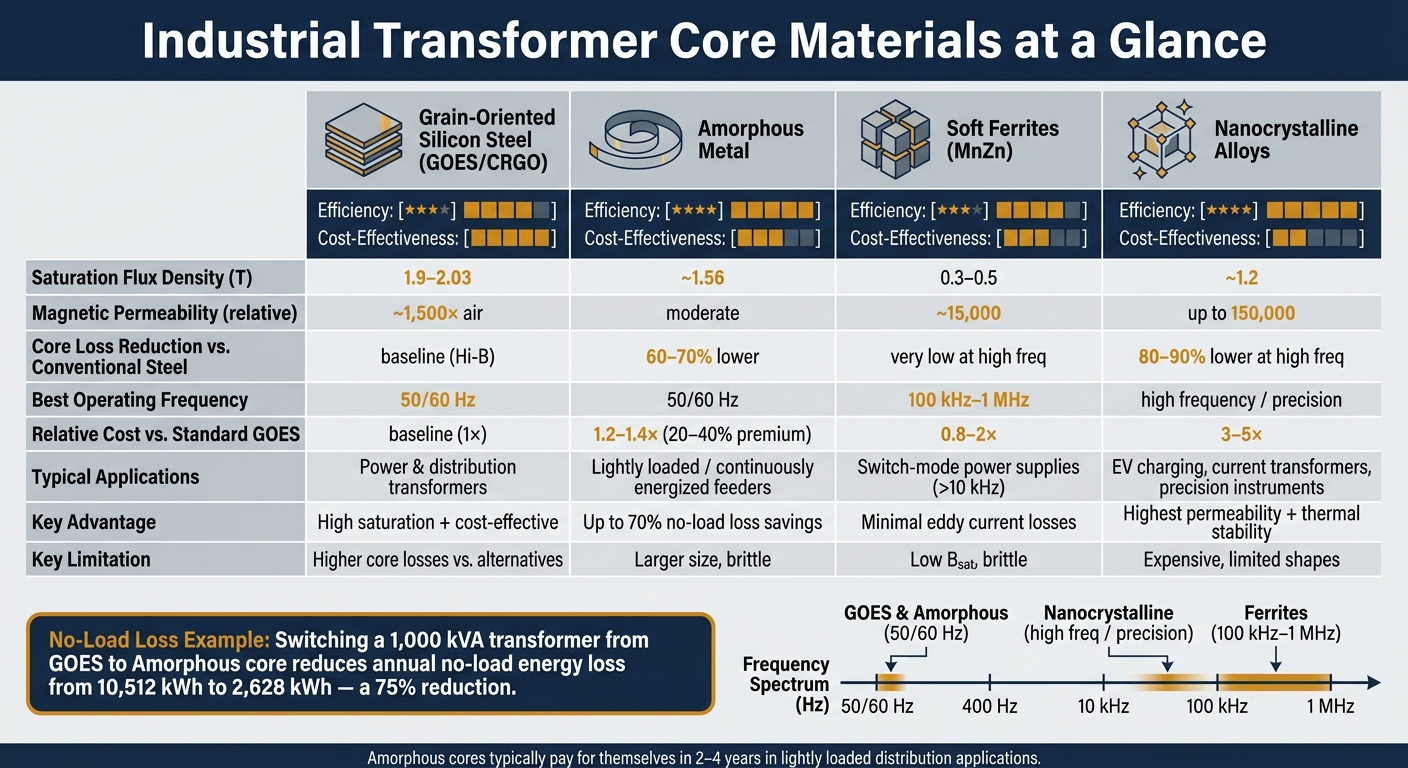
On the other hand, saturation flux density (B_sat) indicates the point where a material's permeability drops sharply as it reaches its magnetic limit. For example, Grain-Oriented Electrical Steel (GOES) has a B_sat between 1.9 and 2.03T, making it suitable for compact, high-power applications. Amorphous metals typically reach about 1.56T, while soft ferrites fall in the range of 0.3T to 0.5T. Lamina Core Solutions highlights the importance of this property:
"Higher values [of saturation flux density] allow for smaller core sizes and greater power density."
Next, let’s explore how these magnetic properties influence energy losses within transformers.
Core Losses: Hysteresis and Eddy Currents
Core losses are a combination of hysteresis loss and eddy current loss. Hysteresis loss occurs as the magnetic domains in the core realign during each AC cycle. Meanwhile, eddy currents are induced by the changing magnetic field, producing heat. Reducing these losses is crucial for achieving better efficiency.
Two main strategies address these losses. First, grain-oriented silicon steel (CRGO) aligns its crystal structure with the magnetic flux, which significantly reduces hysteresis loss. In fact, losses along the rolling direction of CRGO steel can be about one-third of those measured perpendicularly. Second, thinner laminations in the core can limit eddy current paths. Since eddy current losses increase with the square of the lamination thickness, even small reductions in thickness make a big difference. For instance:
- Standard transformer laminations are typically 0.006–0.012 inches thick.
- Amorphous metal ribbons can be as thin as 0.001 inches (around 0.03 mm).
These ultra-thin amorphous metal cores can achieve core losses that are 60%–70% lower than those of conventional GOES. A notable example is the 1986 introduction of mass-produced 25 kVA distribution transformers by Westinghouse. Using 0.001-inch thick amorphous core laminations, these transformers achieved core losses that were just one-third of those in comparable silicon steel models.
The heat generated by these losses has a direct impact on transformer performance and longevity, which brings us to thermal considerations.
Thermal Performance and Aging Under Load
All core losses eventually turn into heat, which accelerates the aging of the winding insulation - the main factor that limits a transformer's lifespan. For industrial transformers, the acceptable temperature rise is generally between 104°F and 122°F (40°C to 50°C) above the ambient temperature, with a maximum internal temperature of about 212°F (100°C). At higher temperatures, a material's saturation margin may shrink, increasing the risk of current spikes during load transients and further compounding heat buildup.
Choosing materials that generate less heat can extend a transformer's service life. This is particularly important for dry-type transformers, which don’t benefit from the thermal buffering provided by oil cooling. In such cases, low-loss materials like High-Permeability (Hi-B) grain-oriented steel are often preferred to keep operating temperatures lower. Nanocrystalline alloys are another strong option, offering excellent thermal stability across a wide range of temperatures, making them ideal for variable-load applications.
Core Material Options for Industrial Transformers
Industrial Transformer Core Materials: Performance & Cost Comparison
When selecting materials for industrial transformers, the choice often comes down to balancing efficiency and cost. Here's a closer look at some of the most common core materials and their characteristics.
Grain-Oriented Silicon Steel
Grain-Oriented Cold-Rolled (CRGO) silicon steel is widely used in 50/60 Hz power and distribution transformers. Its grains are aligned (known as Goss texture) to support single-direction flux, offering permeability approximately 1,500 times greater than air and six times better than in the transverse direction.
CRGO comes in different technology tiers, each tailored to specific applications:
| Technology Tier | Description | Typical Applications |
|---|---|---|
| CGO (Conventional) | Coarse texture control, affordable | Cost-sensitive distribution and instrument transformers |
| Hi-B (High-Permeability) | Enhanced Goss texture, lower losses than CGO | Standard power transformers globally |
| R-Grade (Domain-Refined) | Laser or mechanical scribing reduces magnetic domains | Ultra-high voltage transformers (above 330 kV) and low-loss systems |
When working with CRGO-based transformers, joint design is crucial. Mitred joints (cut at 45° angles) are more efficient than interleaved butt joints, as they reduce cross-grain losses where the magnetic flux changes direction. Additionally, check for high-quality insulating coatings like C-5, which offer better corrosion resistance for harsh environments.
Next, let's examine amorphous metal cores, which provide a different set of advantages.
Amorphous Metal Cores
Amorphous metal cores feature a non-crystalline structure created by rapidly cooling molten metal at about one million degrees per second. This unique structure significantly reduces no-load losses - by as much as 70–80% compared to traditional silicon steel.
However, amorphous cores come with trade-offs. Due to their lower saturation flux density (~1.56 T vs. ~2.0 T for CRGO), these cores require a larger physical size to handle the same capacity, resulting in a 20–40% price premium over conventional transformers. As Wuxi Zhongxin Special Steel explains:
"Amorphous alloy has no-load losses 60–70% lower than silicon steel - shouldn't it just replace grain-oriented steel entirely? The honest answer is: not really. The two are complementary, not substitutes."
These cores are ideal for transformers that remain energized continuously but operate at low average loads, such as backup systems or lightly loaded feeders. In such cases, no-load losses can make up 50–70% of total annual energy loss. For example, switching a 1,000 kVA distribution transformer to an amorphous core can reduce annual no-load energy loss from 10,512 kWh to 2,628 kWh.
For specialized applications, ferrites and nanocrystalline cores offer additional options.
Ferrites and Nanocrystalline Cores
Soft ferrites, particularly Manganese-Zinc (MnZn) grades, are commonly used in the 100 kHz to 1 MHz frequency range. Their high electrical resistivity minimizes eddy current losses, and costs range from 0.8 to 2 times that of standard grain-oriented silicon steel. However, they have limitations, including low saturation flux density (0.4–0.5 T for MnZn) and brittleness, which makes them prone to cracking under mechanical stress.
Nanocrystalline cores, on the other hand, are created by annealing amorphous metals to form nanometer-sized grain structures. This process results in cores with very high permeability (up to 150,000 compared to about 15,000 for MnZn ferrites), a saturation flux density of ~1.2 T, and excellent thermal stability. Their core losses at high frequencies can be 80–90% lower than traditional materials. However, they are expensive - typically costing 3–5 times more than standard grain-oriented silicon steel - and are mainly available in limited shapes like toroids and tape-wound cores. These cores excel in precision applications, such as current transformers and high-accuracy instrument transformers, where factors like phase shift and linearity are critical.
How to Select the Right Core Material
Matching Core Materials to Industrial Applications
When choosing core materials, operating frequency is a key factor. For standard 50/60 Hz applications, grain-oriented silicon steel is the go-to option. For higher frequencies, materials like nickel-alloy, tape-wound cores, or ferrites perform better.
Another important factor is the load profile. Transformers that are continuously energized but lightly loaded, such as those used in backup feeders or rural distribution lines, can experience substantial no-load losses over time. In such cases, amorphous metal cores - despite their higher initial cost - offer long-term energy savings. On the other hand, for high-frequency tasks like EV charging or current transformers, nanocrystalline cores outperform silicon steel in reducing losses.
| Application Type | Recommended Core | Reason |
|---|---|---|
| Industrial power & distribution (50/60 Hz) | Grain-Oriented Silicon Steel | High saturation (1.9–2.03 T), cost-effective, durable |
| Continuously energized, lightly loaded feeders | Amorphous Metal | Up to 70% lower no-load losses |
| EV charging, high-precision instruments | Nanocrystalline | 80–90% lower core losses at high frequencies |
| Switch-mode power supplies (>10 kHz) | Soft Ferrites (MnZn) | Minimal eddy current losses at very high frequencies |
Once you've determined the application needs, a detailed specification checklist ensures the core material aligns with operational requirements.
Core Material Specification Checklist
Velatron Technologies underscores the importance of early material selection:
"Magnetic core selection is not a late-stage optimisation step. It is a primary design decision that must be aligned with system requirements from the very beginning of the development process."
To make the right choice, consider these specifications:
- Operating frequency: Identify whether the application involves standard (50/60 Hz), mid-range (400–2,000 Hz), or high-frequency (above 2,000 Hz) operations.
- Saturation flux density margin: The core must handle peak volt-seconds per turn during startup or faults without losing permeability. Silicon steel provides a margin of about 2.0 T, while ferrites range from 0.3 to 0.5 T.
- Lamination thickness: For CRGO cores, aim for laminations between 0.18 mm and 0.27 mm. Thinner laminations significantly reduce eddy current losses. For instance, reducing thickness from 0.30 mm to 0.15 mm can cut these losses by 75%.
- Thermal stability: Ensure the material maintains permeability across the expected temperature range. Industrial transformers typically allow internal temperature rises of 40°C to 50°C.
- Total Ownership Cost (TOC): Look beyond the purchase price. Although amorphous cores may cost 15–40% more upfront than silicon steel, their energy savings often justify the investment over time.
These criteria also guide the evaluation of used transformer cores.
Evaluating Used Transformers for Core Material Suitability
When assessing used transformers, ensure the core material aligns with your operational needs. A high-quality core with low losses can significantly extend the transformer's lifespan. Here's how to evaluate used units effectively:
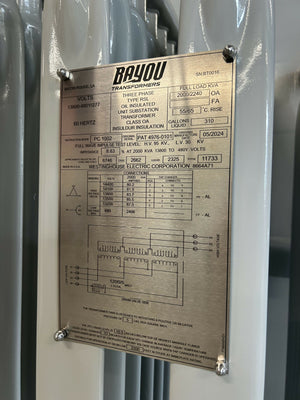
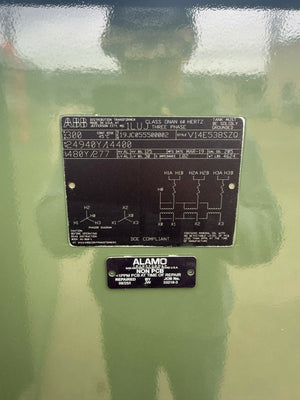
- Check the nameplate: Look for details like core material, winding conductor type, and rated frequency. If this information isn’t available, measure no-load losses to gauge core quality.
- Inspect lamination thickness: Standard silicon steel laminations range from 0.006 to 0.012 inches. Thicker laminations indicate older designs with higher eddy current losses.
- Examine for damage: Amorphous and ferrite cores are more brittle than silicon steel, so inspect for cracks or other signs of wear.
Upgrades can also boost efficiency. For example, replacing a conventional CGO silicon steel core with a high-permeability (Hi-B) or amorphous alternative can improve performance. Hi-B cores are often required to meet DOE 2027 or EU Ecodesign Tier 2 efficiency standards. For lightly loaded distribution transformers, switching to an amorphous core could pay for itself in 2–4 years through energy savings.
Platforms like Electrical Trader offer a range of new and used transformers, making it easier to compare options and find efficient units.
Lastly, always verify frequency compatibility before purchasing. For instance, a silicon steel transformer designed for 60 Hz won’t perform well in high-frequency applications. No amount of refurbishment can change the material's inherent frequency limitations.
Conclusion: Key Takeaways for Industrial Buyers
Core Material Selection Best Practices
The core material of a transformer plays a huge role in its efficiency, durability, and overall cost. A well-constructed industrial transformer can last anywhere from 25 to 40 years. But that longevity depends heavily on selecting the right core material for the job.
Start with frequency: grain-oriented silicon steel is ideal for 60 Hz systems, amorphous metal works best for lightly loaded systems that stay energized, and nanocrystalline or ferrite cores excel in high-frequency environments. Beyond frequency, think about Total Ownership Cost. As Edvard Csanyi, an electrical engineer and founder of EEP, explains:
"Worldwide, more and more consumers are now purchasing transformers based on the total ownership costs, than just the first cost."
This shift in perspective is crucial. For example, amorphous cores may cost 15% to 40% more upfront than silicon steel cores. But their no-load losses are 60% to 70% lower, meaning they can pay for themselves in just 2 to 4 years in distribution setups - especially in systems that stay energized but operate at light loads during off-peak hours.
These considerations are not just about design; they also shape smarter purchasing decisions.
Using Marketplaces to Source the Right Transformers
Once you understand the fundamentals, finding transformers with the right core materials becomes much easier. Platforms like Electrical Trader offer a wide variety of new and used transformers, allowing buyers to compare core technologies and efficiency ratings across options like 3-phase and substation units.
When shopping through a marketplace, always take a few precautions. Request third-party test certificates to confirm core loss performance, and carefully review the nameplate for critical details like winding conductor type, rated frequency, and cooling method. These simple checks can help you avoid costly mismatches and ensure the transformer meets your specific needs.
FAQs
How do I choose a core material for my load profile?
To choose the right core material, the first step is to determine your operating frequency. For frequencies up to 400 Hz, go with silicon-steel. If your frequency falls between 400 and 2,000 Hz, nickel-alloy or tape-wound cores are better options. For frequencies above 2,000 Hz, ferrite cores are the way to go.
Beyond frequency, weigh factors like core losses, saturation limits, and thermal stability. Striking the right balance between efficiency, cost, and size is key. Picking the right core material plays a big role in ensuring your transformer operates reliably and lasts over time.
When does amorphous metal actually pay back its higher cost?
Amorphous metal may come with a higher upfront cost - about 15% to 40% more than silicon steel - but it makes up for this through substantial long-term energy savings. Thanks to its ability to deliver 60% to 80% lower no-load energy losses, it’s especially suited for continuous, low-load operations over a lifespan of 25 to 30 years. To assess its value, weigh the initial investment against the total ownership cost, keeping in mind the dramatically lower operating expenses over time.
What should I check to confirm a used transformer’s core is low-loss?
To ensure a used transformer’s core is efficient and minimizes energy loss, start by examining the core material and its condition. Look for documentation specifying high-grade materials such as amorphous metal or nanocrystalline alloys. These materials can cut losses by an impressive 60–70% compared to traditional silicon steel. If the transformer uses silicon steel, verify that the laminations are thin, properly aligned, and well-stacked to optimize performance. Additionally, inspect the core for any mechanical damage, particularly if the material is brittle, and confirm that the grounding is correctly installed. These steps are crucial for assessing the core's quality and efficiency.